

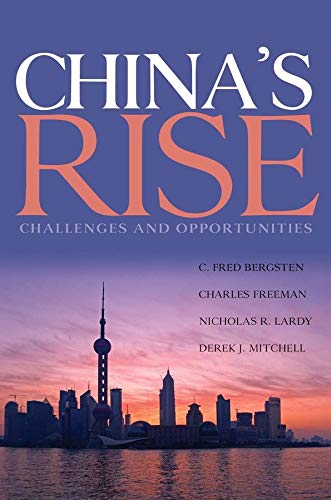
Ebook Info
- Published: 2009
- Number of pages: 288 pages
- Format: PDF
- File Size: 1.33 MB
- Authors: C. Fred Bergsten
Description
China has emerged as an economic powerhouse (projected to have the largest economy in the world in a little over a decade) and is taking an ever-increasing role on the world stage. China’s Rise: Challenges and Opportunities will help the United States and the rest of the world better comprehend the facts and dynamics underpinning China’s rise―an understanding that becomes more and more important with each passing day. Additionally, the authors suggest actions both China and the United States can take that will not only maximize the opportunities for China’s constructive integration into the international community but also help form a domestic consensus that will provide a stable foundation for such policies. Filled with facts for policymakers, this much anticipated book’s narrative-driven, accessible style will appeal to the general reader. This book is unique in that it analyzes the authoritative data on China’s economy, foreign and domestic policy, and national security. The expert judgments in this book paint a picture of a China confronting domestic challenges that are in many ways side effects of its economic successes, while simultaneously trying to take advantage of the foreign policy benefits of those same successes.China’s Rise: Challenges and Opportunities from The China Balance Sheet Project, a joint, multiyear project of the Center for Strategic and International Studies and the Peterson Institute, discusses China’s military modernization, China’s increasing soft power influence in Asia and around the world, China’s policy toward Taiwan, domestic political development, Beijing’s political relations with China’s provincial and municipal authorities, corruption and social unrest, rebalancing China’s economic growth, the exchange rate controversy, energy and the environment, industrial policy, trade disputes, and investment issues. This book is part of the CSIS-IIE China Balance Sheet project. For more information about this project, please visit www.chinabalancesheet.org.
User’s Reviews
Editorial Reviews: Review This is the best single book on China, and I use it to prepare for all my trips to that country. — Zbigniew Brzezinski, former US National Security Advisor…designed to clarify contemporary China and advise how U.S. ‘engagement’ with China may best move ahead. There’s lots here, but clearly presented, with a great chronology. ― Library JournalThere is no better place to find a compact overview of recent developments in China, through mid-2008, both with respect to economic developments and with respect to China’s foreign and national security policy. — Foreign Affairs About the Author C. Fred Bergsten, senior fellow and director emeritus, was the founding director of the Peterson Institute for International Economics (formerly the Institute for International Economics) from 1981 through 2012. He is serving his second term as a member of the President’s Advisory Committee for Trade Policy and Negotiations and was co-chairman of the Private Sector Advisory Group to the United States–India Trade Policy Forum, comprising the trade ministers of those two countries, during 2007–14.Nicholas R. Lardy, called “everybody’s guru on China” by the National Journal, is a senior fellow at the Peterson Institute for International Economics. He joined the Institute in March 2003 from the Brookings Institution, where he was a senior fellow in the Foreign Policy Studies Program (1995-03) and served as interim director of Foreign Policy Studies (2001). Lardy has written numerous articles and books on the Chinese economy including Debating China’s Exchange Rate Policy (2008), China: The Balance Sheet (2006), Prospects for a US-Taiwan Free Trade Agreement (2004), Integrating China into the Global Economy (2002), and China’s Unfinished Economic Revolution (1998). Lardy is a member of the Council on Foreign Relations and is a member of the editorial boards of the China Quarterly, Journal of Asian Business, China Review, and China Economic Review.Charles Freeman is a nonresident senior adviser for economic and trade affairs at CSIS. Previously, he held the CSIS Freeman Chair in China Studies. A second-generation “China hand,” he has lived and worked between Asia and the United States his entire life. Prior to joining CSIS, he served as assistant U.S. trade representative (USTR) for China affairs and was the United States’ chief China trade negotiator, playing a primary role in shaping overall trade policy with respect to China, Taiwan, Hong Kong, Macao, and Mongolia. During his tenure as assistant USTR, he oversaw U.S. efforts to integrate China into the global trading architecture of the World Trade Organization. Earlier in his government career, he served as legislative counsel for international affairs in the Senate.Derek J. Mitchell served as senior fellow and director of the Asia Division of the International Security Program at the Center for Strategic and International Studies (CSIS). Mitchell concurrently served as founding director of the CSIS Southeast Asia Initiative, which was inaugurated in January 2008 and was the Center’s first dedicated program to the study of Southeast Asian affairs.
Reviews from Amazon users which were colected at the time this book was published on the website:
⭐Interesting.
⭐This was a fairly simple read. I needed it for class with Michael Klare. His books are actually better, but he couldn’t get away with simply assigning his own work.
⭐Indispensable I hope for an update
⭐China’s Rise, Challenges and Opportunities is a good read to understand the contemporary China in terms of the current trend. This book is complied with the input collections of experts from their own looking glasses, some dark and some rosy with a Western perspective and viewpoint in a snap shot. It is composed of ten chapters into the topics of economic, growth, Taiwan and military. This book was published around ten years ago around the Beijing Olympic. As China catches up its development after Deng’s opening in 1978 and achieves outstanding development no recent human history has witnessed by Chinese characteristics, neither American nor Russian. As a result, these “experts” create their writings just like the story of the blinds touching the elephant, each with their own perception and fail the whole picture. Being humiliated and bullied by Foreign powers in China in 19th and early 20th Century, China compatriots determined to reclaim the China power and territorial integrity. On trade, China has been the center of world trade for over thousands of years with the famous silk, porcelain and tea without military protection from the Emperors. It was only British deficit in Sino-British trade that The British pushed opium, illegally to the Chinese and got them hooked. Chinese were not Christian to turn the other cheek! It is fun to read that Chiang Kai-shek was converted to Christianity and married the American educated Miss Soong Mei Ling, much to the excitement of American missionaries. However, Mr Cash My Check (as radicaled by Americans) did not run China in American value or democracy. Eventually, Chinese people chose Mao instead of Chiang in the civil war. American politicians cries “Who Lost China?” Of particular interest is chapter 8, Why does the United States Care About Taiwan? This chapter touched upon early history of Taiwan and ignored the 19th Century Chinese, (intentionally?) Why? Japan after Meiji Restoration provoked the First Sino-Japanese War in 1894 and China was to sign the humiliating “Treaty of Shimonoseki” which Taiwan was ceded to Japan. Taiwan was to return to China after Japan unconditionally surrendered. This “unsinkable aircraft carrier” is of vital American interest even after the Sino-American communiques. Do they learn any lessons in meddling other’s internal affairs in the civil war of China? Chapter 9 deals with China’s military modernization. When China was powerful before foreign European powers invasion in 19th Century, China was respected as a leader with moral soft force. Now China tries to develop military modernization with a recent air carrier. Who gets the larges military hardware with bases around the world? Who poses threat? It reports that more Chinese become Christians. Does it mean no military invasion to China? The Tai Ping Heavenly Kingdom, with Chinse Son established this Chinese Christian God’s Kingdom on earth and was suppressed by European Christian Brothers with military supply of generals and weapons in support of the Manchus Government! On p.219, it writes . . . China’s public propaganda was creating mistrust in Japan and fueling sustained animosity from the Chinese people, which threatened to solidity hostile relations between the tow over the long run… Japanese officials visited the Tokyo Yasukuni Shrine which housed the war criminals convicted in 1946 Tokyo Trial and the government whitewash, distort and deny the mass killings such as Nanjing Massacre. This is the bone of contention between the two in Japanese invasions since 1894 to 1945. Even though this book was written ten years ago, it still offers a good base information on the major trend and development. When China was the trade center of silk road years ago, where are the shadows of Americans, British, Spanish and Portuguese? When China was in Ming Dynasty, Europe just finished the dark ages and America was just a barren land to explore. A powerful China is not new, maybe the experts need to adjust their mentality and accept that status.
⭐Bergsten’s book provides good insights into today’s China. China has become a global economic power – second largest national economy, second largest exporter, largest foreign exchange reserves. Its real GDP in 2006 was about 13X that of 1978 when reforms began.President Jiang Zemin’s 2002 “Three Represents” (represent the majority and major components) allowed the formerly reviled entrepreneurs to join the CCP, co opting its rising middle class and intellectuals. The National People’s Congress no longer rubber-stamps everything put before it by the State council – evidence includes protracted drafting of the Property Law, and 10% voting against Zemin staying as chair of the Central Military Committee. Recently there were 8% more candidates than slots, and the Minister of Health was not a CCP member.The central government collects taxes nationwide, splitting the receipts about evenly with local governments. ‘Growth at any cost’ rules at the local level, creating environment problems; also the local governments don’t get enough funding to cover all the central mandates. Local governments are responsible for appointing local officials and judges, along with their pay. Thus, local adherence to central mandates is sometimes half-hearted and frustrates U.S. personnel.The spring of 1989 brought people into the streets in support student-led demonstrations – inflation and official profiteering were major concerns. Chinese corruption appears to have leveled out in the last 15 -years – now approximately at the same level as India, Mexico, Brazil, and better than the U.S.S.R. The most vulnerable areas involve real estate – state funds for real-estate loans, land seizures without proper payment. Bergsten believes this costs about 3-4%/year of GDP.China’s current aim is growth through increased domestic consumption. Benefits include reduced protectionist backlash, faster employment growth than more heavy industry (and faster income equalization), less capital intensive, and less harmful to the environment. Industry takes about 2/3 of China’s energy; China has more heavy industry than Japan and India, and therefore greater pollution. Energy prices are controlled by the Chinese government.It is now commonly recognized that no major international challenge can be met without China’s assistance.
⭐While many people are “aware” of China, very few have much “understanding”. China Rises provides information, observations and insights that are very helpful for those who are interested in developing a more informed view of China, its incredible complexities, remarkable achievements, as well as its massive challenges and opportunities. Although clearly viewed with a “western” bias, this is a book that finally provides a much more balanced perspective of US-China strategic relationships and interdependencies. It is a very useful addition to the “China” dialogue and well worth reading
Keywords
Free Download China’s Rise: Challenges and Opportunities in PDF format
China’s Rise: Challenges and Opportunities PDF Free Download
Download China’s Rise: Challenges and Opportunities 2009 PDF Free
China’s Rise: Challenges and Opportunities 2009 PDF Free Download
Download China’s Rise: Challenges and Opportunities PDF
Free Download Ebook China’s Rise: Challenges and Opportunities