

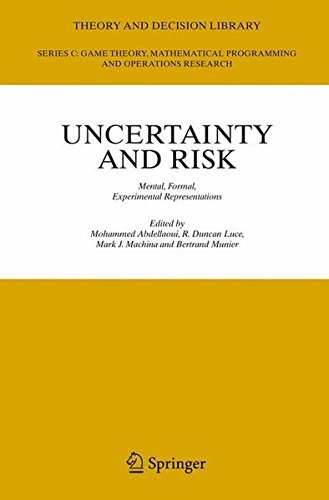
Ebook Info
- Published: 2007
- Number of pages: 314 pages
- Format: PDF
- File Size: 2.05 MB
- Authors: Mohammed Abdellaoui
Description
This book tries to sort out the different meanings of uncertainty and to discover their foundations. It shows that uncertainty can be represented using various tools and mental guidelines. Coverage also examines alternative ways to deal with risk and risk attitude concepts. Behavior under uncertainty emerges from this book as something to base more on inquiry and reflection rather than on mere intuition.
User’s Reviews
Reviews from Amazon users which were colected at the time this book was published on the website:
⭐This book is a collection of essays that primarily attempts to model the differences between the concepts of risk and uncertainty mathematically.This is certainly worthwhile.Unfortunately,all of the authors in this volume have no idea that they are simply reinventing the wheel.J M Keynes had already supplied a complete mathematical analysis with specific models that demonstrated the non additivity and non linearity of decision making under uncertainty.Authors such as Hogarth,Quiggen,Gilboa,Schmeidler,etc.,contribute papers that essentially duplicate their published journal articles. An unfortunate error appears on p.1 of the volume in its Introduction: “Already in the 1930’s , J M Keynes felt the need to deal with another sort of uncertainty.In chapter XII of The General Theory,uncertainty is defined in a more radical way : it is a situation where we just don’t know “.(2007,p.1). Nowhere does “…we just don’t know ” appear in the General Theory . Keynes actually defined his use of the term uncertainty in his Feb.,1937 Quarterly Journal of Economics article as being total or complete uncertainty after he had established that uncertainty is a range or gradation that starts with little or no uncertainty, to mild uncertainty and moderate uncertainty ,and finally reaching total uncertainty.Keynes’s famous statement that “We simply do not know ” refers to the use of the term “uncertainty ” as ignorance or complete and total uncertainty.Nowhere in the General Theory does Keynes give such a definition.Keynes ,instead,correctly defines uncertainty in relation to his weight of the arguments(evidence) analysis in the A Treatise on Probability(1921;TP).Keynes’s crucial analysis appears in chapter 26 of the TP.Keynes ‘s analysis is appended for interested readers below. The goal of the authors of the essays in this book is laudable.However,Keynes had already solved this problem in 1921 and also much earlier in his Cambridge Fellowship thesis of 1909.Keynes presented a clearcut mathematical,technical analysis of ambiguity aversion using his conventional coefficient of risk and and weight( uncertainty),c,in chapter 26 of the TP. A very specific example of Keynes’s nomlinear and non additive approach to probability in chapters 15,17,20,and 22 of the TP was worked out in great detail by Keynes in chapter 26 using his conventional coefficient of risk and weight ,c, on p.314 and in Footnote 2 on p.314.Edgeworth, in his 1922 article on ” The Philosophy of Chance ” in Mind ,was certainly correct in asking for the help of the readers of that philosophy journal in order to figure out the what and the why’s involved in the application of Keynes’s c coefficient.This will be provided for the reader below since it was never done in Mind or anywhere else with the exception of Brady’s work.The foundation of Neoclassical economics is merely the mathematical development of a theoretical approach first proposed by Jeremy Bentham in 1787.Bentham claimed that all individuals have the capability to calculate the odds and outcomes and act on the expected value (the probability times the outcome) in a rational way.This can be expressed by the following ,where p is the probability of success and A is the outcome:Maximize pA.The modern version of this is to Maximize pU(A),where p is a subjective probability that is additive,linear,precise,and exact.U(A) is a Von Neumann-Morgenstern Utility function.The goal is toMaximize pU(A).The modern name for Benthamite Utilitarianism in neoclassical economics is SEU theory(Subjective Expected Utility).Therefore,a microeconomic foundation based on Utility Maximization is just Benthamite Utilitarianism updated with modern mathematical techniques.Modern macro is all SEU theory.Keynes rejected Benthamite Utilitarianism as a very special case that would only hold under the special assumptions of the subjectivist,Bayesian model-that all probabilities were additive,linear,precise,single number answers that obeyed the mathematical laws of the probabiity calculus.Keynes specifies his conventional coefficient of risk and weight,c, model in chapter 26 of the TP on p.314 and fotnote 2 on p.314,as a counter weight to the Benthamite Utilitarian approach.Essentially, Keynes’s generalized model is given byc=2pw/(1+q)(1+w),where w is Keynes’s weight of the evidence variable that measures the completeness of the relevant, available evidence upon which the probabilities p and q are calculated.(Benthamite Utilitarians assume that the value of w is always 1.)w is an index defined on the unit interval between 0 and 1,p is the probability of success,and q is the probability of failure.p+q sum to 1 if they are additive.This requires that w=1.Keynes’s c coefficient can be rewritten asc=p [1/(1+q)][2w/(1+w)].Now multiply by A or U(A).One obtainscA= p[1/(1+q)][2w/(1+w)]A.The goal is to maximuze cA or cU(A).The weight 1/(1+q) deals with non linearity.The weight 2w/(1+w) deals with non additivity.Modern Macroeconomics amounts to nothing more than the claim that c=p or cA (cU(A)= pA (pU(A)) .It is now straightforward to see that the neoclassical microfoundations of macroeconomics assumes that all probabilities are additive and linear.This is nothing but a special case of Keynes’s generalized decision rule to maximize cA,or cU(A),as opposed to the Benthamite Utilitarian pA or neoclassical pU(A).It is now clear that Keynes had created general theories of macroeconomics,probability,and decision making between 1921 and 1936.Keynes’s accomplishments,once understood,make him the only rival to Einstein for the title of the greatest scientist of the 20th century. Economists have only a very vague,hazy,cloudy understanding of Keynes ‘s distinction between risk and uncertainty . It is this distinction that has to be grasped first before any economist has any hope of understanding what Keynes means in the GT.The conclusion is very straightforward. SEU theorists use the rule to Maximize pU(A).Keynes used the rule to maximize cU(A).Keynes’s rule is of the same kind or type of rule used by the overwhelmingly ambiguity averse decision makers that populate the real world in the past and today in the present.Keynes’s analysis of uncertainty is clearly related to non additivity and nonlinearity.It is only an anomaly in a world of linearity and additivity that exists for SEU theorists.
⭐
Keywords
Free Download Uncertainty and Risk: Mental, Formal, Experimental Representations (Theory and Decision Library C Book 41) 2007th Edition in PDF format
Uncertainty and Risk: Mental, Formal, Experimental Representations (Theory and Decision Library C Book 41) 2007th Edition PDF Free Download
Download Uncertainty and Risk: Mental, Formal, Experimental Representations (Theory and Decision Library C Book 41) 2007th Edition 2007 PDF Free
Uncertainty and Risk: Mental, Formal, Experimental Representations (Theory and Decision Library C Book 41) 2007th Edition 2007 PDF Free Download
Download Uncertainty and Risk: Mental, Formal, Experimental Representations (Theory and Decision Library C Book 41) 2007th Edition PDF
Free Download Ebook Uncertainty and Risk: Mental, Formal, Experimental Representations (Theory and Decision Library C Book 41) 2007th Edition