

Ebook Info
- Published: 2010
- Number of pages: 377 pages
- Format: PDF
- File Size: 2.31 MB
- Authors: Stephany Griffith-Jones
Description
The financial crisis, which originated in developed country financial markets, has spread to developing countries and has turned into a global financial meltdown. Governments and Central Banks–though taking many and costly measures–seem powerless to stop the crisis. In light of this major global crisis that is hurting economies across the globe, this highly topical book focuses on the transparency and regulatory measures that become desirable after the current crisis; the implications of both the crisis and regulatory discussions for developing and developed economies; and reforms in the global financial architecture that might make the global financial system more stable and more equitable. Given the depth of the current financial crisis, the world economy is in unchartered territory. As a consequence, this book aims to systematically understand current major problems, both in the financial system, its governance, and in its links to global economic imbalances. It will try to explain how both market actors and regulators behavior, as well as how the prevailing ideology of extreme financial liberalization without sufficient regulation contributed to the financial crisis. The book presents radical, but specific and politically feasible, proposals to try to ensure a more stable, equitable and growing world economy.Contributions are written by leading authorities in their field, with a mixture of very senior national–as well as international–policy makers, practitioners from the private sector, and leading academics; contributors come from both developed and developing countries.
User’s Reviews
Editorial Reviews: Review “Impressive and important… It is hard to imagine a more qualified team of editors in this field. The sheer amount of expertise packed into this volume makes it a very valuable resource indeed. It may not be an exaggeration to describe this book as indispensable in the study of just exactly what happened in late 2008 and what needs to be done to prevent such a profound crisis from striking again…. Readers of Time for a Visible Hand can expect to be well-informed and well-equipped after being exposed to such a wide range of thinkers and policy-makers. This publication may well take on a definitive ‘textbook’ status in years to come.”–Journal of General Management
Reviews from Amazon users which were colected at the time this book was published on the website:
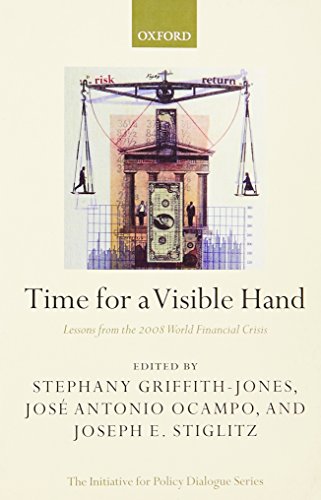
⭐If at amazon.com you search under books for the words „financial crisis“ you can find several dozens of books and reports by the most various authors, editors and publishers; however, from those referring specifically to the 2007-2009 financial crisis, there are only a few that were printed in 2010 and one of them is „Time for a visible hand“. The publishing date is important because the authors responded promptly to the topic (it was finished in 2009) and even though the book is already three years old, it provides reliable and informative information on the causes of the financial crisis and recommendations to better forecast or avoid similar crisis.Behind „Time for a visible hand“ there is a group conformed by over a dozen of experts, including the editors: Stephany Griffith-Jones, José Antonio Ocampo and Joseph E. Stiglitz. The book was published as part of the Initiative for Policy Dialogue (IPD), the non-profit organisation brought to life by Stiglitz, himself. The IPD focuses on supporting democratic processes in developing countries, by exploring different economic policies that better suit different countries and always being critically to the economic policies that benefit some specific groups more than others; something that “Time for a visible hand” does when analysing and criticising the actual financial system and how factors such as de-regulation or the lack of transparency paved the way for the financial crisis.It is almost humorous to read Adam Smith’s invisible hand metaphor on the self-regulation of the markets again as a metaphor to contradict Smith’s beliefs already on the book’s cover. The reader has the feeling that in this collection of essays, the different authors – cleverly chosen and edited – serve as guides who independently explain the different pieces of a puzzle. Even though the chapters do not always describe the happenings in chronological order (as there are time leaps from 2008 to the 1970s, then to the 1990s and the 1930s from Greenspan to Keynes), the book is well developed and intelligently lists the different essays which explain how one of the biggest recent pyramid schemes worked and why it worked. The reader has no need to finish the first half of this book to understand why the authors are pledging against the “invisible hand of the market” and have the position that a sustainable financial sector requires a more “visible hand”, a hand that adapts to the actual needs of the financial system and support making it less vulnerable.The book is divided in three parts and a closing chapter. Being the first a chapter which synthesizes the crisis in the United States. This part describes the de-regulation process that made it possible for financial firms and rating agencies create the sub-prime products that led to the crisis and it closes with a critical analysis of the US government’s response towards the crisis. One of the articles in this first part is by Gerard Caprio Jr. in which he dissects many of the practices such as incentives/reward boni to financial managers and the exploitation by financial institutes of the government’s safety net that in combination with a de-regularisation of the financial market have contributed to the US financial crisis, however, Caprio Jr is optimist and calls for the US government to use the opportunity to make an effort and reshape the way risk is being currently managed.After pointing fingers in the first part of the book and describing how the savings of hundreds of thousands of people vaporised only to see how afterwards the government used billions of Dollars of contributors’ taxes to bail out many of the firms and banks who created the sub-prime packages in the first place, the second part deals with proposals for a reformation of the financial sector – using the critiques on Basel I and Basel II as a starting point. Through all the book, the authors agree on the essential role of the rating agencies on the crisis and therefore it was logic to find an essay on how the work of agencies could be regulated. This part also includes a critical analysis and recommendations to improve the actual global regulatory system. A good example for the second part is the contribution by Persaud, which does not only clearly explain the monetary policy of banks, risk and deposit insurance or pension funds, it also proposes a model for bank regulation based on (1) supervision (focusing on the capacity of an entity to diversify risk and on the “systematization” of risk), (2) placing credit cycle at the focus of capital adequacy, and (3) transparency, after proposing this regulation form, Persaud describes how step by step, many financial institutes failed on these three points during the 2007 crisis.The third part, which focuses on the perspectives in developing, consist of four contributions. In one of them, Y.V. Reddy recalls that during the sub-prime lending period, financial inclusion was misinterpreted as aggressive lending…to those who couldn’t afford it, instead of ensuring access to financial services. Later, Redddy, himself Governor of the Reserve Bank of India, presents some of the regulatory experiences of the entity he presides.Finally, the book’s last part has its emphasis on a reformation of the global monetary system in two articles by two of the three editors: Ocampo and Stiglitz with Greenland. These two articles highlight the current reserve system, one of the aspects of financial markets, that according to the authors, has not been paid the necessary attention, not on its potential to react instable situations.All in all, “Time for a Visible Hand” is an illustrative collection of essays that clearly explain the development of the financial system since the 1920’s (and even provides an anecdote of the banking system in Catalonia of the 14th Century) until the last decade of this century. Due to its publishing year, it does not include an analysis of Basel III, but neither do many of the other books on the financial crisis. The critical tone of Griffith-Jones, Ocampo and Stiglitz regarding the actual way the financial sector operates can be read through all the analysis and recommendations provided by the authors. The book is more than an informative and critical analysis on the 2007-2009 financial crisis, but a call for a much needed reform to the actual financial system.
⭐スティグリッツ教授を中心にした、(おそらく)著名な経済・金融系学者さんたちによるポスト金融危機考察の論文集。各国専門家の提言を覗いてみようかしらという我が国の専門家向け。ホラ見ろ「Invisible Hand」じゃダメだったじゃないか、と言ってもみてもいまこの時点で誰に向かって吠えていることになるのかしら、と素人は疑問に思うのだが、本書掲載の学者さんたちが気焔を吐くほどには、おそらくテキは様々な国際機関にまだしっかり生息しているのだろう。金融本を読んでいる方々に目新しく映る提言があるかは疑問だが、スティグリッツ教授のSDR基軸通貨構想論文ではふと睡魔が退いた。「恐怖の通貨」と化したドルをどうにかして欲しいという思いで皆一致してはいるのだろうが、基軸通貨とはそのように人為的に誕生させられるのだろうか。
⭐
Keywords
Free Download Time for a Visible Hand: Lessons from the 2008 World Financial Crisis (Initiative for Policy Dialogue) in PDF format
Time for a Visible Hand: Lessons from the 2008 World Financial Crisis (Initiative for Policy Dialogue) PDF Free Download
Download Time for a Visible Hand: Lessons from the 2008 World Financial Crisis (Initiative for Policy Dialogue) 2010 PDF Free
Time for a Visible Hand: Lessons from the 2008 World Financial Crisis (Initiative for Policy Dialogue) 2010 PDF Free Download
Download Time for a Visible Hand: Lessons from the 2008 World Financial Crisis (Initiative for Policy Dialogue) PDF
Free Download Ebook Time for a Visible Hand: Lessons from the 2008 World Financial Crisis (Initiative for Policy Dialogue)