

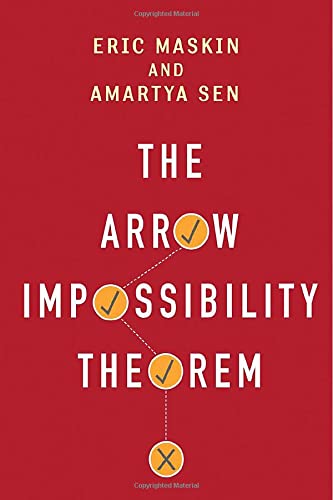
Ebook Info
- Published: 2014
- Number of pages: 168 pages
- Format: PDF
- File Size: 1.03 MB
- Authors: Eric Maskin
Description
Kenneth J. Arrow’s pathbreaking “impossibility theorem” was a watershed innovation in the history of welfare economics, voting theory, and collective choice, demonstrating that there is no voting rule that satisfies the four desirable axioms of decisiveness, consensus, nondictatorship, and independence. In this book Eric Maskin and Amartya Sen explore the implications of Arrow’s theorem. Sen considers its ongoing utility, exploring the theorem’s value and limitations in relation to recent research on social reasoning, and Maskin discusses how to design a voting rule that gets us closer to the ideal―given the impossibility of achieving the ideal. The volume also contains a contextual introduction by social choice scholar Prasanta K. Pattanaik and commentaries from Joseph E. Stiglitz and Kenneth J. Arrow himself, as well as essays by Maskin, Dasgupta, and Sen outlining the mathematical proof and framework behind their assertions.
User’s Reviews
Editorial Reviews: Review Without hyperbole, no postwar intellectual of the first rank has done more good for more people―above all, many of the world’s poorest―than Amartya Sen. — Boyd Tonkin ― The IndependentWhat is Arrow’s impossibility theorem? Why is it true? What are its implications for democratic decision making? Is its nihilism justified? These are the kinds of questions addressed in Maskin and Sen’s masterful Arrow lectures. These lectures and the accompanying essays provide an accessible introduction to Kenneth J. Arrow’s theorem for the neophyte and much food for thought for the cognoscente. — John A. Weymark, Vanderbilt UniversityHow vital it is to understand the ideas behind Kenneth J. Arrow’s impossibility theorem if we want to design reasonably fair ways of coming to consensus decisions that take equitable account of individual preferences. This book is a marvelous introduction to the theorem, a keystone in the theory of social choice. We are treated to a discussion of that theory―its origin, background, and the challenges it points to―by some of its great architects. — Barry Mazur, Harvard University, author of Imagining NumbersThe pioneers of social choice theory give us lively, enjoyable, and stimulating lectures and exchanges of ideas. Their views, more than sixty years after the publication of Kenneth J. Arrow’s theorem, are of paramount interest to anyone aware of the difficulties of collective decisions. — Marc Fleurbaey, Princeton University About the Author Professor Dasgupta is the Frank Ramsey Professor of Economics at the University of Cambridge. He is also the Andrew D. White Professor-at-Large at Cornell University and is currently President of the European Association of Environmental and Resource Economists. His books include Economics: A Very Short Introduction (OUP, 2017), Human Well-Being and the Natural Environment (OUP, 2004) and An Inquiry into Well-Being and Destitution(OUP, 1993).
Reviews from Amazon users which were colected at the time this book was published on the website:
⭐This is a book that should be read and used in conjunction with the works of Elliott Jacques.
⭐Let’s say all the boys in class decide to rank their favorite 20 cars.So every boy writes down on a piece of paper his own ranking of those 20 cars and then we go about listing how we would like to work it all out.0. Suppose we want our ranking to be transitive. So if I know that in the final ranking the Mercedes is above the Honda and the Honda is above the Fiat, then the Mercedes must be above the Fiat.1. Suppose that no matter how many boys there are in class, no matter how many of the (more than 20 factorial, to accommodate draws, missing cars etc.) permutations are submitted, you want to want to come up with a voting scheme that will deliver one, definitive, ranking. (a property of the scheme known us “Unrestricted Domain”)2. Suppose that in this definitive ranking the Ferrari beats the Mercedes. And then suppose we take the Chevrolet out of the list. If then we repeat the vote without the Chevrolet but with all the other 19 cars, the Ferrari had better still beat the Mercedes, or else our voting scheme is unsatisfactory. (a property known as “Independence of Irrelevant Alternatives”)3. Suppose that in every single boy’s ranking the Daihatsu gets beaten by the Lamborghini. It had better also get beaten in the final ranking. (a property known as the “Pareto Principle”)4. Suppose you don’t want there to be a boy who always prevails over the rest if he likes one car more than another (this is the “Non-Dictatorship Principle”)The Arrow Impossibility Theorem says you’re out of luck. You can’t get all of the above.I guess everybody who’s been to elementary school already knows this, but Kenneth J Arrow gave mathematical proof. The proof’s rather easy to follow and I close this review with my version of it. The book is dedicated to an exposition of the Theorem and its ramifications.The result is not a big surprise, obviously, but it is the cornerstone of a beautiful theory. Armed with this result, other economists and philosophers have over the years looked at a number of “voting rules” such as the Anglo-Saxon “first past the post,” the French runoff system, the plurality voting rule, ranking of candidates etc. and worked out when they will yield satisfactory results.This monograph of a book is written by some of the most prominent such theoreticians, including Amartya Sen, Eric Maskin and Partha Dasgupta, with short contributions from Joseph Stiglitz and Kenneth Arrow himself, all beautiful in their own way, though I must say I was confused by the introduction by Prasanta Pattanaik.Also, there is a full paper here that derives some very significant results concerning when “rank-order” voting “works well” (i.e. satisfies conditions such as the ones I describe above), when “plurality rule” voting “works well,” when majority rule is decisive (answer: when there’s no “Concordet triplet” such that x>y>z for fewer than half the voters, y>z>x for fewer than half the voters and z>x>y for a third set of fewer than half the voters) and finally all this work yields the extremely powerful result that if, given a set of preferences, you can come up with some rule that “works well,” then so will majority rule (and that therefore we have not wasted 200 years of democracy using this rule)That said, mathematical symbols are used when words would have fully sufficed. The complex math symbols are never, ever “pushed” in the proof. A Lebesgue integral is defined for no reason. (No use is ever made of measure theory anywhere past this definition) The author never says anything along the lines of “we recognize that this set is a group and apply Theorem X from group theory.” It’s 100% math for the sake of math, and I found that annoying, especially since the book is riddled with errata.For example, on p. 112 there are extra brackets around the main expression that don’t belong; on p. 119 (and again on p. 120 and again on p.p. 143, 144) xRy and xRz and yRxRz and zRxRy are written with the second x’s and y’s and z’s as subscripts when the notation for “x dominates y under R” has been defined as xRy; on p. 123 we are assured that for some t
⭐Good book and seller. 5*
⭐Very interesting and extensive
Keywords
Free Download The Arrow Impossibility Theorem (Kenneth J. Arrow Lecture Series) in PDF format
The Arrow Impossibility Theorem (Kenneth J. Arrow Lecture Series) PDF Free Download
Download The Arrow Impossibility Theorem (Kenneth J. Arrow Lecture Series) 2014 PDF Free
The Arrow Impossibility Theorem (Kenneth J. Arrow Lecture Series) 2014 PDF Free Download
Download The Arrow Impossibility Theorem (Kenneth J. Arrow Lecture Series) PDF
Free Download Ebook The Arrow Impossibility Theorem (Kenneth J. Arrow Lecture Series)