

Ebook Info
- Published: 2011
- Number of pages: 496 pages
- Format: PDF
- File Size: 3.00 MB
- Authors: Jeremy Atack
Description
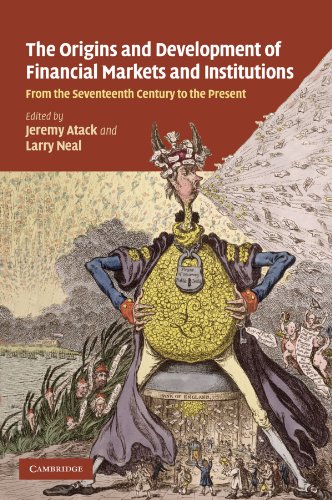
Collectively, mankind has never had it so good despite periodic economic crises of which the current sub-prime crisis is merely the latest example. Much of this success is attributable to the increasing efficiency of the world’s financial institutions as finance has proved to be one of the most important causal factors in economic performance. In a series of insightful essays, financial and economic historians examine how financial innovations from the seventeenth century to the present have continually challenged established institutional arrangements, forcing change and adaptation by governments, financial intermediaries, and financial markets. Where these have been successful, wealth creation and growth have followed. When they failed, growth slowed and sometimes economic decline has followed. These essays illustrate the difficulties of co-ordinating financial innovations in order to sustain their benefits for the wider economy, a theme that will be of interest to policy makers as well as economic historians.
User’s Reviews
Editorial Reviews: Review “This volume offers a substantial contribution to scholarship that will be of interest to many readers…. Recommended.” – Choice Book Description Leading historians examine how financial innovations have challenged established institutional arrangements from the seventeenth century to the present.
Reviews from Amazon users which were colected at the time this book was published on the website:
⭐Larry Neal is an historian of early modern period finance. So one would expect a great book. Unfortunately – perhaps thru editorial interference or thru the demands of his publisher, this book falls short.For example, there is no mention of the origin of the stock exchange (begun at the inn of the Van der Beurse family – hence the origin of the term “bourse”) in Bruges. Nor is there any mention of the very first official Stock Exchange in a building built for that purpose in Antwerp. Nor is there any mention of the exodus of traders and merchants from Antwerp after 1585 that made possible the development of similar financial institutions in Amsterdam (where the founders of these entities literally copied the charter documents they had used in Antwerp).Such selective history is also at a granular level. To offer one example, in the authors’ treatment of the Wisselbank (which was a key factor in the development of the financial markets in the Netherlands). The Wisselbank formed the blueprint of Alexander Hamilton’s text of the Buttonwood Agreement in 1792 – the predecessor of the New York Stock Exchange. The author of this excellent piece was Dirck Van Os from Antwerp. He was the same fellow who headed the Amsterdam Chamber of the Dutch East India Company (“VOC” in Dutch) and who signed the contract with Henry Hudson to explore North America. Yet, there is zero mention of the man nor these contributions.There is value in this book of course. The authors write well and their research is interesting (albeit selective). But for those looking and hoping (as I was) for a comprehensive treatment of the development and origins of financial insttituions and markets, we will need to wait for another book to satisfy that need.
Keywords
Free Download The Origins and Development of Financial Markets and Institutions: From the Seventeenth Century to the Present in PDF format
The Origins and Development of Financial Markets and Institutions: From the Seventeenth Century to the Present PDF Free Download
Download The Origins and Development of Financial Markets and Institutions: From the Seventeenth Century to the Present 2011 PDF Free
The Origins and Development of Financial Markets and Institutions: From the Seventeenth Century to the Present 2011 PDF Free Download
Download The Origins and Development of Financial Markets and Institutions: From the Seventeenth Century to the Present PDF
Free Download Ebook The Origins and Development of Financial Markets and Institutions: From the Seventeenth Century to the Present