

Ebook Info
- Published: 2019
- Number of pages: 232 pages
- Format: PDF
- File Size: 15.87 MB
- Authors: Emmanuel Saez
Description
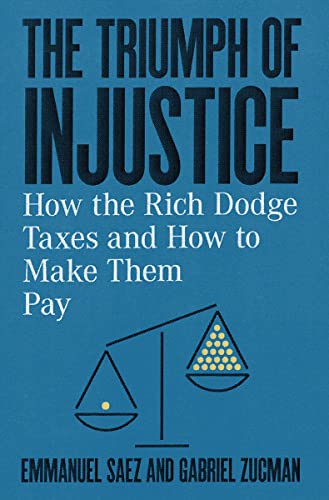
America’s runaway inequality has an engine: our unjust tax system.Even as they became fabulously wealthy, the ultra-rich have had their taxes collapse to levels last seen in the 1920s. Meanwhile, working-class Americans have been asked to pay more. The Triumph of Injustice presents a forensic investigation into this dramatic transformation, written by two economists who revolutionized the study of inequality. Eschewing anecdotes and case studies, Emmanuel Saez and Gabriel Zucman offer a comprehensive view of America’s tax system, based on new statistics covering all taxes paid at all levels of government. Their conclusion? For the first time in more than a century, billionaires now pay lower tax rates than their secretaries.Blending history and cutting-edge economic analysis, and writing in lively and jargon-free prose, Saez and Zucman dissect the deliberate choices (and sins of indecision) that have brought us to today: the gradual exemption of capital owners; the surge of a new tax avoidance industry, and the spiral of tax competition among nations. With clarity and concision, they explain how America turned away from the most progressive tax system in history to embrace policies that only serve to compound the wealth of a few.But The Triumph of Injustice is much more than a laser-sharp analysis of one of the great political and intellectual failures of our time. Saez and Zucman propose a visionary, democratic, and practical reinvention of taxes, outlining reforms that can allow tax justice to triumph in today’s globalized world and democracy to prevail over concentrated wealth.A pioneering companion website allows anyone to evaluate proposals made by the authors, and to develop their own alternative tax reform at taxjusticenow.org.
User’s Reviews
Editorial Reviews: Review “[T]he most important book on government policy that I’ve read in a long time.” ― David Leonhardt, New York Times”One of the best books I’ve read this year. Crystal clear, rigorously empirical. Should be read by policymakers from around the globe, especially in the US. It’s the to-do-list for the next president.” ― Rutger Bregman, author of Utopia for Realists”In 2018, for the first time in more than one hundred years, billionaires paid a lower tax rate than ordinary workers, crowning the dismantling of America’s system of progressive taxation. In this eye-opening book, Emmanuel Saez and Gabriel Zucman show that there is no iron law of economics that led us there, just many whose self-interest or misunderstanding of economics make them claim the opposite. Their radical proposal to reinvent taxation for a globalized world will become an unavoidable starting point to any intelligent conversation.” ― Esther Duflo, winner of the Nobel Prize in Economics and author of Poor Economics: A Radical Rethinking of the Way to Fight Global Poverty”America is tired with inequality and oligarchy. Armed with eye-popping new data, Emmanuel Saez and Gabriel Zucman reveal how tax injustice is fueling the oligarchic drift. But above all, they propose bold solutions to help America reconnect with its tradition of tax justice, from the taxation of extreme wealth and giant corporations to the funding of health care for all. This is a brilliantly argued book that is an essential contribution to the global economic and political debate of the twenty-first century.” ― Thomas Piketty, author of Capital in the Twenty-First Century”The Triumph of Injustice is a groundbreaking work that uncovers a diabolical driver of America’s shocking and growing inequality: unfair and regressive tax policies and a tax avoidance industry that serves the wealthy at the expense of everyone else. Until we reverse this topsy-turvy regime―where ordinary workers may pay a larger share of their income than the very richest Americans―we can’t hope to address our biggest social problems. Anyone who hopes for a better future for everyday Americans needs to read this book.” ― Joseph E. Stiglitz, winner of the Nobel Prize in Economics and author of People, Power, and Profits: Progressive Capitalism for an Age of Discontent About the Author Emmanuel Saez is professor of economics and director of the Center for Equitable Growth at the University of California, Berkeley. His research focuses on tax policy and inequality from both theoretical and empirical perspectives. With Thomas Piketty, he has constructed long-run historical series of income inequality in the United States that have been widely discussed in public debate. He received his PhD in economics from MIT in 1999. He was awarded the John Bates Clark Medal of the American Economic Association in 2009 and a MacArthur Fellowship in 2010.Gabriel Zucman is professor of economics and public policy at the University of California, Berkeley. His research analyzes the accumulation and distribution of wealth through global and historical perspectives. He received his PhD in economics from the Paris School of Economics in 2013. He was awarded the Bernácer Prize in 2018 and a Sloan Research Fellowship in 2019. He is the author of The Hidden Wealth of Nations: The Scourge of Tax Havens, which has been translated into eighteen languages.
Reviews from Amazon users which were colected at the time this book was published on the website:
⭐I originally purchased this book hoping to see an economist’s approach to addressing the impact of the rich poor gap and the relative tradeoffs of the current tax policy of overtaxing producers and under taxing elite wealth. If you are hoping for the same with this book, you will be disappointed. I put the book down after reading the ridiculous assertion that book retained earnings is imputed untaxed wealth to shareholders. I picked it up again this week while captive on a five-hour flight after seeing one of the authors was testifying in front of congress on the issues of tax policy. The book’s misrepresentation of tax issues is only surpassed by its lack of an economist’s rigor in any empirical analysis. The authors hypothesize that the rich routinely and collectively engage in tax fraud, including retaining previously taxed earnings in C-corps, moving accounts offshore, and they go on and on; exemplifying the authors lack of understanding of double taxation and practical knowledge of the current tax world in general. As an example, very few businessowners operate as C-corps, as the earnings are taxed at the corporate rate, then taxed again at the individual level as dividends, or as ordinary income if compensation. The C-corp pays 21% and stated tax (9.3 for CA), and the individual pays another 23.8% (dividend tax plus NIIT) plus call it 12% state tax if in CA. So effectively over 60% taxation on the same earnings, or if treated as compensation the amounts are deductible to the C-corp and income to the recipient, then taxed at 37.5% fed plus 12% individual, plus 2.9% Medicare and .9% Obamacare for 53.3% marginal rate (ignoring the 12.2% payroll tax). Pass throughs have similar treatment to the 53.3% marginal rate, and the answer for the C-corp was worse pre-trump reform. Where is the tax avoidance exactly? Earnings are trapped in the C-corp, and practically more individuals use S-corp or LLC pass throughs for their entity choice. Somehow the authors think an unfavorable and unpopular entity selection leads to tax evasion. The authors further claim entrepreneurs deduct meals, trips, etc. within these entities as personal expenses unrelated to their businesses. Note that meals were 50% limited until Trumps covid relief bill. The government can audit more if they are concerned with inappropriate business deductions – but its highly unlikely this is going to pay for much, let alone for a fraction of Medicare for all. The authors are also obsessed with taxing earnings not distributed to shareholders and reinvested into the business. Normal people call this investing and growing a business, which in turn grows the economy. The earnings have already been taxed at the corporate level, and authors want them taxed again as a dividend even though not distributed as one. The authors also lament that stock buybacks for public companies are untaxed compensation to shareholders. One would expect an economist to do more than a superficial analysis of the issue. And what they may find is much of the stock buybacks are simply purchasing shares related to employee stock options that are exercised, versus materially reducing float. These exercises are ordinary income (unless ISOs, which are increasingly rare) to the option exerciser, so those are again taxed at the individual rate of 53.3% cited above (and deductive to corp as comp). The governments gets their piece. And who cares if a company wants to buy its own stock as an investment, versus any other stock. Somehow this evades taxes and hides wealth. The extent of tax fraud and advisor participation is simply misstated, and the authors provide zero evidence or analytics on the extent of its existence or impact on receipts. The authors also posit since capital gains are taxed at 23.8%, that is another method for the rich to avoid taxes. They also offer, without serious economic rigor or contrarian analysis, that taxes on capital don’t matter and do not impede further formation within the economy, and should also be taxed at a much greater rate than the current third or so (20% cap gains plus 12% California state rates, plus 3.8% NIIT). There is clear evidence that high capital gains rate impact transactions, and more importantly lower capital gains tax rates translate to more government revenue – not less – due to the increased number of transactions. A review of the capital gains receipts after the Bush tax cuts would counter the authors assertions. As if the authors expected non-believers to still be reading beyond the midpoint of the book, they move from these ridiculous arguments to one that simply states its unfair for people to have too much money; as that money brings power – and regardless of whether its worse for government tax receipts people just should not have that much money. Its clear many of these proposed policies will not increase government revenue, and the authors provide scant evidence that it will, but billionaires simply need to not have that much regardless of the impact on the rest of society. The authors further perpetuate the common fallacy that economic activity is a zero-sum game – that individuals that created such great companies as Amazon, Google, etc. did not expand the overall economic pie. According to the authors the economic pie is fixed, and any wealth obtained at the higher end comes at the expense of the lower end. A real economic analysis would try to measure this relative contribution to the economic pie weighted against confiscatory taxes. The authors also estimate income of the various segments of our population without isolating for labor participation rates, government transfer payments, or income earned outside the tax system. There is no discussion of the movement of people between tiers of income as they develop more job skills in life (e.g. only about 20% of the population in the lower tier stays in the lower tier – 80% move on to higher tiers, so individuals churn but the relative wages of the tier move little), nor that the relative pie has expanded such that say 20% of GDP now is much greater than 20% decades ago, and therefore all people in the lower 20% are better off. The lower-end income numbers are simply not credible – and this appears to be done through simple, unanalyzed math. The authors, as supposed economists, do not offer any analysis to other contributions to wage deflation, such as immigration, high government debt lowering the MRP of government spending, labor and tariff policies, etc. The assumption inherent in the book is government is the better allocator of resources and needs to grow to help society versus anything the individual does, and any of these payments to individuals will not impede their personal incentive to better themselves. Some of the policy suggestions may have merit, but also lack depth (e.g. maybe analyze how a wealth tax can make the capital of the wealthy more productive to make a “tax the wealthy” policy point). One of my favorite parts of the ending was the authors stating how easily a wealth tax could be administered and assets valued, ignoring any actual economic history on the topic; and these assets can be valued by the same people (transfer pricing economists, of which there are 250,000 of them apparently – just go with it) that are criminals helping multinationals evade the perfectly constructed tax code. This will offer a nice second career for them since somehow policy makers will be able to convince other countries to equally tax all of their residents and corporations as the US does, and their current work will no longer be needed. The OECD has done this so well in such an expedited time frame. Save yourself some time. If you are trapped on a plane, I suggest rereading the emergency procedure pamphlet a few hundred times versus this undeveloped term paper, as you will be less inclined to depart the plane midair – which I recently learned also carries a $50,000 fine. If you want to hear a summary of the book, simply look up an Elizabeth Warren rant on you-tube. It will offer the same points with as much analysis as you would get out of this book.
⭐UC Berkeley economics professors Emanuel Saez and Gabriel Zucman have written a social democratic screed against economic inequality and a concomitant plea for confiscatory taxes on the super-rich. That is taxation not to raise revenue, but rather to reduce the number of billionaires. It is no accident that they have advised both Elizabeth Warren’s and Bernie Sanders’ presidential campaigns.Their discussion involves a data heavy look at the overall U.S. tax system that includes federal, state and local taxation. They conclude that from 1950-1980 the tax system has gone from a progressive one to a largely flat tax system with mildly regressive aspects at the top end. They use adjusted gross income as the basis for their tax rates among the various income groups. By using that metric they exclude transfer payments which bias the results. Further that ignores the very large charitable contributions made by the super-rich which reduces their effective tax rates as defined by the authors. Had they not made those contributions I would assume that the apparent regressivity would give way to progressivity.What Saez and Zucman get right is the need to crack down on corporate tax havens that allow for the transfer of income from high tax to low tax jurisdictions. The tax allocations performed by multi-national corporations have been elevated to a high art by the global accounting firms. Thus it makes a lot of sense to form a global compact to limit this behavior and establish a minimum corporate tax on the order of 20-25%.Domestically they advocate increasing the corporate tax back to the 50% heyday of the 1950s and increasing the top individual rate to 60 %( federal and state). On top of that they propose a 6% national income tax on all income, but they would eliminate state and local sales taxes. On the individual level they would characterize capital gains and dividends as ordinary income while indexing gains to inflation. Because they are French I would characterize their pies de resistance a wealth tax on the order of 2-3% for the richest Americans. As noted above that tax is not for revenue, but rather to penalize and to reduce the number of super wealthy people. My simple question is how is the confiscating of 2-3% of someone’s wealth each year bear any relationship to justice? Think of a large farm where the government takes 20-30 acres away each year from the farmer without compensation. That would be a taking pure and simple.The authors propose using all of the revenue generated from there overhaul of the tax code to fund child care, pre-K, free college and Medicare for all. It sure sounds like Bernie and Elizabeth.What the authors ignore are the second order effects of their ambitious plan. The stock market would meltdown under the weight of lower after tax corporate profits and the forced selling of shares by the super-rich. With that the already shaky finances of public pension plans would crater and the private retirement savings of millions of Americans would take a severe hit. What would they recommend? The answer is obvious: a bailout.Instead of their meat ax approach to the tax code a scalpel would achieve much of what they desire. A moderate increase in upper-income tax rates, elimination of the capital gains treatment of carried interest, elimination of 1031 exchanges for real estate transactions and increasing the corporate income tax rate from 21% to 25%. Such a program wouldn’t cure their bloodlust for billionaires, but would reduce inequality without wrecking the economy.There is one major factual error in the book. The authors state that the top rates for ordinary income and capital gains taxation are 37% and 20%, respectively. That is wrong. The Obamacare taxes make the high income top rates for ordinary income and capital gains, 39.6% and 23.8%, respectively. They are also wrong in attributing the growth in tax shelters following the 1981 Reagan tax cuts to the genius of the tax avoidance industry. That is not quite true. It was the increased depreciation allowances of the Reagan tax cuts coupled with the Garn-St. Germain Act deregulation of the savings and loan industry that enabled the tax shelter industry to flourish. It was given to them on a silver platter. Lastly they note that stock buybacks were illegal prior to 1982. That is not true. Buybacks were legal, but they were highly restricted.Saez and Zucman have offered up a serious, though dubious in my opinion, proposal for radical tax reform. Credible responses are necessary especially if either Warren of Sanders become the Democratic nominee for president.
⭐This book really is spot on. If rich people do not pay their share, evade taxes etc. democracy itself is at risk. And right- and left-wing people may debate how much each should contribute, but cheating should be condemned by both opinion streams. (And by the way I am paying a lot of taxes myself).The book is very readable and its analysis clear. Sometimes, a certain anti-rich ideology comes through, which the authors nevertheless try fairly successfully to mask, except in their totally unfair attack on Warren Buffett. The fact that Buffett does not personally pay taxes on retained earnings by his companies is the law, he couldn’t do it even if he wanted to, and it feels really wrong to (nearly) equate that with Trump’s tax cheating.One thing the authors might look at more is the idea of making everybody’s tax return public. Obviously, there would be cries about privacy, but that would be special pleading – today most countries publish all directorships, for instance. Why your neighbours would not have the right to see how much you contribute to the common expenses of society – i.e., are you a free-rider – does not sound absurd to me.When my father was working in a Latin American country in the 1960-70’s and we just had a revolution, the new revolutionary government decided to publish in the newspapers the list of the top x (don’t remember exactly, i think 100) tax payers. My father was surprised to be on the list – wealthy, but certainly not at the top. Some incredible wealthy people were not on the list at all. Imagine the situation today and tell me – don’t you think this would help (a) shame some people into paying – after all, what’s the point of sponsoring the Met if everybody considers you a tax fraud ? reputation is important for some people (b) investigative journalists discover interesting targets for a little analysis and therefore (c) the tax offices getting free detective work fingering some people for obviously having some “compliance issues” ?Or would you have voted for a certain British politician if you would have known his zillionaire wife doesn’t pay tax because she’s living in the UK but not domiciled there ?Light is the best disinfectant. Fairness should not only be achieved, it should be seen to be achieved. Publish all tax returns (individuals, companies, trusts, every taxpayer). Not anonymised – full disclosure and by name.Society will become the better for it.
⭐Outstanding summary of the authors’ path-breaking work on tax and (in)justice, should be required reading for all economists and concerned citizens, and a wake-up call for the not-yet concerned. Very relevant for the UK, with many similarities but less rigorous research on our only slightly less extreme inequality and unjust tax system.
⭐Looks like it got banged up in shipping.
⭐Great book. Clear, simple, and very convincing.
⭐Saez and Zucman have written a book about tax policy and managed to make it both understandable and even entertaining. Their main concern is to show how our current US tax policies have made the rich richer. To do this, they provide a history of how the US tax system evolved to what it is today. They also provide some very concrete and influential proposals about how to make the tax system more fair. The footnotes are excellent and they provide a web site with their data and a tax calculator to allow readers to experiment with the parameters of their proposal.
Keywords
Free Download The Triumph of Injustice: How the Rich Dodge Taxes and How to Make Them Pay in PDF format
The Triumph of Injustice: How the Rich Dodge Taxes and How to Make Them Pay PDF Free Download
Download The Triumph of Injustice: How the Rich Dodge Taxes and How to Make Them Pay 2019 PDF Free
The Triumph of Injustice: How the Rich Dodge Taxes and How to Make Them Pay 2019 PDF Free Download
Download The Triumph of Injustice: How the Rich Dodge Taxes and How to Make Them Pay PDF
Free Download Ebook The Triumph of Injustice: How the Rich Dodge Taxes and How to Make Them Pay