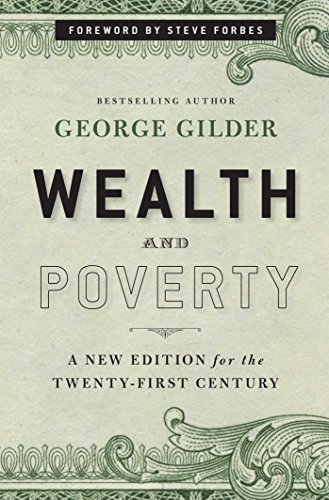
Ebook Info
- Published: 2012
- Number of pages: 256 pages
- Format: PDF
- File Size: 2.64 MB
- Authors: George Gilder
Description
A CLASSIC THAT WILL IGNITE THE NEXT ECONOMIC REVOLUTION Hailed as “the guide to capitalism,” the New York Times bestseller Wealth and Poverty by George F. Gilder is one of the most famous economic books of all time and has sold more than one million copies since its first release. In this influential classic, Gilder explains and makes the case for supply-side economics, proves the moral superiority of free-market capitalism, and shows why supply-side economics are more effective at decreasing poverty than government-regulated markets. Now, in this new and completely updated edition of Wealth and Poverty, Gilder compares America’s current economic challenges with her past economic problems–particularly those of the late 1970s–and explains why Obama’s big-government, redistributive policies are doing more harm than good for the poor. Making the case that supply-side economics and free market policies are–and always will be–the answer to decreasing America’s poverty rate and increasing her prosperity, Wealth & Poverty offers solutions to America’s current economic problems and hope to those who fear that our best days are behind us.
User’s Reviews
Editorial Reviews: From the Inside Flap From the New PrologueThe United States over the last decade has witnessed a classic confrontation between the forces of entrepreneurial capitalism and those of established institutions claiming a higher virtue, expertise, and political standing. One side subsists on unforced profits of enterprise; the other on rents and tolls and privileges at the Treasury, the Federal Reserve, and the White House. &hellp;The wealth of America is not an inventory of goods; it is an organic living entity, a fragile pulsing fabric of ideas, expectations, loyalties, moral commitments, and visions. To vivisect it for redistribution is to kill it. As President Mitterand’s French technocrats discovered in the 1980s, and President Obama’s quixotic American ecocrats are discovering today, government managers of complex systems of wealth soon find they are administering an industrial corpse, a socialized Solyndra. From the Back Cover From the New PrologueThe United States over the last decade has witnessed a classic confrontation between the forces of entrepreneurial capitalism and those of established institutions claiming a higher virtue, expertise, and political standing. One side subsists on unforced profits of enterprise; the other on rents and tolls and privileges at the Treasury, the Federal Reserve, and the White House. &hellp;The wealth of America is not an inventory of goods; it is an organic living entity, a fragile pulsing fabric of ideas, expectations, loyalties, moral commitments, and visions. To vivisect it for redistribution is to kill it. As President Mitterand s French technocrats discovered in the 1980s, and President Obama s quixotic American ecocrats are discovering today, government managers of complex systems of wealth soon find they are administering an industrial corpse, a socialized Solyndra.” About the Author George Gilder, one of the leading economic and technological thinkers of the past forty years, is the author of nineteen books, including Wealth and Poverty, Knowledge and Power, The Scandal of Money, and Life after Google. A founding fellow of the Discovery Institute, where he began his study of information theory, and an influential venture investor, he lives with his wife in western Massachusetts. Read more
Reviews from Amazon users which were colected at the time this book was published on the website:
⭐George Gilder presents his arguments for the superiority of supply-side economics. He provides a lot of good evidence for why a smaller government is best. He shares convincing data but there are also many passages with very questionable standards. For example, he claims real jobs are jobs that produce more than they consume. Based on this, he has no problem with government jobs per se. These sorts of confusions lead to nothing but conflicts later on when explaining why a small government is preferred. He needs to go deeper and realize the importance of individual freedom. Capitalism is good because it is the only system that appreciates individual freedom. Government is bad because it violates the rights of individuals. Gilder ultimately does not believe in individual rights, he doesn’t have a problem with coercing individuals, as long as the outcomes are to his liking. This is the same underlying principle of all collectivists. Whether their goal is the public good or some other higher end, collectivists require force; and that is the underlying issue that needs to be discussed more today….is force okay? If it’s not okay for individuals to force each other, why is it okay for groups of individuals? And if it’s not okay, what are the implications.Entertaining and some original thoughts but three stars based on the confusing standards used.
⭐George Gilder has been rated a legendary analyst on high-tech. After reading this book, I can see how he got that rating. Mr. Gilder covers the analysis of economics by comparing past economic writers, and making his own analyses. He makes one conclusion after another, after presenting his case, and hits the nail on the head. What should governments in the US do? – He explains what they should do. What should individuals, poor and rich do? – He explains what they should be doing. Mr. Gilder also explains the heart of what separates rich from poor, and the fundamental reason may surprise you. He also tells why this underlying power is not explained by economic statistics, but by the inner workings of each human being. I highly reccommend this book. In fact, at the first chance that I get, I plan to read his most recent book, and gain his unique insights…
⭐The original Wealth and Poverty was one of a few great books in the 20th Century. This book is a rehash but a rehash is well worth the read and investment. However the data is old and without new examples based on more current data this books usefulness is downgraded. The references date back mostly to the 1970s and early eighties. Of course some are relevant but many conclusions should be based on more current data. The conclusions however are excellent and well reasoned.I feel I am criticizing a great person but that is not my intent. George Gilder is a hero as his insight changed many to understand not just economics but the future. I have worn out at least three copies of the original Wealth and Poverty but learned a lot in this new edition. This is a great book by a great American. Buy it and study it.
⭐Mrs likes the book
⭐contradictory. He will argue supply side economics, but fails to acknowledge the possibility that since the middle class creates 90% of demand, which in turn creates supply, that perhaps the middle class are the job creators, not only the most successful capitalists?This is a rather complicated stab at “trying to get people to like capitalism”(?). I thought I was to be politically informed and enlightened upon reading this, but rather it’s a convoluted mess of half truths with ZERO references.IE: one part will boldly state that “‘this’ idea is just as bad as the environmentally damaging crockpot idea of an energy wind farm”, without giving any rhyme or reason as to why they think wind farms are so detrimental.Also, it doesn’t seem particularly relevant. To anything.Lastly, I disagree with it’s brashness in that “Capitalism is everything, and naysayers are just naysayers”. THere’s a limit to what a society can stand in terms of hierarchal powers that calcify on the top of capitalism.I’m an economics minor at UW seattle and am infatuated with capitalism as much as the next guy, but this book is just weird.
⭐I THOUGHT THIS WAS INFORMATIVE , NOT THAT EASY TO READ THOUGH ! BUT , IMPORTANTINFORMATION FOR EVERYONE TO UNDERSTAND . I HOPE MR GILDER CONTINUES TO WRITE ANDSPEAK OUT ON GOVERNMENT POLICY , ECONOMIC PRINCIPLES , TAXES , ETC .
⭐If you are an entrepreneur, own your own business or aspire to the American Dream of being fabulously wealthy someday, you will love this book. You will validate your ambition. You will see why your goals are totally reasonable and why you should never, ever stop trying to reach the brass ring of the American Dream. If you are watching for the mailman to make sure your government check is about to hit this book is not for you. If you think everyone is entitled to the same salary, the same job, the same house and no responsibility then don’t buy this book!
⭐This book is extremely “heady” and is basically a reminder what capitalism is, and is not. The author carefully disects socialism and capitalism and shows how they are reciprocal of each other. It gives views from the left and the right but courageously defends capitalism and demeans socialism for the United States.If you are into economics and economic theories you will enjoy this book.
⭐Originally written in the late 1970’s, this book has been updated in 2012. It gives a refreshing view of capitalism as founded in altruism and individual entrepreneurship as the driving force to prosperity. The helping hand of government is seen to result in strangulation of individual motivation, as it clamps down on both the wealthy and the poor.The book is backed up with footnotes and a bibliography. Everyone who claims to want to help humanity and the environment should read it.
⭐Love it! Thanks
Keywords
Free Download Wealth and Poverty: A New Edition for the Twenty-First Century in PDF format
Wealth and Poverty: A New Edition for the Twenty-First Century PDF Free Download
Download Wealth and Poverty: A New Edition for the Twenty-First Century 2012 PDF Free
Wealth and Poverty: A New Edition for the Twenty-First Century 2012 PDF Free Download
Download Wealth and Poverty: A New Edition for the Twenty-First Century PDF
Free Download Ebook Wealth and Poverty: A New Edition for the Twenty-First Century