

Ebook Info
- Published: 2017
- Number of pages: 232 pages
- Format: PDF
- File Size: 7.64 MB
- Authors: Brink Lindsey
Description
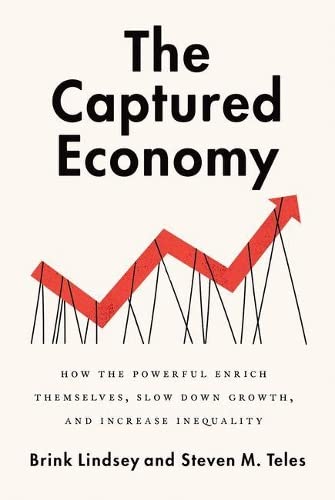
For years, America has been plagued by slow economic growth and increasing inequality. In The Captured Economy, Brink Lindsey and Steven M. Teles identify a common factor behind these twin ills: breakdowns in democratic governance that allow wealthy special interests to capture the policymaking process for their own benefit. They document the proliferation of regressive regulations that redistribute wealth and income up the economic scale while stifling entrepreneurship and innovation. They also detail the most important cases of regulatory barriers that have worked to shield the powerful from the rigors of competition, thereby inflating their incomes: subsidies for the financial sector’s excessive risk taking, overprotection of copyrights and patents, favoritism toward incumbent businesses through occupational licensing schemes, and the NIMBY-led escalation of land use controls that drive up rents for everyone else. An original and counterintuitive interpretation of the forcesdriving inequality and stagnation, The Captured Economy will be necessary reading for anyone concerned about America’s mounting economic problems and how to improve the social tensions they are sparking.
User’s Reviews
Editorial Reviews: Review “Recommended.” — E.P. Hoffman, emerita, Western Michigan University, CHOICE”A compelling and original argument about one of the most pressing issues of our time, The Captured Economy challenges readers to break out of traditional ideological and partisan silos and confront the hidden forces that are strangling opportunity in the contemporary United States.” — Matthew Yglesias, Vox”Are you looking for how to get out of our current mess? The Captured Economy is perhaps the very best place to start.” — Tyler Cowen, Professor of Economics, George Mason University”American politics is mired in endless arguments about how much downward redistribution we want and how to provide it. But as Brink Lindsey and Steven Teles point out in this engaging, powerfully argued book, the reality of our political economy often looks much more like upward redistribution. In one arena after another, public policy enriches the already rich and advantages the already advantaged.” — Yuval Levin, editor of National Affairs”Steven Teles and Brink Lindsey ask one of the most important questions of our times: What are the political reforms we need to reduce the ability of the wealthy to maintain their capture of our government? Combining the analytic forces of liberalism and libertarianism, they provide a much-needed investigation into why the U.S. government works on behalf of the powerful and the steps we can take to address rising inequality and regressive regulation so that it instead acts in the public interest.” — Heather Boushey, co-editor of After Piketty: The Agenda for Economics and Inequality”A clear and brilliant explanation of what has happened to America over the last few decades. Anyone who wants to understand what has happened to our economy, or our politics, needs to read this book.” -Megan McArdle, Bloomberg View”Regardless of where your sympathies lie – redistribution is both good and bad – what connects all these activities and many others is that they don’t result in the production of goods and services. Instead, they involve the shifting of money and wealth from one party or group to another. They recall the spirit of 19th-century politicians’ defense of patronage jobs: ‘To the victors belong the spoils.’ This sort of economy may be larger than you think. That’s the gist of the provocative new book ‘The Captured Economy’ by Brink Lindsey and Steven M. Teles . . . They argue that the economy is riddled with self-serving arrangements, mainly benefiting the rich, that impose excess costs on the poor and middle class and reducreduce economic growth.” -Robert Samuelson, The Washington Post About the Author Brink Lindsey is Vice Policy President and Director of the Open Society Project at the Niskanen Center. He is the author of, most recently, The Age of Abundance and Human Capitalism. Steven M. Teles is Professor of Political Science at Johns Hopkins University and Senior Fellow at the Nikansen Center. He is the author of, most recently, The Rise of the Conservative Legal Movement and Prison Break: Why Conservatives Turned Against Mass Incarceration.
Reviews from Amazon users which were colected at the time this book was published on the website:
⭐This is the work of two authors one list himself as Libertarian the other as Liberal and what they wish to offer is an explanation for the working of the contemporary American economy and its failings. As they say “the Great Recession, the worst downturn since the Great Depression, has been followed by the slowest recovery since World War II.” They go on to explain the staggering inequality that has developed in the years following the 1970s using the concept of ‘Rent’ in four forms as explanatory of both slow growth and inequality — both characteristic of the developed economies of the western world. Rent here is reward for possession not production. There is another study with similar conclusions of rent’s distributive effects, Gus Standing’s The Corruption of Capitalism: Why rentiers thrive and work does not pay.The differences are enormous in causation. Lindsey and Teles give a neoliberal explanation where the functioning Free Market is sacred and the sectors that have resulted in impaired markets are in need of revision – government’s effects primarily negative.Standing sees the problems originating ideological in the 1970’s, with the arrival of neoliberalism, leading to the demise of the working and middle classes resulting from the shift from production to finance, globalization, diminished government countervailing role trimmed back to serve the elite, where income is channeled to the owners of property – financial, physical and intellectual – at the expense of society. The ratio between CEO compensation to average worker soars from 25:1 in 1970 to 335:1 in 2015.In The Captured Economy the authors hope for autonomous formations of free associations to foster change, one of the strangest being Billionaires at play with help of neo-con, neoliberal think tanks and now Betsy DeVos as Sect. of Education, faced off against ‘insidious teachers’ organizations;’ unionization detrimental. The combination has awaken the teachers’ organizations as headlines illustrate.Standing’s The Corruption of Capitalism places his faith in the rising precariat, the displaced, dispossessed, working class of the gig economy, somehow focusing their discontent into revolutionary momentum. Looking into the future does not generate convincing solutions for where modern capitalism has wandered in the age of globalization and ruling authoritarian plutocracy in both the western and eastern countries.In the post WWII period wages rose as productivity did as rising profits were pasted on to employees due in part to unionization and its spill over effects in other markets.The gap between productivity and a typical worker’s compensation has increased dramatically since 19731948–1973:Productivity: 96.7% Hourly compensation: 91.3%1973–2016:Productivity: 73.7% Hourly compensation: 12.3%This as well as any tells where the economic system has changed. For the bulk of the population the system is broken, for the top doing fine.Both works make a valiant attempt to explain why and are worth the reader’s time; the hope would be that policy makers are somehow forced to see what has happened and correct, or more chaos will follow the year 2016.
⭐The Captured Economy: How the Powerful Enrich Themselves, Slow Down Growth, and Increase Inequality, the joint product of Teles (a liberal) and Lindsey (a libertarian), advocates reducing upward distributive rent-seeking. Rent-seeking is the zero-sum contest for excess payments to any factor of production (land, labor, or capital). Reducing this rent-seeking both increases economic growth and makes the distribution of income more equitable, core tenets of their “liberaltarian” philosophy, by lessening the economic distortion of wealthy special interests seeking special favors for themselves instead of engaging in productive activities that spur growth. The book covers four case studies that capture the severity of upward redistribution in the United States: “(1) subsidies for financial institutions that lead to too much risk-taking in both borrowing and lending; (2) excessive monopoly privileges granted under copyright and patent law; (3) the protection of incumbent service providers under occupational licensing; and (4) artificial housing scarcity created by land-use regulation.” Then, the book explains how to “rent-proof” American politics through (1) public mobilization to bring issues to the attention of policymakers such as through civil society organizations advocating for environmental issues or school reform that challenge the special interests of polluters and teachers’ unions, (2) empowering government officials with policy knowledge independent of lobbyists such as through Congressional staffs being chosen through a merit-based civil service system, and (3) selecting institutional venues that do not give preferential access to special interests such as the creation of state-level regulatory review agencies modeled on the Office of Information and Regulatory Affairs. The book covers all of this ground in only about 200 pages of lucid writing accessible to all and edifying even for specialists. I would also recommend Tyler Cowen’s interview with the authors on his podcast “Conversations with Tyler.” The book is essential reading to understand how the government at the federal, state, and local levels currently exacerbate inequality and how to get out of this mess.
⭐This is one of the most thought-provoking books I have read in many years, It has many ideas that represent a way forward to solve some of this country’s biggest problems. In this book a liberal and a conservative actually have a substantive conversation about common ground that both sides can embrace to make progress in helping the bottom half of our population economically. That is why this book is well worth reading. It is not for those at the extremes on both political poles because they generally don’t listen anyway. It is targeted at independent thinkers who understand that compromise is needed for this country to make progress in addressing its problems. It is the best challenge to crony capitalism that I have read in many years. If you can handle common sense ideas and throw out the partisan politics, then by all means find the time to read this well-written, thought stimulating book. You will see that it is possible to have an intelligent discussion on some of our most pressing issues.
⭐Fascinating book looking at how multiple industries have engaged in regulatory capture – using the agencies meant to regulate them for consumer benefit and instead leveraging them to advance their own interests. The book was full of insight into very specific areas impacting our lives, although a bit dull and repetitive.
⭐The rich are getting richer at the expense of the man on the street – certainly in the US. Why – because of rent-seeking and hidden subsidies. This book will explain everything in an easy to read fashion.
⭐I find it a very informative book; but it would have been much easier to understand if, instead of alway using the term “rent-creating” or “rent-creation,” the authors would have used, “rent-boosting” (trickle up) and “rent-contracting” (trickle-down) and “rent-determining” for legislation that affected up or down movement of wealth.
⭐Offers both abstract discussions and concrete ideas. Useful and essential read for those who are not just into book writing and scoring ideological brownie points by preaching to the choir.
Keywords
Free Download The Captured Economy: How the Powerful Enrich Themselves, Slow Down Growth, and Increase Inequality 1st Edition in PDF format
The Captured Economy: How the Powerful Enrich Themselves, Slow Down Growth, and Increase Inequality 1st Edition PDF Free Download
Download The Captured Economy: How the Powerful Enrich Themselves, Slow Down Growth, and Increase Inequality 1st Edition 2017 PDF Free
The Captured Economy: How the Powerful Enrich Themselves, Slow Down Growth, and Increase Inequality 1st Edition 2017 PDF Free Download
Download The Captured Economy: How the Powerful Enrich Themselves, Slow Down Growth, and Increase Inequality 1st Edition PDF
Free Download Ebook The Captured Economy: How the Powerful Enrich Themselves, Slow Down Growth, and Increase Inequality 1st Edition