

Ebook Info
- Published: 1997
- Number of pages: 368 pages
- Format: PDF
- File Size: 9.83 MB
- Authors: Frans B. M. de Waal
Description
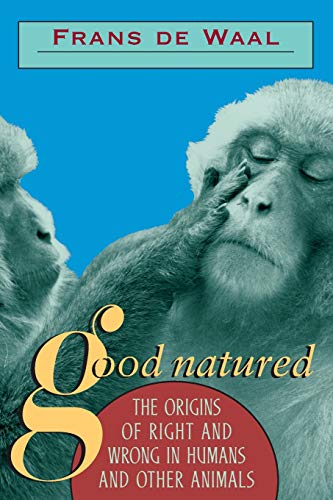
To observe a dog’s guilty look.to witness a gorilla’s self-sacrifice for a wounded mate, to watch an elephant herd’s communal effort on behalf of a stranded calf–to catch animals in certain acts is to wonder what moves them. Might there he a code of ethics in the animal kingdom? Must an animal be human to he humane? In this provocative book, a renowned scientist takes on those who have declared ethics uniquely human Making a compelling case for a morality grounded in biology, he shows how ethical behavior is as much a matter of evolution as any other trait, in humans and animals alike.World famous for his brilliant descriptions of Machiavellian power plays among chimpanzees-the nastier side of animal life–Frans de Waal here contends that animals have a nice side as well. Making his case through vivid anecdotes drawn from his work with apes and monkeys and holstered by the intriguing, voluminous data from his and others’ ongoing research, de Waal shows us that many of the building blocks of morality are natural: they can he observed in other animals. Through his eyes, we see how not just primates but all kinds of animals, from marine mammals to dogs, respond to social rules, help each other, share food, resolve conflict to mutual satisfaction, even develop a crude sense of justice and fairness.Natural selection may be harsh, but it has produced highly successful species that survive through cooperation and mutual assistance. De Waal identifies this paradox as the key to an evolutionary account of morality, and demonstrates that human morality could never have developed without the foundation of fellow feeling our species shares with other animals. As his work makes clear, a morality grounded in biology leads to an entirely different conception of what it means to he human–and humane.
User’s Reviews
Editorial Reviews: Amazon.com Review In Good Natured Frans de Waal, ethologist and primatologist, asks us to reconsider human morality in light of moral aspects that can be identified in animals. Within the complex negotiations of human society, a moral action may involve thoughts and feelings of guilt, reciprocity, obligation, expectations, rules, or community concern. De Waal finds these aspects of morality prevalent in other animal societies, mostly primate, and suggests that the two philosophical camps supporting nature and nurture may have to be disbanded in order to adequately understand human morality. A theoretician, de Waal is meticulous in his research, cautious not to extrapolate too much from his findings, and logically sound in his arguments. He also writes with precision and a flair for the dramatic, carrying readers along with graceful ease and vivid examples. Review “Evolutionary continuities have been sought in intelligence, language, tool making–anywhere but in morality. Now a respected ethologist, Frans de Waal, tackles the problem from a novel angle…Good Natured is no touchy-feely celebration of animal innocence, but a hardheaded study by a specialist in primate behavior with a wealth of observational experience. Mr. de Waal, a research scientist at the Yerkes Regional Primate Center at Emory University, presents his rich data in an accessible prose lit with flashes of wry humor and beautifully illustrated with his own vivid photographs…Far from being half ape, half angel, torn between a moral sense that strives upward and an eons-old bestial viciousness that drags us down, [we are portrayed by de Waal] as inheritors of a basically moral view of life that has evolved over countless millenniums–not through some fictitious social contract between self-sufficient individuals, but through the inevitable give-and-take of communal living…Anyone who cares about humans or their future will profit from this excellent book, which sheds at least as much light on our own lives as it does on those of other creatures.”―Derek Bickerton, New York Times Book Review“So lucid is de Waal’s manner of setting things forth that each time he finishes drawing an aspect of animal morality, your first response is to wonder why you hadn’t noticed it around the house, if not at a primate research center, a remote island, or the zoo…[His] startling contributions to the way the general reader, or general citizen, has of thinking seriously about “humans and other animals” might be permanent.”―Vicki Hearne, Village Voice Literary Supplement“A sparkling master work…de Waal…is perhaps the most literate, entertaining, and soulful of the cognitive ethologists…In Good Natured, [he] takes his humanizing project a step further, employing the rich lexicon of human moral concepts as figures of speech to depict and lend meaning to the behavior of nonhuman animals…[A] provocative, endearing, and brilliantly written book.”―Richard A. Shweder, Los Angeles Times“Modern Darwinian evolutionary theory is based on individual reproduction, on ‘selfish’ genes that have been selected at the expense of others that might act for the greater good. How then could survival of the fittest lead to empathy?…This profound paradox has led some scholars in the past to assume that the emergence of morals must be a transcendent process beyond the bounds of scientific explanation. Frans de Waal, one of the world’s best-known primatologists, has set out to prove that assumption wrong. On the final page of his startling new book, he asserts that “we seem to be reaching a point at which science can wrest morality from the hands of philosophers.” How the author…came to this conclusion makes for compelling reading.”―William C. McGrew, Scientific American“In [this] original and engaging new book…de Waal makes a strong case that the four ingredients of morality–empathy/sympathy, sharing or reciprocity, justice/rules and peacemaking/reconciliation–are very much evident in other mammals…The book employs a solid core of statistical evidence to bolster his case, but what makes his argument so compelling is the richness of detail…De Waal is an original thinker and writes with such a light hand that the reader can take a stimulating ride through his imaginative philosophical discourse…This work is…penetrating and profound.”―Vicki Croke, Boston Globe“De Waal [questions]…whether the roots of human morality can be found in the behaviour of other species. He is more or less ideally placed to answer that question, after years of perceptive research on captive chimpanzees, bonobos and monkeys…As de Waal fans will already know, chimpanzees and other primates come alive as individuals under his expert gaze…Sympathy, attachment, social norms, punishment, a sense of justice, reciprocation, peacemaking and community concern–all are writ large in chimpanzee society. Good Natured makes the point with the help of a profusion of gripping examples.”―Stephen Young, BBC Wildlife“As a book of ideas…this is excellent and on the whole I am inclined to believe de Waal’s case for the antecedents of our own morality in other species, Perhaps most interestingly, however, is that the domain hitherto of philosophers is now being contested by evolutionary biologists. Not only does this tighten up the terms of the debate (as did ape language research for linguistics), but ironically it injects a special kind of humanism that recognises the origins of our moral failings as well as our successes.”―Thomas Sambrook, Times Higher Education Supplement“[A] well-written, provocative book.”―Charles T. Snowdon, Science“A large and entertaining collection of anecdotes about animal behaviour. These are used to bolster the proposition that mental processes governing complex forms of human behaviour, such as sympathy and empathy with others, must have their homologues in the animal kingdom…[This book] is extremely well written and very entertaining.”―Alan Dixson, Quarterly Journal of Experimental Psychology“[Good Natured] is a tour de force and a landmark in the growing field of cognitive ethology….[It] is an example of the very best in popular science writing. De Waal skilfully weaves together anecdotes, theories and data to create a text that is thought-provoking and a pleasure to read.”―Gail Vines, New Scientist (UK) About the Author Frans B. M. de Waal is C. H. Candler Professor of Primate Behavior in the Psychology Department and Director of Living Links, part of the Yerkes Primate Center, Emory University. Read more
Reviews from Amazon users which were colected at the time this book was published on the website:
⭐I found the book to be highly readable and subject matter to be fascinating. This subject is no where near my field (which is history) but found that De Waal presents the material in way that is very accessible to anyone. De Waal has an entertaining writing style that keeps you absorbed in the reading without the effort I have found in other books on the subject.It’s very important for us to really look at where we come from and why we are what we are, and taking a look at our closest relatives is a good window into our minds. I found the analysis and the conclusions to be well formed and fairly presented. The evidence he gives for his conclusions is well documented and explained.While I did have a few problems here and there, these did not detract from the overall readability and the pure enjoyment of the book. This was just a very enjoyable book that I would recommend to anyone, whether you have a deep interest in the topic or you’re just looking for an interesting book to use up a few hours in the day.
⭐Good Natured is a book focusing on morality in the animal kingdom, specifically primates. Overall, I thought this was definitely a fairy easy and engrossing read. The book deals with the structure of primate societies and how they enforce morality, how deeply it extends through the primate family (de Waal primarily researches chimpanzees), and instances of love, guilt, aggression, deception from his own research and those of other primatologists. He also describes other philosophies and research into moral systems.I like de Waals style: the studies he talked about were fascinating and he really keeps your interest. I guess the only negative is that the book is a little disjointed in places. For example, in the chapter on sympathy there is a section on deception. In the end he makes his own speculation on morality stretching across human boundaries and what he makes of the implications for treatment of primates and other animals. It’s definitely a great read for anyone interested in the evolution of morality and primatology.
⭐This book changed my life. Our human idea that we are masters of all creatures and that we alone have emotions is proved wrong. The pictures are marvelous. The elephant daughter returning to roll the bones of her mother long after the demise of her mother and the extremely powerful picture of the monkeys marveling at the new born, are worth the book itself. I read it twice and have given it to many people. It is a book like, The City of Joy, once you read it you will never look at animals the same way or as in the City of Joy the human condition in the third world the same way. Marvelous.
⭐Excellent research and presentation. Very informative and enlightening focusing in ethics and morality. While I have read many books that were decades long studies, this one helped me see much deeper. Thank you!
⭐Got it for school
⭐This work succeeds most of all by gradually eroding invisible assumptions about morality as an exclusively human prerogative. Chapter by chapter, Frans De Waal builds a convincing and rich assembly of proto-moral practices among nonhuman primates, defining and illustrating terms such as empathy, nurturance, cognitive altruism, and many others along the way. The result, which can sometimes feel like a complicated mass of overlapping and related terms, is a kind of ground shift in perception. This, at any rate, seems to be what he aims to accomplish, staying within the warrant of observational evidence. For some readers this might be a kind of Copernican Revolution against the absolute centrality of human beings in the moral universe. We are not alone: we have moral ancestry and moral companionship (fast disappearing) in the wilderness, in the zoos, and in the animal research laboratories. [As an aside, it also seems clear that there could be no effective substitute for the actual first-hand experience of social primates that De Waal reports]De Waal’s occasional jabs against contemporary moral philosophers (Peter Singer seems to be a main target) are suggestive but not thorough (which is perhaps just as well given the aim of the work). In particular, I found De Waal’s “floating pyramid” a poor improvement on the more common notion of an “expanding circle” of moral empathy, as employed by Singer and others. The two are the same except for De Waal’s addition of a resource constraint, which ensures that one’s circle of moral concern only expands as resources become available. On this account, the affluent will (or should) demonstrate greater moral concern than the poor for strangers in need. This is not in accord with facts as far as I can tell. In all, however, this is an exciting read with some especially memorable tales of animal morality.
⭐I must say that this book has really helped me understand how monkeys, bonobos, and chimps live in both captivity and in the wild. In the same token it has also help understand how they all interact with each other, and sometimes I must admit that they seem to treat each other like humans treat one another.Chapter Two in the book to me seemed to be the most interesting. De Waal with great detail writes about relationships within the species. How they accept handicap within the species and how they deal with an offspring’s death.Overall this book is outstanding and clearly understood. All chapters of this book even though this book is about primates, monkeys, etc., have a tie to human beings. I recommend this book to those individuals interested in learning the behavior and the nature of primates, monkeys, etc., but most of all those interested in learning the behavior and nature of humans, after all we did evolve from old world primates.
⭐Very valuable book
⭐De Waal argues convincingly, scientifically and objectively yet without the straitjacketed approach of many scientists, for the existence of ethical behaviour in non-human animals. Beautifully written, this book should be read by every student of animal behaviour.
⭐I did not like this book much. It did not help me to understand the topic any better and I found it boring and took a lot of concentration to focus on it however if this topic really interests you then it is easy to read, use of language is not complicated.
⭐De wallet tells us that the descent of man is a little more complex than what we believe
Keywords
Free Download Good Natured: The Origins of Right and Wrong in Humans and Other Animals in PDF format
Good Natured: The Origins of Right and Wrong in Humans and Other Animals PDF Free Download
Download Good Natured: The Origins of Right and Wrong in Humans and Other Animals 1997 PDF Free
Good Natured: The Origins of Right and Wrong in Humans and Other Animals 1997 PDF Free Download
Download Good Natured: The Origins of Right and Wrong in Humans and Other Animals PDF
Free Download Ebook Good Natured: The Origins of Right and Wrong in Humans and Other Animals