

Ebook Info
- Published: 2001
- Number of pages: 332 pages
- Format: PDF
- File Size: 2.93 MB
- Authors: Judith Shapiro
Description
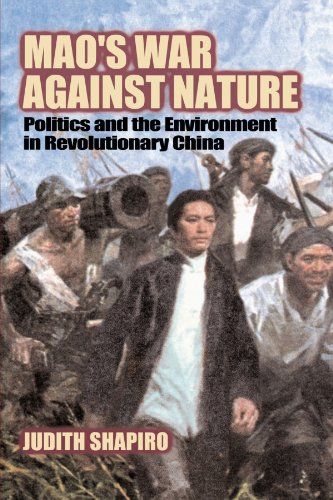
In clear and compelling prose, Judith Shapiro relates the great, untold story of the devastating impact of Chinese politics on China’s environment during the Mao years. Maoist China provides an example of extreme human interference in the natural world in an era in which human relationships were also unusually distorted. Under Mao, the traditional Chinese ideal of “harmony between heaven and humans” was abrogated in favor of Mao’s insistence that “Man Must Conquer Nature.” Mao and the Chinese Communist Party’s “war” to bend the physical world to human will often had disastrous consequences both for human beings and the natural environment. Mao’s War Against Nature argues that the abuse of people and the abuse of nature are often linked. Shapiro’s account, told in part through the voices of average Chinese citizens and officials who lived through and participated in some of the destructive campaigns, is both eye-opening and heartbreaking. Judith Shapiro teaches environmental politics at American University in Washington, DC. She is co-author, with Liang Heng, of several well known books on China, including Son of the Revolution (Random House, 1984) and After the Nightmare (Knopf, 1986). She was one of the first Americans to work in China after the normalization of U.S.-China relations in 1979.
User’s Reviews
Editorial Reviews: Amazon.com Review Historians have well chronicled Mao Zedong’s crimes against the people of China over his four decades of rule, but his crimes against the Chinese land have been less studied. Judith Shapiro, a historian at American University, tells that dark story with admirable thoroughness. A central tenet of Maoist ideology was the rejection of both ancient Chinese tradition and modern Western science, both of which offered an ample store of evidence to suggest that rivers flow best when unimpeded, that biological diversity is a good and necessary thing. Instead, Mao Zedong insisted, the laws of historical materialism mandated that everything in creation be put into the service of the revolution: Forests had to be felled to make steel for China’s industrial development, mountains had to be leveled to make room for agricultural fields, rivers had to be reversed in their courses to provide power and irrigation. Marshaling the people of China in campaigns to clear land and destroy grain-hungry birds, among other things, Mao remade the landscape in just a few years, ordering imperial-scale projects such as the Three Gorges Dam. His policies led to disaster, to deforestation, air and water pollution, and ultimately famine–but some of those policies are still in force. Shapiro observes that Mao Zedong cannot be held entirely accountable for the destruction of China’s land, water, and air; he had, after all, many willing deputies. Still, the political repression he put in place made resistance almost impossible–and even today, Shapiro writes in her impressive study of Mao’s war on the environment, his actions have proved difficult to undo. “Until China confronts its uneasy Maoist legacy,” the author concludes, “it may struggle fruitlessly to achieve a sustainable relationship with the natural world.” –Gregory McNamee From Scientific American In China during the Mao years, Shapiro writes, “coercive state behavior such as forcible relocations and suppression of intellectual and political freedoms contributed directly to a wide range of environmental problems ranging from deforestation and desertification to ill-conceived engineering projects that degraded major river courses.” Indeed, “few cases of environmental degradation so clearly reveal the human and environmental costs incurred when human beings, particularly those who determine policy, view themselves as living in an oppositional relationship to nature.” Shapiro, who teaches environmental politics at American University in Washington, D.C., examines closely such disastrous Mao projects as the Three Gate Gorge Dam on the Yellow River and the devastation of agriculture through campaigns that imposed a uniform agricultural model on the entire country regardless of local conditions. China’s environmental problems continue today, 25 years after Mao’s death, although Shapiro sees some “apparently serious efforts” by the central government to deal with them. She also sees the possibility that “a government may yet evolve that is environmentally responsible and responsive.” EDITORS OF SCIENTIFIC AMERICAN Review “Shapiro is a gifted storyteller, and the book is a fascinating read…a must-read for anyone interested in understanding not only all that the Chinese people have endured in their recent past but also how those turbulent times shape the current environment and future possiblities.” WWW.WASHINGTONPOST.COM”We knew that Mao traumatized the psyche of his nation. Now, thanks to Judith Shapiro’s meticulous research and fine writing, Westerners can realize just how badly he traumatized its landscape and resources. I’ve never read a better argument for openness in decision-making. An utterly fascinating book.” Bill McKibben, author of The End of Nature and Maybe One”This important volume offers food for thought for those concerned about China’s environmental past and future and the broader connections between humans and nature.” American Historical Review”Dr. Shapiro’s well-researched book records the disastrous degradation of China’s natural environment during the era of Mao Zedong. The traditional teaching that men must live in harmony with nature was declared backward and counter-revolutionary. Scholars and experts who opposed his policy were persecuted. As a result, damage to China’s environment will take generations to recover. This book provides a timely warning, and an encouragement to the enlightened few who have realized the seriousness of the situation.” Nien Cheng, author of Life and Death in Shanghai”The case studies are informative and well done.” American Political Science Review”In an illuminating and absorbing account, Judith Shapiro reveals how Mao’s policies resulted in such massive environmental degradation that it clouds China’s future despite current conservation efforts. Even today, countries often seem to subscribe to Mao’s dictum, ‘Man Must Conquer Nature.’ China’s mistakes offer important lessons for everyone, as this timely book so lucidly describes.” George B. Schaller, Wildlife Conservation Society; author of The Last Panda”well-written…It tells a shocking story that needs to be told, but ends on a note of hope.” Nature”This book represents the first Western-language work to elucidate the environmental problems of the Mao era. Mao’s War Against Nature will become the classic book on this topic and is essential reading for anyone interested in the Chinese environment or the legacy of the Mao era. The discussions of Ma Yinchu and Huang Wanli are unique and provide excellent case studies of the problems intellectuals encountered during those years.” Richard Louis Edmonds, School of Oriental and African Studies, University of London; author of Patterns of China’s Lost Harmony”engaging…compelling” Dow Jones News Service Book Description This book tells the story of environmental destruction and human suffering during the Mao years. Read more
Reviews from Amazon users which were colected at the time this book was published on the website:
⭐This is a very interesting history of China in the mid-twentieth century vis a vis the disastrous approach the government of Mao took in a completely ignorant and foolhardy attack on the natural environment from efforts to fill in lakes to create more arable farmland (a monumental failure) to attacking sparrows to near extinction (they somehow managed to survive (just barely). Ms. Shapiro is an thorough investigator and engaging writer. This book offers an interesting perspective on an area of Chinese history that may have been overlooked and offers an important cautionary tale for all of those who might have the hubris to think that Nature can be controlled.
⭐This is an interesting book, and it is one that explores a theme that many ecologists and students of Asian anthropology have missed – namely the ecological destruction of Mao’s China and the far reaching social consequences of this destruction. Judith Shapiro does an excellent job of documenting and exploring those aspects of government policy that wreaked absolute havoc on the environment in China under Mao’s rule. This book is well written and well organized. What Judith Shapiro did not explore, and what I hoped she would – are the historical foundations of Mao’s anthropocentric worldview – which are firmly rooted in Marxist ideology. In fact, ecological destruction in communist countries is commonplace – it stems from the inability of Marxist ideology to interpret the environment in anything other than purely exploitative, economic terms. Within this context, Mao’s policies were not an aberration. I would have liked to see Judith Shapiro dig deeper into this realm.
⭐There is a reason Shapiro is so often cited in other books — this is an excellent book that surveys the destructive and creative force of Maoist policies, and the human strife with and against nature in China. China’s history of wrestling with nature’s violent tendencies are reflected in the modernization efforts of the Communist Party; while the title suggests a belligerent nature of the policies, Shapiro’s examination goes further than that, into the cultural heart of modern China that has deep roots in Confucian ideals. Authority and obedience in conjunction with the drive to modernize and expand result in great changes while maintaining the same core — Shapiro’s book is a must-read for any student of China, whether you are a businessman, politician, or student of Chinese history. I highly recommend this book!****I am an undergraduate student in Economics and History, and found this to be an excellent read pertaining to both of my academic fields.
⭐A good introduction to the environmental history of a chaotic period in China’s recent past, 1949 to 1978, which has relevance to understanding China today. Despite occasional minor inaccuracies, this is a valuable resource for anyone hoping to understand the relationship of modern Chinese citizens to their environment, and the roots of government policies.
⭐Book was much appreciated. Useful for a specific research project; well written but could have had more detail, which would be difficult given the enormity of the subject. Appears to be the only reference on this issue. Would recommend it to anyone interested in one of the more insidious sides of Mao’s campaigns.
⭐Shapiro’s book is fascinating history that illuminates many of China’s current environmental views and problems. Well researched with strong conclusions.
⭐Buy it, borrow it or steal it… But read it, if you are interested in environment, history, political science, sociology and socio-cultural anthroplogy.
⭐In terms of the historiography of China’s environmental policies during the Mao era this book is certainly an important work. Shapiro does a great job of laying out the general trends of the policies concerning the environment during the Mao years, and this general framework is nicely complemented by anecdotal evidence. The thesis of this work is that governments and policies that victimize people also tend to victimize the environment. That thesis is convincingly supported by Shapiro as the book documents how environmental destruction was particularly pronounced during the political reform movements that have become so notorious (the Great Leap Forward, the Cultural Revolution, etc.).Unfortunately, this otherwise superb book has a major flaw for which I feel compelled to dock one star in my rating. Shapiro’s final analysis concerning the changes needed in the future is simply weak. Throughout the book Shapiro criticized ideologies/philosophies that considered nature as something to be conquered. She also touches on how those ideologies/philosophies are often related to the modern world view of progress and materialism. I think she is absolutely correct in this part of her diagnosis.Oddly, when it comes to her prescription Shapiro suggests what is essentially more of the same. She, of course, wouldn’t see it that way, but she fails to refute the modern world view of progress and materialism. The answer, according to Shapiro, isn’t a break from the ideology of progress but rather a progress that is tempered by the implementation of new technology and a sense of “humility”. Well, humility would certainly help, but even a humility that at the end of the day still is primarily interested in material progress will end in the same types of environmental abuses that Shapiro is so sincerely concerned with.The problem that Shapiro misses is that the modern world view is one which in which societies are driven by the notion that history is (or at least can) progress toward some sort form of utopian reality. In the case of China the utopian reality is socialism/communism, but I would argue the nonconservative vision of capitalism’s role in enriching the world is basically of the same essence. The point here is that this view of history and reality is especially pronounced in modernity. The predominant world view before modern times in Western Civilization, for example, was the Augustinian world view that considered this world as simply “growing old” and “passing away”. According to this view, the world has no directional history; eschatological fulfillment is only found in transcendent history (aka, salvation by God). For more on this, see Eric Voegelin,
⭐.In any case, this was a valuable read that should be seriously considered as an addition to any modern Chinese history course, especially those with a focus on Maoist policies. Shapiro is a good writer and her anecdotes are very interesting. Her thesis is solid and well supported, though I think her final analysis could have been stronger. Four stars for a solid book.
⭐An amazing real tale that all should know.
⭐Brilliant original work that will ring bells with anyone who has travelled in the Chinese countryside, what is left of it. Readable, not in academic jargon, but expensive for a paperback.
⭐While Saphiro’s book has been a significant reference to outline for the ecological damages during Mao’s era, it lacks a global approach. A few and awful sample cases are developed but that is all. It also lacks technical explanations. In any case a must read book in English for those scholars willing to get an understanding of China and its XX century disasters.
⭐著者は米中の関係改善後、語学教師として中国に渡って以来中国専門家となる。本書はケンブリッジ大学出版の環境問題シリーズであるが、学術書の割にはグラフ、統計が少ない。中国研究では信用できるデータに乏しいのでこれは仕方ない。その埋め合わせとして聞き取り(匿名も多い)などの資料が豊富である。 毛沢東の病的な精神主義に翻弄された50年~70年代の中国社会、人々の姿が活写されていて読み応えがある。山門峡ダムに反対した治水専門家の悲惨な運命だの、大躍進運動で動員された人々、ダイサイに学べ運動で無駄に作られた段々畑、そこに無駄に注ぎ込まれた膨大なエネルギー、これまた現地の実情を無視した熱に浮かされたような埋めたて工事等々、狂気ともいえる数十年になされた自然大破壊の全貌がこれでもかと描かれ、そのおバカな情熱と行動につくづく呆れる。またほんとに可哀そう!! 著者は最後に現在の中国には環境保全の点で希望はあると言っているが、2001年の出版であるから、15年後の今、残念ハズレ!
⭐
Keywords
Free Download Mao’s War Against Nature: Politics and the Environment in Revolutionary China (Studies in Environment and History) in PDF format
Mao’s War Against Nature: Politics and the Environment in Revolutionary China (Studies in Environment and History) PDF Free Download
Download Mao’s War Against Nature: Politics and the Environment in Revolutionary China (Studies in Environment and History) 2001 PDF Free
Mao’s War Against Nature: Politics and the Environment in Revolutionary China (Studies in Environment and History) 2001 PDF Free Download
Download Mao’s War Against Nature: Politics and the Environment in Revolutionary China (Studies in Environment and History) PDF
Free Download Ebook Mao’s War Against Nature: Politics and the Environment in Revolutionary China (Studies in Environment and History)