

Ebook Info
- Published: 2010
- Number of pages: 916 pages
- Format: PDF
- File Size: 17.36 MB
- Authors: Richard J. Herrnstein
Description
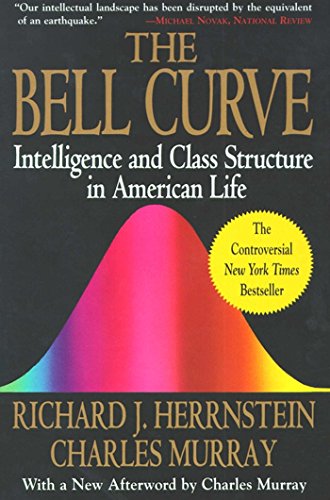
The controversial book linking intelligence to class and race in modern society, and what public policy can do to mitigate socioeconomic differences in IQ, birth rate, crime, fertility, welfare, and poverty.
User’s Reviews
Reviews from Amazon users which were colected at the time this book was published on the website:
⭐”The Coming of the Custodial State” says, on page 523, “When a society reaches a certain overall affluence, the haves begin to feel sympathy toward, if not guilt about, the condition of the have-nots. Thus dawns the welfare state – the attempt to raise the poor and the needy out of their plight … Over the next decades [moving forward from 1994] it will become broadly accepted by the cognitive elite that the people we now refer to as the underclass are in that condition through no fault of their own but because of inherent shortcomings about which little can be done. Politicians and intellectuals alike will become much more open about the role of dysfunctional behavior in the underclass, accepting that addiction, violence, unavailability for work, child abuse, and family disorganization will keep most members of the underclass from fending for themselves.”I’ve chosen 1 sequence from 1 page concluding the book. I could have chosen a thousand sequences as telling as this. Also, by 1994, it wasn’t all too prescient to predict that the Paternalistic state of whites to blacks would continue to grow as the IQ influences of both genes and environment would combine to accelerate and exacerbate the demise of dysfunctional families in the per-child welfare system, thus widening gaps right before our eyes all the way up to 2016. As Herrnstein and Murray point out early, gains made in the 1970s and early 1980s, gains made through integration, had already begun to show reversals by the early 1990s as poor mothers became younger and less affiliated with their children’s father. Bad neighborhoods not only became worse; they became bigger. An entire generation has come since then, and the snowball is getting bigger. Good neighborhoods became more isolated.Like anybody, I have to evaluate the book by what I bring to the book. Some disclosure: I know a genius, a co-worker, and he is as intellectually functional as anybody I know. Socially, he is difficult to predict. Although his IQ is doubtless in the 140 plus range and he works probability questions without pause, as well as doing long division in his head, speaking to him in the hallway can be a challenge. He is married, has raised his polite children, and is ready to retire. I have often wondered if his obesity is a sign of his eccentric ability or an exception. I would not trade places with him. My wife’s first husband was an exceptional engineer, an expert on so many of the structures we see in our civil society. Socially, he was an impossible presence to enjoy. His flat sense of humor, his social dependency, his physical laziness, and his deadbeat dad habits led him to drunken helplessness around his own family. The court had to tell him to pay child support, not a manifestation of the typical characterization of “Very bright” on Bell Curve’s many charts.So why, in 2016, should people still read this book? (I would like you to, but it’s not fun, and like so many other things that give satisfaction, it also enrages.) I believe the overall premise of the book is to clarify the upward mobility that we have had and continue to have in this country. SES, social economic status, consistently plays less of a role in life success than IQ. This book will bombard you with factual studies that indicate significant differences between poor who are less intelligent and poor who are more intelligent. Regarding IQ scores, SAT performances, higher education, lower crime rate, change in income, age at marriage, age and marital status during first pregnancy, amount of divorces (everything but number of tattoos and music preference), the book repeatedly reports that starting poor was less of a factor than starting off with lower intelligence indicators. The poor in this country, but mostly in regard to the smarter of that class, have a long, illustrious record of moving up to middle class and beyond.So in effect, the book does not ask readers to stop making excuses. It urges readers to shift their guilt from man-made, societal problems like inner cities and coal-mining communities to Natural-made differences. And this would just be common sense, and the “cognitive elite” who don’t watch Jeopardy and who don’t look at or believe data simply can’t be very “elite” if this needs 575 pages of explanation. Clearly, Herrnstein and Murray set out to cover all bases. As soon as a crack in the argument was suggested, it was addressed, and it was addressed with calm, thorough, rational information. East Asians are smarter than whites, more so in math. Whites are smarter than blacks, and East Asians are smarter than blacks by a wide margin regardless of economic background, school choice, favoritism or discrimination, or any other strain of SES.But I am not finished with this book’s bottom line, because of the liberal mindset that welcomes and encourages the indoctrination of service. In other words, I see many of our nation’s brightest, from Baby-boomer flower children to Millennials (a higher percentage of the former), trapped in the dumbness of “white guilt”. This notion should be, in the spirit of the book, examined logically and not emotionally. Is the white guilt as it has existed since 1964 working? The most valuable insight this book provides is not the answer “no” but the explanation behind that no, and the resounding impact of that “NO!” Paternalism for the less intelligent is failing the less intelligent; only a diabolical liberal whose real plot is to push the poor further down and further away would continue to throw government benefits at people in hopes they’ll become dependent on them: a teenage mother from a rough neighborhood in Baltimore is enabled to have a second child, then a third, with Head Start then available. The father(s) is less inclined to be present, more inclined to repeat the process with another single mother. The family, such as it is, will propagate a lower Intelligence Quotient among this specific population. Illegal activities such as drugs and gang violence are much more likely. All the while, liberal whites believe their advocacy is helping because, stupidly, it only takes short term consequences into account. The next generation will be more than 1-2 standard deviations below because of the clearly recognizable “malleability” of intelligence.
⭐This book is about 25 years old so I thought it was about time I checked it out. Much of the book is a tedium of statistical analysis but there is really no way to avoid that. Personally, I found few of the the conclusions shocking or or surprising — whether valid or not they have been around for some time in one form or another. Still I think that they serve to demonstrate the authors opinions are the result of serious thought. The book is NOT all about race and could have been written in a way to totally avoid that aspect. The fundamental premise is that during the 20th century a person’s intelligence has become much greater determinate regarding social status and economic well being than in previous centuries. Further that social hierarchy has become so highly stratified by the late 20th century such that those of low to middling intelligence are loosing meaningful roles in the community and are fated to live of degrading dependence government charity. Using the authors’ analysis the preceding can be stated with out respect to race. I.e., the data support that conclusion whether one looks at Whites only, African Americans only, or any other sub-group of the population. It is also true of the population as a whole.Many decades ago I had exposure to similar statistical analysis, regression to be exact. However, this was in connection economics, econometrics and economic history. There lies my discomfort and bias. My recollection that a regression exhibiting r**2 less that .8 was not taken very seriously and would probably not get one published published. There authors hang their hats on r=.4 and r**2=.16. Times may have changed, theirs is a different discipline but still my bias leaves me with doubt and discomfort.Starting at a tender age in the 1950’s the public schools I attended subjected me to various IQ tests, to PSATs, SATs and who knows what else. I was told well but they all bored and annoyed me. So there is another bias. So I’ll agree that some people are smarter than others and these test seem to agree (kind of) with the degree of smartness. However, this is all statistical relationship of something to something neither of which is understood directly. The presumption is that goes on in the brain that causes high scores on tests and results in success in life. The associated biochemistry and brain structure at the cellular level that is associated with all this remains undetermined though there may be hints. It is reasonable to suppose that one’s DNA (and thus biological inheritance) is involved to one degree or another. Still, I think that there remains uncertainty as to what is going on and that conclusions regarding society, policy and politics should be written about but with caution an skepticism.Then race come in to the picture. OK, so race is a murky concept. Still, if I’m walking down the street an one of my neighbors looks at me and thinks “white dude” and I correspondingly think “black dude” there is zero ambiguity. We are both 100% certain and 99.9% correct. It is silly to pretend race isn’t a real thing but it is also silly not understand that there is a lot unknown beyond the melanin. [If you live in the southwest you may look at someone walking your way and wonder whether they are “Hispanic”, “Native American” or “Asian” and not have a ready answer. The correct answer with respect to DNA is mostly “yes”.] If you want to check this personally send your sample in to 23AndMe. The authors use data based on racial/ethnic self identification. They likely had no alternative. Need I add that race and ethnicity (whatever that is) are not equivalent. Thus I think the authors could and should have left race out of the discussion. At some future date whether 1, 10 or 100 years I expect someone will accurately link a DNA sequence or sequences to “cognitive ability” or “abilities”. Until then I advise caution and to consider what it means if you have been wrong in your assumptions and preferences. This applies to both hard core racists and to committed progressives.
⭐Astonishing to see that in 2019 scientists such as James Watson are still being punished for speaking science-based truths regarding inherited intelligence, just as Hans Eysenck was decades ago. As the author states, the consensus among scientists is 180 degrees opposite to the media and public perception. If scientists speak on inherited intelligence in public they are severely punished by ill-informed socialists who can never alter their absurd political beliefs that all people are born equally intelligent and differences can be eliminated by redistribution of wealth to change the environment. Given the physical beatings and career destructions dished out over the post-war years, it is unsurprising scientists have learned to keep quiet on this topic. The authors and researchers who published The Bell Curve are very brave.Perhaps in the distant future our generations will be viewed dimly for refusing to face facts and letting puritanical politics trump scientific research.
⭐A massive investigation into the demographics surrounding intelligence and American society. Much of the writing applies to the UK too. This book isn’t exactly easy reading and takes some effort to work through, the results are well worth it though.The central argument of the book is that intelligence is a strong predictor of life prospects, including the chance of getting a good job, being happily married, avoiding drugs, crime, large families and children born out of wedlock. The result of trends in US Society is seeing two separate groups emerge which increasingly have less and less interaction with each other. It follows that charity is not able to help poor people on the whole as their poverty is a result of their low intelligence.Emotive reactions and politically correct thinking shouldn’t interfere with scientific facts, if IQ is indeed hereditary to a large extent then nothing we say or feel will alter that. Having said this, there are plenty of people willing to twist data and misrepresent facts to suit their own far-right racist views. I’d warn the reader to be both open minded and critical of the book and to draw their own conclusions based on their wider knowledge of this debate.I wasn’t totally clear who the book was written for, the general public or academics? The book seems a little bloated and dry for your average reader but it seems to have been marketed to them. I felt the authors too were a little hesitant to draw conclusions from their data. Predicting the future is far from easy and making policy recommendations which will work is often even harder.I wasn’t convinced that the book did enough to take into account the social and economic barriers often found in societies around the world by which the children of the wealthy and privileged are given a much bigger hand up in life. The dismantling of some of these barriers is surely necessary before we can fairly judge. Plants growing in inferior quality soil will be unlikely to grow to the same height as those not, regardless of genetics. The book does argue using statistics that the brighter children of poorer parents will over the course of time achieve higher levels of success in their lives than those dull children born into middle class families.
⭐I bought this as part of reading for a course along with ‘the mismeasure of man’, which is a critic of the book. It’s a long book, and though I don’t necessarily agree with the premise because of the nature of the measurement of ‘intelligence’ it’s good to understand where people who argue this way of working are coming from.
⭐An outstanding book on a controversial social issue. Many people may disagree with his opinions, however, you cannot keep a blind eye on this or accuse it of pseudoscience. I disagree on many important aspects. A few of them are below.Authors have mentioned that the IQ score improves over generations (in the US as well as in many other countries), This may not be due to genetic changes rather it may be due to environmental/cultural changes. That in turn indicates that the influence of environment/culture has a significant impact on IQ (which is contrary to the main theme of the book). There is not much discussion on this. Also in another chapter authors indicate that the IQ of the US population decreasing over generations due to the low birth rate among educated women. This is contradicting the previous observation.Another thing I disagree with is their opinion that difference in IQ is leading to stratification and class difference.Despite these disagreements, the book discusses many important aspects of social science that most scientists avoid for political correctness.A few points are below.* IQ is in part inborn (part of it hereditary, part random), and part environmental.* Most of the life skills (education, job performance, law obedience, etc) are highly correlated to IQ. This is difficult to believe but his arguments are compelling.* There is a significant difference in IQ between ethnic groups. Very difficult to believe, however they claim that there is ample evidence. It is not clear though if this difference is due to genes or cultural differences. My personal observation is that Asians do better in Science because parents encourage kids in STEM subjects for better employment opportunities. The bar for such controversial claims should be high.* Unequal representation of different ethnic groups in employment or higher education not necessarily due to discrimination.When they discuss the rationale for affirmative action, I felt one justification left out. It (affirmative action) is like representative participation (a legislative body is not elected based on the best qualification for legislation rather a quota for each region). When you are allocating a scarce resource (college admissions), it has to be equal among different parties as the resource itself has not produced the higher IQ of the applicants. However there is one catch – race and sex are not the only discrepancies, there will be huge discrepancies between urban and rural as well as different regions of the country.I appreciate the authors for the courage to present such a controversial topic also done in a fair way (I think so).
⭐Very thought provoking book. Coldly clinical analysis of the implications of how American society is evolving and the implications therein, backed by hard statistics and a maths primer to help those without a Maths degreee (me). understand. This book has been attacked by the Left as being racist, elitist and downright bad, but it’s just reporting on the observations. I’m sure it is very well received in China – the PRC does not operate on sentiment.
Keywords
Free Download The Bell Curve: Intelligence and Class Structure in American Life (A Free Press Paperbacks Book) in PDF format
The Bell Curve: Intelligence and Class Structure in American Life (A Free Press Paperbacks Book) PDF Free Download
Download The Bell Curve: Intelligence and Class Structure in American Life (A Free Press Paperbacks Book) 2010 PDF Free
The Bell Curve: Intelligence and Class Structure in American Life (A Free Press Paperbacks Book) 2010 PDF Free Download
Download The Bell Curve: Intelligence and Class Structure in American Life (A Free Press Paperbacks Book) PDF
Free Download Ebook The Bell Curve: Intelligence and Class Structure in American Life (A Free Press Paperbacks Book)