Ebook Info
- Published: 2006
- Number of pages: 488 pages
- Format: PDF
- File Size: 8.03 MB
- Authors: Samuel P. Huntington
Description
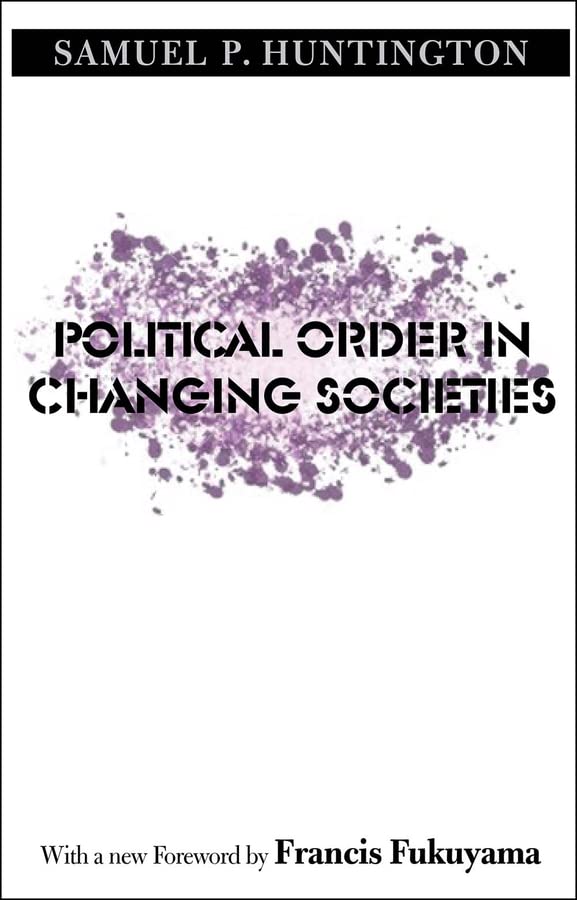
This now-classic examination of the development of viable political institutions in emerging nations is a major and enduring contribution to modern political analysis. In a new Foreword, Francis Fukuyama assesses Huntington’s achievement, examining the context of the book’s original publication as well as its lasting importance.“This pioneering volume, examining as it does the relation between development and stability, is an interesting and exciting addition to the literature.”―American Political Science Review“’Must’ reading for all those interested in comparative politics or in the study of development.”―Dankwart A. Rustow, Journal of International Affairs
User’s Reviews
Editorial Reviews: Review “This pioneering volume, examining as it does the relation between development and stability, is an interesting and exciting addition to the literature.”—American Political Science Review”‘Must’ reading for all those interested in comparative politics or in the study of development.”—Dankwart A. Rustow, Journal of International AffairsNamed one of the significant books of the last 75 years by Francis Fukuyama in Foreign Affairs”This book, which first appeared in 1968, was one of the classics of late twentieth-century social science, a work that had enormous influence on the way people thought about development, both in academia and in the policy world. The breadth of knowledge about developing countries, as well as the analytical insight that Political Order brought to bear, was astonishing, and cemented Samuel Huntington’s reputation as one of the foremost political scientists of his generation.”—Francis Fukuyama, from the Foreword About the Author Samuel P. Huntington, one of America’s most influential political thinkers, is the Albert J. Weatherhead III University Professor at Harvard University and the author of many books including The Clash of Civilizations and the Remaking of World Order and Who Are We?
Reviews from Amazon users which were colected at the time this book was published on the website:
⭐Huntington was certainly a genius!
⭐This book exemplifies the kind to analysis and thinking that has been undermining higher education and U.S. politics since the turn of the 19th/20th century. It is the worship of centralization disguised as unbiased fact-based evaluation.For example, a central position is that the U.S. form of government was antiquated because it was modeled on that practiced by English Tudors. While grossly misrepresenting the political realities of this era and admitting that it was one of the most prosperous and peaceful in British history, Huntington pervasively critiques the the U.S. as antiquated and ineffective. The premise is European-like (and less obviously, Soviet) centralized parliamentarian governments are more “modern” and “effective”, thus to be emulated by the U.S. Since these governments represent “modernization”, the must be emulated by the “antiquated” U.S. The unstated assumption is centralized decision-making – whether practiced by legislators and bureaucrats (i.e. mostly social “science” experts like Huntington)- is superior to the decentralized social, economic, moral, and political judgments of “the invisible hand of wisdom” of millions of common citizens. It is, of course, decision-making by the population upon which the design of U.S. Constitution and its principles of government and law are based, not on control of the nation by government officials and legal/intellectual elites.Centralization of government in the national legislatures and the E.U. and in all three branches in Washington has proven to do nothing but empower an aristocracy of elites trained in social “science” derived fields taking control of the nation’s political economy and citizen’s private property and daily lives. The intellectual elites in professions of the applied social pseudosciences – law, education, communication, psychology, history, etc. The elites share their conjecture and ideologies and collaborate through literature like this book, textbooks, journals, and so forth. They operate and express their intellectual superiority (aka “expertise”) through special interest groups, lobbies, labor unions, loyal corporations, “community” organizations, and other minority factions using the media; and by directly pressuring government officials via activism. Thus intellectuals has effectively replaced the feudal property-based aristocracies of earlier times in the West, but like those aristocrats they live in idealism and are out of touch with reality because they are unable to directly observe the consequences nor suffer severe consequences from their judgements.The Tudor era did not function in the way this book assumes and the founders of the U.S. did not generally base their principles on that period. They instead relied primarily on what their research led them to believe were the best of the experiences of Moses, the Greeks, the Romans, and the early Anglo-Saxons. Finally, there is nothing “modern” about centralized forms of government practiced by the Europeans during the 20th century, regardless of how structured and disguised with confused academic rhetoric. Centralized governments ruled by dictators and tribal councils, as well as by the idealism and Machiavellian methods of people convinced they are superior to, smarter, or more deserving than the general population has existed since humans dwelled in caves or wandered the deserts and savannas in ancient times. It is “progressive” speculative rewriting of history and fictitious analysis based on false or distorted evidence like that presented in this book that have led to the erosion the productivity, prosperity, and security of the United States and West today.This is dangerous book that should be read with mature skepticism and great caution, and not presented to the intellectually naive as grounded in veracious philosophy and reliable knowledge. Unfortunately books like this have lay the foundation for the erroneous idealistic group-think of “expert” specialists that now pervades and substitutes for objective study in Western social science and has taken over control of those country’s governments. Thanks to books like this, the U.S. is now primarily controlled by a centralized government in which decision-making is concentrated in the hands of special interest groups, lobbyist, and specialized “experts” led by intellectuals who substitute their self-interests and judgment on social, economic, political, and cultural matters for that of the general public.
⭐Huntington takes issue with Lipset’s argument regarding modernization, arguing instead taht the process of modernization may lead to instability rather than democracy. Huntington aruges that the process of modernization – urbanization, industrialization, increased literacy, and rising wealth – expands political conscioussness which broadens political participation, thus multiplying political demands. In a state where political institutions are weak, these increased demands can lead to political disorder and instability. In other words, where Lipset argues taht modernization will bring in lower-class, potenitally disillusioned groups into a more coesive state culture, Huntington would argue that this will occur only if institutions are in place to provide a medium of voice for those lower classes.Additionally, Huntington calls for a strong state structure during the modernization process. Modernization destroys traditional authority structures which must be replaced by one central authoritative body. This parallels the Weberian idea that as political freedoms expand in modern society, strong bureaucratic structures for social institutions are imperative.When discussing modernization, Huntington argues that during the process it may be necessary to constrain some human rights in order to ensure political stability. This illustrates that modernization may not lead to total democracy. Donnelly (1984) referred to these human rights versus development conundrums as needs tradeoffs, equality tradeoffs, and liberty tradeoffs. For example, Huntington argues that economic development (modernization) may require that the central authority limit “consumption-oriented” human rights during the economic development process.Huntington also sees the potential of an equality tradeoff. This idea holds that a society in transition to a modern economy will experience high levels of income inequality, but over time, this inequality will recede to a more moderate level. Where Huntington sees the equality tradeoff as temporary, Donelly argues that the problem may be more long lasting.Lastly, Huntington argues that when modernization weakens traditional authority structures, other associational groups may arise, which may lead to political decay, i.e. these groups may rise up in opposition to the central political authority. As such, the civil and political rights of these groups may need to be suspended during the early stages of economic development. Huntington would argue that the long-term interests of modernization must take precedence over the short-term interests of various groups.
⭐This is a preliminary review. I have not finished the book yet.But, this is a classic that should be in the library of every scholar. Huntington’s basic thesis – to which I cannot begin to do justice – is that, contrary to the prevailing consensus among political economists and political scientists holding that economic aid leads inexorably to economic growth that leads inexorably to political stability, in fact countries in the process of economic development tend to have the highest levels of political instability.Huntington avoids ideological bias – in a book written in 1968 – and treats the U.S., U.K. and U.S.S.R. as comparable in terms of political order. [The nature and quality of that order is, of course, another issue. But, quoting de Tocqueville, he says (I’m paraphrasing), “In organized political societies, it is critical that citizens be governed. Ideally, they will be governed by rulers of their choosing, and ideally they will have a significant measure of freedom, but the most important thing is that they be governed.”] The explanation of the relationship between modernization and the tendency to political disorder and conflict is fascinating. This book will make any reader think.This is not an easy read. Huntington is very clear, but there are many concepts and many relationships that affect political order in developing societies. Every minute is worth the effort. [I was astonished at his prescience in discussing the potential impact of the Muslim Brotherhood on stability in Egypt in a book written 46 years ago!]Read this book. It will be personally memorable and influential.
Keywords
Free Download Political Order in Changing Societies (The Henry L. Stimson Lectures Series) in PDF format
Political Order in Changing Societies (The Henry L. Stimson Lectures Series) PDF Free Download
Download Political Order in Changing Societies (The Henry L. Stimson Lectures Series) 2006 PDF Free
Political Order in Changing Societies (The Henry L. Stimson Lectures Series) 2006 PDF Free Download
Download Political Order in Changing Societies (The Henry L. Stimson Lectures Series) PDF
Free Download Ebook Political Order in Changing Societies (The Henry L. Stimson Lectures Series)