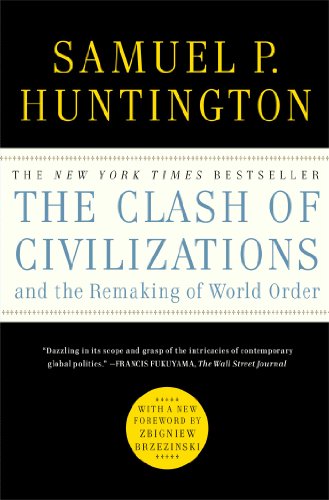
Ebook Info
- Published: 2007
- Number of pages: 370 pages
- Format: PDF
- File Size: 6.74 MB
- Authors: Samuel P. Huntington
Description
The classic study of post-Cold War international relations, more relevant than ever in the post-9/11 world, with a new foreword by Zbigniew Brzezinski.Since its initial publication, The Clash of Civilizations and the Remaking of World Order has become a classic work of international relations and one of the most influential books ever written about foreign affairs. An insightful and powerful analysis of the forces driving global politics, it is as indispensable to our understanding of American foreign policy today as the day it was published. As former National Security Adviser Zbigniew Brzezinski says in his new foreword to the book, it “has earned a place on the shelf of only about a dozen or so truly enduring works that provide the quintessential insights necessary for a broad understanding of world affairs in our time.” Samuel Huntington explains how clashes between civilizations are the greatest threat to world peace but also how an international order based on civilizations is the best safeguard against war. Events since the publication of the book have proved the wisdom of that analysis. The 9/11 attacks and wars in Iraq and Afghanistan have demonstrated the threat of civilizations but have also shown how vital international cross-civilization cooperation is to restoring peace. As ideological distinctions among nations have been replaced by cultural differences, world politics has been reconfigured. Across the globe, new conflicts—and new cooperation—have replaced the old order of the Cold War era. The Clash of Civilizations and the Remaking of World Order explains how the population explosion in Muslim countries and the economic rise of East Asia are changing global politics. These developments challenge Western dominance, promote opposition to supposedly “universal” Western ideals, and intensify intercivilization conflict over such issues as nuclear proliferation, immigration, human rights, and democracy. The Muslim population surge has led to many small wars throughout Eurasia, and the rise of China could lead to a global war of civilizations. Huntington offers a strategy for the West to preserve its unique culture and emphasizes the need for people everywhere to learn to coexist in a complex, multipolar, muliticivilizational world.
User’s Reviews
Reviews from Amazon users which were colected at the time this book was published on the website:
⭐Everything is okay but the paperback in the photo is different.
⭐This is an outstanding, thought provoking work. On reflection it makes a lot of sense! The author takes the position early in the book that cultures do differ. There is no such think as a global culture and the boundary lines between maximally different cultures is where future wars are most likely. Maximally different cultures is what the author means by different civilizations.
⭐Reading this 1996 publication after 9/11/2001, the onset of the War on Terror and the US experiment in “regime change” and “nation building,” one cannot but be amazed at the accuracy of its prognostication and the degree to which its advice was not heeded. The basic thesis of the book is that it is impossible to impose Western political, religious and cultural values on non-Western countries. A most astonishing proof of this thesis is the first Gulf War of 1990, waged by the United States against Iraq. To Western eyes it was an entirely just war, backed up by a coalition of Arab states, which succeeded in stopping Saddam Hussein from invading a weaker sovereign state, Kuwait. But, as Huntington shows, it was roundly condemned by public opinion in the Middle East as an imperialist intervention in domestic affairs, a threatening show of military force and a war of the West against all Arabs and all Muslims. The good war, even altruistic war, backfired. Undertaken to protect the life and property of an Arab state, it provoked fear and hatred in the Arab world and empowered the defeated aggressor, whose prestige gained in neighboring states.On the basis of such examples, Huntington draws the painful conclusion that we (as Westerners) cannot universalize rights and principles that we hold dear and apply them to other peoples, governments and states that do not observe them. To do so, he warns, is false, immoral and dangerous. He asserts toward the close of his book: “Western intervention in the affairs of other civilizations is probably the single most dangerous source of instability and potential global conflict in a multicivilizational world.” He advances an “abstention rule”: that core states of one civilization abstain from intervening in the conflicts of other civilizations. He proposes that a constant seeking for common values, practices and institutions among different peoples, states and civilizations is the key to peace and world order in the realignment of nations taking place after the end of the Cold War.THE CLASH OF CIVILIZATIONS was a bestselling book that was widely discussed and debated throughout America–in the popular media, in the halls of academe and in the chambers of government. Henry Kissinger endorsed it. Zbigniew Brzezinski called it revolutionary. Presumably every reader of FOREIGN AFFAIRS, where Huntington’s initial statement was published, studied the book. This means all the world analysts in the Department of State, the Department of Defense and the Cabinet. It is hard to imagine another publication that had a greater chance of influencing US foreign policy. And yet, as the US prepared to go to war for a second time against Iraq, then went to war and got stuck, every single argument, proof and piece of advice packed into its nearly 400 pages was forgotten or ignored. All that was left was a catch-phrase, “clash of civilizations,” which was denied and almost always misused.Contrary to one of the reviews on this page, there is nothing simplistic about this book. The concepts of “civilization,” “core state” and “fault-line war” are put forward with precise definitions, reasoned exposition and pertinent historical examples buttressed by statistical data and a full scholarly apparatus. Balkan politics are discussed in exacting detail, Chinese and Central Asian politics as well. Islamic militancy is examined with unflinching objectivity. Distinctions are drawn between domestic multiculturalism and foreign universalism which are hairsplitting, but crucial. The writing abounds in classifications and qualifications; often tedious, but often capped with a memorable maxim: “The great beneficiaries of the war of civilizations are those civilizations who abstained from it.”For me, the discussions of post-Soviet Russia and Eastern Europe are most instructive: “People could no longer identify as Communists, Soviet citizens or Yugoslavs, and desperately needed to find new identities. They found them in the old standbys of ethnicity and religion. The repressive but peaceful order of states committed to the proposition that there is no god was replaced by the violence of people committed to different gods.” The presentation of civilizational alignments in the Afghan war of 1979-1989, the Tadzhikistan war of 1992 and the Chechen wars beginning in 1994 provides the background for ongoing conflicts today. The analysis of Sino-Russian politics and prospects brings us right up to the moment.The failure of this book to prevent the very thing it warned against is very troubling and raises questions about the real impact of public discourse today. No doubt it is too much to ask power-mongers to re-read it, but for us mere mortals it is essential. We may not be able to change the world, but we at least want to understand it.
⭐As pundits reference THE CLASH OF CIVILIZATIONS regularly (or at least frequently recycle the phrase “clash of civilizations”), I half-expected the book to be a neocon apologist’s version of why the U.S. must wage war in the Middle East and Central Asia. It is not. Actually, the book provides an incredibly thoughtful and provocative examination of the world we live in today. Huntington writes: “[C]lashes of civilizations are the greatest threat to world peace, and an international order based on civilizations is the surest safeguard against world war” (13). As he clearly states in the preface, it is intended as a paradigm for viewing global politics.Huntington’s thesis is based on his belief that “the most important distinctions among people are not ideological, political, or economic. They are cultural” (21). Thus, the most important and dangerous conflicts will be between people from different cultures (28). Huntington sees the world “divided between a Western one and non-Western many” (36). He states that “[c]ulture is the common theme in virtually every civilization,” and that the most important element which defines culture is religion (42). At this point, one might assume that Huntington is setting the reader up for justification as to why the U.S. must go to war with ________ (insert Muslim country here). He is not.Some concepts that Huntington elaborates upon are that of ‘fault lines’ and ‘core states,’ as well as ‘indigenization,’ which would be defined as the reassertion of indigenous cultures and beliefs. Indigenization serves to explain why many countries in the world are not on the same page as that of the U.S. And his idea of core states is especially significant. To simplify, basically each civilization has a core state. For example, in the West it is (and must remain) the U.S. In East Asia, it is China. But in the Muslim civilization, there is no core state, and this, according to Huntington, helps explain why there is so much conflict and unrest in this part of the world. Incredibly, this book very much holds up after 9/11, and I’d say that recent history could serve to validate much of Huntington’s thesis thus far. This is not to say that I agree with everything he espouses. For example, I think he unfairly paints the Muslim world with a broad stroke, and I would argue that many people in the Muslim civilization are actually motivated by reasons that are political and economic (not religious), yet his argument merits serious contemplation. Huntington also focuses significantly on China/Sinic civilization, Russian/Orthodox civilization, as well as examines the Bosnian War as a case study in fault line wars.Huntington makes two points that especially stood out to me. One is addressing the issue of weapons proliferation. Huntington writes, “The hold-down efforts of the West may slow the weapons build up of other societies, but they will not stop it” (190). He explains this in further detail, but I can’t help think of the U.S.’s position on Iran and those who advocate another pre-emptive attack. Secondly, in his conclusion, Huntington encourages that civilizations focus on what they have in common in order to get along peacefully. This makes perfect sense to me, and I wish we would hear this more often. He writes: “[T]he world’s major religions – Western Christianity, Orthodoxy, Hinduism, Buddhism, Islam, Confucianism, Taoism, Judaism – also share key values in common. If humans are ever to develop a universal civilization, it will emerge gradually through the exploration and expansion of these commonalities” (320).Reading this book is well worth your time. I recommend it.
⭐In this ground-breaking and controversial book, Huntington considers civilisations as being more than just cultures. He emphasises religion as a key player even though the West is rapidly divesting itself of its Judeo-Christian roots. The new world order, following the last world war and the cold war, has been shaped by liberal ideologies and politics, where the secularisation of the West is its dominant instrument. Whereas these liberal peace stances have seemingly reduced tensions and conflict, they are facing two civilisations that challenge the concept that all conflict can be resolved through peaceful means. One is the intolerance of the Islamic world, the other the assertive/aggressive stance of the Chinese as they march towards supplanting the USA as the world’s leading superpower.This book pulls no punches and has been widely condemned amongst left-wing ideologues. Nevertheless, it details a world where democracy is under scrutiny and totalitarianism gets a free pass. In minimising the existential threat to the West of two civilisations that seek to dominate, are Tolerance, Multiculturalism, Equality and concerns about Human Rights, all that the West has to offer in what amounts to a fundamental clash of civilisations? Are we facing the end of democracy as appeasement gains ground?
⭐The Cold War was bookended by two articles: “The Sources of Soviet Conduct” (based on the
⭐”Long Telegram”
⭐) in 1947 and the “Clash of Civilisations” in 1993. Both articles were published in the journal Foreign Affairs.In 1996 Samuel P. Huntingdon expanded his article into this book. Sixteen years later how has this book aged? ”
⭐The End of History
⭐” may not have happened, but the “Clash of Civilisations” still seems relevant.”The Clash of Civilisations” is not an idée fixe. The author proposes his model as a useful tool to replace the previous bi-polar one used during the Cold War. He is careful to present it as a working model that should be applied with all the caveats that present themselves in a real, complex world. In 1996 he defined his civilisations as these broad cultural entities: Western, Latin American, (sub-Saharan, non-Islamic) African, Islamic, Sinic (Chinese), Hindu, Orthodox (mainly Russian), Buddhist and Japanese.In 1995 the author stated that the clashes of the future “. . . are likely to arise from the interaction of Western arrogance, Islamic intolerance and Sinic assertiveness”. Modernism, he said, is universal, but modernism is not the same as Westernism. The West was a civilisation before it became modern and the same process is happening with other civilisations. Islam can modernise but it does not have to Westernise. The author thought that the future is a world which is more modern, but less Western. Many will disagree, but many will disagree because they think that modernism and Westernism are the same. That they are not the same is the author’s point.Today, Russia is only superficially western and the Han Chinese Empire has continued to rise; Hindustan has kept a low profile. The American Empire has overreached itself and continues to project power, but on borrowed money. Dominating all this is the economic implosion of the western financial system, the clash with Islam and the clash within Islam. The multi-polar, multi-civilisation world continues.
⭐This is one of those books that everyone who thinks and cares about the future should read. You probably won’t agree with everything in it, but Huntington’s thesis is powerful and, I fear, has a lot of truth in it. I don’t think this means that ‘one world’ liberals should give up, but it does show that the route to a future peaceful world will be a difficult one. (But what a grand challenge for bright, well-meaning people in the next generation!)To me, the most interesting point is the continuing role of religions in defining supranational boundaries. Rather than getting fanatical at spreading our own faith, or going down the Dawkins route of rubbishing all religion, we need to get used to this basic fact.It’s a shame this wasn’t on the bookshelves in the White House and Downing Street in 2003.
⭐Very well written but heavy reading
⭐Huntington seems prophetic, writing from his vantage in the 90s.Korea hasn’t yet unified, but played the 2018 Olympic Games under a unified banner. Australia never became an Asian country. The West is increasingly at odds with Islam and China.He expressed concern that Islamic immigration would make Europe a “torn country”, and this is even more relavant now. Multiculturalism in the USA is increasingly shrill and divisive. Anxiety about Western decline are ever more present with the election of Trump.He is insightful to point out the link between feel-good western universalism and feel-bad western imperialism.Western values are not universal: they are unique. This book can be read as a call to defense of the West from undermining forces both within and without the civilization. To liberals, the West is our only home. Let’s preserve it.
Keywords
Free Download The Clash of Civilizations and the Remaking of World Order in PDF format
The Clash of Civilizations and the Remaking of World Order PDF Free Download
Download The Clash of Civilizations and the Remaking of World Order 2007 PDF Free
The Clash of Civilizations and the Remaking of World Order 2007 PDF Free Download
Download The Clash of Civilizations and the Remaking of World Order PDF
Free Download Ebook The Clash of Civilizations and the Remaking of World Order