

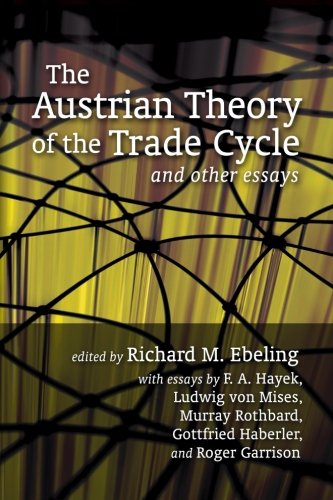
Ebook Info
- Published: 2014
- Number of pages: 128 pages
- Format: PDF
- File Size: 0.20 MB
- Authors: Ludwig von Mises
Description
New edition with an introduction by Roger Garrison and an index. Booms and busts are not endemic to the free market, argues the Austrian theory of the business cycle, but come about through manipulation of money and credit by central banks. In this monograph, Austrian giants explain and defend the theory against alternatives. Includes essays by Mises, Rothbard, Haberler, and Hayek. In his later years, Professor Haberler distributed many of these monographs to friends and associates.
User’s Reviews
Reviews from Amazon users which were colected at the time this book was published on the website:
⭐The Mises essay can be read in 15 mins and he summarizes what you read in “Theory of Money & Credit” perfectly. What a sage.I haven’t read the Hayek one yet and don’t even know who this Harberler character is. But instead of quoting the Mises paper I’ll quote his biggest #1 fan of all time (you can get this book for free off mises dot org, just google it.p. 86, halfway into Rothbard’s usual rant”Mises, then, pinpoints the blame for the cycle on inflationary bank credit expansion propelled by the intervention of government and its central bank. What does Mises says should be done, say by government, once the depression arrives? What is the governmental role in the cure of depression? In the first place, government must cease inflating as soon as possible. It is true that this will, inevitably, bring the inflationary boom abruptly to an end, and commence the inevitable recession or depression. But the longer the government waits for this, the worse the necessary readjustments will have to be. The sooner the depression-readjustment is gotten over with, the better. This means, also, that the government must never try to prop up unsound business situations; it must never bail out or lend money to business firms in trouble. Doing this will simply prolong the agony and convert a sharp and quick depression phase into a lingering and chronic disease. The government must never try to prop up wage rates or prices of producers’ goods; doing so will prolong and delay indefinitely the completion of the depression-adjustment process; it will cause indefinite and prolonged depression and mass unemployment in the vital capital goods industries. The government must not try to inflate again, in order to get out of the depression. For even if this reinflation succeeds, it will only sow greater trouble later on. The government must do nothing to encourage consumption, and it must not increase its own expenditures,for this will further increase the social consumption/investment ratio. In fact, cutting the government budget will improve the ratio. What the economy needs is not more consumption spending but more saving, in order to validate some of the excessive investments of the boom.Thus, what the government should do, according to the Misesian analysis of the depression, is absolutely nothing.
⭐What makes the Austrian economics school different to others? While their are numerous schools of thought which state government spending means more taxes from you, and less disposable income; unless the government is hiring you, the Austrians point out that any intervention from the government can destablise the economy. Included to this is their theory on fiat money. If their is another school of thought that agrees it would be the Rational Expectations Theory.The way the Austrians look at things is that their is a consumption driven part of the economy, and their is a capital goods side of the economy, and both employ people. If their are say 10,000 businesses in a city, and every year 1,000 of those buys new capital equipment (tools, machinery equipment), then those parts of the economy that develop capital goods will be able to consistently employ the same amount of people. But if the central bank creates money out of nothing and lends it at an interest rate of 2% lower than the market rate, what will happen is in one particular year, 3,000 businesses will invest in capital for that year, not because they need new capital, but because capital is effectively at a good price (the interest rate is part of the price). And this means that in one particular year demand for capital goods is higher than normal, but then the next 2 years those businesses that would have invested in new capital goods don’t, because 2,000 businesses have bought their capital goods in advance.This means that in one year those that make capital goods are needed, but then in the next couple of years some of them aren’t. So in one year those employed in making capital goods are making money, and able to spend, in the next two years, they aren’t hired. So the essence of Austrian monetary theory is if you have a stable demand for capital goods, you have a stable economy, but if you allow a central bank to manipulate this you won’t have a stable economy. So that’s what the focus of this book was on. One of the authors ‘Gottfried Haberler’ offered a bit of a twist, yes he agreed that a central bank’s monetary policy does create instability, however if their is a new technological breakthrough this can also affect the sudden surge in demand of capital goods. You’ll also be challenged, they believe that when their is a recession, the economy is healing from the years of overexpansion, this is the total opposite of keynesianism and even some other schools of thought. While we’re on the topic monetarism says the government should do nothing except allow a small increase in money to struggling families provided its kept small. I can see monetarism as not exactly the same but in many ways compatible. Instead of bailing out banks, businesses like Keynesians would recommend, it would simply give to those at the bottom, and it would otherwise be hands off; at least that was how monetarism originally started.But make no mistake Austrians believe that gold and silver are the only reliable form of money. Whereas monetarism says a stable growth of 4% can also work.
⭐This is a very insightful collection of essays from many of the leading “Austrian School” trade economists. They run from essays in the 30s aimed at countering the wave of post-depression social planning to essays in the 70s arguing against Keynesian economics. The key economic insight across the essays is the temportal nature of the Austrian view of business cycles. An artificially low interest rate (mandated by banks or the central government) increases investment in primary goods. Before the capacity can be deployed, there’s an increase in wages, which causes inflation in end products. The only end is a return to sounder money (the gold standard) and a cut back of the credit. The reader could easily extrapolate the market conditions described in the book to the current situation. As for the solution – it hasn’t been tried, and unlike the symptoms of the problem (which have had empirical support), nobody knows if a switch to the gold standard will really solve the problem. Either way, the economics described are thought provoking, and worth a look. It is also timely given Ron Paul’s support of these policies.This recommendation does come with a few caveats… Know what you’re getting into. This isn’t a “Cover all” for Austrian theory. It’s a series of essays, none of which can get into tremendous detail. That said, it’s very deep. Even for the initiated, much of the book requires multiple reading to critically understand what’s going on. Lastly, like most Austrian works, it is heavier on analysis than empirical data.In all, it is worth the read to help the reader understand an important view of business cycles.
⭐Gosto bastante de economia austríaca, acredito que é a linha econômica mais correta e até então menos conhecida, recomendo muito.Boa visão geral sobre a escola austríaca da economia. Trata se de diferentes textos dos principais representantes da escola que já foram publicados. Seria interessante comparar a aplicação teórica em relação a situação atual de quantitative easing e inflação relativamente estável.Es un librito, menos de 80 páginas, con cuatro o cinco breves artículos de autores de primer nivel: Mises, Hayeck.. Destacar que es un libro reimpreso en Polonia por Amazon (viene indicado en la última página): debe ser una impresión escaneada del original; pero no se lee mal.Dieses Buch ist für jeden, der sich für die Ursachen der Finanz- und Wirtschaftskrise interessiert äußerst empfehlenswert. Es betrachtet die Ursachen der Krise aus einem ganz anderen Blickwinkel und löst sich so von der allgemein vertretenen Erklärungen und Handlungsempfehlungen. Es handelt sich um eine Theorie, die schon sehr lange existiert, jedoch noch immer nicht vollständig berücksichtigt wird.
⭐
Keywords
Free Download The Austrian Theory of the Trade Cycle and Other Essays in PDF format
The Austrian Theory of the Trade Cycle and Other Essays PDF Free Download
Download The Austrian Theory of the Trade Cycle and Other Essays 2014 PDF Free
The Austrian Theory of the Trade Cycle and Other Essays 2014 PDF Free Download
Download The Austrian Theory of the Trade Cycle and Other Essays PDF
Free Download Ebook The Austrian Theory of the Trade Cycle and Other Essays