Ebook Info
- Published: 2013
- Number of pages: 328 pages
- Format: PDF
- File Size: 3.34 MB
- Authors: Peter Temin
Description
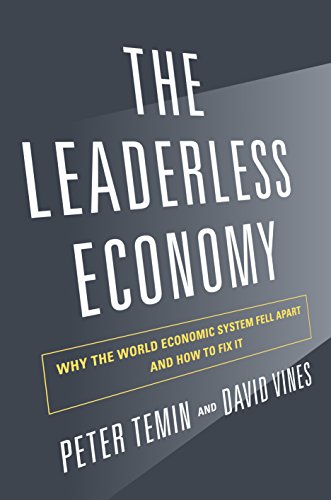
A new way to understand financial crises―and a blueprint for tomorrow’s recoveryThe Leaderless Economy reveals why international financial cooperation is the only solution to today’s global economic crisis. In this timely and important book, Peter Temin and David Vines argue that our current predicament is a catastrophe rivaled only by the Great Depression. Taking an in-depth look at the history of both, they explain what went wrong and why, and demonstrate why international leadership is needed to restore prosperity and prevent future crises.Temin and Vines argue that the financial collapse of the 1930s was an “end-of-regime crisis” in which the economic leader of the nineteenth century, Great Britain, found itself unable to stem international panic as countries abandoned the gold standard. They trace how John Maynard Keynes struggled for years to identify the causes of the Great Depression, and draw valuable lessons from his intellectual journey. Today we are in the midst of a similar crisis, one in which the regime that led the world economy in the twentieth century―that of the United States―is ending. Temin and Vines show how America emerged from World War II as an economic and military powerhouse, but how deregulation and a lax attitude toward international monetary flows left the nation incapable of reining in an overleveraged financial sector and powerless to contain the 2008 financial panic. Fixed exchange rates in Europe and Asia have exacerbated the problem.The Leaderless Economy provides a blueprint for how renewed international leadership can bring today’s industrial nations back into financial balance–domestically and between each other.
User’s Reviews
Editorial Reviews: Review “One of Choice’s Outstanding Academic Titles for 2013″”[T]emin and Vines’s measured analysis will reward serious readers and economists who can keep up with global theory in motion.” ― Publishers Weekly”A rigorous analysis of the collapse of the world economy in 2008–and why things don’t seem to be getting better. . . . [S]obering.” ― Kirkus Reviews”[The Leaderless Economy] presents sensible arguments in favour of a rebalanced world economic system.”—Tony Barber, Financial Times”In The Leaderless Economy, Temin and Vines demonstrate that Keynes’ economic theories remain robust and relevant. . . . [T]heir book provides a clear and compelling analysis of the roots of our global financial crisis and the lessons we can learn from it.”—Glenn C. Altschuler, Huffington Post”You can learn a lot by reading [The Leaderless Economy]. . . . The authors are commendably alert throughout to the economic and political complexities involved.”—Daniel Akst, Bloomberg News”Temin and Vines . . . offer a thoughtful exploration of the situation of the world financial system through detailed analysis and comparisons of the recent international economic crisis with circumstances during the Great Depression. . . . The book is a great resource for those interested in international economics and history. A must read for upper-division undergraduate students, business leaders, and future policy makers, and a pleasure for graduate students, faculty, and general readers.” ― Choice”In this timely and important book, Peter Temin and David Vines argue that our current predicament is a catastrophe rivaled only by the Great Depression. Taking an in-depth look at the history of both, they explain what went wrong and why, and demonstrate why international leadership is needed to restore prosperity and prevent future crises.” ― World Book Industry”A compact book, brimming with insight, which will prove useful to economists, political scientists, investors and, above all, policy-makers.”—Michael Pettis, Economic Record Review “Looking back, we know now that the Great Depression and the breakdown of the Bretton Woods system were turning points in modern economic history. Temin and Vines make a compelling case that we are now at another such juncture. Policymakers have signally failed to come to grips with the depth of this crisis―they would be well advised to read this book.”―Jonathan Portes, Director of the National Institute of Economic and Social Research, London”The global economy is deeply troubled, and the United States faces no more pressing task than to fix it. Temin and Vines recount in rich detail the history of the modern world economy and the currents of economic thought that attempted to explain it, providing a fascinating explanation of the roots of today’s crisis and the way forward.”―Jeffry A. Frieden, coauthor of Lost Decades: The Making of America’s Debt Crisis and the Long Recovery”In this thoughtful and cogently argued book, Temin and Vines enlist the history of the Great Depression to provide a powerful set of dos and don’ts for the current financial crisis. The interesting question they pose is why today’s policymakers, to a remarkable and alarming extent, have embraced the don’ts.”―Barry Eichengreen, author of Exorbitant Privilege: The Rise and Fall of the Dollar and the Future of the International Monetary System”For the world economy to truly return to health, advanced nations must cut domestic spending and make it up through higher exports, while emerging economies must do the reverse. Fiscal policies, interest rates, and exchange rates must adjust. Can it happen? Will it happen? Temin and Vines say it can, but only through international cooperation. Otherwise, history tells us, there are good reasons to worry. A great read.”―Olivier Blanchard, International Monetary Fund”This work dissects the global and euro area crises with refreshing clarity. It also sheds new light on Keynes’s intellectual struggle to diagnose correctly the related events of the 1930s. The warning is clear: policymakers today need a clearer vision of how to deal with the domestic and international stress affecting their economies. Otherwise, they risk repeating the experience of the Great Depression rather than learning from it. Temin and Vines have done economists and the general public a huge service.”―Max Watson, University of Oxford”The Leaderless Economy focuses a historical lens on our current economic problems. While there have been many superficial analogies between the Great Depression and today, this illuminating book offers a more detailed, international economic look at those parallels.”―Douglas A. Irwin, author of Peddling Protectionism: Smoot-Hawley and the Great Depression From the Inside Flap “Looking back, we know now that the Great Depression and the breakdown of the Bretton Woods system were turning points in modern economic history. Temin and Vines make a compelling case that we are now at another such juncture. Policymakers have signally failed to come to grips with the depth of this crisis–they would be well advised to read this book.”–Jonathan Portes, Director of the National Institute of Economic and Social Research, London”The global economy is deeply troubled, and the United States faces no more pressing task than to fix it. Temin and Vines recount in rich detail the history of the modern world economy and the currents of economic thought that attempted to explain it, providing a fascinating explanation of the roots of today’s crisis and the way forward.”–Jeffry A. Frieden, coauthor ofLost Decades: The Making of America’s Debt Crisis and the Long Recovery”In this thoughtful and cogently argued book, Temin and Vines enlist the history of the Great Depression to provide a powerful set of dos and don’ts for the current financial crisis. The interesting question they pose is why today’s policymakers, to a remarkable and alarming extent, have embraced the don’ts.”–Barry Eichengreen, author ofExorbitant Privilege: The Rise and Fall of the Dollar and the Future of the International Monetary System”For the world economy to truly return to health, advanced nations must cut domestic spending and make it up through higher exports, while emerging economies must do the reverse. Fiscal policies, interest rates, and exchange rates must adjust. Can it happen? Will it happen? Temin and Vines say it can, but only through international cooperation. Otherwise, history tells us, there are good reasons to worry. A great read.”–Olivier Blanchard, International Monetary Fund”This work dissects the global and euro area crises with refreshing clarity. It also sheds new light on Keynes’s intellectual struggle to diagnose correctly the related events of the 1930s. The warning is clear: policymakers today need a clearer vision of how to deal with the domestic and international stress affecting their economies. Otherwise, they risk repeating the experience of the Great Depression rather than learning from it. Temin and Vines have done economists and the general public a huge service.”–Max Watson, University of Oxford”The Leaderless Economy focuses a historical lens on our current economic problems. While there have been many superficial analogies between the Great Depression and today, this illuminating book offers a more detailed, international economic look at those parallels.”–Douglas A. Irwin, author of Peddling Protectionism: Smoot-Hawley and the Great Depression From the Back Cover “Looking back, we know now that the Great Depression and the breakdown of the Bretton Woods system were turning points in modern economic history. Temin and Vines make a compelling case that we are now at another such juncture. Policymakers have signally failed to come to grips with the depth of this crisis–they would be well advised to read this book.”–Jonathan Portes, Director of the National Institute of Economic and Social Research, London”The global economy is deeply troubled, and the United States faces no more pressing task than to fix it. Temin and Vines recount in rich detail the history of the modern world economy and the currents of economic thought that attempted to explain it, providing a fascinating explanation of the roots of today’s crisis and the way forward.”–Jeffry A. Frieden, coauthor of Lost Decades: The Making of America’s Debt Crisis and the Long Recovery”In this thoughtful and cogently argued book, Temin and Vines enlist the history of the Great Depression to provide a powerful set of dos and don’ts for the current financial crisis. The interesting question they pose is why today’s policymakers, to a remarkable and alarming extent, have embraced the don’ts.”–Barry Eichengreen, author of Exorbitant Privilege: The Rise and Fall of the Dollar and the Future of the International Monetary System”For the world economy to truly return to health, advanced nations must cut domestic spending and make it up through higher exports, while emerging economies must do the reverse. Fiscal policies, interest rates, and exchange rates must adjust. Can it happen? Will it happen? Temin and Vines say it can, but only through international cooperation. Otherwise, history tells us, there are good reasons to worry. A great read.”–Olivier Blanchard, International Monetary Fund”This work dissects the global and euro area crises with refreshing clarity. It also sheds new light on Keynes’s intellectual struggle to diagnose correctly the related events of the 1930s. The warning is clear: policymakers today need a clearer vision of how to deal with the domestic and international stress affecting their economies. Otherwise, they risk repeating the experience of the Great Depression rather than learning from it. Temin and Vines have done economists and the general public a huge service.”–Max Watson, University of Oxford”The Leaderless Economy focuses a historical lens on our current economic problems. While there have been many superficial analogies between the Great Depression and today, this illuminating book offers a more detailed, international economic look at those parallels.”–Douglas A. Irwin, author of Peddling Protectionism: Smoot-Hawley and the Great Depression About the Author Peter Temin is the Elisha Gray II Professor Emeritus of Economics at the Massachusetts Institute of Technology. His books include Prometheus Shackled, The Roman Market Economy (Princeton), and The World Economy between the World Wars. David Vines is Professor of Economics and a Fellow of Balliol College, University of Oxford. His books include The IMF and Its Critics and The Asian Financial Crisis. Read more
Reviews from Amazon users which were colected at the time this book was published on the website:
⭐Peter Temin and David Vines plead for more vigorous cooperation to overcome the impasse in which the underperforming global economy is stuck. Global demand is not large enough for global supply.Messrs. Temin and Vines observe that the global financial crisis of 2007-2009 has bereft the United States of its hegemonic power to maintain and, when needed, to restore the prosperity of the international economy. The authors remind their readers that the world economy sunk into the Great Depression in the 1930s due to the loss of British hegemonic power after WWI and the unwillingness of the United States, the new hegemon, to take over from Britain. No country like the United States, Germany, or China is currently able and willing to steer the needed global rebalancing without jeopardizing the tenuous global recovery. Furthermore, the G-20 Mutual Assessment Process (MAP) has failed to move the needle significantly due to the lack of a hegemonic power.The global economy has been out of balance for decades. The severe lack of global balance in the exchanges within and between the United States, the European Union, and East Asia reflects the Prisoner’s Dilemma. Each participant makes the best of the underperforming global economy without considering what might be accomplished through meaningful cooperation that is sustained over time. The aim of the badly needed global rebalancing is to ensure 1) external balance, i.e., exports being sufficient to pay for imports, and 2) internal balance requiring both full employment and stable inflation.Messrs. Temin and Vines clearly explain what is at the heart of this lack of global balance:1. Fiscal consolidation needed to achieve internal balance is happening too fast. More and more countries are under financial and political pressure to decrease expenditures and / or to increase taxes. Many countries feel that they have to comply with this required fiscal consolidation to avoid interest rate hikes that would undermine their recovery. Furthermore, many countries pursue export-led growth through competitive exchange rates to compensate for the lack of sufficient domestic demand.2. Achieving external balance requires both an increase in domestic consumption in the surplus countries such as China and Germany and an increase in their domestic costs relative to those abroad. The lack of liberalization of prices for labor, capital, land, and / or resources represents implicit subsidies for producers, investors, and exporters. Furthermore, East Asia, and in particular China, compounds the difficulty of rebalancing the global economy through the maintenance of an undervalued exchange rate. This lack of external balance pushes the United States and the European Union to experiment with quantitative easing that at best redistributes wealth; at worst may temper its creation.Taking on the vested interests that are locked into investments that support manufacturing production designed for export will require politicians in the surplus countries to show much courage. Their populations will be grateful if they do. They have not reaped enough the fruits of economic growth.Politicians from the different economic blocks could find inspiration in the Plaza Accord of 1985 to come up with a binding timetable for achieving a better mutual external balance. This recalibrated external balance will require 1) changes to their exchanges rates among themselves and 2) increases in domestic demand and costs in the surplus countries. Subsequently, each economic block, especially the European Union, will have to negotiate internally to come up with more balanced exchanges among block members. Otherwise, Messrs. Temin and Vines warn that the lack of cooperative outcome could degenerate into a sustained period of recession.In summary, the authors convincingly show that the world faces a choice: either the private sector can grow fast enough to compensate for the ongoing fiscal tightening or the policies pursued by the different economic blocks (and their members) will lead to an outcome that does not rebalance the world economy but instead leads to stagnation.
⭐Excellent theoretical economic discussions of the historical background leading up to the seemingly impossible new economic dilemma that the world faces today – especially most of the leading advanced economies of the world have been using up the traditional tool to combat the stagnant economy by keeping the interest rates at near zero.This book offers good explanations of why we face current economic difficulties among all major countries in the world, and at least in theoretical bases, the book offers what can be done to solve this problem.This is an excellent text book of economic history and analysis of current world situation, but it is written in a style that is not always easy to read by an average American reader like myself; thus the rating I gave.
⭐China manipulation. German dogma. US self destruction and abdication of world system leadership.A great marrying of economic history and economic theory.Only quibble is Hume’s price-species follow mechanism is of limited importance when holding foreign currency denominated securities dominates reserve accumulation. Also capital account can be the driver as portfolio shifts dominate trade flows. Stocks of assets are large in relation to flows of trade.
⭐This book summarize the actual economic and financial situation in the world with precision …. but you should have an economic background .
⭐Nice read. The analysis is lucid and clear although sometimes it could me more precise. A call for global leadership to avoid the drone war.
⭐The largely French idea that a European Community should be formed after WWII was a political brainstorm. Monnet (France) and Spaak (Belgium) were bureaucrats who introduced their proposal, believing that control over coal and steel production would prevent rearmament and control key industries, especially in Germany. The ECSC comprised ‘the Six’ original EEC economies. The EU evolved from these six countries, but early success encouraged them to accept any European country, regardless of suitability and without economic assessment. This bred with political support, but economic differences bredserious problems, because of strength disparities. Members built up huge debts and formed a political nightmare in Brussels thathas believed its own propaganda, until now it faces breakdown.The solution to the disparities between the three main economic blocs is presented in this volume.
Keywords
Free Download The Leaderless Economy: Why the World Economic System Fell Apart and How to Fix It in PDF format
The Leaderless Economy: Why the World Economic System Fell Apart and How to Fix It PDF Free Download
Download The Leaderless Economy: Why the World Economic System Fell Apart and How to Fix It 2013 PDF Free
The Leaderless Economy: Why the World Economic System Fell Apart and How to Fix It 2013 PDF Free Download
Download The Leaderless Economy: Why the World Economic System Fell Apart and How to Fix It PDF
Free Download Ebook The Leaderless Economy: Why the World Economic System Fell Apart and How to Fix It