

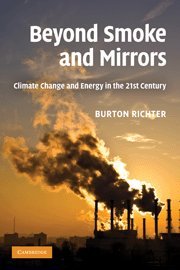
Ebook Info
- Published: 2010
- Number of pages: 242 pages
- Format: PDF
- File Size: 2.08 MB
- Authors: Burton Richter
Description
Global climate change is one of the most important issues humanity faces today. This book assesses the sensible, senseless and biased proposals for averting the potentially disastrous consequences of global warming, allowing the reader to draw their own conclusions on switching to more sustainable energy provision. Burton Richter is a Nobel Prize-winning scientist who has served on many US and international review committees on climate change and energy issues. He provides a concise overview of our knowledge and uncertainties within climate change science, discusses current energy demand and supply patterns, and the energy options available to cut emissions of greenhouse gases. Written in non-technical language, this book presents a balanced view of options for moving from our heavy reliance on fossil fuels into a much more sustainable energy system, and is accessible to a wide range of readers without scientific backgrounds – students, policymakers, and the concerned citizen. Burton Richter on the Leonard Lopate Show – Listen to the Podcast: Burton Richter talks about the book and the issues: To view Part 2 of Burton Richter’s interview, click here to visit the book’s supplementary web site. About the Author Dr. Burton Richter was awarded the Nobel Prize in 1976. He is a recipient of the E.O. Lawrence Medal from the U.S. Department of Energy, member of the National Academy of Sciences, past President of both the American Physical Society and the International Union of Pure and Applied Physics, and has served on many U.S. and international review committees on climate change and energy issues. Past Loeb Lecturer at Harvard and Astor Lecturer at Oxford, Dr. Richter now serves on the board of directors for Scientists and Engineers for America, and continues his energy work at Stanford University.
User’s Reviews
Editorial Reviews: Review “The climate naysayers will surely challenge Burton Richter: What makes a mere physics professor an expert on climate change, even if he holds a Nobel Prize for finding some exotic particle inside the atom? The answer: The Stanford professor has been researching issues of energy and climate since 1978 as a member of Jason, an independent group of scientists who advise the government on major policy questions, and he is increasingly concerned that controversies over climate change and energy have become ominously political, and the debates are flaring beyond reason. Richter’s book is the clearest guide yet to the facts and issues of climate and energy – without smoke or mirrors. Richter has no special interest, and his book’s survey of all the evidence for climate change and all the available energy sources is a model of rational discourse in this time of inflammatory arguments.” -SF Chronicle”Global warming and a host of energy problems are in the news every day. In this new book, Nobel Laureate Burt Richter offers a smart and careful survey of the problem and a dose of sobriety on real solutions. Rare in the field, the book is both well-informed yet accessible and written in elegant prose. The core of the study is a series of short yet far-ranging chapters on all the world’s major energy sources and their opportunities for improvement. Richter’s masterful study is stuffed full of optimism about solving the global warming problem, but it is also realistic about the scale of the effort that will be needed. And he warns that today, governments are falling far short in devising the required policies.” – David G. Victor, Professor of International Relations, University of California, San Diego”Burt Richter has packed a remarkable amount of two very important and rare commodities in a short compass: reliable information on energy and climate change and (even rarer) good judgment. He has done all this with a light touch and engaging style which will draw the intelligent reader’s sustained interest. The reader will be able to improve greatly the level of the important debates on policy in these fields.” – Kenneth J. Arrow, Joan Kenney Professor of Economics, Emeritus and Professor of Operations Research, Emeritus, Stanford University”A brilliant display of ideas and information about energy and climate change: readable, educational, constructive. A wonderful book that sets out with clarity the issues and challenges. I enjoyed this book and I’m sure it will have a wide readership.” – George P. Shultz, former Secretary of State (Reagan administration); Distinguished Fellow, Stanford University”Finally, citizens and policymakers have a comprehensive and comprehensible guide to global warming and what might be done about it. Written by a Nobel prize-winning physicist with no interest other than making the world habitable for his great-grandchildren, this eminently readable book covers the gamut of issues from basic climate science and economics to the policies and technologies necessary to mitigate global warming.” – Paul Brest, President, William and Flora Hewlett Foundation”The facts about climate change and the responses to it are the subject of substantial confusion among the public. Burton Richter, a Nobel Laureate in physics, has written a cogent analysis of what is known – and not known – about climate change and about the components of the energy system that contribute to climate change or that are offered as a means to mitigate it. Beyond Smoke and Mirrors: A Citizen’s Guide to Climate Change and Energy brings sophisticated insights and common sense to the issues, but is fully accessible to the public. This book should be required reading for anyone who seeks to understand one of the most significant global challenges that confronts humankind.” – Richard A. Meserve, President of the Carnegie Institution for Science and Former Chairman, U.S. Nuclear Regulatory Commission”I enjoyed the book and the lively personal way Richter writes. Readers, once they start, will want to read the book right through to the end. I did. The chapters on energy were wonderful and made me hope that the book will be widely read.” – James Lovelock, originator of the Gaia Theory, Green Templeton College, University of Oxford”This new book is another important contribution to the semitechnical literature on the human components of climate change: what they are, what expected impacts they will have over the next decades, and what can be done to mitigate the effects. … In summary, this is an admirably succinct book which effectively presents the key aspects of climate change, human energy use, and the options of changing the latter to help mitigate the effects of the former. It will be a valuable read for anyone concerned about these issues–highly recommended.” – William R. Green, The Leading Edge”‘Please point me to a short overview of energy and climate, with numbers but not equations, and with a no-nonsense view of the politics.’ This request has been put to me in one version or another dozens of times. At last, I am comfortable with my answer: Read Beyond Smoke and Mirrors. It is an unpretentious yet deeply insightful book by Burton Richter, a physicist at Stanford and Nobel Laureate. … Smoke and mirrors are the tools of deception, and by contrast Richter is promising to talk straight. With his title, Richter is acknowledging that a large proportion of the energy literature available to the layman is promotional–a sales pitch for this, a sales pitch for that. He is asking us to trust him, and we do. For example, he tells us that he is “a biofuels skeptic,” and he takes ten pages to explain why, stressing impacts on food supply, net-carbon issues, and the thus far unrealized claims from the research community. Such candor is rare and refreshing.” – Robert H. Socolow, American Journal of Physics”…a wonderfully balanced overview. It opens with a fine summary of the science linking carbon to climate … provides a concise primer on the economics of long-term climate policy, and concludes with a short, sensible, and well-argued set of opinions and policy recommendations.” – Physics Today”It is rare that a scientist with the credentials of the author, Burton Richter, 1976 Nobel Laureate in Physics, attempts to communicate to society in a way that makes such an intimidating and contentious topic as climate change and the complexity of the associated energy issues that must be tackled seem easy to understand. This is a brilliant book written in a very informal way yet packed with easily understood information. Richter’s judgment is superb in assessing the role that the various possible solutions may play in averting a global warming catastrophe. His long experience as an energy advisor to US governments shows clearly in this discussion. He manages to communicate calmly but objectively the urgency of tackling the issues under discussion. … Richter has been extremely successful in presenting the big picture about the implications of climate change and how the rise in global mean temperature can be minimized. … It should be on the reading list for 2011 of all concerned citizens. Physicists should read this book because it is a template for how they should proselytize about science to the general public. As Richter observes “I have learned one thing: politics – particularly international politics – is much harder than physics”. This reviewer can only add that the effort to communicate to the political system is well worth the effort.” – Harvey A. Buckmaster, Canadian Association of Physicists”…the author adequately outlined the past, current and future effects on greenhouse gas emissions without requiring the reader to have any preconceived notions of the topic. I would recommend anyone with an interest in climate change to read this book with complete understanding toward those with a background in high school level general science.” CMOS Bulletin”As a compendium of vital energy information, clear facts on climate change and insights into how political decisions about energy are made in the U.S. and the world, Richter’s book is an invaluable resource. EnviroLine” EnviroLine Book Description Nobel Prize-winning scientist’s assessment of options for switching to sustainable energy provision to avert potentially disastrous consequences of climate change. About the Author Burton Richter is Paul Pigott Professor in the Physical Sciences, Emeritus and Director Emeritus, Stanford Linear Accelerator Center at Stanford University. He is a Nobel Prize-winning physicist for his pioneering work in the discovery of a heavy elementary particle. He received the Lawrence Medal from the US Department of Energy and the Abelson Prize from the American Association for the Advancement of Science. Over the last decade, he has turned his attention from high-energy physics to climate change and energy issues, and has earned a strong reputation in this field as well. He has served on many national and international review committees, but his most direct involvement is with nuclear energy where he chairs an advisory committee to the US Department of Energy. He is also a chairman of a recent American Physical Society study on energy efficiency, and a member of the ‘Blue Ribbon Panel’ that oversaw the final edit of the US climate impact assessment that was released in 2000. He has written over 300 papers in scientific journals and op-ed articles for the NY Times, Washington Post, and LA Times. Read more
Reviews from Amazon users which were colected at the time this book was published on the website:
⭐This short book, written in first person style, is an excellent overview of global (and U.S.) fuel use as it pertains to climate change. Richter reiterates the virtual concensus among climate scientists that human activity, primarily burning fossil fuels but also land use practices, is causing global temperature to rise, and that this is a serious concern. Taking a basically conservative approach, he labels various proposal for improvement as “winners” or “losers,” and backs these judgements with good if subjective reasoning. Nuclear power is a winner, corn ethanol a loser. I’m convinced.But there are some shortcomings. Richter, or more accurately, his wife, is an ethusiast for electric cars, and Richter gives a good discussion of these but strangely shys away from the fact that in the U.S., half the energy that would power pure electric cars, or electricity for plug-in hybrids, is produced by burning coal, the worst greenhouse fuel. Whether or not electric cars, compared to regular hybrids, are a good bet for climate is an open question. I was suprised that Richter did not explore this issue, as he does corn-based ethanol.Another curious omission is cogeneration, barely practiced in the U.S., though clearly it should be in the “winner” column. Richter points out that two-thirds of the energy in fossil fuels are wasted (lost as heat) in the production of electricity, but he does not mention the desirability and practicality of putting this “waste” heat to good use, whether in space heating or industrial processes.A Nobel laureate in physics, Richter has studied his economics but should have gone further in the social sciences, perhaps taking a good sociology course. By now sociologists have pretty well demonstrated that industrialized nations, all of them high energy users, gain virtually nothing in measurable quality of life by using even more energy. The U.S. in particularly has no superior quality of life than nations of Europe, or Japan, that use less energy (and electricity) per capita. So why do we continually increase our consumption of fuels and especially of electricity? The reason, pretty clearly, is that each fuel, and electricity, has a constellation of producers and governmental supporters who encourage increased consumption because it serves their interests. This cannot be news to Richter because he properly brands corn ethanol as a sop to agribusiness, subsidized by government to gain political support in the Corn Belt states. But he shows no awareness that this is true more broadly. If electric cars, plug-in hybrids, are broadly adopted, it would be manna falling on the electrical industry and on Big Coal. Limiting climate change of course means limiting energy consumption, as Richter asserts, but he misses the larger point that it also means limiting the promotion of ever more consumption of energy, especially as electricity, by those who profit from it.
⭐Burton Richter received a Nobel Prize for physics in 1976. His book on climate change and the solutions for the supposed catastrophe read like a more succinct and better written version of the reports of the International Panel on Climate Change (IPCC). That’s not a complement, since that body totally lacks objectivity and has a propagandistic approach. Burton appears to be entirely unaware of the serious and science-based criticisms of the climate catastrophe theory. Referring to global warming skeptics (he calls them anti-greens) Burton says: “Why they do not agree that changing the greenhouse gas concentration changes the temperature is beyond me.” Of course they do agree and Burton misses the point that the argument is about how much temperature change, not if there may be some temperature change.Burton’s explanation of the greenhouse effect is very naive for a physicist. He seems unaware that the temperature of the lower atmosphere is mainly regulated by convection and the movement of energy by water vapor. The restriction of outgoing radiation by greenhouse gases is of greatest interest in the high atmosphere at the boundary of the stratosphere. He takes computer climate models at face value even though it is well-known that they have severe problems. In short Burton buys in to the mythology that the science is “solid” and “settled.”At times Burton sinks into gross error. For example he says: “Nothing in the past 1200 years is like the sharp increase in temperature that began in the nineteenth century coinciding with the increase in the use of fossil fuels. Natural processes do not normally change the global average temperature this fast. The most likely cause is human activity.” The problem with this statement is that the increase in fossil fuels did not become significant until the late 20th century. In the 19th and early 20th century the use of fossil fuels was small, as was the world economy. The temperature record prior to the deployment of weather stations starting in the 19th century is extremely dubious. The early 20th century warming, when greenhouse gases could not have played a big part, was similar to the late 20th century warming that the warmists insist was caused by human emissions of greenhouse gases.Burton never really explains why the IPCC projection of 3 degrees Celsius average temperature increase for doubling CO2 is bad. Are things so much worse in St. Louis which is 3 degrees warmer than Chicago?Are there any redeeming parts in this book? Yes, he is skeptical concerning economists’ projections based on discount rates and he gives a thumbs up to nuclear energy.
⭐After hearing and reading a great deal in the popular press about climate change caused by human activities, I became convinced that most of what one hears on this subject is highly biased and unreliable. The problem is that almost everyone who speaks out on this controversial subject has either an economic interest, a political interest, or a professional career interest to advance by taking a biased or extreme position. Seeking a balanced and unbiased presentation of this topic, I found it in this excellent and highly readable book by Burton Richter. As a Nobel Laureate in physics with extremely high intelligence and none of these special interests to influence him, he seems to be the ideal person to tell the straight story.And tell it he does, in a very clear English that anyone can read. The few portions of the book that are even slightly technical are designated with a grey background so the reader can skip them if desired. He describes each problem and each possible solution in ways that show how large or small a contribution it makes to the big picture. The end result is a very balanced and reasonable overview of the entire global energy usage and greenhouse gas story.In summary, I would highly recommend this book to anyone who would like to look past the “smoke and mirrors” of the climate change and energy usage debate to discover the facts that should help guide us to a more sustainable energy future.
Keywords
Free Download Beyond Smoke and Mirrors: Climate Change and Energy in the 21st Century 1st Edition in PDF format
Beyond Smoke and Mirrors: Climate Change and Energy in the 21st Century 1st Edition PDF Free Download
Download Beyond Smoke and Mirrors: Climate Change and Energy in the 21st Century 1st Edition 2010 PDF Free
Beyond Smoke and Mirrors: Climate Change and Energy in the 21st Century 1st Edition 2010 PDF Free Download
Download Beyond Smoke and Mirrors: Climate Change and Energy in the 21st Century 1st Edition PDF
Free Download Ebook Beyond Smoke and Mirrors: Climate Change and Energy in the 21st Century 1st Edition