

Ebook Info
- Published: 2001
- Number of pages: 288 pages
- Format: PDF
- File Size: 25.58 MB
- Authors: Helga Nowotny
Description
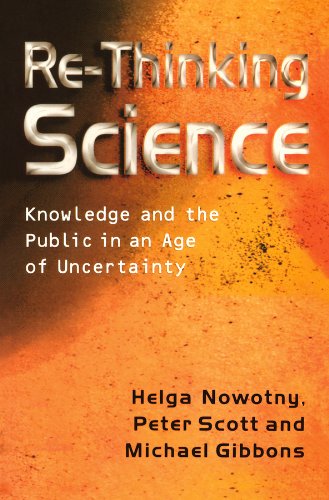
Re-Thinking Science presents an account of the dynamic relationship between society and science. Despite the mounting evidence of a much closer, interactive relationship between society and science, current debate still seems to turn on the need to maintain a ‘line’ to demarcate them. The view persists that there is a one-way communication flow from science to society – with scant attention given to the ways in which society communicates with science. The authors argue that changes in society now make such communications both more likely and more numerous, and that this is transforming science not only in its research practices and the institutions that support it but also deep in its epistemological core. To explain these changes, Nowotny, Scott and Gibbons have developed an open, dynamic framework for re-thinking science. The authors conclude that the line which formerly demarcated society from science is regularly transgressed and that the resulting closer interaction of science and society signals the emergence of a new kind of science: contextualized or context-sensitive science. The co-evolution between society and science requires a more or less complete re-thinking of the basis on which a new social contract between science and society might be constructed. In their discussion the authors present some of the elements that would comprise this new social contract.
User’s Reviews
Editorial Reviews: Review ‘What you always wanted to know about the “knowledge society”, Nowotny, Scott and Gibbons are telling it in Re-Thinking Science, the sequel to their much acclaimed book The New Production of Knowledge (1994). This is a splendid book, full of empirical insight and intellectual vision. Re-Thinking Science is reliable and robust at the same time.’ Wolf Lepenies, Rektor, Institute for Advanced Study, Berlin ‘The authors take us beyond the dichotomies of science and society in their ovular new work, Re-Thinking Science, into a new agora of interactive forces in which old institutional boundaries of science, industry and government are transcended. Re-Thinking Science re-thinks society.’ Henry Etzkowitz, Director, Science Policy Institute, State University of New York at Purchase ‘This book goes far beyond The New Production of Knowledge (1994), the earlier collection of essays by Michael Gibbons, Helga Nowotny and others. That book launched the debate on the trend towards a new regime for the production of knowledge and the practice of research … Re-Thinking Science revisits these themes in the form of a single brilliant essay in social theory … a splendid vision of a probable future world, in which science and society will increasingly overlap and be exposed to the growing expertise and contesting forces of the agora.’ Nature ‘This book is packed with novel and quite complicated ideas … We look forward to a further harvest of sharp observations and deep interpretations in the next product from this outstanding scholarly team.’ Interdisciplinary Science Review ‘an enourmously important book, which deserves to be widely read and discussed.’ Science as Culture The book could be influential in providing sustenance to higher education managers as they struggle to find new definitions of what it means to be a university. Political leaders too would do well to study it in order to move their policy-making away from dependence on mode 1 ideas. The vision of the science of the future outlined in the book could perhaps have gone further. However, there is a balance to be struck between being influential and being visionary. This book will clearly be influential. The vision will hopefully grow.” Studies in Higher Education From the Inside Flap Re-Thinking Science presents an account of the dynamic relationship between society and science. Despite the mounting evidence of a much closer, interactive relationship between society and science, current debate still seems to turn on the need to maintain a ‘line’ to demarcate them. The view persists that there is a one-way communication flow from science to society – with scant attention given to the ways in which society communicates with science. The authors argue that changes in society now make such communications both more likely and more numerous, and that this is transforming science not only in its research practices and the institutions that support it but also deep in its epistemological core. To explain these changes, Nowotny, Scott and Gibbons have developed an open, dynamic framework for re-thinking science. The authors conclude that the line which formerly demarcated society from science is regularly transgressed and that the resulting closer interaction of science and society signals the emergence of a new kind of science: contextualized or context-sensitive science. The co-evolution between society and science requires a more or less complete re-thinking of the basis on which a new social contract between science and society might be constructed. In their discussion the authors present some of the elements that would comprise this new social contract. From the Back Cover Re-Thinking Science presents an account of the dynamic relationship between society and science. Despite the mounting evidence of a much closer, interactive relationship between society and science, current debate still seems to turn on the need to maintain a ‘line’ to demarcate them. The view persists that there is a one-way communication flow from science to society – with scant attention given to the ways in which society communicates with science. The authors argue that changes in society now make such communications both more likely and more numerous, and that this is transforming science not only in its research practices and the institutions that support it but also deep in its epistemological core. To explain these changes, Nowotny, Scott and Gibbons have developed an open, dynamic framework for re-thinking science. The authors conclude that the line which formerly demarcated society from science is regularly transgressed and that the resulting closer interaction of science and society signals the emergence of a new kind of science: contextualized or context-sensitive science. The co-evolution between society and science requires a more or less complete re-thinking of the basis on which a new social contract between science and society might be constructed. In their discussion the authors present some of the elements that would comprise this new social contract. About the Author Professor Nowotny is Chair of Social Studies of Science at the Swiss Federal Institute of Technology (ETH) in Zurich Professor Scott is Vice-Chancellor and Chief Executive of Kingston University Professor Gibbons is Secretary General of the Association of Commonwealth Universities Read more
Reviews from Amazon users which were colected at the time this book was published on the website:
⭐This is a terrific book. The argument goes roughly like this: there has been a change from mode 1 to mode 2 science (explained in their previous book) involving greater interdisciplinarity, more goal directed research, and a diversification of sources of research funding. This book now argues that there has also been a concomitant change in the public sphere. Perhaps the easiest way to describe it is that in the 19th century we had mass primary education; in the first half of the 20th mass secondary education; and in the last 50 years mass university education. As a result, expert decisions cannot be taken by only a few: there are too many civil servants, think tank employees, consultants, and other members of the general public who are able to understand and criticize. Scientific and technical decisions, especially relating to science policy, simply cannot be taken behind closed doors. What we get instead is a more complex and more democratic process, where the aim is socially robust knowledge – a compromise that the enlarged body of decision makers can agree upon. It may be called socially distributed expertise. The authors pursue this using the term agora, the Greek equivalent of the Latin forum. They are attuned to the many interesting changes that has come with this new setting, such as the challenge to the peer review system.The book is written in the genre of the grand, unspecific sweep. There are few references and few concrete examples. The crude before-and-after discourse is heuristically useful but of course in many ways misleading. These stylistic choices are not everyone’s cup of tea, but they do help making the above argument.
Keywords
Free Download Re-Thinking Science: Knowledge and the Public in an Age of Uncertainty 1st Edition in PDF format
Re-Thinking Science: Knowledge and the Public in an Age of Uncertainty 1st Edition PDF Free Download
Download Re-Thinking Science: Knowledge and the Public in an Age of Uncertainty 1st Edition 2001 PDF Free
Re-Thinking Science: Knowledge and the Public in an Age of Uncertainty 1st Edition 2001 PDF Free Download
Download Re-Thinking Science: Knowledge and the Public in an Age of Uncertainty 1st Edition PDF
Free Download Ebook Re-Thinking Science: Knowledge and the Public in an Age of Uncertainty 1st Edition