

Ebook Info
- Published: 2020
- Number of pages: 287 pages
- Format: PDF
- File Size: 0.75 MB
- Authors: Milton Friedman
Description
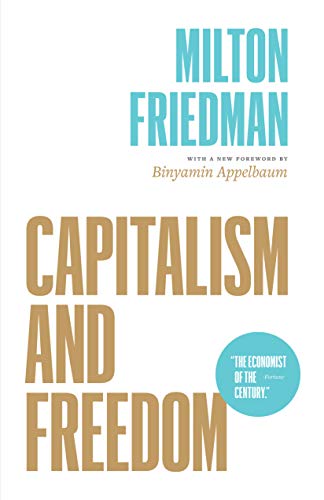
One of TIME magazine’s All-TIME 100 Best Nonfiction BooksOne of Times Literary Supplement’s 100 Most Influential Books Since the WarOne of National Review’s 100 Best Nonfiction Books of the CenturyOne of Intercollegiate Studies Institute’s 50 Best Books of the 20th CenturyHow can we benefit from the promise of government while avoiding the threat it poses to individual freedom? In this classic book, Milton Friedman provides the definitive statement of an immensely influential economic philosophy—one in which competitive capitalism serves as both a device for achieving economic freedom and a necessary condition for political freedom.First published in 1962, Friedman’s Capitalism and Freedom is one of the most significant works of economic theory ever written. Enduring in its eminence and esteem, it has sold nearly a million copies in English, has been translated into eighteen languages, and continues to inform economic thinking and policymaking around the world. This new edition includes prefaces written by Friedman for both the 1982 and 2002 reissues of the book, as well as a new foreword by Binyamin Appelbaum, lead economics writer for the New York Times editorial board.
User’s Reviews
Reviews from Amazon users which were colected at the time this book was published on the website:
⭐Here in the United States (and to a larger extent the modernized western world) we are fortunate to exercise a variety of freedoms. The freedoms of speech, press, and religion are the obvious ones, but also others like the freedom to send our children to the schools of our choosing or the freedom to relocate to another state if we so desire. In addition to these, we also value our freedom to spend our own money where and how we choose.The central principle to this book is that free market capitalism is the surest way to achieve maximum freedom for the people. While this is true in theory, Friedman shows how this has become less and less an actual reality. Governmental policies and interventions have gradually eroded our economic freedoms and we have largely been blind to this truth because these freedoms are lost incrementally slowly over long periods of time and are thus hard to recognize.The first major governmental move into the economy came with the establishment of the Federal Reserve. When it was first established (1913) the global economy was backed by a gold standard. However, within only a few short years, the First World War occurred and that standard was quickly abandoned. With these developments, the Fed was given the unfettered ability to print money and put it into circulation. As the quantity of dollars has increased, the relative value of each dollar has decreased. Unless your income has also gone up, this means that you are poorer.Ever since then, the government has gotten its sticky fingers farther and farther into the pocketbooks of its citizens. This is evidenced by implementations such as tariffs, fair-trade laws, import quotas, production requirements, and trade union restrictions on employment. Things like registration, certification, and licensing requirements across a spectrum of viable potential occupations and job opportunities hinder people from pursuing them (Think about qualified doctors who emigrate to a new country and are unable to practice medicine because their new home-country requires renewed certification, something that can take years and lots of money.) Governmental approval of new taxes and hikes in existing taxes all to pay for publicly funded programs have often been endorsed with little to no forethought as to the potential negative ramifications (for example, if you set welfare benefits at a particular income level, does it incentivize people to remain just below that level so as to continue getting governmental monetary assistance, thus further motivating people to remain unmotivated towards improving their economic standing in society?) And when the time comes for unnecessary programs to be eliminated, how often are they kept well past their expiration date?One of the more well-known programs that gets the most scrutiny is Social Security, and depending on the lens with which you view it, determines its importance to you. Friedman makes two such arguments. On the one hand, it seems to be an imposition on our financial freedom to make Social Security payments mandatory. If an individual prefers to live for today and not save for later in life, shouldn’t that be their prerogative? We can suggest that they don’t make such choices, but ultimately it should be up to them. It is wrong for the government to decide on our collective behalves, and to subsequently take money out of our pockets to enact the program. For the other side of this argument, Friedman writes: “The man who does not provide for his old age will become a public charge. Compelling him to buy an annuity is justified not for his own good, but for the good of the rest of us.” Through this lens, the government has a well founded argument for its implementation of Social Security, because its aim is to take care of society as a whole.Friedman suggests, and I agree, that there are only two areas in which the government should impose itself economically. The first is in setting up the rules of the ‘game’ and regulating them. Even a free market economy can become victim to cheaters and swindlers, and the government should act as the enforcer of the rules. The second is to limit the monopolization of any one industry. If a single entity has control over a particular segment of the market, they can unfairly exercise control over it. Historical examples include Andrew Carnegie’s Steel Company and John D. Rockefeller’s Standard Oil. Today, monopolies are even more prevalent and predatory than ever. Wal-Mart, Amazon, and Target own our commercial goods business. Google, Facebook and Twitter own our information and communications. The Walt Disney Company alone owns ABC, ESPN, FX, Hulu, the entire Marvel universe (including toys, movies, and theme park rides,) Star Wars, Pixar, and more. Friedman equates monopoly and government when he writes: “Our minds tell us, and history confirms, that the great threat to freedom is the concentration of power.”We all know that we need the government because without it we would have anarchy, but what is the right amount? It seems clear that as it currently stands, governmental intervention is too broad and needs to be scaled back. This is exemplified by a quote close to the end of the book: “state help kills self-help.” The more we ask the government to do for us, the less we do for ourselves (and the more we take for granted.) Let us not forget another old adage: “Give a man a fish and you feed him for a day; teach a man to fish and you feed him for a lifetime.” With the implementation of Social Security, the government has decided to give us all fish. In order for our society to survive longer and prosper into the future, we the people must learn to fish for ourselves.
⭐Everyone who is interested in preserving their personal liberty would do well to heed the advice of nobel laureate Milton Friedman and vote for leaders who are commited to keeping our society free from obtrusive government.
⭐In trying to teach myself about the history of economics, I have often gone to the source texts in an attempt to get a sense of the history of economic thought (something that from reading the blogs these past five years seems to show is missing; Krugman quoted Thoma recently saying that there are no new ideas in economics, just old books). It has been a slog at times. I read Keynes’ “General Theory” as one of the first books in the project and had to skip the equations and luxuriate in his explanatory prose. I should return to that text someday just to see my marginalia. I read “The Road to Serfdom” on a succession of un-air-conditioned nights one summer, and felt he was making a critical error in categorizing German Fascism and Soviet Communism as being of a kind. Many people who visited the page on Amazon where I posted that critique disagreed. It didn’t help that I posted it two days before Glen Beck devoted an entire episode to the book and its greatness, making mine the most recent critical review. I was able to get into a fruitless exchange below the review in the comments section until I decided to stop. Then the trolls stopped. I have to say that Hayek did teach me one thing: Don’t feed the trolls. I have to admit that I started and abandoned Wealth of Nations about a third of a way in, and Schumpeter at an equally early point. I have every intention of going back, but my “to read” shelf is thick and my time on this planet finite. It is in that vein that I started reading Friedman’s “Capitalism and Freedom” last night. I am not sympathetic to the man – from watching interviews of him he is an arrogant prick assured of his own correctnessness. I am not sympathetic to his arguments or the political legacy of his arguments. I am much more left-wing than he was. I am, however, desirous to read what was a popular book aimed at non-economists. Prefaces: The layout of the book is such – the edition of the book I have is the third edition, and there are prefaces to go with each edition, counting back. So there’s a 2002, 1982, and 1962 preface at the front of the book. What interests me is the tone on each of the sections. In 2002, Friedman is a little triumphant because the US has made much progress towards a more “free” society through Reagan and Bushes. In 1982 he is hopeful about the future. In 1962 he sounds cynical, because the welfare state has taken away his freedom (I hope ‘62 Miltie was prepared for Freedom Summer and the Civil Rights Act). Introduction, first pages of chapter 1: What got me as I was reading was that there was no positive definition of “Freedom”. There is no sentence, that I saw, that started “Freedom is…”. Friedman splits freedom down to economic and political freedom, saying that they often go hand-in-hand, cheering the symbiotic relationship between capitalism and democracy. But then there’s this: he starts the book by trying to deconstruct Kennedy’s “Ask not” quote. He poo-poos the idea of a hierarchy between people and the state, no matter who you put on top. This will take a while, thankfully the book is only about 200 pages. Then I put it aside for a while and picked it back up. Fewer details now. But I’m not convinced. What is interesting is that what was right wing in the 60s became so ingrained in the culture that it wasn’t really even right wing by the time I read it. Milton became mainstream. Even Chapter Nine, where he advocates for the negative income tax. That was done (now we can argue if it was done well enough or if it needs extension now, but the EITC is one of the most broad-based poverty-elimination policies we have in place).
⭐As a left-leaning political thinker, this book clearly wasn’t written for me. I’ve chosen to buy and read it to expand my mind, and its probably one of the best books I’ve seen in describing the libertarian/conservative economic mindset of liberal markets, low taxes etc. I’ve tried to go in with an open mind, but I’ve failed to be convinced.While being aimed at the lay reader, the book gets incredibly technical during some of the earlier chapters. Many of Friedmann’s arguments are simple (many are VERY simple), and he often provides no evidence for them. This is consistent with other books I’ve read by other modern economists, who have confirmed this about Friedmann-refusing to believe their evidence based arguments, dismissing them off-hand with pure conjecture.I’m still glad I read it, I’d recommend everyone interested in the economic side of politics does, but don’t expect a well-reasoned justification for the positions proposed here
⭐Honestly one of my favourite books ever. By today’s standards, much of what Friedman has to say would be considered as being very extreme. But Friedman’s coherent style of writing, combined with his well thought out arguments, create ideas that are honestly undeniable. Friedman argues his points very well, and I often found it hard to disagree. What surprised me the most was the fact that much of Freidman’s arguments are extremely easy to understand (excluding, perhaps, the chapter on monetary policy) – his principles are fairly basic, although this shouldn’t be interpreted negatively.This book truly changed by perspective on a lot of issues that I thought were rather obvious. Very well written, and I’d encourage people from both sides of the political aisle to read. Truly eye-opening, and a book that I will never forget.
⭐This is a fantastic book. Having studied Friedman extensively for his work on transaction cost economics, I wanted to read more of his work. I found this book to be incredibly insightful, whilst some of the language is now a little dated, none of the concepts presented within it are, if anything they have more poignancy than ever before.Even if you have only the subtlest interest in economics, politics and social study’s, then book will be a great read and time well spent, it really is an eye opener and gives the reader real insights and powerful positive arguments of the benefits of the capitalist system.
⭐A great book, which does not just focus on his economic theories but presents a good intro into liberalism itself and the advantages / disadvantages of a market economy compared to other systems in the light of liberalism.Milton is often misquoted, misunderstood, and his reasoning contorted – it is a pleasure to read this book and follow his train of thought across various political, economic, and social subject areas.Even if you disagree with his economic theory, you will be delighted by his style of writing and clear deduction.A book that goes against blind conformity – what a pleasure to read and I hope there are more critical thinkers out there.
⭐Great book a man ahead of his time
Keywords
Free Download Capitalism and Freedom in PDF format
Capitalism and Freedom PDF Free Download
Download Capitalism and Freedom 2020 PDF Free
Capitalism and Freedom 2020 PDF Free Download
Download Capitalism and Freedom PDF
Free Download Ebook Capitalism and Freedom