Ebook Info
- Published: 2011
- Number of pages: 240 pages
- Format: PDF
- File Size: 0.93 MB
- Authors: Jaron Lanier
Description
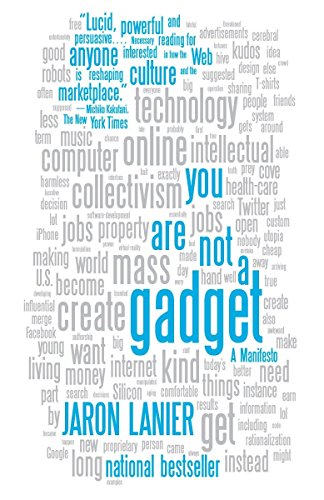
A NATIONAL BESTSELLERA programmer, musician, and father of virtual reality technology, Jaron Lanier was a pioneer in digital media, and among the first to predict the revolutionary changes it would bring to our commerce and culture. Now, with the Web influencing virtually every aspect of our lives, he offers this provocative critique of how digital design is shaping society, for better and for worse. Informed by Lanier’s experience and expertise as a computer scientist, You Are Not a Gadget discusses the technical and cultural problems that have unwittingly risen from programming choices—such as the nature of user identity—that were “locked-in” at the birth of digital media and considers what a future based on current design philosophies will bring. With the proliferation of social networks, cloud-based data storage systems, and Web 2.0 designs that elevate the “wisdom” of mobs and computer algorithms over the intelligence and wisdom of individuals, his message has never been more urgent.
User’s Reviews
Editorial Reviews: Review A New York Times, Los Angeles Times, and Boston Globe Bestseller“Lucid, powerful and persuasive. . . . Necessary reading for anyone interested in how the Web and the software we use every day are reshaping culture and the marketplace.”—Michiko Kakutani, The New York Times“Persuasive. . . . Lanier is the first great apostate of the Internet era.”—Newsweek“Thrilling and thought-provoking. . . . A necessary corrective in the echo chamber of technology debates.”—San Francisco Chronicle “Mind-bending, exuberant, brilliant. . . . Lanier dares to say the forbidden.”—The Washington Post“With an expertise earned through decades of work in the field, Lanier challenges us to express our essential humanity via 21st century technology instead of disappearing in it. . . . [You Are Not a Gadget]compels readers to take a fresh look at the power—and limitations—of human interaction in a socially networked world.”—Time (“The 2010 Time 100”)“Lanier is not of my generation, but he knows and understands us well, and has written a short and frightening book, You Are Not a Gadget, which chimes with my own discomfort, while coming from a position of real knowledge and insight, both practical and philosophical.”—Zadie Smith, The New York Review of Books“Sparky, thought-provoking. . . . Lanier clearly enjoys rethinking received tech wisdom: his book is a refreshing change from Silicon Valley’s usual hype.”—New Scientist “Important. . . . At the bottom of Lanier’s cyber-tinkering is a fundamentally humanist faith in technology. . . . His mind is a fascinating place to hang out.”—Los Angeles Times “A call for a more humanistic—to say nothing of humane—alternative future in which the individual is celebrated more than the crowd and the unique more than the homogenized. . . . You Are Not a Gadget may be its own best argument for exalting the creativity of the individual over the collective efforts of the ‘hive mind.’ It’s the work of a singular visionary.”—Bloomberg News “A bracing dose of economic realism and Randian philosophy for all those techno utopianists with their heads in the cloud. . . . [Lanier is] a true iconoclast. . . . He offers the sort of originality of thought he finds missing on the Web.” —The Miami Herald “For those who wish to read to think, and read to transform, You Are Not a Gadget is a book to begin the 2010s. . . . It is raw, raucous and unexpected. It is also a hell of a lot of fun.”—Times Higher Education “[Lanier] confronts the big issues with bracing directness. . . . The reader sits up. One of the insider’s insiders of the computing world seems to have gone rogue.”—The Boston Globe “Gadget is an essential first step at harnessing a post-Google world.”—The Stranger (Seattle) “Lanier turns a philosopher’s eye to our everyday online tools. . . . The reader is compelled to engage with his work, to assent, contradict, and contemplate. . . . Lovers of the Internet and all its possibilities owe it to themselves to plunge into Lanier’s manifesto and look hard in the mirror. He’s not telling us what to think; he’s challenging us to take a hard look at our cyberculture, and emerge with new creative inspiration.”—Flavorwire “Poetic and prophetic, this could be the most important book of the year. . . . Read this book and rise up against net regimentation!”—The Times (London) “[Lanier’s] argument will make intuitive sense to anyone concerned with questions of propriety, responsibility, and authenticity.”—The New Yorker “Inspired, infuriating and utterly necessary. . . . Lanier tells of the loss of a hi-tech Eden, of the fall from play into labour, obedience and faith. Welcome to the century’s first great plea for a ‘new digital humanism’ against the networked conformity of cyber-space. This eloquent, eccentric riposte comes from a sage of the virtual world who assures us that, in spite of its crimes and follies, ‘I love the internet.’ That provenance will only deepen its impact, and broaden its appeal.”—The Independent (London) “Fascinating and provocative. . . . Destined to become a must-read for both critics and advocates of online-based technology and culture.”—Publishers Weekly About the Author Jaron Lanier is known as the father of virtual reality technology and has worked on the interface between computer science and medicine, physics, and neuroscience. He lives in Berkeley, California. Visit the author’s website at www.jaronlanier.com. Excerpt. © Reprinted by permission. All rights reserved. an apocalypse of self- abdicationTHE IDEAS THAT I hope will not be locked in rest on a philosophical foundation that I sometimes call cybernetic totalism. It applies metaphors from certain strains of computer science to people and the rest of reality. Pragmatic objections to this philosophy are presented.What Do You Do When the Techies Are Crazier Than the Luddites?The Singularity is an apocalyptic idea originally proposed by John von Neumann, one of the inventors of digital computation, and elucidated by figures such as Vernor Vinge and Ray Kurzweil.There are many versions of the fantasy of the Singularity. Here’s the one Marvin Minsky used to tell over the dinner table in the early 1980s: One day soon, maybe twenty or thirty years into the twenty- first century, computers and robots will be able to construct copies of themselves, and these copies will be a little better than the originals because of intelligent software. The second generation of robots will then make a third, but it will take less time, because of the improvements over the firstgeneration.The process will repeat. Successive generations will be ever smarter and will appear ever faster. People might think they’re in control, until one fine day the rate of robot improvement ramps up so quickly that superintelligent robots will suddenly rule the Earth.In some versions of the story, the robots are imagined to be microscopic, forming a “gray goo” that eats the Earth; or else the internet itself comes alive and rallies all the net- connected machines into an army to control the affairs of the planet. Humans might then enjoy immortality within virtual reality, because the global brain would be so huge that it would be absolutely easy—a no-brainer, if you will—for it to host all our consciousnesses for eternity.The coming Singularity is a popular belief in the society of technologists. Singularity books are as common in a computer science department as Rapture images are in an evangelical bookstore.(Just in case you are not familiar with the Rapture, it is a colorful belief in American evangelical culture about the Christian apocalypse. When I was growing up in rural New Mexico, Rapture paintings would often be found in places like gas stations or hardware stores. They would usually include cars crashing into each other because the virtuous drivers had suddenly disappeared, having been called to heaven just before the onset of hell on Earth. The immensely popular Left Behind novels also describe this scenario.)There might be some truth to the ideas associated with the Singularity at the very largest scale of reality. It might be true that on some vast cosmic basis, higher and higher forms of consciousness inevitably arise, until the whole universe becomes a brain, or something along those lines. Even at much smaller scales of millions or even thousands of years, it is more exciting to imagine humanity evolving into a more wonderful state than we can presently articulate. The only alternatives would be extinction or stodgy stasis, which would be a little disappointing and sad, so let us hope for transcendence of the human condition, as we nowunderstand it.The difference between sanity and fanaticism is found in how well the believer can avoid confusing consequential differences in timing. If you believe the Rapture is imminent, fixing the problems of this life might not be your greatest priority. You might even be eager to embrace wars and tolerate poverty and disease in others to bring about the conditions that could prod the Rapture into being. In the same way, if you believe the Singularity is coming soon, you might cease to design technology to serve humans, and prepare instead for the grand events it will bring.But in either case, the rest of us would never know if you had been right. Technology working well to improve the human condition is detectable, and you can see that possibility portrayed in optimistic science fiction like Star Trek.The Singularity, however, would involve people dying in the flesh and being uploaded into a computer and remaining conscious, or people simply being annihilated in an imperceptible instant before a new superconsciousness takes over the Earth. The Rapture and the Singularity share one thing in common: they can never be verified by the living.You Need Culture to Even Perceive Information TechnologyEver more extreme claims are routinely promoted in the new digital climate. Bits are presented as if they were alive, while humans are transient fragments. Real people must have left all those anonymous comments on blogs and video clips, but who knows where they are now, or if they are dead? The digital hive is growing at the expense of individuality.Kevin Kelly says that we don’t need authors anymore, that all the ideas of the world, all the fragments that used to be assembled into coherent books by identifiable authors, can be combined into one single, global book. Wired editor Chris Anderson proposes that science should no longer seek theories that scientists can understand, because the digital cloud will understand them better anyway.*Antihuman rhetoric is fascinating in the same way that selfdestruction is fascinating: it offends us, but we cannot look away.The antihuman approach to computation is one of the most baseless ideas in human history. A computer isn’t even there unless a person experiences it. There will be a warm mass of patterned silicon with electricity coursing through it, but the bits don’t mean anything without a cultured person to interpret them.This is not solipsism. You can believe that your mind makes up the world, but a bullet will still kill you. A virtual bullet, however, doesn’t even exist unless there is a person to recognize it as a representation of a bullet. Guns are real in a way that computers are not.Making People Obsolete So That Computers Seem More AdvancedMany of today’s Silicon Valley intellectuals seem to have embraced what used to be speculations as certainties, without the spirit of unbounded curiosity that originally gave rise to them. Ideas that were once tucked away in the obscure world of artificial intelligence labs have gone mainstream in tech culture. The first tenet of this new culture is that all of reality, including humans, is one big information system. That doesn’t mean we are condemned to a meaningless existence. Instead there is a new kind of manifest destiny that provides us with a mission to accomplish. The meaning of life, in this view, is making the digital system wecall reality function at ever- higher “levels of description.”People pretend to know what “levels of description” means, but I doubt anyone really does. A web page is thought to represent a higher level of description than a single letter, while a brain is a higher level than a web page. An increasingly common extension of this notion is that the net as a whole is or soon will be a higher level than a brain. There’s nothing special about the place of humans in this scheme. Computers will soon get so big and fast and the net so rich with information that people will be obsolete, either left behind like the characters in Rapture novels or subsumed into some cyber-superhuman something.Silicon Valley culture has taken to enshrining this vague idea and spreading it in the way that only technologists can. Since implementation speaks louder than words, ideas can be spread in the designs of software. If you believe the distinction between the roles of people and computers is starting to dissolve, you might express that—as some friends of mine at Microsoft once did—by designing features for a word processor that are supposed to know what you want, such as when you want to start an outline within your document. You might have had the experience of having Microsoft Word suddenly determine, at the wrong moment, that you are creating an indented outline. While I am all for the automation of petty tasks, this is different.From my point of view, this type of design feature is nonsense, since you end up having to work more than you would otherwise in order to manipulate the software’s expectations of you. The real function of the feature isn’t to make life easier for people. Instead, it promotes a new philosophy: that the computer is evolving into a life-form that can understand people better than people can understand themselves. Another example is what I call the “race to be most meta.” If a design like Facebook or Twitter depersonalizes people a little bit, then another service like Friendfeed— which may not even exist by the time this book is published— might soon come along to aggregate the previous layers of aggregation, making individual people even more abstract, and the illusion of high- level metaness more celebrated.Information Doesn’t Deserve to Be Free“Information wants to be free.” So goes the saying. Stewart Brand, the founder of the Whole Earth Catalog, seems to have said it first. I say that information doesn’t deserve to be free.Cybernetic totalists love to think of the stuff as if it were alive and had its own ideas and ambitions. But what if information is inanimate? What if it’s even less than inanimate, a mere artifact of human thought? What if only humans are real, and information is not?Of course, there is a technical use of the term “information” that refers to something entirely real. This is the kind of information that’s related to entropy. But that fundamental kind of information, which exists independently of the culture of an observer, is not the same as the kind we can put in computers, the kind that supposedly wants to be free.Information is alienated experience.You can think of culturally decodable information as a potential form of experience, very much as you can think of a brick resting on a ledge as storing potential energy. When the brick is prodded to fall, the energy is revealed. That is only possible because it was lifted into place at some point in the past.In the same way, stored information might cause experience to be revealed if it is prodded in the right way. A file on a hard disk does indeed contain information of the kind that objectively exists. The fact that the bits are discernible instead of being scrambled into mush—the way heat scrambles things—is what makes them bits.But if the bits can potentially mean something to someone, they can only do so if they are experienced. When that happens, a commonality of culture is enacted between the storer and the retriever of the bits. Experience is the only process that can de- alienate information.Information of the kind that purportedly wants to be free is nothing but a shadow of our own minds, and wants nothing on its own. It will not suffer if it doesn’t get what it wants.But if you want to make the transition from the old religion, where you hope God will give you an afterlife, to the new religion, where you hope to become immortal by getting uploaded into a computer, then you have to believe information is real and alive. So for you, it will be important to redesign human institutions like art, the economy, and the law to reinforce the perception that information is alive. You demand that the rest of us live in your new conception of a state religion. You need us to deify information to reinforce your faith.*Chris Anderson, “The End of Theory,” Wired, June 23, 2008 (www.wired.com/science/discoveries/magazine/ 16- 07/pb_theory). Read more
Reviews from Amazon users which were colected at the time this book was published on the website:
⭐Jaron Zepel Lanier is an American computer scientist (who was an innovator in the field of virtual reality), visual artist, composer of contemporary classical music, and author.He wrote in the Introduction to the paperback edition of this 2000 book, “This book is not antitechnology in any sense. It is prohuman. [It] argues that certain specific, popular internet designs of the moment—not the internet as a whole—tend to pull us into life patterns that gradually degrade the ways in which each of us exists as an individual. These unfortunate designs are more oriented toward treating people as relays in a global brain. Deemphasizing personhood, and the intrinsic value of an individual’s unique internal experience and creativity, leads to all sort of maladies…“While the core argument might be described as ‘spiritual,’ there are also profound political and economic implications. For instance, the idea that information should be ‘free’ sounds good at first. But the unintended result is that all the clout and money generated online has begun to accumulate around the people close to only certain highly secretive computers, many of which are essentially spying operations designed to pull money out of a marketplace…. The implications of the rise of ‘digital serfdom’ couldn’t be more profound. As technology gets better and better, and civilization becomes more and more digital, one of the major questions we will have to address is: Will a sufficiently large middle class of people be able to make a living from what they do with their hearts and heads? Or will they be left behind, distracted by empty gusts of ego-boosting puffery?” (Pg. ix-x)At the end of Chapter 1, he adds, “in this book, I have spun a long tale of belief in the opposites of computationalism, the noosphere, the Singularity, web 2.0, the long tail, and all the rest. I hope the volume of my contrarianism will foster an alternative mental environment, where the exciting opportunity to start creating a new digital humanism can begin. An inevitable side effect of this project of deprogramming through immersion is that I will direct a sustained stream of negativity onto the ideas I am criticizing. Readers, be assured that the negativity eventually tapers off, and that the last few chapters are optimistic in tone.” (Pg. 23)He observes, “The coming Singularity is a popular belief in the society of technologists. Singularity books are as common in a computer science department as Rapture images are in an evangelical bookstore… The Singularity… would involve people dying in the flesh and being uploaded into a computer and remaining conscious, or people simply being annihilated in an imperceptible instant before a new superconsciousness takes over the Earth. The Rapture and the Singularity share one thing in common: they can never be verified by the living.” (Pg. 25-26)He notes, “if you want to make the transition from the old religion, where you hope God will give you an afterlife, to the new religion, where you hope to become immortal by getting uploaded into a computer, then you have to believe information is real and alive. So for you, it will be important to redesign human institutions like art, the economy, and the law to reinforce the perception that information is alive. You demand that the rest of us live in your new conception of a state religion. You need us to defy information to reinforce your faith.” (Pg. 28-29)He suggests, “It seems to me… that the Turing Test has been poorly interpreted by generations of technologists. It is usually presented to support the idea that machines can attain whatever quality it is that gives people consciousness… What the test really tells us, however… is that machine intelligence can only be known in a relative sense, in the eyes of a human beholder. The AI way of thinking is central to the idea I’m criticizing in this book. If a machine can be conscious, then the computing cloud is going to be a better and far more capacious consciousness than is found in an individual person. If you believe this, then working for the benefit of the cloud over individual people puts you on the side of the angels. But the Turing test cuts both ways. You can’t tell if a machine has gotten smarter or if you’ve just lowered your standards of intelligence to such a degree that the machine seems smart. If you can have a conversation with a simulated person presented by an AI program, can you tell how far you’ve let your sense of personhood degrade in order to make the illusion work for you?” (Pg. 31-32)He explains, “To help you learn to doubt the fantasies of the cybernetic totalists, I offer two dueling thought experiments. The first [is]… Imagine a computer program that can simulate a neuron… Now imagine a tiny wireless device that can send and receive signals to neurons in the brain… hire a neurosurgeon to open your skull… Replace one nerve in your brain with one of those wireless gadgets. (Even if such gadgets were already perfected, connecting them would not be possible today. The artificial neuron would have to engage all the same synapses—around seven thousand, on average—as the biological nerve it replaced.) Next, the artificial neuron will be connected over a wireless link to a simulation of a neuron in a nearby computer… There are between 100 billion and 200 billion neurons in a human brain, so even at only a second per neuron, this will require tens of thousands of years. Now for the big question: Are you still conscious after the process has been completed?… Does the computer then become a person? If you believe in consciousness, is your consciousness now in the computer, or perhaps in the software? The same question can be asked about souls, if you believe in them.” (Pg. 40)He points out, “We don’t understand how brains work… there are fundamental questions that have not even been fully articulated yet, much less answered. For instance, how does reason work? How does meaning work?… While the physical brain is a product of evolution as we are coming to understand it, the cultural brain might be a way of transforming the evolved brain according to principles that cannot be explained in evolutionary terms.” (Pg. 50-51)He states, “In Silicon Valley … there is one belief system … [that] serves as a common framework… I call it computationalism … the underlying philosophy is that the world can be understood as a computational process, with people as subprocesses… I must make it clear that computationalism has its uses. Computationalism isn’t always crazy… If you want to consider people as special, as I have advised, then you need to be able to say at least a little bit about where the specialness begins and ends… If you hope for a technology to be designed to serve people, you must have at least a rough idea of what a person is and is not. But… Dividing the world into two parts, one of which is ordinary—deterministic or mechanistic, perhaps—and one of which is mystifying, or more abstract, is particularly difficult for scientists. This is the dreaded path of dualism. It is awkward to study neuroscience, for instance, if you assume that the brain is linked to some other entity—a soul—on a spirit plane… I am contradicting myself here, but the reason is that I find myself playing different roles at different times. Sometimes I am designing tools for people to use, while at other times I am working with scientists trying to understand how the brain works. Perhaps it would be better if I could find one single philosophy that I could apply equally to each circumstance, but I find that the best path is to believe different things about aspects of reality when I play these different roles…” (Pg. 153-154)He acknowledges, “The most important thing about postsymbolic communication is that I hope it demonstrates that a humanist softie like me can be as radical and ambitions as any cybernetic totalist in both science and technology, while still believing that people should be considered differently, embodying a special category.” (Pg. 191)He adds in the Afterword, “While there is a lot of talk in the air about whether to believe in god or not, I suspect that religious arguments are gradually incorporating coded debates about whether to even believe in people anymore. Are people just one form of information system, one form of gadget? The old debates about God are now also about us. For instance, when I suggest we should act as if we’re real—as if consciousness and experience exist, just in case it turns our we ARE real—I am retooling Pascal’s famous wager about God, but in this case applied to people.” (Pg. 206)This fascinating and thought-provoking book will be “must reading” for those interested in the future of computer science, the philosophy of mind, and the direction modern culture is heading.
⭐A rule of thumb is that it takes ten years to become an expert. Among PhD’s and software engineers, there is a common delusion that hard-won expertise in a miniscule area of human knowledge is automatically extended to everything under the sun.Lanier is a name in a creative area of computing, and he is a professional composer and musician. Unfortunately that did not confer the chops required to write a coherent book on economics, history, cultural analysis, software engineering or the host of other things he attempts here. So he wings it. The result is a number of real howlers accompanied by less egregious chapters where he obsesses about the color of an elephant’s tail without understanding that there is an elephant attachedLanier’s Method of Operation: * pick a personal pet peeve * select some phenomenon of general interest * fabricate a random cause-effect relation linking the popular phenomenon to his pet peeve. * ignore any relevant historical, economic or cultural information.Looking back on that paragraph, I realize that I just described Fox News’s MO. Except Fox does it on purpose for millions of dollars. I believe Lanier was just misguided by bilious enthusiasm for his own biases.The biggest howler? Lanier walks into a hedge fund office and sees a wall of computer monitors. “Aha!” he thinks, “the ‘cloud’ is responsible for the bank crash.”Now behind all the hype, the “cloud” is just a more rational way of billing for computer hardware use, supported by a means of running multiple servers safely on one machine. It does allow much smaller businesses to afford hosted “servers”, but it explains absolutely nothing about the 2006-2008 financial crash — or the 15 “pre-cloud” other financial crashes in U.S. history! Lanier was simply looking the wrong way in that hedge-fund office. If, like Michael Lewis, he had ignored the hardware and paid attention to the “wetware”, he might have learned something.If you want an adult discussion of the crash, see the excellent movie “An Inside Job”, which will change forever the meaning of the phrase “leading economists” for you. Read Michael Lewis’s “The Big Short” which gives you a manager’s eye view of the thing or “Confidence Men” which gives you the political side back to Clinton and Larry Summers. Lanier could have at least read Lewis’s “Liar’s Poker, which was available at the time he was writing this book, or could have simply kept silent until he knew enough not to embarrass himself.Howler number two: Lanier experiences a lag on his new iPhone. “It must be Linux! I can just feel it!” Funny that every other iPhone user identified the problem correctly as the AT&T network, which could not handle the sudden increase of activity from the new iPhone. IPhone apps phone home promiscuously, but that’s not Linux, it’s marketing. If Lanier had been equally wrong but less biased, he might have attacked Objective C, a more immediate software platform than Linux. But Lanier was a Microsoftie, and Linux was his pet peeve.Google: Lanier seems unaware that capitalism breeds monopolies! But he thinks that Google is a really dangerous one. Lanier forgot to count the horse he rode in on. In the nineties and the oughts, Microsoft was the oppressive monopoly. Unlike Google, MS were always happy to throw users under the bus with software that simply did not run (Windows 3.0, DOS 4.0, Windows Millenium, Vista). They were willing to use illegal means to keep better software off the market (DR-DOS). (With iOS, Apple now throws developers as well as users under the bus.) I don’t like monopolies, but Google has contributed a tremendous amount of good free software and free developer cycles to the community, so between Microsoft, Apple and Google, I’ll take Google.If Lanier had any insight, he would have identified U.S. internet service providers as the monopoly/cartel most dangerous to the average computer user. In most markets in this country, internet providers charge outrageous rates for broadband in order to subsidize their “no-choices” cable TV business. Broadband is a utility: if you are employed you need it and if you are unemployed you need it even more. You can easily live without cable TV (for PBS, local news and weather, I get better reception with an antenna []). So the cable TV company doubling as an internet provider is a monopoly with devastating consequences and no justification. And it costs us three times as much for half the speed that many European countries enjoy.Which brings me to open-source software. I have read some reviews here where the review writer is apologizing for giving his review away. Sad, sad. Amazon reviews are probably the greatest innovation in shopping since cash. I am grateful for this community and contribute freely to it. (Contrast Amazon with a really useless shopping site like the iStore/appStore.)Because of Lanier’s bias (or a kool-aid overdose), he doesn’t notice that open source software may be the biggest single job creator in our economy. Thousands of tiny businesses exist because of it. The problem with commercial software like Oracle, Windows and Apple software is not so much the up-front cost (well, with Oracle it used to be). It is the ongoing maintenance and management expense due to the poor usability and the opacity of the software itself. The proprietary vendors seem to glory in re-inventing computer science with out-of-date technology masked by really impenetrable nomenclature.If I run into a bug in open source software that affects only a few users, I can go in and fix it myself right away because I have the source and because the open source community generally evolves solid, readable, pattern-based software. With a commercial program, bugs that affect you will not be fixed in the next release unless you throw tons of extra money at the software vendor — and maybe not then, because the best and the brightest programmers have already left for more interesting open source projects. Major innovation will not be happening in proprietary software because you can’t pre-calculate the bottom line for innovation and all the manpower is required just to keep the legacy stuff from crashing.By the way, if YOU use open source, do what I do: contribute money — it’s well worth paying for.Creative Commons: Lanier’s cultural history chops are far too weak to understand the Creative Commons concept. He allows that he might be willing to let some of his work be used for free but he would like to control how it is used.Now, Shakespeare was the greatest mash-up artist of all time (along with Marlowe, Moliere, Aeschylus, Sophocles, Euripides, Ovid, Vergil…). If forced to, the Bard might have grudgingly given a few shillings to the prior authors of everything he borrowed (and he borrowed pretty much everything). But if he had to write Hamlet with Kyd’s executor looking over his shoulder, or R&J, Richard II, III or Henry IV,V,VI,VIII with Brooke’s or Holinshed’s attorneys telling him what he could or could not write, he would surely have packed it in and gone home to make beer.I believe strongly in the modern concept of paying authors for their work — even though Shakespeare, Mozart and most other geniuses had to have day jobs. But the intellectual rigidity of our copyright laws (not to mention our libel laws) absolutely guarantees that there will never be another Shakespeare.Creative Commons is an attempt to restore literature’s ability to cross-fertilize (the way classical and folk music used to and visual art still does) by trying to reproduce the open-source software phenomenon there.My problem with this book is that Lanier did not respect his subject or his readers enough to question his own prejudices or ignorance. You could read Lanier’s book as a study of hand-waving and proof by intimidation, but the content is hardly worth the effort. Read “How to Win Every Argument” instead for shorter, more humorous and more self-aware examples of chopped logic.If you want an example of somebody doing a great job at what Lanier fails at here, read “Freakonomics”. (Read it anyway, it’s great.)[Disclosure: the author of this review is an ex-actor/musician and a writer of fiction who has done graduate research in artificial intelligence and has been doing software engineering for about 30 years.]
⭐I first heard of Jaron Lanier in the early 90s as one of the originators of virtual reality, and had formed a more recent impression of him as a digital iconoclast, based in part on references to this book (first published in 2010). He suggests that the the way in which the Web and the software we use to browse, search, communicate, shop and advertise has evolved (and has continued to evolve since the book’s appearance) is, in the words of the back cover blurb, “deadening personal interaction, stifling genuine inventiveness and even changing us as people”. This is contentious stuff, in a world where just about all of us have been happy to hand over our identities for the sake of convenience, self-aggrandizement and ease of access to stuff that is cheap or (apparently) free. The idea that, if you can’t identify as a user of an online system, then you’re being used by it is by now well-established (in part due to this book), but – once again – people still appear to be pretty happy with their side of the deal.Lanier’s argument includes a lot of personal anecdote – e.g. “I know quite a few people […] who are proud to say that they have accumulated thousands of friends on Facebook. Obviously this statement can only be true if the idea of friendship is reduced” [p53]. Elsewhere (on p71), he eulogises an online forum populated by players of the oud (a middle Eastern string instrument) like himself; he sees this as a counterexample to the way in which people on the Web have become less human (through insensitivity, lack of consideration, appreciation or identification, coupled with an exploitation of the gift to be abusive which anonymity has given them).Regarding the commercial aspects of the Web, he proposes transitioning to a system in which we earn money when bit-based artifacts that we own (like photos or music) are visited by others, and we pay money to visit the bits of others. This is proposed in part as an alternative to online piracy, but mainly to encourage denizens of the Web to become more creative, rather than passive consumers of artifacts and culture. Later on, he links this passivity to a perceived stasis in music – specifically, he challenges the reader (especially if youthful) to identify the characteristics of a piece of music from the late 2000s which distinguish it from the late 1990s. He acknowledges (in part) that this perception could arise from his own age (he was in his early fifties when he wrote the book – exactly a year younger than me, I just discovered), but thinks it worth raising as a concern that the Web and its tools are responsible for the replacement of originality with “a petty mashup of pre-web culture” [p131].Even though it’s quite a short book, there’s room for other ideas, including the notion that neoteny (the retention of juvenile characteristics in mature organisms) is being exacerbated for humans by online technology, which – for example – provides social media and blogs to answer the craving for attention “which young adults in their newly extended childhood” [p180] have. Elsewhere, he speculates on the evolution of semantics, the difference between the perception of images, sounds and odours and physiological bases for metaphor.This is all stimulating stuff which I enjoyed reading, although I occasionally wondered whether the use of big words (e.g. “Bachelardian neoteny”, “cephalapod envy”, “postsymbolic communication”) was helping the argument, or merely demonstrating some degree of wackiness on the part of the author.
⭐‘You are not a gadget – a manifesto’, by Jaron LanierHave carried this book around with me for a couple of years. Just finished it today. Great read and lots to think about. Would not claim to understand all of the points made but food for thought for anyone like myself who spends much time contributing to social networks.Lanier deals with a long list of concerns he has with recent developments. In fact one of these relates to information being taken out of context e.g. fragments being reused in various social networks. While reviewing the book – and therefore selecting some of the ideas – I suggest that if you think the subject matter is of interest you should read the full book.The author addresses the subject of ‘authorship’ – referencing a discussion between Kevin Kelly (who postulates that eventually there will be only one book) and John Updike on the subject. His opionion is that authorship is not a priority for the new ideology promoted by the singularity, the anti humanist computer scientists, promoters of ‘digital maoisim’ or the ‘noosphere’.Lanier is highly critical of web 2.0 designs which actively demand that people define themselves downwards. Nor is he a fan of Wikipedia – which he sees as (1) a system which removes individual ‘points of view’ and (2) lendds itself to ‘lazy’ search engines serving up its context as its first answer each time.Lanier also has less expectations of crowd wisdom than James Surowiecki. The author stresses the need for a combination of collective and individual intelligence. In fact he would avoid having crowds frame their own questions. He has concerns for a society that risks mob rule as a follow on from crowd wisdom, in its extreme form.Interestingly the author claims to be optimistic and to see benefits in technology. But the technology should exist to server people and to improve the human condition. He seems to be unconvinced about the benefits of much of the web 2.0 culture and associated ideology. He sees it lending itself to a winner take all – the lords of the cloud and search – while the creators of cultural experiences will work for very little (if anything at all).He spends a reasonable amount of time looking at modern music and suggesting that we have lost much of the creativity of previous generations – that in fact much so what we hear is rehash of previously created music. Later in the book he also references phenotropics (his own programming/ development environment).Lanier is encouraging everyone to value their own individualism – in this context we are all encouraged to be expressive in our website content, to be reflective and to take more time in preparing blog postings. His concern is that we are devaluing the individual and are at risk of ‘spirituality committing suicide’ as consciousness wills itself out of existence.He is a long way from accepting the Ray Kurzweil view (‘singularity’) – that the computing cloud will scoop up the contents of our brains so we can live in virtual reality’. While not necessarily signing up to all of his commentary and analysis (e.g. re music) I certainly find myself more aligned to the humanist than the ‘noosphere’ group.
⭐An amazing book, easy to read and follow despite what might feel like heavy subject matter, I would heavily recommend this book to anyone who consumes Internet culture, uses social networking sites, blogs or tweets. Don’t be scared, it’s not a massive behavioural slap in the face. It does critique a culture we all now sit within but is optimistic overall and defiantly makes you think.
⭐Bit of a difficult read.
⭐Lanier is a computer scientist and philosopher and this is his eloquent statement on Web 2.0 and where he thinks things are heading.The thrust of his argument seems to be that with the spread of social media, Wikipedia, amateur bloggers, free content, mashups on YouTube, the demise of the music industry, the impending demise of (paper) book publishing, the impending demise of Hollywood, the impending demise of newspapers – ie the demise of paid-for content generated by experts and artists – and the rise of “the hive mind” of the internet, we (society, humankind) are headed in an unproductive direction.He has a lot of ideas about the music industry (he is a musician) and, as a lifelong fan of popular music, I had to agree with a lot of what he had to say. Hip-hop was the last true development in popular music. Everything since has just been a shadow of what went before. And, furthermore, it’s difficult to see how anything new could now appear. From my point of view, as each year passes, “new” artists simply seem ever more derivative.It’s not all doom and gloom. He does have a lot of suggestions that could prevent the predicted slide into ouroboros-like auto-digestion but – he’s clearly a very bright chap – I did find the last quarter of the book rather heavy going.Thought-provoking, insightful and provocative.8/10
Keywords
Free Download You Are Not a Gadget: A Manifesto in PDF format
You Are Not a Gadget: A Manifesto PDF Free Download
Download You Are Not a Gadget: A Manifesto 2011 PDF Free
You Are Not a Gadget: A Manifesto 2011 PDF Free Download
Download You Are Not a Gadget: A Manifesto PDF
Free Download Ebook You Are Not a Gadget: A Manifesto