

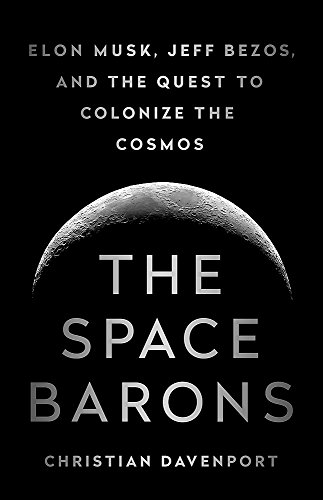
Ebook Info
- Published: 2018
- Number of pages: 320 pages
- Format: PDF
- File Size: 6.33 MB
- Authors: Christian Davenport
Description
The historic quest to rekindle the human exploration and colonization of space led by two rivals and their vast fortunes, egos, and visions of space as the next entrepreneurial frontierThe Space Barons is the story of a group of billionaire entrepreneurs who are pouring their fortunes into the epic resurrection of the American space program. Nearly a half-century after Neil Armstrong walked on the moon, these Space Barons-most notably Elon Musk and Jeff Bezos, along with Richard Branson and Paul Allen-are using Silicon Valley-style innovation to dramatically lower the cost of space travel, and send humans even further than NASA has gone. These entrepreneurs have founded some of the biggest brands in the world-Amazon, Microsoft, Virgin, Tesla, PayPal-and upended industry after industry. Now they are pursuing the biggest disruption of all: space. Based on years of reporting and exclusive interviews with all four billionaires, this authoritative account is a dramatic tale of risk and high adventure, the birth of a new Space Age, fueled by some of the world’s richest men as they struggle to end governments’ monopoly on the cosmos. The Space Barons is also a story of rivalry-hard-charging startups warring with established contractors, and the personal clashes of the leaders of this new space movement, particularly Musk and Bezos, as they aim for the moon and Mars and beyond.
User’s Reviews
Editorial Reviews: Review “The Space Barons by Christian Davenport, a Washington Post reporter, is an exciting narrative filled with colorful reporting and sharp insights. The book sparkles because of Davenport’s access to the main players and his talent for crisp storytelling.”―Walter Isaacson, NewYork Times Book Review”The Space Barons is a pacy, smartly reported book on the new generation of entrepreneurs who are transforming the business of space… [The] book fizzes with some wonderful human stories of imagination and endeavor but also provides a broad sweep of the current state of the space industry.”―Financial Times “Davenport displays his reporting and storytelling skills. His writing is tight and, suitably for the subject matter, propulsive. He fleshes out the main protagonists with fine character vignettes.”―TheWashington Post”Highly accessible… Davenport’s access to key players, from the companies’ founders to its employees, lends authority to his account.”―Scientific Inquirer”Important and revealing”―The Weekly Standard”The Space Barons is fastidious and engrossing”―TheSpectator”Entertaining, skillfully narrated book”―The Week”In The Space Barons: Elon Musk, Jeff Bezos, and the Quest to Colonize the Cosmos, Christian Davenport tells the backstories of the billionaires who are vying for control of the emerging NewSpace industry.”―The New Yorker”Christian Davenport has written a terrific book on the new space entrepreneurs.”―Newt Gingrich”Topping my reading list for space fans this summer is The Space Barons: Elon Musk, Jeff Bezos, and the Quest to Colonize the Cosmos, Christian Davenport’s fine new book on competition in the New Space world.”―Forbes.com”In The Space Barons, Davenport lays out a compelling narrative of how Musk (SpaceX, Tesla), Jeff Bezos (Blue Origin, Amazon), Richard Branson (Virgin) and Paul Allen (Microsoft) all dreamed at an early age of the prospects of commercial space travel…Through compelling storytelling… [and] impressive research and extensive interviews.”―Winnipeg Free Press”In prose more than worthy of a staff writer at the Washington Post, Davenport glides effortlessly between biographical vignettes, engineering and financial challenges in building spacecraft, government obstacles to private space exploration, project failures and triumphs, and rivalry as ‘the best rocket fuel.'”―Seeking Alpha”Strap in, you dreamers of space travel, you lovers of invention, you admirers of the unquenchable thirst for exploration, for here is a book that will thrill you to your core… It’s a wonderful story, a thrilling adventure of literal and metaphoric highs and lows, based on interviews with the billionaires but encompassing a much broader range of reporting… A big story, told through its vividly evoked small details.”―Booklist”Readers will thrill at this lucid, detailed, and admiring account of wealthy space buffs who are spending their own money, making headlines, producing genuine technical advances, and resurrecting the yearning to explore the cosmos.”―Kirkus, Starred Review”Starting with a blank canvas, Christian Davenport has painted a comprehensive portrait of some of the most influential leaders in commercial space, and indeed of the industry itself. Well-researched and entertaining, The Space Barons gives both a rich texture to the beginnings and a tantalizing outline of the future of commercial human space travel.”―Michael Lopez-Alegria, former NASAastronaut, past president of the Commercial Space Flight Federation, andprincipal, MLA Space, LLC”A must-read. A compelling account of how today’s self-made tycoons are driven to change our world and our relationship with outer space. This is distinctly an American story, nowhere but America could these Space Barons rise, thrive, and succeed. Follow their journey into the future.”―Dr. Mark Albrecht, executive secretary of the National Space Councilunder President George H. W. Bush and author of Falling Back to Earth:A First Hand Account of the Great Space Race and the End of the Cold War”Unlike the space race of the 1950s and 1960s, the new space race is not a competition between superpowers-it is a competition among billionaires with egos and ambitions that match their fortunes. The Space Barons provides a superb behind-the-scenes look that chronicles the new space race from its beginning some two decades ago to the headlines of today. This book is a must-read for everyone who fell in love with space as a kid and still longs to reach for the heavens.”―Todd Harrison, Center for Strategic and International Studies About the Author Christian Davenport is a staff writer at the Washington Post covering the space and defense industries for the financial desk. He joined the Post in 2000, and has written about the DC-area sniper shootings, the Abu Ghraib prison scandal, and the burial problems at Arlington National Cemetery. He is a recipient of the Peabody award for his work on veterans with Traumatic Brain Injury and has been on reporting teams that were finalists for the Pulitzer Prize three times. Before joining the financial staff, Davenport was an editor on the Metro desk, overseeing coverage of local government and politics. He has also worked at Newsday, Philadelphia Inquirer, and Austin American-Statesman. As a frequent radio and television commentator, he has appeared on MSNBC, CNN, PBS NewsHour, and several NPR shows, including All Things Considered and Diane Rehm.
Reviews from Amazon users which were colected at the time this book was published on the website:
⭐Not long ago, I reviewed Elon Musk: Tesla, SpaceX, and the Quest for a Fantastic Future by Ashlee Vance, and The Everything Store: Jeff Bezos and the Age of Amazon by Brad Stone. Both books are well done. They’re the product of professional journalists who are good at what they do. But neither book comes close to Christian Davenport’s superb new book, The Space Barons: Elon Musk, Jeff Bezos, and the Quest to Colonize the Cosmos, in offering insight into the personality of these two extraordinary men who are the central characters in his book.Illuminating personal detailsThe personal details about the lives of Musk and Bezos are abundant and highly revealing. For example, here is Davenport with an anecdote from the early life of Elon Musk: “He had such concentration that as a toddler in Montessori school, his teachers would have to pick him up—in his chair—to keep him moving from task to task.” And this about Bezos: “His girlfriend from high school had once told an interviewer that Bezos had founded Amazon in order to make enough money to start a space company.” Davenport notes that Bezos “conceded that there ‘is some truth to that.'”The pivotal role of four private space companiesDavenport’s subject in The Space Barons is the pivotal role of four billionaires and the private space companies they’ve started in the emergence of the rejuvenated space industry. All four men envision lowering the cost of space travel and making it more accessible—and Davenport makes clear that they have taken great strides toward this goal. Although Musk and Bezos occupy center stage, Paul Allen (cofounder of Microsoft) and Richard Branson (the Virgin companies) also play large roles. Davenport tells the tale with great assurance in prose that is always lively and engaging. He interviewed all four of his subjects and many of their associates (and critics) as well. This is the remarkable story of four self-made billionaires whose great wealth and passion allowed them to pioneer space technology that NASA had grown too old and bureaucratic to develop itself. If humankind ever succeeds in populating the solar system, historians may conclude that the determination and resources of these men were largely responsible.Four distinctive personalitiesMusk, Bezos, Allen, and Branson are very different from one another, though each is undoubtedly brilliant in his own way, and at least three of the four are science fiction fans. Musk is the youngest of the lot—he was born in 1971—and by far the brashest and most impulsive. His company, SpaceX, has made the biggest splash to date and has generated by far the most revenue, but Musk has a bad habit of setting impossible deadlines for what he envisions as the principal goal of his efforts: building a city of one million people on Mars. He has also gotten his way at times only by suing NASA and the Pentagon. By contrast, Bezos and his company, Blue Origin, have been the tortoise to SpaceX’s hare (“Slow is smooth and smooth is fast” as compared to “Head down. Plow through the line.”) Bezos’ highly secretive company has consistently been wary of publicizing its achievements.Both Musk and Bezos (born in 1964) envision traveling into space on their own rockets. Allen and Branson, who are older—born in 1953 and 1950, respectively—do not contemplate the trip to Mars that Musk hopes to take. Allen’s part in the emergence of the new industry was for a time very limited by his fear that lives might be lost in the process; later, however, he staked out a unique project of his own: building a spaceplane larger than any airplane ever built. Branson, who is even more flamboyant than Musk, is all showman and marketer. His contribution was initially to promote the work of aircraft designer Burt Rutan, assuming the controlling interest in Rutan’s company in place of Allen and only later getting into the business of building rockets, as Musk and Bezos have been doing for nearly two decades.Differing views of humanity’s future in spaceElon Musk is single-mindedly focused on building a large city on Mars. Jeff Bezos does not share this focus. “‘There’s all kinds of interesting stuff you can do around the solar system,'” he told Davenport, “‘but the thing that’s going to move the needle for humanity the most is mining near-Earth objects and building manufacturing infrastructure in place . . . That’s the big thing.'” Given the obstacles to living on the surface of Mars that I have learned through other reading, I tend to agree with Bezos.About the authorChristian Davenport is a reporter for the Washington Post, which is owned by Jeff Bezos. He acknowledges that it is “somewhat awkward writing a book about someone who could have you fired.” However, his editor, Marty Baron, “has made it clear that [the Post] covers Jeff’s companies as it would any other” and encouraged him to write the book. The Space Barons is Davenport’s second.
⭐The chronicles of the principals outlined in this well written volume provide an excellent view of how we have gotten to our present state of space exploration and commercial development. Since it’s publication, the pace has increased and brought on new horizons and challenges. I am looking forward to the continuing story of these barons, particularly against the background of later challenges, e.g. COVID-19, the Trump administration, military developments in Afghanistan, Syria, and Ukraine, and climate change.
⭐This book is a thorough and professional review of the current state of space flight in the US. As the cover promises, it’s a tale filled with the current rock stars of capitalism: Musk, Bezos, Branson, et al. And a few names that have made history but aren’t quite as familiar: Burt Rutan, Mike Melvill, and a host of others.It’s a book of tales, not technology, and that’s great for most readers. And the stories and subplots are magnificent and glorious; just what you’d expect from men who have already achieved wealth and fame and now have the time and resources to feed the soulful flames that burn within. These are men not content to sit by the pool, but whose inner curiosity, in its immense proportions, define who they are.The book is well researched and easy to read. I definitely came away with a much fuller portrait of Musk and Bezos (a study in contrast, for sure), in particular, and while it would be impossible for any author not to have an opinion about the players, Davenport is a pro and works hard to simply tell their stories and not show his own cards.I only have two issues with the book. The first is common to all discussion involving the tech industry. There is a lot of effort expended differentiating between the commercial space industry (Musk & Bezos), the government (NASA), and the “contractors” (Boeing, LMT, & the military-industrial complex). The commercial companies (particularly SpaceX) are, of course, the quixotic “everyman,” the feisty, never-sleeps underdog who refuses to give in to convention and who is obsessed with saving money and making time. In that narrative, NASA and the contractors are old, overweight, slow, expensive, and risk-averse.It’s the now familiar Silicon Valley (the figurative SV) narrative and it’s starting to sound a bit over-hyped and dated. Narrative is a function of perspective. Replacing the obscenely expensive latch previously used on the nose cone by the grumpy old men with the one used on the stall doors in the bathroom sounds ingenious; until it fails and we discover that the latch was expensive for a reason. It’s not the wrong idea, mind you. But the distinction between genius and rash judgment can be a subtle one that is only apparent with hindsight.Which brings me to the second concern. There is an underlying implication that NASA and the contractors all get their money from the taxpayers but the commercials companies do not. The “astropreneurs”, in other words, have skin in the game, and according to the SV narrative, that is the essence of genius and value. And that, too, is true to a point.But all of this delightful technology ultimately comes from the American people. All of the engineers, whichever entity they work for, were all educated in large part with taxpayer funds, they drive on taxpayer-funded roads, they enjoy the protection of taxpayer-funded defense, etc. It’s not that the entrepreneurial perspective is false, but it is often over-stated for the world we live in. Whether we accept it or not, we now live in a collective society; made all the more collective by technology.And on a related note, of course, there is a libertarian message from the tech entrepreneurs – regulation will kill the industry and the opportunity that is space. Again the narrative is classic tech libertarianism. But space doesn’t exist in isolation any more than tech ultimately does. If a commercial rocket plunges into a populated area, the fact is that the government/taxpayer will be expected to come to the rescue.I am as anguished by the US’ lack of commitment to space as any of the people in the book. I was a teenager when Armstrong walked on the moon and I remember it vividly. It was liberating for every man, woman, and child on the planet in a way almost nothing since has been, although the fall of the Berlin Wall came close. But we were able to do it, in part, because we responded to President Kennedy’s bold challenge as a nation. It was a collective effort.I think the space entrepreneurs covered in this book are remarkable men and women. They represent a core element of the American spirit. But at the heart of that same spirit is another American ideal; “It is amazing what can be accomplished if we don’t worry who gets the credit for it.”
⭐Disappointing. I really didn’t enjoy this book, although it took me a while to figure out why. A major reason is that not much happens in the book, it’s very repetitive without much progress. Each chapter is basically the same, a billionaire does some research, runs some tests and launches a rocket. Then in the next chapter, a billionaire does some research, runs some tests and launches a rocket. After that, a billionaire does some research, runs some tests and launches a rocket. The problem is that there is no payoff to all this rockets, the story doesn’t lead anywhere. By the end of the book they are still years away from sending people into space and decades from space tourism. This isn’t entirely the author’s fault, but they could have written about a more interesting topic. Or made the story interesting, to be honest the writing was dull.Another problem is the book is very one sided. We hear almost everything from the point of view of Elon Musk and SpaceX, to the point that the book feels mostly comprised of SpaceX press releases. (Probably because Jeff Bezos is so publicity shy). When Musk criticises NASA, we don’t get anyone else’s viewpoint, so we just have to take his word that he is the best and everyone else is inefficient or corrupt. We never hear from NASA or SpaceX’s rivals or any journalists or experts to provide context. In fact we never hear anyone who questions if it is worth investing billions in space or if any of the proposals are realistic, feasible or even worth doing.Instead it is constantly repeated about how clever and innovative SpaceX is, while Lockhead and Boeing are corrupt and wasteful. Safety standards are dumb wastes of money which our brave genius Elon Musk finds ways around. Honestly, this got really dull after a while and the book felt like an advertisement for Elon Musk and the Libertarian Party. SpaceX & Musk are presented as almost perfect and if they ever lose, it’s never because they’re not good enough but because their rivals cheated and are corrupt.All in all, a dull book that mainly parrots press releases without fully engaging with the topic.
⭐Brilliant book telling the true story which is far from over and indeed is still at the beginning of the new rush to colonise the stars. It tells of the competition between the various players and how they are achieving their goals in rather different ways and through different routes. SpaceX getting funding through sales of satellite launches and NASA contracts while Blue Origin gets funding at the present time through sales of Amazon Stock. At the end of the day though they all complement each other. Musk has his sights on Mars while Bezos is following the route laid out by the teachings of the Princeton physicist Gerard O’ Neill in his book the High Frontier. Is there room for both and the other players such as Sir Richard Branson and his Virgin Empire. Space is a big place, I’d say there is. Musk can do the exploring while Bezos can follow up with the millions of settlers who will certainly follow just like the settlers who ventured first across the atlantic from Europe then in Wagon trains heading west to California. Nobody knew then what riches were to be had and what was to happen in the future, all that they were going to find a new life. The same is going to happen now with the settlement of the Sky! People don’t actually realise this is going to happen, but the factories are being built and the designs finalised for the first of the vehicles to begin this next step in the evolution of humanity into the cosmos.
⭐Not a bad book, written in an engaging style, the writer well acquainted with the subject matter, with two discoveries for me (chapter on Andrew Beale + recovery of Saturn V engines by Bezos) but:- written in sensational “page turner” style, whichs explodes chronology and muddies the storyline- insists on putting Musk, Bezos and Branson on the same level, which was ludicrous enough in 2018 when the book was published and has only got more absurd every day since- no technical information. Nada. Zilch. Don’t expect to learn anything on rocketry- lastly gets quite repetitive after a while, hard to shake the impression that the author has recycled his stash of old WaPo articles
⭐Highly readable and well informed account of the space initiatives of Jeff Bezos and Elon Musk (and to a lesser extent Richard Branson and Paul Allen). Gives an especially interesting view of why Bezos is investing some of his Amazon billions in his space start-up, Blue Origin.
⭐Really interesting and well written. I particularly loved the tortoise vs hare angle..
Keywords
Free Download The Space Barons: Elon Musk, Jeff Bezos, and the Quest to Colonize the Cosmos in PDF format
The Space Barons: Elon Musk, Jeff Bezos, and the Quest to Colonize the Cosmos PDF Free Download
Download The Space Barons: Elon Musk, Jeff Bezos, and the Quest to Colonize the Cosmos 2018 PDF Free
The Space Barons: Elon Musk, Jeff Bezos, and the Quest to Colonize the Cosmos 2018 PDF Free Download
Download The Space Barons: Elon Musk, Jeff Bezos, and the Quest to Colonize the Cosmos PDF
Free Download Ebook The Space Barons: Elon Musk, Jeff Bezos, and the Quest to Colonize the Cosmos