

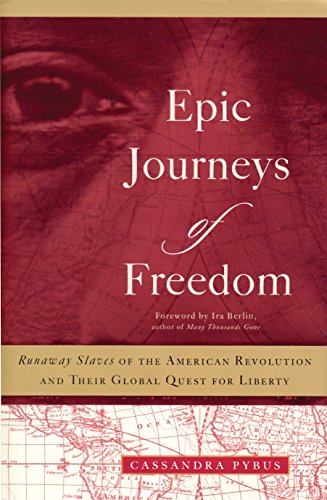
Ebook Info
- Published: 2007
- Number of pages: 304 pages
- Format: PDF
- File Size: 25.82 MB
- Authors: Cassandra Pybus
Description
During the American Revolution, thousands of slaves fled from their masters to find freedom with the British. Having emancipated themselves–and with rhetoric about the inalienable rights of free men ringing in their ears–these men and women struggled tenaciously to make liberty a reality in their lives.This alternative narrative includes the stories of dozens of individuals–including Harry, one of George Washington’s slaves–who left America and forged difficult new lives in far-flung corners of the British Empire. Written in the best tradition of history from the bottom up, this pathbreaking work will alter the way we think about the American Revolution.
User’s Reviews
Editorial Reviews: Review “Through her meticulous research and an engaging narrative, Pybus provides a superb collective biography of those slaves during the American Revolution who dared to pursue their dreams of freedom. This book would be an appropriate addition to either African-American History or Revolutionary War collections.”—Clark E. Heath (AASL) Southfield Lathrup High School, Lathrup Village, MI”This book shines because of Ms. Cassandra Pybus’s stellar research. Her description of the upheaval surrounding the American Revolution is sound . . . Cassandra Pybus’s book adds much needed historical documentation to a group of people who have largely been forgotten by history. Every school and public library should own a copy of this book.”—Christina Maria Beaird (PLA), Plainfield Public Library District, Plainfield, IL”An impressive and extremely important work.”-Library Journal, starred review”A significant contribution to contemporary studies of the Black Atlantic.” -Publishers Weekly”What a gripping narrative . . . [and] an awesome achievement.”–Alfred F. Young, author of The Shoemaker and the Tea Party About the Author Cassandra Pybus holds the Australian Research Council Chair of History at the University of Tasmania. An award-winning author who has written ten books, she is a frequent Fulbright professor and international fellow at American universities. Excerpt. © Reprinted by permission. All rights reserved. Epic Journeys of FreedomRunaway Slaves of the American Revolution and Their Global Quest for LibertyBy Cassandra PybusBeacon PressCopyright © 2007 Cassandra PybusAll right reserved.ISBN: 9780807055151Chapter OneLIBERTY OR DEATH It was early spring at Mount Vernon, the seven-thousand-acre estate of Colonel George Washington in Fairfax County, Virginia. Vestiges of winter snow lingered on the expanse of lawn that swept down to the Potomac River, while along the lovingly tended cherry walk, plump buds showed the first hint of spring blossom. The early-morning air was still raw on March 15, 1775, when the enslaved hostler at Mount Vernon prepared the colonel’s horse for his trip to the Second Virginia Convention in Richmond, a three or four days’ ride to the south. Like all the Mount Vernon slaves, Harry had only the tattered woolen jacket and the short breeches that he had worn since last summer to ward off the chill. Harry felt the cold keenly; he was from West Africa, where such bitter weather was unknown. Harry probably came to Virginia in one of several shipments of slaves from the Senegambia imported into the Upper Potomac by Thomson Mason, the brother of Washington’s close friend George Mason. Washington acquired Harry in 1763 from the estate of a deceased neighbor, one of a job lot of four people Washington purchased to be his contribution to an enslaved workforce of the Great Dismal Swamp Company. Washington was the prime mover and manager of this scheme, whereby twelve “adventurers” each contributed five slaves to the workforce in order to drain sixty square miles and establish a rice plantation. Nan was another of Washington’s acquisitions for the Dismal Swamp, and she may have been Harry’s wife, as Washington had scruples about permanently separating couples. There was also a boy, Toney, who could have been her son, as he was additional to the five adult slaves that Washington was required to contribute. By 1766, both Harry and Nan were taken from the Great Dismal Swamp to work at Mount Vernon. If they were a couple, they were not permitted to live together at Mount Vernon; Harry was employed around the Mansion House, while Nan labored on one of the outlying farms at Muddy Hole. In the spring of 1775, Washington was leaving his handsome estate to attend the Second Virginia Convention as the elected representative for Fairfax County. Despite the beguiling promise of incipient cherry blossom, these were uncertain, turbulent times in Virginia. The threat of war with Britain loomed, a prospect Washington dreaded. He was already the elected commander of a number of independent militias raised across northern Virginia, and he knew that if war came he would be the one to lead the American forces into a conflict bloodier than he had ever before witnessed. By the time Washington left Richmond to return home, a fortnight later, black frost had burned the blossom from all his fruit trees and his prospect for continuing with rustic pleasures at Mount Vernon was equally blighted. With a heavy heart he wrote his brother, “It is my full intention to devote my life and fortune to the cause we are engaged in, if need be.” The Second Virginia Convention chose to meet in the small town of Richmond rather than the colonial capital of Williamsburg in order to avoid the wrath of the royal governor, John Murray, Earl of Dunmore. They selected the Henrico County church on a hill above the village because the recent addition of a north wing to the pleasant wooden building made it the largest in the town. Even so, the church could barely contain all the 127 delegates who converged on Richmond from all over the colony on March 20. For the townsfolk of Richmond to have the colonial elite debating matters of great urgency in their church was cause for much excitement. Word must have spread like wildfire about Patrick Henry’s electrifying performance on March 23, when he urged that the reluctant delegates must prepare to resist the British. With his face flushed with passionate intensity, Henry laid out the choice Virginians faced between freedom and enslavement. “Is life so dear, or peace so sweet, as to be purchased at the price of chains and slavery?” he demanded, his voice rising to a crescendo. “Forbid it, Almighty God! I know not what course others may take; but as for me …”-he allowed an exaggerated pause while he held an ivory letter opener poised above his heart-“give me liberty or give me death!” With this emotive allusion to Addison’s play Cato, which had a profound influence on so many of the Virginia gentry, Henry invited his fellow delegates transform their provincial lives into a theater of heroic resistance and republican virtue. Washington, too, was a devotee of Cato and he shared Henry’s assessment of the stark choices facing the colonists, even though he remained silent in the debate that followed Henry’s thunderbolt. In his more prosaic style, he had said much the same thing six months earlier when he wrote to his friend Bryan Fairfax, “The crisis is arrived when we must assert our rights, or submit to every imposition that can be heap’d upon us; till custom and use, will make us as tame, and abject slaves, as the blacks we rule over with such arbitrary sway.” Henry’s rhetorical flourish gave a heroic gloss to sentiments reverberating through the colony for more than a year. The cries of “liberty” heard at rowdy gatherings at the county courthouse, and in the ardent talk swirling about the streets of every town, were discreetly absorbed by enslaved people who mingled unobtrusively in the excitable crowd. Passionate chatter about liberty and despotism, which animated the dining tables and drawing rooms of Virginian plantations, was not lost on the footmen and cooks, the valets and maids, who were as much a fixture of the plantation house as the furniture. At Mount Vernon, Harry may well have listened with more than idle interest to the colonel’s views about the tyranny of the British masters and the inviolable concept of liberty. He had briefly managed to achieve the condition of liberty when he ran away on July 29, 1771, after being transferred from the Mansion House to work on the construction of a mill nearly three miles away, near the newly acquired Ferry Farm. He was soon caught, in response to advertisements Washington had placed, and returned to Ferry Farm. After a year, he was again put to work at Mansion House in 1773. Though he made no further attempt to abscond, Harry had not abandoned the idea of liberty that now so animated his master. Even if Washington had been canny enough to send his slaves out of earshot, it would not have been possible to quarantine the ideas that he discussed with his friends and neighbors. Snatches of talk overheard were almost instantaneously channeled from plantation to plantation through the complex networks of the enslaved community. In the Tidewater region, dominated by long-established plantations with a large slave workforce, the slave quarters would house twenty or more people who were related, and they were likely to have other siblings, spouses, uncles, aunts, and cousins living within the neighborhood. These people had intricate means of communication, barely understood by the master. Under the cover of darkness, they would congregate together for songs and storytelling, and the word would spread. On Sunday, they would come together from all over the county to sell the produce raised in their family plots and to trade information. “The Negroes have a wonderfull art of communicating intelligence among themselves,” two southern planters explained to John Adams. “It will run severall hundreds of miles in a week or a fortnight.” The Mansion House at Mount Vernon employed an enslaved workforce of up to fifty people who lived communally in a large, two-storied frame structure across the lane from the blacksmith’s forge, known as the House for Families. Here the volatile political events that so engaged Colonel Washington were rehearsed in talk, song, and dance. In early May, when Washington rode off in his carriage to attend the Continental Congress in Philadelphia, the House for Families must have been humming with news from Massachusetts about pitched battles with British regulars at Concord and Lexington. Speculation, too, perhaps, that the master had packed his militia uniform in the expectation that he would be asked to command the Patriot forces against the British. News of the elevation of the master to General Washington, Commander in Chief of the Continental Army, would surely have triggered celebrations in the House for Families and gleeful anticipation of his bloody confrontation with the three British generals who had arrived with the British army in Boston. The message Harry extracted from all this heady revolutionary tumult was that if King George III was now the master’s enemy, then it was to the king’s men that he would entrust his aspirations for freedom. The young James Madison intuitively understood that there was a potential for danger in the revelry in the slave quarters. A few months earlier, Madison had warned a friend that if hostilities did break out the British would promote a slave revolt. Trouble of this sort had already been instigated, he confided. “In one of our counties lately a few of those unhappy wretches met together and chose a leader who was to conduct them when the English troops should arrive-which they foolishly thought would be very soon and that by revolting to them they should be rewarded with their freedom.” He was pleased to report that the plot had been discovered and “proper precautions taken to prevent the infection.” Madison, who regarded slaveholding with distaste, chose not to elaborate about the “proper precautions” taken in this instance. Very likely, the “unhappy wretches” were savagely flogged and mutilated, although some may have been dispatched to the West Indies, a common practice for dealing with refractory slaves. As a final caution, Madison advised, it would be “prudent such attempts should be concealed as well as suppressed.” By the summer of 1775, he must have realized what a Herculean and grisly task it would be to arrest the contagion of liberty, since the air was thick with infection issuing from the mouths of impassioned slave owners. A great deal more in the way of “proper precautions” would be required. Anxiety about a slave insurrection was heightened when the embattled royal governor of Virginia removed all the gunpowder from the magazine in the colonial capital at Williamsburg on April 20, 1775. Confronted by an outraged citizenry, who believed Lord Dunmore had acted in order to expose them to the mercy of their slaves, the governor inflamed passions by announcing what he would do in the case of any retaliation: “I shall be forced to arm my own Negroes and receive all others that will come to me, who I shall declare free.” Given that the planters of Virginia held some 180,000 people enslaved, to even hint at such a thing was truly shocking. Prominent Loyalists insisted that the governor would use such tactics if attacked, but their reassurance did nothing to diminish the terror of white Virginians for whom, it was said, “even the whispering of the wind was sufficient to rouze their fears.” At that time, a group of unidentified slaves had taken their lives in their hands to call on the governor and offer their service in support of the king, only to have him turn them away. In his besieged position in the governor’s mansion, Dunmore was not prepared to risk more fury from the Williamsburg populace. His threats to free the slaves had “stirred up fears in them which cannot easily subside,” he explained to the secretary of state in England; “as they know how vulnerable they are in that particular.” By June, however, he had been forced to take refuge on a British warship in the James River (and to send his wife back to England) and he was only too happy to take advantage of the offer of service from fugitive slaves. From the relative safety of HMS Fowey, Dunmore began to assemble a squadron to strike back at the rebellious Virginians, welcoming any runaways that were able to make their way across to his fleet. At first the British response was equivocal; some runaways were returned to their outraged owners, but the British consistently refused to hand over a runaway pilot who knew the waterways of Chesapeake intimately. Throughout the summer tenders from the ships cruised up and down the river, openly inciting slaves to come on board, spreading indignation and alarm throughout the Tidewater. In late October, the town of Hampton came under fire from a small collection of British boats, providing stark evidence that the British fully intended to use enslaved people against white Virginians, and the news raised the country “into perfect phrensy,” so Thomas Jefferson reported. By this time the “proper precautions” to prevent slave defections were well in place. Throughout the Tidewater slave patrols were increased and exemplary punishment was applied to runaways. A fifteen-year-old girl who had fled from her master and tried unsuccessfully to reach Dunmore received a flogging of eighty lashes followed by hot embers poured on her lacerated back. Enslaved Virginians understood that the terrible risks involved in running away had never been greater, yet still they went. In August 1775, Edward Hack Moseley, a prominent planter of Princess Anne County near Portsmouth, placed a notice for three runaways between the ages of sixteen and eighteen that he named Jack, Daniel, and Peter. Since Moseley was a friend of Lord Dunmore, and had just been appointed Lieutenant of Princess Anne County, his runaways probably did not head for Dunmore’s nearby fleet. More likely they did as Moseley supposed and took refuge in one of the towns of Portsmouth, Hampton, or Norfolk. Planters were consistently angered by the willingness of white artisans and tradespeople in the towns to shelter runaways rather than return them. Jack appears to have found work with Captain John Cunningham, an Irish sea captain who was a regular visitor to the James River and whose ship was in Portsmouth in order to mend a mast that had been damaged on the voyage from Ireland. Even if Moseley’s runaways were not making a beeline for Dunmore’s ships, plenty of fugitives were. About a hundred had reached his fleet by November 1775. This was exactly the kind of “tampering with the slaves” that James Madison had most feared. “To say the truth,” he confided to his friend, “that is the only part in which this Colony is vulnerable … we shall fall like Achilles by the hand of one that knows that secret.” Lord Dunmore knew that secret. Made bold by the idea of what might be accomplished should the trickle of runaways become a flood, Dunmore declared martial law on November 14, 1775, and published a proclamation that freed “all indented Servants, Negroes, or others … that are able and willing to bear Arms.” He made no distinction between Patriot or Loyalist property. Here was every white Virginian’s nightmare. The proclamation came as such a shock to Loyalist William Byrd III that he immediately offered his services to the Patriots. When Thomas Jefferson was drafting the Declaration of Independence the following summer, he was still so outraged by Dunmore that he wrote into the document his most impassioned charge against George III, accusing the king of “exciting those very people to rise in arms … and to purchase that liberty of which he has deprived them, by murdering the people upon whom he also obtruded them: thus paying off former crimes committed against the liberties of one people with crimes which he urges them to commit against the lives of another.” George Washington, in his capacity as commander in chief of the Patriot forces, labeled Dunmore an “arch-traitor to the rights of humanity.” Dunmore must be crushed, he warned, or the momentum of slave defections would be “like a snow ball in rolling.” Continues…Excerpted from Epic Journeys of Freedomby Cassandra Pybus Copyright © 2007 by Cassandra Pybus. Excerpted by permission. All rights reserved. No part of this excerpt may be reproduced or reprinted without permission in writing from the publisher.Excerpts are provided by Dial-A-Book Inc. solely for the personal use of visitors to this web site. Read more
Reviews from Amazon users which were colected at the time this book was published on the website:
⭐A great book for a White Boy like me to read; the role of the Evil Brits in Rev War much refreshingly reversed. Thanks! tcg
⭐The first three “official” reviews of this book fail to convey the sheer original, revealing, even emotional nature of this book. Many Americans now accept that their patriotic Revolutionary ancestors–including the Founding Fathers–owned slaves. Some Americans are aware that many of these slaves fled to the British controlled areas and cities under the promise of gaining freedom. A few Americans may then know of what happened to these former slaves–how many were take off to Nova Scotia with thousands of white Loyalists. What Cassandra Pybus reveals in this book opens all this up into dimensions undreamed of by all but perhaps a literal handful of historians. And in fact, what she presents is more like a nightmare than a dream. In an impeccably researched and footnoted narrative, she first investigates those three relatively “knowns” that I referred to above, providing details that will astound most of us. And when she goes onto present the story of what happenened to most of these former slaves as they movd on not only to Nova Scotia and London but then on to Sierra Leone and Australia–well, it is history as revelation. Although Pybus stays rooted in the strictest procedures of the historian, the end effect is to feel you are reading a novel. But a novel describing events of such unnmitigated misery, of human suffering, of human cruelty, that no novelist would dare invent these happenings. I defy any reader to put the book down saying (a) “Oh, I had suspected all this might have happened” and (b) “In any case I can’t see getting especially worked up over it.” The end result is a book that both charges far more human beings than we have imagined with being cruel to African-Americans and at the same time informs us of how many of these same African-Americans endured these cruelties and utimately prevailed. In a word, I found it spellbinding!
⭐I was looking for links to an ancestor of mine who came to Australia via joining British troops in America, then going with them to U.K and finally deported on 1st fleet. Found many references in this book and have filled a big gap in family history.
⭐The book was a little confusing at first but never the less did its job in telling a bunch of great stories. I am sure that many did not know of these experiences during that time period. I glad my professor made us read it.
⭐I am simply humbled and stunned at how mind-changing this book is.Epic Journeys of Freedom recounts the tribulations of Runaway Slaves during the American War of Independence. It opens the door to a whole movement of slaves who jumped at the chance at collaborating with the British “loyalists” in exchange for their freedom – and out of pure hatred at their American slave-holding revolutionaries.The likes of George Washington and Co. are portrayed for what their are: inspired ideologues with a sinister background of slave brutality. That they could talk about the rights of man while pleasantly looking at the suffering and torturing of their slaves (Washington personally saw to the punishment in quite sadistic ways of any slave attempting to flee) shows the inherent hypocrisy of the times.The journeys of these runaway slaves, nonetheless, was but a straight one. They were used and exploited in their quest for a self-made free life, and would end up shipped to the furthers corners of the Earth – to Nova Scotia in Canada, to Australia, to Sierra Leone. The experiences they all endured are touching, moving, gripping. I simply could not put the book down, and i must confess that my eyes were watering quite often.
⭐While most American schoolchildren in the U.S. are taught of the American Revolution as a glorious struggle of backwoods colonials fighting for their freedom and independence against the world’s most powerful empire, few, if any, are taught of the great tragedy experienced by African-Americans, many of them former slaves, who fought with or sided with the British in the hopes that they would secure their individual freedoms. I was one of those many schoolchildren inculcated in the myth of the Revolution, but I have since expanded my knowledge of the Revolution beyond the history texts. Despite this, I was not aware of the globe-circling stories of former slaves of the American Revolution as carefully documented and researched by Cassandra Pybus in “Epic Journeys of Freedom”. But now that I am, I hope these stories become more widely known as examples of not only the failure of the American Revolution to live up to its ideals, but more important, as examples of the unquenchable human desire for freedom and the extent to which brave men and women will go to find it.I cannot do justice to any of the individual stories in “Epic Journeys of Freedom” in this or any review, and much of the immediacy and drama of the stories come from the first-hand sources of the era that Pybus has collected and orchestrated into compelling narratives. By retelling the history of individual lives set within the context of the American Revolution and its aftermath, Pybus reduces a mythic, seminal event in America’s founding to a personal level. The eyes through which we see the Revolution, however, belong not to the victors, but to the disenfranchised and dehumanized; America’s victory meant their enslavement, so they fled the land of liberty to seek their own freedom across distant borders and oceans.Some may ask why bring up more stories of America’s past injustices when we have come so far in addressing them. We read these stories and remember their lives because they remind us why men and women have risked all and died for their freedom. They remind us of both our worse and better natures, and offer hope for a more just and free world.
⭐I am simply humbled and stunned at how mind-changing this book is.Epic Journeys of Freedom recounts the tribulations of Runaway Slaves during the American War of Independence. It opens the door to a whole movement of slaves who jumped at the chance at collaborating with the British “loyalists” in exchange for their freedom – and out of pure hatred at their American slave-holding revolutionaries.The likes of George Washington and Co. are portrayed for what their are: inspired ideologues with a sinister background of slave brutality. That they could talk about the rights of man while pleasantly looking at the suffering and torturing of their slaves (Washington personally saw to the punishment in quite sadistic ways of any slave attempting to flee) shows the inherent hypocrisy of the times.The journeys of these runaway slaves, nonetheless, was but a straight one. They were used and exploited in their quest for a self-made free life, and would end up shipped to the furthers corners of the Earth – to Nova Scotia in Canada, to Australia, to Sierra Leone. The experiences they all endured are touching, moving, gripping. I simply could not put the book down, and i must confess that my eyes were watering quite often.
⭐A must-read for anyone who wants to understand the Black Loyalist experience.
Keywords
Free Download Epic Journeys of Freedom: Runaway Slaves of the American Revolution and Their Global Quest for Liberty in PDF format
Epic Journeys of Freedom: Runaway Slaves of the American Revolution and Their Global Quest for Liberty PDF Free Download
Download Epic Journeys of Freedom: Runaway Slaves of the American Revolution and Their Global Quest for Liberty 2007 PDF Free
Epic Journeys of Freedom: Runaway Slaves of the American Revolution and Their Global Quest for Liberty 2007 PDF Free Download
Download Epic Journeys of Freedom: Runaway Slaves of the American Revolution and Their Global Quest for Liberty PDF
Free Download Ebook Epic Journeys of Freedom: Runaway Slaves of the American Revolution and Their Global Quest for Liberty