

Ebook Info
- Published: 2010
- Number of pages: 793 pages
- Format: PDF
- File Size: 4.03 MB
- Authors: Isabel Wilkerson
Description
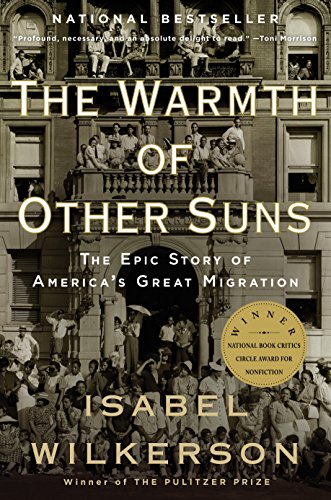
NATIONAL BOOK CRITICS CIRCLE AWARD WINNER • NEW YORK TIMES BESTSELLER • In this beautifully written masterwork, the Pulitzer Prize–winnner and bestselling author of Caste chronicles one of the great untold stories of American history: the decades-long migration of black citizens who fled the South for northern and western cities, in search of a better life.From 1915 to 1970, this exodus of almost six million people changed the face of America. Wilkerson compares this epic migration to the migrations of other peoples in history. She interviewed more than a thousand people, and gained access to new data and official records, to write this definitive and vividly dramatic account of how these American journeys unfolded, altering our cities, our country, and ourselves. With stunning historical detail, Wilkerson tells this story through the lives of three unique individuals: Ida Mae Gladney, who in 1937 left sharecropping and prejudice in Mississippi for Chicago, where she achieved quiet blue-collar success and, in old age, voted for Barack Obama when he ran for an Illinois Senate seat; sharp and quick-tempered George Starling, who in 1945 fled Florida for Harlem, where he endangered his job fighting for civil rights, saw his family fall, and finally found peace in God; and Robert Foster, who left Louisiana in 1953 to pursue a medical career, the personal physician to Ray Charles as part of a glitteringly successful medical career, which allowed him to purchase a grand home where he often threw exuberant parties.Wilkerson brilliantly captures their first treacherous and exhausting cross-country trips by car and train and their new lives in colonies that grew into ghettos, as well as how they changed these cities with southern food, faith, and culture and improved them with discipline, drive, and hard work. Both a riveting microcosm and a major assessment, The Warmth of Other Suns is a bold, remarkable, and riveting work, a superb account of an “unrecognized immigration” within our own land. Through the breadth of its narrative, the beauty of the writing, the depth of its research, and the fullness of the people and lives portrayed herein, this book is destined to become a classic.
User’s Reviews
Reviews from Amazon users which were colected at the time this book was published on the website:
⭐This book is a meticulously researched saga of the Great Migration of African Americans in the Jim Crow South to the West and North. The narrative follows three brave individuals on their journeys. It is a amazing achievement about real heros, packed with raw history.I’m at a loss as to how to write a review worthy of this masterpiece. Ms. Wilkerson’s exemplary storytelling and years of interviews and research and her own history come together to tell this incredible story. She writes about the best and worst of humanity from punishing lynchings to unyielding courage and perseverence of the oppressed.Here are a few of the many passages that stayed with me.”A series of unpredictable events and frustrations led to the decisions of Ida Mae Gladney, George Swanson Starling, and Robert Pershing Foster to leave the South for good. Their decisions were separate and distinct from anything in the outside world except that they were joining a road already plied decades before by people as discontented as themselves. A thousand hurts and killed wishes led to a final determination by each fed-up individual on the verge of departure, which, added to millions of others, made up what could be called a migration.””Any migration takes some measure of energy, planning, and forethought. It requires not only the desire for something better but the willingness to act on that desire to achieve it. Thus the people who undertake such a journey are more likely to be either among the better educated of their homes of origin or those most motivated to make it in the New World, researchers have found.””Contrary to modern-day assumptions, for much of the history of the United States—from the Draft Riots of the 1860s to the violence over desegregation a century later—riots were often carried out by disaffected whites against groups perceived as threats to their survival. Thus riots would become to the North what lynchings were to the South, each a display of uncontained rage by put-upon people directed toward the scapegoats of their condition. Nearly every big northern city experienced one or more during the twentieth century. Each outbreak pitted two groups that had more in common with each other than either of them realized. Both sides were made up of rural and small-town people who had traveled far in search of the American Dream, both relegated to the worst jobs by industrialists who pitted one group against the other. Each side was struggling to raise its families in a cold, fast, alien place far from their homelands and looked down upon by the earlier, more sophisticated arrivals. They were essentially the same people except for the color of their skin, and many of them arrived into these anonymous receiving stations at around the same time, one set against the other and unable to see the commonality of their mutual plight.”In the following, Robert Pershing Foster tries to get a hotel room to rest in New Mexico on his long drive to California:”He replayed the rejections in his mind as he drove the few yards to the next motel. Maybe he hadn’t explained himself well enough. Maybe it wasn’t clear how far he had driven. Maybe he should let them know he saw through them, after all those years in the South. He always prepared a script when he spoke to a white person. Now he debated with himself as to what he should say.He didn’t want to make a case of it. He never intended to march over Jim Crow or try to integrate anybody’s motel. He didn’t like being where he wasn’t wanted. And yet here he was, needing something he couldn’t have. He debated whether he should speak his mind, protect himself from rejection, say it before they could say it. He approached the next exchange as if it were a job interview. Years later he would practically refer to it as such. He rehearsed his delivery and tightened his lines. “It would have been opening-night jitters if it was theater,” he would later say.He pulled into the lot. There was nobody out there but him, and he was the only one driving up to get a room. He walked inside. His voice was about to break as he made his case.“I’m looking for a room,” he began. “Now, if it’s your policy not to rent to colored people, let me know now so I don’t keep getting insulted.” A white woman in her fifties stood on the other side of the front desk. She had a kind face, and he found it reassuring. And so he continued.“It’s a shame that they would do a person like this,” he said. “I’m no robber. I’ve got no weapons. I’m not a thief. I’m a medical doctor. I’m a captain that just left Austria, which was Salzburg. And the German Army was just outside of Vienna. If there had been a conflict, I would have been protecting you. I would not do people the way I’ve been treated here.”It was the most he’d gotten to say all night, and so he went on with his delivery more determinedly than before. “I have money to pay for my services,” he said. “Now, if you don’t rent to colored people, let me know so I can go on to California. This is inhuman. I’m a menace to anybody driving. I’m a menace to myself and to the public, driving as tired as I am.”She listened, and she let him make his case. She didn’t talk about mistaken vacancy signs or just-rented rooms. She didn’t cut him off. She listened, and that gave him hope.“One minute, Doctor,” she said, turning and heading toward a back office.His heart raced as he watched her walk to the back. He could see her consulting with a man through the glass window facing the front desk, deciding in that instant his fate and his worth. They discussed it for some time and came out together. The husband did the talking. He had a kind, sad face. Robert held his breath. “We’re from Illinois,” the husband said. “We don’t share the opinion of the people in this area. But if we take you in, the rest of the motel owners will ostracize us. We just can’t do it. I’m sorry.”Wilkerson wrote this about Harlem and the Harlem Renaissance:“The basic collapse of all organized efforts to exclude Negroes from Harlem was the inability of any group to gain total and unified support of all white property owners in the neighborhood,” Osofsky wrote. “Landlords forming associations by blocks had a difficult time keeping people on individual streets united.”The free-spirited individualism of immigrants and newcomers seeking their fortune in the biggest city in the country thus worked to the benefit of colored people needing housing in Harlem. It opened up a place that surely would have remained closed in the straitjacketed culture of the South.By the 1940s, when George Starling arrived, Harlem was a mature and well-established capital of black cultural life, having peaked with the Harlem Renaissance, plunged into Depression after the 1929 stock market crash, climbed back to life during World War II, and, unbeknownst to the thousands still arriving from Florida, the Carolinas, Georgia, and Virginia, not to mention Jamaica and the rest of the Caribbean when George got there, was at that precise moment as rollickingly magical as it was ever likely to be.Seventh Avenue was the Champs-Élysées, a boulevard wide and ready for any excuse for a parade, whether the marches of the minister Father Divine or several thousand Elks in their capes and batons, and, on Sunday afternoons, the singular spectacle called The Stroll. It was where the people who had been laundresses, bellmen, and mill hands in the South dressed up as they saw themselves to be—the men in frock coats and monocles, the women in fox stoles and bonnets with ostrich feathers, the “servants of the rich Park and Fifth Avenue families” wearing “hand-me-downs from their employers,” all meant to evoke startled whispers from the crowd on the sidewalk: “My Gawd, did you see that hat?”Virtually every black luminary was living within blocks of the others in the elevator buildings and lace-curtained brownstones up on Sugar Hill, from Langston Hughes to Thurgood Marshall to Paul Robeson, Duke Ellington, and W. E. B. Du Bois, on and off, to Richard Wright, who had now outgrown even Chicago, and his friend and protégé Ralph Ellison, who actually lived in Washington Heights but said it was close enough to be Harlem and pretty much considered it so.”If I were to approach reading this book again for the first time, I would slow down and savor it. I might expect to read it over a period of several months instead of over a week as I did. There is so much to take in. I rushed it.
⭐I will have to say Isabel Wilkerson is a fabulous storyteller and writer. The way she incorporated individual histories along with current events and relative topics was brilliant. I really was surprised because I had such low expectations of what this book had to offer. I delayed reading this book for over two years because I just didn’t want to be inundated with her progressive retelling of our history. While I would give it five stars on the way she communicated this powerful journey of so many people during this period, I wish she would’ve stopped there because I would be able to recommend this to many people. She gets less than zero stars for keeping it about the facts and not subtly trying to influence people that America has a caste system.If you’ve never studied any part of history, this book is a very dangerous and slanted opinionated version of what took place during this period. To talk about a period piece during the 20th century and use the word “xenophobic” really shows her true message. It’s not enough for her to just let the real stories stand alone by just sharing the stories in and of themselves. She hast to infiltrate throughout the book this destructive opinion that American history includes a caste system. I don’t want to go into too much detail because it’s not worth my time and energy. Those who read it and don’t see it for what it is whatever going to really engage in what really happened but just regurgitate this 1619 version of what took place in our country. But for so many people to recommend this books with such accolades reveals how successful the public school system has been in retelling and revising what actually happened in history. most people don’t even know when they’re being sold a bill of goods these days. They’re so worried about being racist that they’ll accept whatever hogwash is fed to them under the name of “the real deal“.I will have to say that I’m very impressed that while she denied most of the damage done by the Democratic Party, she in turn did not call out the Republicans as well. She missed so much of why this was such a tumultuous for blacks in the south. I find it interesting that she does not include any part of our history from the Civil War ending to the end of Reconstruction. So much is missed by what amazing things did happen before reconstruction ended in the south to establish a new way of life for the freed blacks. For example so much of the south elected black representatives in the new government that was reestablished after the Confederates tried to destroy it. didn’t see any of that mentioned in this book. But she conveniently overlooked that section. Check out David Barton’s Black and White to see just how significant what she overlooked was.By presenting all of the history I think she would’ve established better credibility with her desire to retail history, but I don’t think that was her main goal. So while I will say kudos to a brilliant piece of literature, I will say stay away from it until you actually know history because she will influence and deceive you into believing something about our country that never happened. but man do we grieve about the horrendous behavior by some crazy notion that it was ever OK to treat any human less than Image bearers of God.
⭐An excellent history of the Great Migration, as told through the experiences of three migrants who moved at different times and for different reasons: one who migrated from Mississippi to Chicago in 1937, one who migrated from Florida to New York in 1945, and one who migrated from Louisiana to Los Angeles in 1953.The first 183 pages are a detailed account of the three main characters’ lives before they left the South, a section of the book that I felt was far too long. The author could have conveyed the same information in about a hundred and thirty fewer pages.The following chapters are far more interesting and tell how these people made their way across the country — I love travel stories and this section of the book in particular is especially well written — and document their varied lives in their new homes, from their arrival as young people to their deaths as pensioners many decades later.One key issue that is frequently touched on but never fully addressed is the impact that the arrival of hundreds of thousands of black migrants had on the receiving cities and on the places the migrants left.For example, is Chicago a better city now that so many of its residents are black rather than white? Is the South worse off now that it has lost so many black people?I feel that a chapter on this particular topic would have been a good way to end the book and to analyse the overs effects of the Migration.Overall, a thoroughly well-written, well-researched and enjoyable book.I learnt a lot about an important aspect of twentieth-century social history.
⭐I would highly recommend this book which describes the personal stories of 3 black Americans who moved from the South to Northern cities in the US during the Great Migration. It intersperses those stories with historical facts from the time and gives a moving, joyous and painful view into their experiences, hopes and dreams. Their stories show how much we have in common as people, regardless of race or class, and how our individual experiences drive our life choices and outcomes. A truly wonderful piece of work.
⭐I loved this book. The Warmth of Other Suns looks at the migration of Black Americans from North to South America. It chronicles the journeys of several individuals. . These weaving narratives highlight the racism faced by Black Americans in both parts of the U.S.A. Each of the narratives is engrossing and Immersive. I highly recommend this book. I received this book via netgalley in exchange for a honest review.
⭐A poignant, descriptive narrative about the many Americans migration to the Northern cities in the United States and the reasons why. The hardship they faced and the courageous decision to seek a better life but tinged with sadness at leaving behind family who they may not have seen again. A bitter sweet story of migration and the reality of prejudice in America through the years even today. Truly a must read to gain a full understanding of how the human spirit yearns for freedom and equality.
⭐What a great book. I couldn’t put it down, so interesting and beautifully written – it reads like a novel with wonderful characters. Have recommended it to so many of my friends – a must read for everyone.
Keywords
Free Download The Warmth of Other Suns: The Epic Story of America’s Great Migration in PDF format
The Warmth of Other Suns: The Epic Story of America’s Great Migration PDF Free Download
Download The Warmth of Other Suns: The Epic Story of America’s Great Migration 2010 PDF Free
The Warmth of Other Suns: The Epic Story of America’s Great Migration 2010 PDF Free Download
Download The Warmth of Other Suns: The Epic Story of America’s Great Migration PDF
Free Download Ebook The Warmth of Other Suns: The Epic Story of America’s Great Migration