

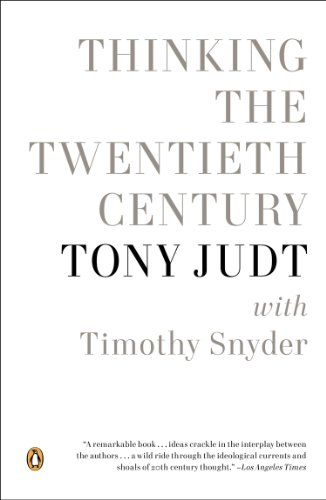
Ebook Info
- Published: 2012
- Number of pages: 434 pages
- Format: PDF
- File Size: 1.96 MB
- Authors: Tony Judt
Description
“An intellectual feast, learned, lucid, challenging and accessible.” —San Francisco Chronicle“Ideas crackle” in this triumphant final book of Tony Judt, taking readers on “a wild ride through the ideological currents and shoals of 20th century thought.” (Los Angeles Times)The final book of the brilliant historian and indomitable public critic Tony Judt, Thinking the Twentieth Century maps the issues and concerns of a turbulent age on to a life of intellectual conflict and engagement.The twentieth century comes to life as an age of ideas—a time when, for good and for ill, the thoughts of the few reigned over the lives of the many. Judt presents the triumphs and the failures of prominent intellectuals, adeptly explaining both their ideas and the risks of their political commitments. Spanning an era with unprecedented clarity and insight, Thinking the Twentieth Century is a tour-de-force, a classic engagement of modern thought by one of the century’s most incisive thinkers.The exceptional nature of this work is evident in its very structure—a series of intimate conversations between Judt and his friend and fellow historian Timothy Snyder, grounded in the texts of the time and focused by the intensity of their vision. Judt’s astounding eloquence and range are here on display as never before. Traversing the complexities of modern life with ease, he and Snyder revive both thoughts and thinkers, guiding us through the debates that made our world. As forgotten ideas are revisited and fashionable trends scrutinized, the shape of a century emerges. Judt and Snyder draw us deep into their analysis, making us feel that we too are part of the conversation. We become aware of the obligations of the present to the past, and the force of historical perspective and moral considerations in the critique and reform of society, then and now.In restoring and indeed exemplifying the best of intellectual life in the twentieth century, Thinking the Twentieth Century opens pathways to a moral life for the twenty-first. This is a book about the past, but it is also an argument for the kind of future we should strive for: Thinking the Twentieth Century is about the life of the mind—and the mindful life.Judt’s book, Ill Fares the Land, republished in 2021 featuring a new preface by bestselling author of Between the World and Me and The Water Dancer, Ta-Nehisi Coates.
User’s Reviews
Reviews from Amazon users which were colected at the time this book was published on the website:
⭐”For the first time I met Israelis who were chauvinistic in every meaning of the word: anti-Arab in a sense bordering on racism; quite undisturbed at the prospect of killing Arabs wherever possible…” (117). This was historian Tony Judt’s observation when he served as a translator in the Israeli army in 1967. Those who have heard of professor Judt may remark that, while his statement is controversial, it is nonetheless indicative of his left-leaning positions.It would be inaccurate, however, to reach such a conclusion after reading Tony Judt and Timothy Snyder’s Thinking the Twentieth Century, a text which explores and critiques in uncensored detail the dominant ideas, leaders, and events that helped shape the twentieth century. His final testament to the world before succumbing to ALS, Judt, through his discussions with renowned Yale historian Timothy Snyder and author of Bloodlands, evinces a masterpiece that will regale those who thought his greatest feat was Postwar.Stated in the foreword and reiterated in the afterword, Judt wants to impart to his reader his view of himself as an outsider. In each of the nine chapters, for example, he provides autobiographical information as a means of placing himself squarely in the context of the twentieth century but more as an observer rather than as active participant.To support this image of the outsider, we learn that the origin of his name was from a relative, which is not particularly unusual, until he adds that his relative died in Auschwitz. There is the history of his family, which includes Eastern Europe and his socialist father and grandfather, but it also includes a mother who is more interested in being British than anything else. In his youth, which he characterizes primarily as lonely, his teachers praise his intellectual prowess in history, politics, and literature, but at the same time he has to contend with a public whose anti-Semitic attitudes cast blame for the deaths of British soldiers on “those Jews.”In college, his professors recognized his intellectual abilities, but at the same time he was aware that privilege had allowed students entrance into an elite institution that they had not earned. Considering himself a Marxist at Cambridge, he never really participated in student protests with the exception of the Vietnam War. Finishing his Ph.D. at 24, he was always the youngest member of college faculty members and often in disagreement with their historiography and academic political correctness. He married and divorced twice before falling in love and marrying one of his graduate students, Jenny.While teaching in Atlanta, he struggled adapting to its climate and southern culture. He finally found his niche in New York, only to alienate himself from members of the history department, whose neo-liberal approach to history irritated him. Finally, he antagonized much of the elite media when he was a vocal opponent of the Iraq War, calling their journalism habitually reckless. Saying that one is an outsider is merely lip-service; in the case of Tony Judt, his personal life mirrored his approach to intellectual pursuits: that one should be honest enough to view reality for what it is regardless if it may hurt the sensibilities of those deemed “insiders.”And in his discussions with Timothy Snyder, Judt does not hesitate espousing what he believes to be the truth on a variety of twentieth century topics. In chapter one, for example, he states that the Jewish question was never his focus in academia, even though it certainly spills over when he writes about a “general history.”He criticizes both Jews and non-Jews for isolating themselves culturally, which unfortunately leads to stereotypes that would have disastrous human consequences. Even in the Jewish community, he expressed that there was a pecking order (common in all ethnic groups) where those of German stock were revered more than those who were Polish. He explores why Jews were overrepresented in socialist and communist groups, concluding that European democracy lowered their standing and naturally lent a stronger voice to anti-Semitism.Not only Jews but other groups found Communism alluring because it proselytized salvation to those who joined provided that they follow the dialectics of history. He even indicted those such as Jean Paul Sartre, who, even though they knew that Communism was a complete failure, still followed the party line as their “comrades” shot and tortured innocents.In chapters two, three, and four, there are many stimulating intellectual topics, but two that stand out are their discussions of Marxism and the state of Israel. Judt goes so far to suggest that the logic of Marxism and Christianity are quite similar, which explains its popularity in countries dominated by rigid religious orthodoxy. There is also his insight that Marx to him was a historical commentator rather than revolutionary agitator.Indeed, in England Marx was popular among the upper middle class, and it was the foundation of left thinking. However, he criticizes those who refused to see to its conclusion the detrimental impact of Marxist ideology upon Eastern Europe and the Soviet Union. This was one of the recurring traits of the twentieth century: the willingness to believe in an ideology even though it was painfully obvious that it enslaved rather than liberated.Chapter four, by far the most controversial, contains Judt’s excoriating views of the state of Israel. A former Zionist and Israeli soldier, Judt attacks Israel in ways that only a “Jew could” (his words) since any non-Jew who were to argue these points would automatically be called anti-Semitic. His position is that Israel is immoral for using the Holocaust to excuse its brutish behavior, and that he sees no real purpose for its existence since the Holocaust is no longer likely and because it has created greater instability in the region. There are points in chapter four where one will ask: Can he really get away with saying that? Even near his death, Judt maintains his principle that history must be told, even if it makes him a loathed outsider in his community.Chapters five, six, and seven may not be as salacious as chapter four, but Snyder and Judt address historical topics that most of us would not care to venture: fascist intellectuals, political correctness in American universities, his disagreement with multi-cultural history, and his condemnation of previous American presidents.Of particular insight on fascist intellectuals is his definition of the fascist Italian model. Not until the early 1930s did it take on a racial component, and its origins he suggests comes from those born a generation before World War I, who witnessed the destruction of their world and were looking for a new order that could help them reclaim their greatness. Fascist intellectuals were likely to be critics of modern culture, with its loose morals and its rampant focus on materialism. Part of its popularity was that many viewed it as the only alternative to Communism, which was spreading from east to west and whose followers were trying to use elections to their advantage. By no means does Judt support fascism; his brilliance is that he shows how one extreme naturally leads to another.In chapters eight and nine, Judt and Snyder tackle more current topics, such as 9/11, the wars in Iraq and Afghanistan, the growing age of insecurity, the fragility of American democracy, the welfare verses the warfare states, economic theory, the impact of privatization, the unfair distribution of resources, and the remaking of capitalism into a Chinese model.Much of these ideas can be found in Judt’s Ill Fares the Land, but nonetheless Judt is likely to have offended several people–i.e. he called Bill Clinton “smug” and George Bush “disastrous” when it came to foreign policy; he said that Republican politicians such as Newt Gingrich and Sarah Palin purvey a national fascism that has damaged the political climate; he argues that feminism advanced “privatized politics” which worked to solidify the privatization model of American life; he contends most politicians today are “mediocre at best” and lack the expertise to fully understand the issues that confront us; and surprising even social democrats, he agrees with free market proponents in that guaranteeing loans is a threat to capitalism.There is much that I have left out, partly so as not to reveal every “hot topic” that is discussed in detail, but also because there is not enough space in a review to categorize them. Certainly, Thinking the Twentieth Century is nor for the faint of heart, but then again the title should serve as a warning to those who would approach this 400 page text as historical laymen. As Judt has done in all of his books, he forces the reader to think critically about everything that transpired in the twentieth century.Having read his books, I truly understand that his goal is to provide us with a general history that can serve as clarification for those who lived through it and as a springboard for future discussion for those who want to make the twenty-first century better than it has started. The brilliance of Judt’s accomplishment is that it displays what thinking looks and sounds like beyond political labels.
⭐This book is a mix of memoires and a critical introduction to 20th C. history. As a historian specializing in contemporary issues, he brings a unique perspective to the major political problems that we have faced in our lifetimes, reviewing them for the basics but also adding his unique interpretation. Indeed, as a “major” in international relations in France, I studied every single issue that he covers in this wonderfully interesting and challenging book.Starting off in a working class family, Judt outlines how he got into Cambridge, entering an intellectual elite that he never left. It was a combination of brains and extremely hard work, plus a bit of luck in the teachers who encouraged him. He laments that the path that led him to Cambridge is rapidly vanishing as the power of money and privilege is renewing itself as he was writing.As I see it, there are 3 large issues that he attacked during his career. First, there was the French intellectual tradition, starting in about the 1930s and up to the 1980s. That was the era of Sartre, Camus, and Aron, men that I studied as a student in Paris. Though I have long since left them behind, it was an absolute delight to get his read on them, a journey that I made in a far less scholarly way than he. Second, starting as a young Zionist, he recapitulates his long journey from ardent Kibbutzim to the disillusioned critic, who saw Israel as a colonial power of questionable legitimacy. Agree with him or not, the case he makes – based on personal experience as a participant in the 1967 war that transformed Israel from a defensive power to an aggressively militaristic one – deserves consideration. Third, he covered the communist idea, from its origins in the 19C up to its end and the aftermath in Eastern Europe. This went beyond what had occurred during my studies and so was a great eye opener for me, truly new content that created an agenda of study that I wil undertake over the next decade. Again, an intellectual delight.Throughout the book, Judt offers details from his personal life, which paralleled his intellectual undertakings. It is a candid and self-critical view, from his divorces to the environment at the New York Review of Books that opened new vistas for him as a writer. He even took up Czech in his mid-30s, to complete his study of the collapse of communism. He is wonderfully candid, to the point that I am not sure I would have liked to work with the man. For example, he cheerfully admits that New York University – his career home base – is mediocre. He also calls Thomas Friedman of the NYT “execrable” as a thinker, which I admit is exactly how I perceive him. Judt was a difficult guy, never wastes time on false modesty, and displays a refreshingly biting cynicism about the pretentions of his milieu. Now that is fun!The book was written as a kind of dialogue with another historian. I can’t say that I particularly liked this style, but it offers a very fun overview of a life’s work. The co-author is no sycophant, but he doesn’t add much in my view and occasionally disrupts the unity of voice. While rigorous, it also lacks the tightness of a fully academic work, offering generalizations rather than a finely honed original thesis.Recommended as an introduction to a great thinker and a delightful summary of a life’s work. Judt will be missed.
⭐We historians and intellectuals in general have been long familiar with Judt’s ideas and thoughts about teh 20th century, and I like most of all what he has written avout intellectuals and intellectual history. So this book does not offer anything amazingly knew. But it is so well written, Snyder’s remarks or questions are all pertinent, and you can almost observe Judt’s mind working. A pleasure. I shall recommend the book to my fellow historians.
⭐I got this book from the library never having heard of Tony Judt [now deceased]. Wow what a revelation about what has been going on over the last 100 years. I’m now an addict of this author and can can recommend it for those who like to know about stuff,history etc. Good entry point [but might be more logical to start with some of his earlier work].Well done Timothy Snyder for getting this together for our benefit. A worthy tribute.
⭐Fantastic read and quite an educative and intellectual read. It enlightens the mind on the 20th century like no other book I have read so far on the subject.
⭐I wish to clarify that ‘moraliste’ is how the historian author Tony Judt describes himself in the book. The French word is both more embracing than its English equivalent and quite lacking the implied pejorative nuance. The French call their greatest writers, from Montaigne to Camus, ‘moralistes’. These French writers are far more likely than their Anglo – American counterparts to inform their work with explicit ethical engagement.Tony Judt is a graceful, erudite author. His writing is informed by his English education, he read French history at King’s College, Cambridge, his French education at Ecole Normal Superieure, and his Eastern European Jewishness; though born in London, his grandparents were Polish Jews. But I have to clarify that though informed by the preceding still his writing transcends them and acquires a genuine universality. The book bears similarity with’The Memory Chalet’ in their autobiographical dimension but similarities end there with the present book the distinctly more consummate work.The book is a spoken book. The author was afflicted in 2008 with amyotrophic lateral sclerosis, a degenerative neurological disorder that brings progressive paralysis and certain and usually rapid death. Only his brain remained intact and retained its crystalline clarity.The book began at the prompting of Timothy Snyder, a Yale historian, twenty – one years junior than the author and with complementary expertise. Though born in the United States, Timothy Snyder went to Oxford and undertook a doctorate in Polish history – he acquired facility in the languages of East – Central Europe and familiarity with the country and the history of the region. The book has a gratifyingly rich presence of East European intellectuals and historians.The book was the result of a series of conversations of Timothy Snyder with the author which were recorded and transcribed. Timothy Snyder posed the questions or posited statements to which the author responded. The resulting work is impressive in its scope, ideas, subtlety and the number of intellectuals, historians, writers, politicians, and economists that parade in it.The book is history, biography, and ethical treatise. It is a history of modern political ideas in Europe and the United States. Its subjects are power and justice, as understood by liberal, socialist, communist, nationalist and fascist intellectuals from the late nineteenth through the early twenty – first century. It is also a contemplation of the limitations (and capacity for renewal) of political ideas and of moral failures (and duties) of intellectuals in politics.The book offered me an intense intellectual stimulation and gratification.
⭐Well what else could you call a book that offers the view that the century in question really began in 1914 with the advent of the first world war, and ended in 1989 with the collapse of the Soviet Union? The twentieth century was thus not a period of time, but an event!The book is not easy reading but encourages the thought that all men really are not born equal. The reader is in awe of the mind that can describe history, economics and politics on a grand scale and retain a grasp of the realities that have shaped our lives.Not a quick or easy read but one that will leave you with plenty to think about.
Keywords
Free Download Thinking the Twentieth Century 1st Edition in PDF format
Thinking the Twentieth Century 1st Edition PDF Free Download
Download Thinking the Twentieth Century 1st Edition 2012 PDF Free
Thinking the Twentieth Century 1st Edition 2012 PDF Free Download
Download Thinking the Twentieth Century 1st Edition PDF
Free Download Ebook Thinking the Twentieth Century 1st Edition