

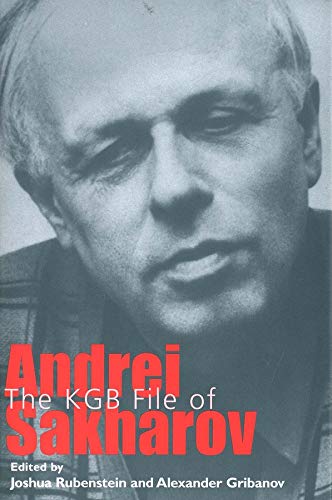
Ebook Info
- Published: 2005
- Number of pages: 448 pages
- Format: PDF
- File Size: 1.57 MB
- Authors: Joshua Rubenstein
Description
Andrei Sakharov (1921–1989), a brilliant physicist and the principal designer of the Soviet hydrogen bomb, later became a human rights activist and—as a result—a source of profound irritation to the Kremlin. This book publishes for the first time ever KGB files on Sakharov that became available during Boris Yeltsin’s presidency. The documents reveal the untold story of KGB surveillance of Sakharov from 1968 until his death in 1989 and of the regime’s efforts to intimidate and silence him. The disturbing archival materials show the KGB to have had a profound lack of understanding of the spiritual and moral nature of the human rights movement and of Sakharov’s role as one of its leading figures.
User’s Reviews
Editorial Reviews: Review “A fascinating, illuminating book, a treasure trove of information on the development of Sakharov’s views and of the ‘dissident movement’ in the Soviet Union and Eastern Europe.”―Jeane J. Kirkpatrick, Senior Fellow, American Enterprise Institute. — Jeane J. Kirkpatrick”It is fascinating and inspiring to read these documents and witness how the Soviet security apparatus with all its spies and bugging devices was unable to break the will of one indomitably courageous man.”―Richard Pipes, Baird Professor of History, Emeritus, Harvard University — Richard Pipes”Sheds fascinating light on the working of the Soviet system at the highest level―its policy towards the intelligentsia and the dissidents.”―Walter Laqueur — Walter Laqueur Book Description In this powerful book, the story of KGB surveillance and intimidation of Nobel prize laureate Andrei Sakharov from 1968 to his death in 1989 comes to light for the first time. Disturbing archival documents show how deeply the KGB feared this great figure of Soviet science, and how profoundly it misunderstood his role in the human rights movement. About the Author Joshua Rubenstein is northeast regional director of Amnesty International USA and a longtime associate at Harvard University’s Davis Center for Russian and Eurasian Studies. Alexander Gribanov is a literary scholar and archivist. He was the literary editor of the Chronicle of Current Events in Moscow, and arranged and processed the papers of Andrei Sakharov at Brandeis University. Read more
Reviews from Amazon users which were colected at the time this book was published on the website:
⭐does not give rise to revolt but to submission.” Simone Weil’s statement provides a fairly accurate overview of the low level of public dissent seen in the Soviet Union through much of its existence. The inexorable and seemingly invincible oppression took root during Stalin’s reign and remained in place in one form or another through the beginning of Gorbachev’s glasnost campaign. Yet dissent was not silenced entirely. Throughout the Soviet era a small band of individuals, mostly acting individually or in very loose coalitions, did not submit. It is clear that dissidents such as A.I. Solzhenitsyn, Anatoly Scharansky, and Roy Medvedev caused the Soviet regime no small amount of concern. But as set out in “The KGB File of Andrei Sakharov” no one caused more aggravation to the Soviet authorities than Andrei Sakharov.The editors Joshua Rubenstein and Alexander Gribanov have done an excellent job of putting the files in perspective. The book begins with a brief political biography by Rubenstein of the life of Sakharov and on the history of dissent in the USSR. Rubenstein, a director at Amnesty International has been involved in Soviet affairs for years and his deep knowledge of the subject matter shows through. The biographical introduction is concise but provides sufficient background information for the documents that follow. (I recommend Richard Lourie’s “Sakharov a Biography” and Sakharov’s “Memoirs” but Rubenstein’s introduction is sufficient.)Sakharov was the Soviet scientist primarily responsible for the development of the Soviet’s H-bomb. He was a hero of the Soviet Union and had almost unlimited, direct access to the Soviet leadership. But Sakharov grew distant from the regime. He refused membership in the Communist Party and began to take up the cause of fellow scientists who had been unfairly dismissed. As Sakharov dissent evolved the regime grew increasingly intolerant of Sakharov’s actions. Sakharov went from focusing on small issues to issues of internal democracy and global peace. It is clear that if Sakharov did not possess a vast array of nuclear secrets he would have been subject to the exile in the same manner as Alexandr Solzhenitsyn. At the same time, Sakharov was awarded the Nobel Peace Price. The Soviet authorities treated the award as part of a capitalist conspiracy to discredit it. Eventually, the authorities exiled Sakharov and his wife to the closed city of Gorky. There he was harassed and harried on a daily basis by the KGB and its agents.The Sakharov files are sorted into five sections. They follow the trajectory of Sakharov’s involvement in the dissident movement, through his exile to Gorky, and his return from internal exile and untimely death. Most of the files consist of memos and status reports from the KGB to the Central Committee of the Communist Party. Most of the reports were written by Yuri Andropov in his capacity as Chairman of the KGB.The documents are chilling on many levels. The writing is banal at best. One expects dull bureaucratic prose from low level bureaucrats but I expected more from the Chairman of the KGB. Andropov did have various insights along the way but it almost seems accidental. Second, we see evidence of the type of cheap bullying that one see in B-gangster movies from the 1950s. In one memo Andropov notes that Sakharov takes walks in the woods and notes that “during these excursions, unexpected occurrences, accidents, etc. can happen and . . . [it would be wise] to speak to Sakharov and point out to him the undesirability of doing things that might jeopardize his health.”Despite all the cheap threats, the intimidation, and the deprivation, Sakharov won his fight. Shortly after Gorbachev came to power Sakharov and Bonner returned to Moscow. At the time of his death Sakharov had emerged as the leading opposition figure in the fight over the new Soviet constitution that eventually ended the Communist Party’s monopoly on political power. The Soviet Union died shortly after Sakharov did.It is easy in the west to minimize the impact dissidents such as Andrei Sakharov had on the Soviet regime. However, as Rubenstein points out in his Introduction, former Ambassador to the U.S. Anatoly Dobrynin acknowledged that the dissidents “caused considerable damage not only at home, but also to our relations with the rest of the world.” When asked how this was possible another dissident, Andrei Amalrik made the point eloquently: “In an unfree country they behaved like free men, thereby changing the moral atmosphere and the nation’s governing traditions.”Andrei Sakharov walked free in an unfree land and in so doing confound the Soviet authorities. Rubenstein and Gribanov’s “The KGB Files of Andrei Sakharov” is an excellent place to examine Sakharov’s life as seen through the eyes of those who tried unsuccessfully to have him revert to submission.
⭐An insightful look into the way the KGB works. A must read for anyone who is interested in Russian history, especially the secret service.
⭐Absolutely sick. I couldn’t believe it. I was on the toilet reading this and it was an experience I would never forget.
⭐
Keywords
Free Download The KGB File of Andrei Sakharov (Annals of Communism Series) in PDF format
The KGB File of Andrei Sakharov (Annals of Communism Series) PDF Free Download
Download The KGB File of Andrei Sakharov (Annals of Communism Series) 2005 PDF Free
The KGB File of Andrei Sakharov (Annals of Communism Series) 2005 PDF Free Download
Download The KGB File of Andrei Sakharov (Annals of Communism Series) PDF
Free Download Ebook The KGB File of Andrei Sakharov (Annals of Communism Series)