Ebook Info
- Published: 2016
- Number of pages: 448 pages
- Format: PDF
- File Size: 32.99 MB
- Authors: Jeffrey N. Wasserstrom
Description
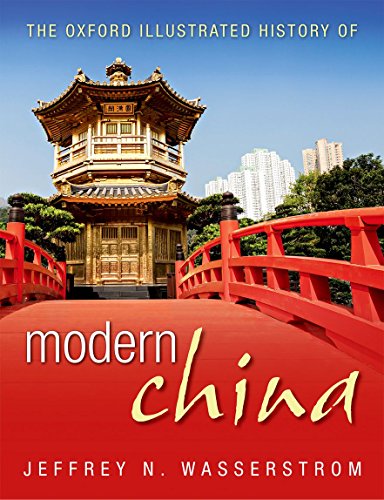
This lavishly illustrated volume explores the history of China during a period of dramatic shifts and surprising transformations, from the founding of the Qing Dynasty (1644-1912) through to the present day. The Oxford Illustrated History of Modern China promises to be essential reading for anyone who wants to understand this rising superpower on the verge of what promises to be the “Chinese century”, introducing readers to important but often overlooked events in China’s past, such as the bloody Taiping Civil War (1850-1864), which had a death toll far higher than the roughly contemporaneous American Civil War. It also helps readers see more familiar landmarks in Chinese history in new ways, such as the Opium War (1839-1842), the Boxer Uprising of 1900, the rise to power of the Chinese Communist Party in 1949, and the Tiananmen protests and Beijing Massacre of 1989. This is one of the first major efforts to come to terms with the broad sweep of modern Chinese history, taking readers from the origins of modern China right up through the dramatic events of the last few years (the Beijing Games, the financial crisis, and China’s rise to global economic pre-eminence) which have so fundamentally altered Western views of China and China’s place in the world.
User’s Reviews
Editorial Reviews: Review “The best place to start for those who wish to get a handle on modern China.” – Asian Review “This beautifully illustrated set of essays by a collection of the world’s leading China scholars makes compelling reading for the China novice and seasoned China-hand alike. It is a wonderful guide to understanding the sweeping changes and dramatic transformations that have shaped China from the dynastic era to the present day.” – Elizabeth Economy, C.V. Starr Senior Fellow and Director for Asia Studies at the Council on Foreign Relations “the best place to start for those who wish to get a handle on modern China.”- Isian ReviewR About the Author Jeffrey N. Wasserstrom is Chancellor’s Professor of History at the University of California, Irvine, and Editor of the Journal of Asian Studies. He has edited a number of books on China and is the author of four: Student Protests in Twentieth Century China: The View from Shanghai (1991), China’s Brave New World-And Other Tales for Global Times (2007), Global Shanghai, 1850-2010 (2009), and China in the 21st Century: What Everyone Needs to Know (2010; new ed. 2013), the last of which was also published by Oxford University Press. A co-founder of and contributing editor to the influential China Beat blog (2008-2012), he is a regular contributor to the press, including the New York Times and Wall Street Journal, and he co-edits the Asia section of the Los Angeles Review of Books. A member of the Board of Directors of the National Committee on U.S.-China Relations, he has been traveling to China regularly since the 1980s.
Reviews from Amazon users which were colected at the time this book was published on the website:
⭐I know this book contains essays and therefore opinion, but the Cultural Revolution Era section in the vein of wordsmithing contains some ‘logicsmithing.’.Such as “It may be tempting to view the Cultural Revolution as a lost decade for China’s development, but China enjoyed much greater international opportunities after the Cultural Revolution than before.” OK so what about **during**? So if China wants to enjoy greater economic opportunities 10 years from now they should enter a Cultural Revolution II ???.And “life expectancy, which increased from only 35 in 1949, to 65 in 1980.” OK, so what about **during**? Are you assuming the reader will just assume a linear growth line?.And another “The Cultural Revolution initially halted economic growth in 1966….The 1968 restoration of Party authority and the dispersal of the Red Guards led to two years of extraordinary growth;” Well of course if you go from 0.01% growth to 1% growth that can be looked at as 100% growth. Extraordinary!.Statements like these make the section writer look like an apologist, and it’s really annoying. The writer as far as I can tell is an academic, would he want to live in that era? IYI
⭐Well-written and comprehensive history of modern China and how it achieved power.
⭐Great overview, but not a single Chinese scholar involved in a history of China? Hmmm.
⭐Great book on China, many insightful contributions from several China hands.
⭐I prefer to have a complete history written by the same person. Rather, this one is broken down by periods and then each period is covered by a different person (or persons). This leads to different weight being given to the different periods, based upon (I’m assuming) the emphasis given by the different historians writing this.The first couple of chapters suffered from typos… not enough to seriously distract from the text but surprising in a book from Oxford. Also, the book fails to address in the later chapters the role of the PLA in China’s “economic miracle” and it’s relationship to both the military complex and the economy as a whole. Indeed, even FINDING the PLA listed in the index is a chore. You wind up going to Military Forces: Communist: People’s Liberation Army (PLA). Even then, it does not break it down further despite the PLA’s role in the Cultural Revolution and other aspects of Communist China.Nor does it seem interested in discussing China’s expansionism: the One-Belt, One-Road (OBOR) has seen the Chinese construction of overseas facilities (most notably in Djibouti) and other projects financed through international agreements which put the smaller signatories at a disadvantage. While this does make for both easier access to raw materials for China and better access for its goods to Europe and Central Asia, it also provides possible basing for China’s increasing military power projection. The book barely mentions the Spratleys and does not discuss China’s claims in the South China Sea, it’s construction of “new” territory to enforce those claims or its disregard for international law in this area. Indeed, “Spratleys” isn’t even listed in the index.I did learn what I wanted about the post-Cultural revolution China and also revisited the period from 1900 to the 1960s. Unfortunately, it was rather redundant in places and the emphasis on civil rights in one chapter and economics in another tiresome. The volume is well-illustrated with photographs and maps. I believe that it could have been a better book, however.
⭐This book sets out to be a serviceable summary of Chinese history since around 1600 ce, and that’s exactly what it is. If you want to understand our world , you have to understand China. You can’t do that without some acquaitance with the events of China’s past. If you’re like me, you probably already know something about the opium wars, the Boxer rebellion, or the Cultural Revolution, but are hazy on the details. This book will help you to fill in such events so that you can have a bit more sophisticated understanding of their impact on China today. Not a thrilling read, but definitely worth your time. PS- Another reviewer pointed out that there are apparently no Chinese scholars included in this anthology. That is an interesting point. I hadn’t thought of that while I read the book. Might be worth chewing on as you read.
⭐I was startled by the assertion in the beginning chapter that “Dream of the Red Chamber” was a Ming dynasty novel. I was of the mind of not continue to read this book as there is no excuse for that major a mistake. But I did anyway, only to find more error in historic facts as pointed out by another reviewer. No, those are not typos.If one can get over some of these errors, this is kind of an introductory survey of modern China history. Of course, books can be written on the subject matter of each chapter. So this book is best read by beginning students of Chinese history. This makes the errors in this book all the more regrettable, as this may be the only Chinese history book read by these readers.As for the title of this book, yes there are some illustrations to go with each chapter. But it’s still a text-based book, the illustrations do not illustrate too much of Chinese history.I cannot recommend this book.
⭐I wish someone had reviewed the book before it is published. I won’t read a book on the historyof China that can’t get the basics right, e.g., Yongle emperor is the son of the Hongwu emperor,(who founded the Ming dynasty), not his grandson, as claimed in the book (at least in theKindle version).
⭐Excellent
⭐Ottimo acquisto. Il libro è in buone condizioni ed è arrivato puntualmente. Consigliato a chi vuole “vedere” la storia della Cina da un punto di vista originale, senza però mettere in secondo piano la qualità delle informazioni.
⭐
Keywords
Free Download The Oxford Illustrated History of Modern China 1st Edition in PDF format
The Oxford Illustrated History of Modern China 1st Edition PDF Free Download
Download The Oxford Illustrated History of Modern China 1st Edition 2016 PDF Free
The Oxford Illustrated History of Modern China 1st Edition 2016 PDF Free Download
Download The Oxford Illustrated History of Modern China 1st Edition PDF
Free Download Ebook The Oxford Illustrated History of Modern China 1st Edition