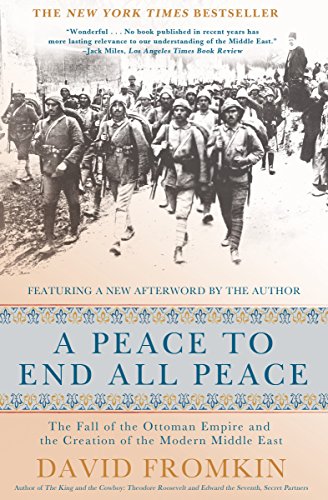
Ebook Info
- Published: 2009
- Number of pages: 688 pages
- Format: PDF
- File Size: 6.41 MB
- Authors: David Fromkin
Description
Published with a new afterword from the author―the classic, bestselling account of how the modern Middle East was createdThe Middle East has long been a region of rival religions, ideologies, nationalisms, and ambitions. All of these conflicts―including the hostilities between Arabs and Israelis, and the violent challenges posed by Iraq’s competing sects―are rooted in the region’s political inheritance: the arrangements, unities, and divisions imposed by the Allies after the First World War.In A Peace to End All Peace, David Fromkin reveals how and why the Allies drew lines on an empty map that remade the geography and politics of the Middle East. Focusing on the formative years of 1914 to 1922, when all seemed possible, he delivers in this sweeping and magisterial book the definitive account of this defining time, showing how the choices narrowed and the Middle East began along a road that led to the conflicts and confusion that continue to this day.A new afterword from Fromkin, written for this edition of the book, includes his invaluable, updated assessment of this region of the world today, and on what this history has to teach us.
User’s Reviews
Editorial Reviews: Review “Wonderful…No book published in recent years has more lasting relevance to our understanding of the Middle East.” ―Jack Miles, Los Angeles Book Review“Extraordinarily ambitious, provocative and vividly written…Fromkin unfolds a gripping tale of diplomatic double-dealing, military incompetence and political upheaval.” ―Reid Beddow, Washington Post Book World“Ambitious and splendid…An epic tale of ruin and disillusion…of great men, their large deeds and even larger follies.” ―Fouad Ajami, The Wall Street Journal“[It] achieves an ideal of historical writing: its absorbing narrative not only recounts past events but offers a useful way to think about them….The book demands close attention and repays it. Much of the information here was not available until recent decades, and almost every page brings us news about a past that troubles the present.” ―Naomi Bliven, The New Yorker“One of the first books to take an effective panoramic view of what was happening, not only in Egypt, Palestine, Turkey, and the Arab regions of Asia but also in Afghanistan and central Asia….Readers will come away from A Peace to End All Peace not only enlightened but challenged–challenged in a way that is brought home by the irony of the title.” ―The New York Times Book Review About the Author David Fromkin (1932-2017) was a professor at Boston University and the author of several acclaimed books of nonfiction, including A Peace to End All Peace, The King and the Cowboy: Theodore Roosevelt and Edward the Seventh, Secret Partners. He lived in New York City.
Reviews from Amazon users which were colected at the time this book was published on the website:
⭐This is the story, from 1914 until 1922, of how the Allies, especially Britain, the United States, France, Italy, Greece, and Russia, tried to exert influence and control over the factious governments of the Middle East, who resented foreign intrusion. Here are some highlights from this exhaustively researched book.THE EMERGENCE OF THE YOUNG TURKSPrior to WWI, ambitious new men such as Enver Pasha, Mehmed Talaat Bey, and Ahmed Djemal Pasha, also known as the Young Turk Party, took power in the Ottoman Empire, which had not kept up with European intellectual, industrial, and military progress, in the hope of bringing it into the 20th century. For example, the primary mode of Middle Eastern transportation was the caravan of camels, horses, mules, and animal-drawn carts. This could not compete against the foreign-held railroads and steamships. The Young Turk Party also resented when European powers intervened in defense of Christian minorities and Christian rights. Nevertheless, the young leaders sought a European ally who could provide money and military support so they could preserve and build their empire.THE DARDANELLES AND GALLIPOLIIt was always mistakenly believed, even by the general public, that Winston Churchill had started the war between Turkey and the Allies by authorizing the seizure of the German battleships, the Goeben and Breslau. But it was Enver and Germany who had done so. In fact, it was not known until years later, that Enver had secretly executed a treaty of alliance with Germany PRIOR to Britain seizing these ships. Churchill was also blamed for the failed Dardanelles plan. This was the strategy of sending Allied ships and troops through the Dardanelles, up the Black Sea, and attacking Germany’s southern border. This would then require thousands of German troops to be be pulled from the WWI trenches, possibly winning the war for the Allies. But the British admirals and generals did not listen to Churchill. Had they done so, the Dardanelles would have been an Allied victory incurring only a few hundred causalities rather than the actual 200,000 lost. The incompetent British Admiral Carden, charged with mine-sweeping the Dardanelles, lost his nerve when fired upon by small arms Turkish fire, even though he had lost no ships nor suffered any casualties! Also, Gallipoli was a strategic nightmare. The Allies, with overwhelming numerical superiority, because of confusion as to who was in command, chose to dig in on the beaches rather than to ascend the heights and destroy the small Turkish garrisons.THE ARMENIAN MASSACRESIn early 1915, Enver claimed that the Armenian Christians, who lived in northeastern Anatolia, Turkey’s northern border next to Russia, were openly supporting Russia against Turkey. There had been previous Turkish massacres of Armenians in 1894, 1895, 1896, and 1909. Enver ordered the entire population of Armenians deported to locations outside of Anatolia. These deportations are remembered as the Armenian Massacres of 1915. Rape and beatings were commonplace. Those who were not immediately killed were driven through the mountains and deserts without food, drink, or shelter. Hundreds of thousands died. Armenian sources place the figure as high as 1.5 million. Turkish historians claim that Enver and other Ottoman rulers acted only after Armenia has risen against them. But German officers stationed there say that the area was quiet until the deportations began. What remains controversial today is whether or not there had been insurrection among the Armenians, and whether Russia had actually instigated it. But by July 1915, the German ambassador to Turkey, said there was no longer any doubt that the Turkish leadership was trying to “exterminate the Armenian race in the Turkish empire.”ORIGIN OF THE TERM “MIDDLE EAST”In 1902, the American naval officer and historian, Alfred Thayer Mahan, invented the term “Middle East” to designate the area between Arabia and India.WHY AMERICA ENTERED WWIPresident Woodrow Wilson was sincerely committed to keeping America out of WWI. It was the German submarine campaign, exacerbated by the notorious Zimmerman telegram, that pushed the United States toward war. German military leaders believed that the war could be won speedily through unrestricted submarine warfare. They believed in January 1917 that Britain could be forced into submission within 6 months, and that American intervention in the war would come too late. On March 17, 1917, German submarines sank 3 American merchant vessels. On April 2nd, Wilson went before Congress to ask for a declaration of war against the German Empire on the grounds that Germany had sunk 3 American merchant vessels and proposed to sink more. Acts of war were being committed against the United States, to which she had no honorable choice but to respond in kind.The Zimmerman telegram was sent by the German Foreign Secretary, Arthur Zimmerman to his minister in Mexico, seeking an alliance with Mexico against the United States. Mexico was to be given Texas, New Mexico, and Arizona. The British government, having broken the German Enigma code, turned over an intercepted copy of Zimmerman’s cable to President Wilson, who published it.THE ZIONIST MOVEMENT IN BRITAINIn the mid-17th century, English Puritans Joanna and Ebenezer Cartwright believed that the advent of the Messiah would occur once the people of Judea were restored to their native land. In the mid-19th century, the social reformer Anthony Cooper, who became Earl of Shaftesbury, inspired a powerful Evangelical movement within the Church of England that aimed at bringing the Jews back to Palestine, converting them to Christianity, and hastening the Second Coming of Christ. Shaftesbury also inspired Palmerston, the Foreign Secretary, who believed that Britain was to be the chosen instrument of God to bring back the Jews to the Holy Land. Lloyd George, who had been brought up on the Bible, was the only man in government who wanted to acquire Palestine for Britain. The Zionist movement’s roots were as old as Judea, whose independence had been crushed by Rome, and whose inhabitants had been driven into foreign lands in the second century A.D. While in exile, the Jews clung to their own religion, with its distinctive laws and customs, often resulting in inferior status, persecutions, frequent massacres, and repeated expulsions. This actually reinforced their separate identity. According to their teachings, God would bring them back to Zion, as they would say each year in their ritual Passover ceremony, “Next year in Jerusalem!”Churchill avidly supported Zionism, writing “It is manifestly right that the scattered Jews should have a national centre and a national home to be re-united and where else but Palestine with which for 3,000 years they have been intimately and profoundly associated? We think it will be good for the world, good for the Jews, good for the British Empire, but also good for the Arabs who dwell in Palestine…they shall share in the benefits and progress of Zionism.”THE MAJOR FLAW IN BRITISH THINKING ABOUT THE MIDDLE EAST……was that the Middle East wanted to be governed by Britain, or with assistance. But Middle Eastern leaders wanted full and complete independence. On August 7, 1920, a leading article in The Times demanded to know “how much longer are valuable lives to be sacrificed in the vain endeavor to impose upon the Arab population an elaborate and expensive administration which they never asked for and do not want?” The Middle East was predominately a Moslem world which resented any foreign or Christian country attempting to impose its own rule.HOW PRESIDENT WARREN G. HARDING DIFFERED FROM PRESIDENT WOODROW WILSONWoodrow Wilson’s Middle Eastern policy included support for Christianity, especially American missionary colleges and missionary activities. Wilson was the grandson of a pastor and the son of a Presbyterian minister. However, when church groups in the Middle East asked the U.S. Government to stop the massacre of Christians in Smyrna, President Harding said, ” It is difficult for me to be consistently patient with our good friends of the Church who are properly and earnestly zealous in promoting peace until it comes to making warfare on someone of the contending religion.” Harding’s Secretary of State said, “While nothing can excuse in the slightest degree or palliate the barbaric cruelty of the Turks, no just appraisement can be made of the situation which fails to take account of the incursion of the Greek [Christian] army into Anatolia, of the war there waged, and of the terrible incidents of the retreat of that army, in the burning of towns, and general devastation and cruelties.” In short, Harding’s argument was that both sides had committed atrocities.Wilson also wanted to ensure that the Middle Eastern countries should be ruled by governments of their own choosing. Harding limited his effort’s only to American interests, which were primarily commercial oil interests.
⭐This is a fascinating book. It’s probably fairly common knowledge that the modern national boundaries of the Middle East were imposed by the Allies after the defeat of the Ottoman Empire in WWI, but for me (and I’m guessing most people), this was a pretty vague knowledge. This book gives a very thorough account of what that means, how it came about, and its implications, starting from how the Ottoman Empire entered the war and continuing through the Settlement of 1922. The lessons of the book are still highly relevant today (depressingly so, in fact), and indeed, the author provides an afterward to the 2009 edition (the book was originally published in 1989) that draws a clear line from the events 100 years ago to more recent infamous events.Despite covering such a complex subject so thoroughly, this is a very readable book. Fromkin organizes the book well, concentrating on particular spheres of action methodically in succession, but I think what really drives its readability is how he focuses the action around a succession of the interesting and influential characters — people such as Churchill, Kitchener, Lawrence, Lloyd George, and Mark Sykes. The book thereby becomes more than an extensive litany of events and facts, it becomes a succession of characters studies and personal stories, just enough to draw in the reader, but not so much as to overshadow the events and facts. That said, the book is very long, and the device loses steam as Fromkin runs out of new characters to introduce, but I hardly think anyone could pull the subject into readable form any better while retaining all the density and comprehensiveness required by the subject.Throughout, one gets a good sense for the fundamentally condescending and sometimes just plain mistaken attitudes and policies of the Western powers towards the Middle East. International diplomacy is frighteningly error prone for something so impactful, and the best laid plans go awry as a matter of course. At the end, the situation dissolves into a mess of ruined political careers, face-saving, and not-so-graceful exits as the Allies realize the economic limits of military power and face the realities of trying to hold the prizes they had claimed.The final chapter ties it up well, providing summary and perspective. The Allies tried to impose European-style, nationalistic, secular statism where loyalties were more sectarian and local. Fundamentally, it did not fit, not to mention the bungled execution as they imposed rulers more to appease their political alliances than to serve the local people. Moreover, they did so in the last throes of the imperialistic impulse which they had been used to, but then they could not follow through on the impulse as the imperial eras were on the wane for many powers. In other words, they completely disrupted the region but had no capability to hold it together afterwards. Does any of this sound familiar?
⭐The subtitle of this book is “The Fall of the Ottoman Empire and the Creation of the Modern Middle East”, and that gives one a pretty good idea of what the book covers. Extremely well researched and documented by the American author, lawyer, and historian, David Fromkin, the book describes in detail—including much “insider” detail—about the complex, Machiavellian maneuvering of the imperial powers—Britain, France, Germany, Austria-Hungary, the Ottoman Empire, and Russia—in the theater of what we now call the “Middle East” in the period between 1914 and 1922, in other words, the imperial struggle that we label the First World War or the Great War. The book is particularly good at elucidating the machinations of (and struggles among) the British Foreign Office, Kitchener of Khartoum, and the India Office and their complicated relations with the French, the Turks and the Arabs that turned the “War to End All Wars” into what we now know today as “A Peace to End All Peace”. Unflattering pictures emerge of David Lloyd George, Winston Churchill, Lord Kitchener and a host of Arab and Ottoman leaders; but they are condemned by their actions and not by slurs from Fromkin. Can’t be read without taking notes unless you have a total photographic memory. Amazing how the best histories are not written by esteemed academic historians.
⭐Packed with good historical facts. Makes wrong use of some terminology. Showing colonial bias / ignorance. Goos history book of the era.
⭐Excellent book, very well researched. It was a pleasure to read it.It is one of those books that explains a lot of today’s problemsand very much worth keeping it for future reference.
⭐great book thanks
⭐Excellent. Explained most of what puzzled me about artificial division of the Middle East .A different world of Empites rivalries. Recommended reading.
Keywords
Free Download A Peace to End All Peace: The Fall of the Ottoman Empire and the Creation of the Modern Middle East in PDF format
A Peace to End All Peace: The Fall of the Ottoman Empire and the Creation of the Modern Middle East PDF Free Download
Download A Peace to End All Peace: The Fall of the Ottoman Empire and the Creation of the Modern Middle East 2009 PDF Free
A Peace to End All Peace: The Fall of the Ottoman Empire and the Creation of the Modern Middle East 2009 PDF Free Download
Download A Peace to End All Peace: The Fall of the Ottoman Empire and the Creation of the Modern Middle East PDF
Free Download Ebook A Peace to End All Peace: The Fall of the Ottoman Empire and the Creation of the Modern Middle East