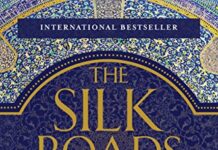
Ebook Info
- Published: 2016
- Number of pages: 657 pages
- Format: PDF
- File Size: 9.00 MB
- Authors: Peter Frankopan
Description
Far more than a history of the Silk Roads, this book is truly a revelatory new history of the world, promising to destabilize notions of where we come from and where we are headed next. From the Middle East and its political instability to China and its economic rise, the vast region stretching eastward from the Balkans across the steppe and South Asia has been thrust into the global spotlight in recent years. Frankopan teaches us that to understand what is at stake for the cities and nations built on these intricate trade routes, we must first understand their astounding pasts. Frankopan realigns our understanding of the world, pointing us eastward. It was on the Silk Roads that East and West first encountered each other through trade and conquest, leading to the spread of ideas, cultures and religions. From the rise and fall of empires to the spread of Buddhism and the advent of Christianity and Islam, right up to the great wars of the twentieth century—this book shows how the fate of the West has always been inextricably linked to the East.Also available: The New Silk Roads, a timely exploration of the dramatic and profound changes our world is undergoing right now—as seen from the perspective of the rising powers of the East.
User’s Reviews
Reviews from Amazon users which were colected at the time this book was published on the website:
⭐This book disappointed me. Central Asian history is definitely a neglected part of my education, so I was excited to dive into a big book by an Oxford history professor on the topic. Having read it, I suggest that people look elsewhere to educate themselves. This book is a feel-good history of central Asia. But it’s also misleading, and consistently anti-western in its bias. It’s pro-central Asia–wildly pro-central Asia, like what you’d expect from drunken football fans. I can’t think of a reason I need a history that tells such a cleaned up one-sided tale. His narrative is so pro-central Asia that many of the events he includes can’t be made sense of. He spends so many chapters explaining the daring architecture of central Asia, the incredible gardens, the breath-taking palaces (only once mentioning the slaves!) and keeps commenting on how backwards Europe was during this time (500’s through 1500’s). And then suddenly Europeans have the most advanced ocean-going ships in the world! How did that happen? He says it’s because they fought so much. They fought their way to the best ships in the world. It doesn’t make any sense. History can’t be objective. Selecting one fact over infinite others makes the presentation unavoidably biased. But one can have a clean bias, one can be upfront with their thesis. Frankopan fails to do this the whole way through. Instead of a thesis he has themes. Like the “unique violence of Europe,” which he returns to many times. Or the assertion that Europe was uniquely greedy, and this explains its actions and outcomes. He doesn’t seem to miss any opportunities to point out European excesses, violence, and greed. But always forgets to look for financial motives or mention the masscres, or the intolerance of Persia, or the Muslim caliphate. I could write about Frankopan’s bad theories on the unique violence of Europe. I could dissect his claim that Islam takes better care of women than Christian Europe does, in the area of inheritance. I could give a critique of his poor understanding of economics based on the outsized significance he places on trade and the absence of the role of private property, banking, capitalism, and a well-paid consumer class. I could argue against his dark age thesis after the fall of Rome. I could argue against his case that the Persian empire and the Muslim kingdoms were bastions of tolerance and learning. These were all terrible problems in his history that ruined this book as a useful source of information. But I’ll keep my critique to 3 concrete problems with his text. First the good. This is a very easy to read history book, compelling even; I always wanted to pick it up and find out what happened next. And he included some interesting details I had never heard about. The giant Buddhas of Bamiyan that stood in northern Afghanistan for 1500 years until the Taliban blew them up, that was interesting. He spoke of some remarkable scholarship carried out by middle easterners from the 800’s to 1100’s. I became curious and looked into it some more. One of the men he mentioned, just briefly, Ibn al-Haytham, actually put the finishing touch on the scientific method in Egypt in 1021 when he published a book on astronomy and optics and proposed that along with the Greek insights of observing nature and using reason, we should also conduct experiments to verify our theories. He didn’t start a scientific revolution, but he seems to be the first person to publish and advocate for such an approach. I didn’t know! But where this book goes wrong seems to be everywhere else. There’s no clear thesis. He sprinkles outrageous claims throughout the book without supporting them with any reasoning or evidence, and even sometimes contrary to the narrative he just finished laying out. To keep the flow moving along he is very sparing with his insertion of numbers. I started circling dates on the pages, because he’d go for pages without giving a date, just narrating events, and I’d page back trying to find where we were in the timeline again. There are very few other numbers. When Alexander the Great defeated a “vastly superior Persian army”(6), how many men did each side have? (Best estimates are: 100,000 Persians, 40,000 Greeks. Resulting in 40,000 dead on the Persian side, and only 500 dead Greeks. Wow!) You’ll be glad wikipedia is more obliging than Frankopan. Or this, the “1956 military action began against Egypt, with British and French forces moving to secure the canal zone…”(410). Frankopan suggests this intervention was due to Western greed and Imperial proclivities. He’s bizarrely circumspect when it comes to the Suez canal, even though his whole book is purportedly about the trade linkages between east and west, of which the Suez is clearly the most important, after the European standardization of ocean-crossing trade. Again, thanks to the internet I was able to discover the real story. The French went to the administrator of the department of Egypt, Sa’id, and in 1856 signed a concession to build a canal, and operate it for 99 years from the time of the completion of the construction, which was in 1869. So the Suez canal company should have legally maintained operation until 1968. They raised money by selling shares in the company. Egypt bought 44% of the shares, but later sold them to the British when they got into some financial trouble. It took 10 years and $100 million to build. That’s $2.7 billion in today’s dollars. So when Egyptian president Gamal Nasser seized the canal and nationalized it, the French and British felt their legal and financial rights had been violated, because they had been. Nasser deprived the British and French of 12 years of proceeds legally due to them. Nasser said that it was unjust that Egypt wasn’t earning anything from the canal, but that’s what happens when you sell all your shares in an enterprise. Frankopan agrees with Nasser, while explaining none of the ways the British and French had funded, engineered, even invented the machinery necessary to do the task. Frankopan does a biased curation of events to make either Christians or the West look like the bad guys. He cites some wrongs that can’t be disputed. Britain seized control of Bengal. Britain forced the sale of opium to the Chinese despite the fierce objection of Chinese rulers. The French and British looting and burning of the Summer Palace in Beijing wasn’t nice. Or the terrible act of a British destroyer ramming a Jewish refugee ship so it couldn’t go to Palestine. And then returning the holocaust survivors to Germany, etc. etc. There are plenty of wrongs that the West is guilty of. But I’m not sure how to understand a host of wrongs he blames the West for that the West wasn’t guilty of. “The Mayan Empire had also been flourishing before the arrival of the Europeans”(231). What a bizarre thing to say! The Mayan empire fell due to a host of factors almost 600 years before the Europeans arrived. And I don’t think I’d say they were flourishing exactly when they were in the midst of a self-created ecological collapse, an incredibly bloody civil war, and a drought. Is he saying things were generally better for people in the Americas before Europeans came? Or he expresses his admiration for the Incan civilization and how the elites were required to work in the fields a certain number of days each year so as not to “affront the poor” (252). He describes these societies as “enlightened in comparison to the highly stratified societies” of Europe. As if the Incan and Aztec societies weren’t highly stratified. As if it’s better to have the elites do a couple days of pretend work than it is to have a much more wealthy and prosperous working class like Europe had. Another strange passage “…its global significance [The D’Arcy oil concession from Iran] is on a par with Columbus’ trans-Atlantic discovery of 1492. Then too, immense treasures and riches had been expropriated by the conquistadores and shipped back to Europe. The same thing happened again” (320). First, I wouldn’t characterize what happened in the Americas this way. I guess the similarity is that in both cases European powers benefited? That’s an incredibly thin similarity. Expropriated is a fancy way of saying “stolen.” When Frankopan made the above statement he had just finished one of his more detailed accounts, filling 6 pages, explaining how Knox D’Arcy wasn’t interested in this venture, he had to be recruited to it by a Persian agent. Then they spent an unknown amount of time greasing palms in Persia to get a contract (a concession) signed by the Shah. Both parties freely agreed to it. The Shah was paid 20,000 pounds up front, 20,000 pound in shares of the company, and 16% annual royalty on net profits. All he had to do was sign the paper. D’Arcy’s oil company had to do all the work. After 3 years of drilling and getting nothing, and multiple rounds of seeking additional investors, they finally had their big strike right at the edge of bankruptcy. And once the oil started to flow, and the profits, suddenly elements in Persia became resentful, claiming the deal was unjust, and Frankopan seems to agree! I wish he’d clarify what the exact injustice is. Because despite his lengthy account, I can’t see one. Is it injustice if European powers make a deal to use their greater expertise in a mutual deal in another country? Is it wrong if European nations benefit from enterprises they built, funded, and successfully operated? Why would these industrialists have taken these risks, made these huge financial outlays if there hadn’t been favorable terms in the contract? All the resentment Frankopan notes of the Persians, seems better fitted to the British, who were constantly black mailed, had their work stopped by religious festivals, etc. And the Persians could have been happy that a valuable resource they literally didn’t have the expertise to unlock, had finally been made accessible, and now there were new possibilities, and a new revenue stream, not to mention all the secondary revenue streams that come with major industry starting operation in your country. But no, they’d been swindled by the contract they’d freely signed. And according to Frankopan, the theft was of the same quantity and kind as all the gold and silver Europe got from the Americas. Except there was a legal contract. Except that the only reason oil was being pumped was because the Shah agreed that it was a good idea. There is no moral equivalency here. Last example, “This is imperial policy in all but name” (453). Frankopan concludes that US president Jimmy Carter’s stated policy that the US will act to protect our critical investments and resource and trade arrangements around the world, is a statement of Imperial intent. He makes another passing comment about how the US is an empire (pg 475 “…gift of the American empire…”). For an historian Frankopan seems shockingly fuzzy on key concepts like “Empire.” The British had an empire, as did Russia, and Rome and Persia. What makes them empires is that one political unit took over others and ruled them, often against their will. Britain was its own self-contained nation. But then it went around the world picking up lands and peoples like a rock star at an after party. It directly ruled these places, like India, Australia, South Africa, etc. And all the other empires did this too. The US has never done this. As nations go, the USA is a superpower. It is the most militarily and economically powerful nation in the world right now. It pursues its interests like all nations do, but it can do that more effectively because it has so much power. When the US acts to protect its interests abroad, meaning allies, trade relations, key pieces of global infrastructure that we and many nations of the world benefit from, this is what every nation does that has the power to do so. Yes, sometimes the US invades a country. But it doesn’t keep those countries, they don’t become part of the USA. The US is always looking for more friendly governments to do business with. And it supports governments that it likes and undermines governments it does not like. Other countries do this too. If any of this activity makes the US an empire then we have to change the definition of empire, and make it apply to many countries. No empire in history matches this description. I would give this book negative stars if I could. It is highly misleading, it doesn’t help one understand why things happened, if anything it obscures the true causes. Yes, the author is a professor of history at the prestigious Oxford university. But don’t let that fool you. This book is garbage. He has a thick section of citations, and I don’t doubt any of them. I think he knows the Europeans didn’t destroy the Mayan Empire. He knows the US is not an empire like Britain and Russia were. He knows that Europe was more scientifically and technologically advanced than any other place on earth by the 1400’s, the 1500’s, in the 1600’s and on. He has good sources, he knows the facts of the matter, so why does he tell this twisted absurd history? It looks to me like the answer is ideology. He’s committed to finding fault with Europe and over-praising the East. A trend that’s popular these days. Using this tactic kind of proves the opposite though. If central Asia was as good as he claims it is, as progressive, innovative and important, then one wouldn’t have to lie to convince people. But that’s what this is. Leave out all the bad things they did, really focus in on the bad things the West did, “my doesn’t central Asia look good now!” It’s like central Asia is catfishing us. And then we go on a date and find out they’re still pushing gay people off rooftops, there’s no democracy or human rights, it’s an extreme unrepentant patriarchy. The land is barren, people live mostly in poverty with very little education. And then you’re like “Oh! This is a back water! The West may not be perfect, but it’s WAAAAYY better than this!”Frankopan has crafted a transparent misrepresentation. He can do that if he wants. But we don’t have to fall for it, and we don’t have to recommend his book. And I for one will be recommending a much better book of world history “How the West Won” by Rodney Stark.
⭐Author Peter Frankopan sets out, mostly successfully, to reorient our knowledge of history as taught in Europe and North America — history as viewed through the lens of Western Civilization courses. My quibble is that this is still a view of Central Asia though European eyes, and arguably the author pays slight attention to the history of ancient India and China and overplays the history of Central Asia and Western misconceptions of the Mongols.Frankopan’s main thesis is that the region stretching from the Mediterranean to China, and particularly the region that is now Iraq, Iran, and Afghanistan, remains the crossroads of civilization and the center of global affairs. As such, we need to understand ancient history and historical development over more recent centuries, as well as the way history is perceived by those in the region.The book proceeds chronologically. Chapter headings trace the many “silk roads” that have influenced global history, including the emergence and migration of major forms of religious faith, the rise and fall of empires at a time when Europe was an uncivilized backwater, and the role of trade as a conduit for the spread of ideas and wealth.We learn, for example, that the early expansion of Islam was benign. Often the major religions coexisted peacefully. Mohammed and the Jews needed each other as both repudiated Jesus as the Messiah. In Damascus, churches were untouched even as Islam became the religion of the majority. Only after divisions began to develop in Islam did attitudes harden toward other religions, says the author.Western Europe in the 600s and 700s was barbaric, while Baghdad was at the height of its wealth and academic achievement. Thus, traders and intellectuals along the Mediterranean were oriented toward the East, not Western Europe. Among conventional beliefs that Frankopan seeks to puncture is the notion that the Mongols were chaotic. Instead he says they were good bureaucrats and operated as a meritocracy. Terror was applied selectively but was broadcast broadly as a tool of coercion. The result was to control wealthy territories with a minimum of effort.As Elizabethan England competed with Spain, says the author, there was an opportunistic alliance with the Muslim world against a common enemy. Both the English and the Moors engaged in piracy against the Spanish and Portuguese. The English freed Muslims who had been “galley slaves” and returned them home, and had Muslim support for the 1596 attack on Cadiz. Shakespeare portrays positively the Moor in Othello and Persia was also characterized favorably in English literature of the time.By the late 18th and early 19th Century, however, the power relationship between rising Western European powers and Persia and neighboring countries had been reversed. India became a crown jewel in the British Empire and the British became preoccupied with fear of Russian expansion into Persia. Misunderstandings were rife. “The British cannot say what they mean and the Persians do not mean what they say,” noted one observer.In the aftermath of World War I, the British created Iraq out of Mesopotamia, arbitrarily combining a hodgepodge of nationalities. As oil was discovered in Iraq and Iran, the British moved quickly to exploit these resources and minimize the royalties that were paid to the nations from which oil was extracted. Dissatisfaction with British oil companies resulted in a greater role for American oil companies, but the exploitation of the region changed little until OPEC was formed.The final 40% of the book is devoted to British and American ignorance and arrogance in the 20th and 21st Centuries, resulting in the support of the Shah in Iran, Saddam Hussein in Iraq, and Ayub Khan in Pakistan among others. Frankopan characterizes British, then American strategy as “solving today’s problems without worrying too much about tomorrow’s problems.”This is useful background for anyone trying to understand the resentment felt in Iraq and Iran toward the West today.As Frankopan looks forward, there is little analysis of the potential role of China in the balance of power that could shape the region’s future or of India whose population and economy are among the world’s largest and fastest-growing.Instead, with an emphasis on what was once known as Mesopotamia, the author asserts that, “the Silk Roads are rising up once more.” Events that appear chaotic instead are the “birthing pains of a region that once dominated the intellectual, cultural and economic landscape of the world…We are seeing the signs of the world’s centre of gravity shifting — back to where it lay for millennia.” This seems an optimistic analysis.In sum, the value for many readers will be found in the first half of the book, as a balance to the history taught in the West. The resentments held in the region toward American and British influence are the result not just of recent decades but of exploitation taking place in the past 100 years. Oddly, though, the author’s contemporary assessment of the region seems viewed through the same Western lens that he criticizes as having warped our understanding of the past.
⭐Opens up a clear understanding of the interactions from history to modern day, which shows the impact of Western and Eastern policies on the countries and people of the Silk Road now and then. One can appreciate why countries and people of this area have the attitudes they have.
⭐The Silk Roads reads like a novel, but is absolutely packed with information. It is meticulously footnoted, and the author’s academic pedigree guarantees the depth of research he has mined. I picked up the book thinking that it would be another history of the Middle East and the Chinese trade routes. Instead, the book is an extraordinary and granular examination of history from the viewpoint of the cradle of civilization. This alone is worth the price of admission. However, the author has illuminated the tremendous political errors made by the western overseers of the Middle East, particularly Great Britain and the United States. Finally, he takes us into the future — what will be the consequences of the rise of fantastically wealthy, well-educated, and militarily potent nations, who will no longer participate in unilateral franchises with the West or the East. Great book, and a real wake-up call.
⭐The scope of this book is immense taking us from the battles between Ancient Greece and Persia up to the present day. It is both illuminating and depressing to be reminded that in the last 2000 plus years of human history, so little has changed.International trade has enriched us in the West and made the elites in other corners of the world very wealthy but with that wealth comes exploitation, inequality and the great games of empires who seek advantage at the expense of human lives.There are no answers here but there are lessons. We are all connected, and interdependent .
⭐I am not a history scholar as many reviewers obviously are. I have read a lot of the reviews which I found very interesting. Despite all the criticisms of the book, I learned a lot and am inspired to read and learn more (bearing in mind the constructive criticisms). Whether due to age, I have to say I found the book hard work and the amount of detail was too much to fully absorb. For me, it was an interesting perspective covering a lot of stuff I didn’t know. I could have done with a bit more definitive chronology. Also, I think I could have edited the writing a bit better; there was room for greater clarity.
⭐I liked this book. It’s a very well-balanced account of trade between individuals, nations, and political systems over thousands of years, and as such it’s quite long – from about the halfway point on I was starting to tire – but persevered. (This is why I’m making it a four-star read, not quite five.)The writing isn’t quite as vivid as, say, Gibbon’s “Rise and Fall”. You’re not quite there on the Silk Road the same way Gibbon put you in the Roman agora. But this book is important for a different reason. It’s one of very, very few books from any culture that takes global trade as a whole, without being biased towards one culture or viewpoint, which makes it deeply admirable.Frankopan has made a genuine effort to be even-handed across thousands of years of history, and does so very well. The rise of the West is seen in its proper context, as a fairly recent event coming after centuries of Asian dominance. It’s in the early chapters that the book feels strongest, with the most vivid anecdotes and stories. At the halfway point it loses a lot of colour, so it’s a struggle to finish.But carry on – once done, you’ll be pleased you did.
⭐One of the most interesting and thought-provoking books I’ve read in years; a history centred on the region between the middle east and the Chinese border from the beginning of time to today. Huge in scope, and in places highly unsettling, it effectively challenges the smug certainties we still largely hold in the west. Despite its size – 540 pages of text – it could easily be double the size size without repetition and without becoming boring or turgid.It would certainly get 5 stars, or 5+ if that were possible, but for one striking omission. Despite having several potentially very useful maps (possibly 9 or 10, all full-page or double-page) there is no index of maps. So unless you either have a superlative memory for page numbers, or maintain a written index as you go, the maps are virtually useless. This hugely detracts from the enjoyment of a book centred on a region most of us know little about, and where constant reference to maps would vastly enhance understanding. So small an omission, and yet so great.
⭐Peter Frankopan is unbelievably accomplished. He reads Russian and Arabic in the original, and the list of references for this book is both arcane and long.He places central asia as the fountainhead of world history. Huns, Vandals, Turks, Seljuks, Moghals, Mongels come streaming out to east and west. Some of the later chapters, about the duplicity of the ‘Great Powers’ in middle-eastern affairs, make uncomfortable reading.If I have a complaint, I would have liked an explanation of why the steppes of central asia are such a cradle of expansionist, violent hordes.
Keywords
Free Download The Silk Roads: A New History of the World in PDF format
The Silk Roads: A New History of the World PDF Free Download
Download The Silk Roads: A New History of the World 2016 PDF Free
The Silk Roads: A New History of the World 2016 PDF Free Download
Download The Silk Roads: A New History of the World PDF
Free Download Ebook The Silk Roads: A New History of the World