

Ebook Info
- Published: 2011
- Number of pages: 1018 pages
- Format: PDF
- File Size: 13.21 MB
- Authors: Barbara Wertheim Tuchman
Description
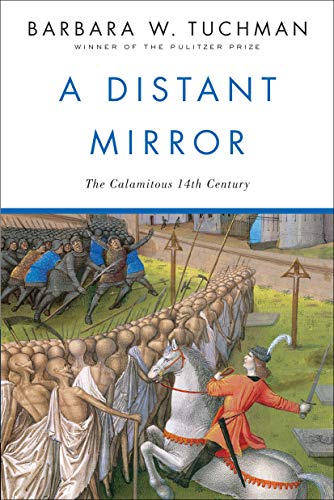
A “marvelous history”* of medieval Europe, from the bubonic plague and the Papal Schism to the Hundred Years’ War, by the Pulitzer Prize–winning author of The Guns of August *Lawrence Wright, author of The End of October, in The Wall Street Journal The fourteenth century reflects two contradictory images: on the one hand, a glittering age of crusades, cathedrals, and chivalry; on the other, a world plunged into chaos and spiritual agony. In this revelatory work, Barbara W. Tuchman examines not only the great rhythms of history but the grain and texture of domestic life: what childhood was like; what marriage meant; how money, taxes, and war dominated the lives of serf, noble, and clergy alike. Granting her subjects their loyalties, treacheries, and guilty passions, Tuchman re-creates the lives of proud cardinals, university scholars, grocers and clerks, saints and mystics, lawyers and mercenaries, and, dominating all, the knight—in all his valor and “furious follies,” a “terrible worm in an iron cocoon.” Praise for A Distant Mirror “Beautifully written, careful and thorough in its scholarship . . . What Ms. Tuchman does superbly is to tell how it was. . . . No one has ever done this better.”—The New York Review of Books “A beautiful, extraordinary book . . . Tuchman at the top of her powers . . . She has done nothing finer.”—The Wall Street Journal “Wise, witty, and wonderful . . . a great book, in a great historical tradition.”—CommentaryNOTE: This edition does not include color images.
User’s Reviews
Reviews from Amazon users which were colected at the time this book was published on the website:
⭐I recall 30-some years ago the first time I saw the great cathedral in Richmond, Britain and wondering how could it be that this enormous structure be so remote from people? Like the Salisbury Plain … how could the 12th century version of Lincoln have possibly mustered the labor and wealth to build this structure taller than the great pyramid? It was the tallest building in the world for 238 years. After a few minutes of thinking, I remembered Barbara Tuchman’s “Distant Mirror”. Lincoln, like the whole regions of modern Brittany and Picardy have never recovered from the 14th century.I someway stumbled on the Kindle enabled edition. I don’t know how. The original print edition would have been mightily enhanced with an internet. When it was first published, “A Distant Mirror” was a Dewey Decimal System exploration in extrimis. There were simply too many side alleys to be exploredI read the book as soon as it was published around 1982. The ‘distant mirror’ that the early ‘80’s reader related to was the memory of the 70’s becoming the ’80’s … hot and cold war, economic “malaise”, pandemic swine flu, upward economic stagnation and class struggle, 16% usurious mortgage rates, gas lines week end and out, a predicted ice age, etc, etc. … it was bad, really bad.How bad could it get? Tuchman had perfect timing and an intuitive narrative to ‘parallels’ from the 14th century that frankly no one had much knowledge of at the time. In my 25-30 year-old mind, Tuchman captured my rapt attention. The book remains in the top 10 historicals for me for the reason that there are no other similar historicals following the life of one extraordinary, little known Enguerrand de Coucy. The first reading has stayed with me for many years. I would have rated it a 6-star at the time. The re-read goes to show that my memory was not as crisp as I once imagined.This Kindle enhanced re-read revealed one thing I don’t recall noticing at the time. The elephant in the room is Tuchman’s 20th century moral/social critique to the 14th century. Her opinion was not necessary for the narrative to be excellent. How could I have missed that Tuchman was a non-historian and elitist of old Morgenthau wealth? I don’t know. I’m more discriminating in historical authors these days before committing to a 600-page read.99.5% of the narrative is still amazing. .5% is naïve and materially questionable and it jerks you back when you see it. Modern historical deep dives simply don’t follow the Tuchman pattern today for a reason. Who are we to judge a nearly 600 year-old generational period when half of the people you know died of the plague then half again died 20 years later? Most of your family today would have never survived birth then. Without the Capetian and Valois propaganda and fake ‘chivalry’ source Froissart, Tuchman’s sourcing is narrow.I can’t believe I’m critical. This was an historical monument to my fascination in deep diving history. Tuchman’s decidedly sharp positions and determinations have not survived the test of our greater historical knowledge today.The Kindle read is phenomenal. What was a full-on Dewey Decimal System labor has become instant access to sources, places, names and opens lines into other dimensions and 14th century dynamics. I may have spent more time venturing into references than the book.Finally, I so wanted to re-visit the sense of my first read. Perhaps I was bound for some disappointment. The 14th century, the 13th century … whatever century was nothing comparable to the present any more than the present is akin to the future. History frankly is not what repeats. The base nature of our species constructs and behavior are unsuppressed and this is what is repeated.In the current context of socio-historical writing, 4 stars. I would doubt the book would be the huge success if it was a new History release.
⭐Copy was like new and a good replacement for my misplaced copy
⭐This book uses a single family/character to move through an entire century covering political and military history, religion, culture, and gender along the way. I listened to the audiobook version on another service, but it’s definitely worth the read.
⭐One of the best history books I’ve ever read. Tuchman starts off, great historian that she was, pointing out how conflicting and exaggerating medieval sources can be, and even introduces “Tuchmans Law” (pronounced tuck-men) which basically states that bad news is repeated and spread so much that it multiplies the seeming presence of bad things in life to the point you would think nothing good ever happens (just like watching the evening news). A Distant Mirror is actually a biography of a nobleman named Enguerrand de Coucy VII (pronounced On-geh-hon-de-koo-see). She briefly covers his ancestors as some of them absolutely butchered peasants and barons in their domain while some built the great castle of Coucy in Picardy, France. She spends the first several chapters setting the stage for Enguerrand’s life. The “little ice age” that kicked off the century with some mass starvation. Chivalry and romance, with the knights who were mostly hypocrites and brigands, and women who had minimal say in life. War, how it was all about “the fight” and “the glory”, not even about good strategy. Youth, and how children were basically just treated like little adults, meaning they didn’t have an idea of “childhood” like we have today where it’s a very special time of life, separate and distinct, and deserving special attention. Again, she points out contradictions from her research (“children are neglected and children are loved”). And of course, she covers a long and excellent chapter on the Black Death (which was originally her main goal for the book, but being the good historian that she was, she figured out it was more than the plague that ruined the 1300’s and so expanded the scope of her research)! Here are the Flagellants, whipping themselves through the streets, announcing Gods judgment through “the pestilence,” only to quickly blame the Jews for poisoning the wells and turning whole towns against them! Here are people hanging out next to the “privies” thinking they’ll avoid the plague that way. Tuchman is so accurate, she even points out that the statistic about 1/3 of the population dying from plague didn’t come from anyone actually counting the dead, it came from the book of Revelation! It was a way of life for intellectuals and scholars back then to use scripture and ancient literature to interpret events (doctors read Galen instead of just actually looking at what was wrong with their patients). And just when I thought I couldn’t get more enthralled, we actually begin the life of Enguerrand de Coucy VII. We are with him when he’s captured at the battle of Poitiers. With him when he’s taken hostage and shipped to England (likely in the same group with Geoffrey Chaucer!), when he marries the kings daughter, when he goes on a crusade…won’t spoil anything for you. There is the peasants revolt or “Jacquerie uprising.” There is John Wycliffe becoming buddies with, of all people, John of Gaunt (Duke of Lancaster) because they both want the state to be over the church, not the church over the state as it then was. Here is King Charles the VI of France being followed through the forest of Mans by a strange, ragged man saying, “Ride no further, noble King! Turn back! You are betrayed!” which leads him to have a psychotic snap upon exiting the forest, killing some of his own knights. And that’s just the beginning of his woes. Anyways…if you haven’t already read A Distant Mirror, I hope you will soon!
⭐After reading this great work One feels like they have a real grasp on the medieval world.
⭐Lots of facts, lots of names, lots of dates, but didn’t really give me a “feel” for the period or find the book engaging. I found it too long and dry (600 pages plus of tiny text). Had too much of a rambling textbook style for me, but may suit others as clearly lots of good reviews on here.
⭐A wonderful, beautiful book painting a brilliant and detailed picture of France and Europe in the disastrous 14th century. I would say this is one of the best and most enjoyable books of history I have ever read.
⭐Bought as paperback a few years ago. Deteriorating eyesight and ongoing decluttering means a switch to kindle.An interesting read
⭐Read this years ago, still love it. Tuchman always qualifies every sweeping statement with an opposite example. This historical scepticism , mixed with considerable knowledge, provides the reader with a very believable and credible history of the 14th century.Excellent , sceptical history, worthy of David Hume himself.
⭐A fascinating study of an horrendous century and the wicked idiocy of the medieval mind and the role of the church and twisted ideas of chivalry. A real page turner too!This book might change your views about the benefits of having noble antecedents!
Keywords
Free Download A Distant Mirror: The Calamitous 14th Century in PDF format
A Distant Mirror: The Calamitous 14th Century PDF Free Download
Download A Distant Mirror: The Calamitous 14th Century 2011 PDF Free
A Distant Mirror: The Calamitous 14th Century 2011 PDF Free Download
Download A Distant Mirror: The Calamitous 14th Century PDF
Free Download Ebook A Distant Mirror: The Calamitous 14th Century