

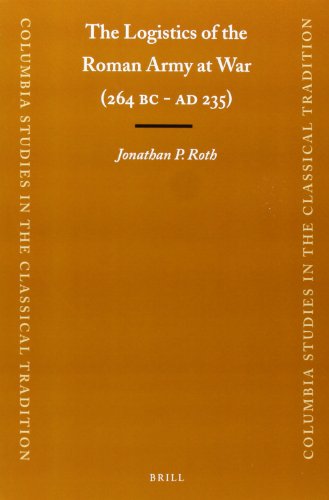
Ebook Info
- Published: 2012
- Number of pages: 399 pages
- Format: PDF
- File Size: 1.43 MB
- Authors: Roth
Description
This work is devoted to a study fo Roman logistics from the Punic Wars through the Principate. It explores various aspects of supply: rations, trains, foraging, supply lines; administration and logistics in warfare. The book traces the increasing sophistication of the Roman military supply system.
User’s Reviews
Editorial Reviews: Review ‘…the first accessible account of this fascinating subject in English, R.’s book is guaranteed a place on every Roman military bookshelf.’Duncan B. Campbell, Journal of Roman Studies, 2000.’…a major contribution to the study of an important aspect of the functioning of the Roman army.’Israel Shatzman, Scripta Classica Israelica, 2000.’…this is the most comprehensive and detailed investigation on the subject to appear in English.’Stefan G. Chrissanthos, Ancient History Bulletin, 1999. From the Back Cover Relying on a variety of literary, documentary and archaeological sources, this work explores the Roman military supply system from the Punic Wars to the end of the Principate. Each chapter is devoted to a different aspect of logistics: supply needs and rations; packs, trains and military servants; foraging and requisition; supply lines; sources of supply; administration; and the impact of logistics on Roman warfare. As a whole the book traces the development of the Roman logistics into a highly sophisticated supply system – a vital element in the success of Roman arms. In addition, it makes a critical study of important technical questions of Roman logistics, such as the size of the soldier’s grain ration, the function of military servants, and the changes in logistical management under the Republic and Empire. About the Author Jonathan P. Roth, Ph.D. (1991) in History, Columbia University, is an Assistant Professor of History at San Jose State University. He has published a number of articles on Roman military history and is Secretary/Treasurer of the Society of Ancient Military Historians. Read more
Reviews from Amazon users which were colected at the time this book was published on the website:
⭐Very detailed content of a subject area not well considered in other texts I have read. A question I ask myself is how do you feed an army of 10,000. The legionarie receives X amount of grain for the two meals per day what could you make unleavened bread? (what grain? I’ve seen corn documented as a ration, barley – punishment ration). On the production side what was yield per acre, number of farmers/slaves to seed, manage, harvest the grain, how much was taken. What was the end result of the grain purchased from the Gaul? Taken from the Britain family. Most certainly beyond the scope of this text. Vol. 2?Pictures would be a helpful addition, I’ma visual learner and I believe it would have helped me digest some of the content.Some familiarity with the conflicts that took place during the time period would be useful.I keep asking myself – how were they able to accomplish what they did.This answers some of my questions.
⭐With a book this expensive you would think they could have found a decent editor, but such is not the case. This book is filled with hundreds of grammar and spelling errors (at times several on a single page) that would have been caught by even the most casual editorial review or even a read-through by an English 101 student. The editor of this volume (William V. Harris) should be ashamed to have his name attached to it.If bad editing does not bother you, then I can recommend this book with five stars. It retreads a lot of ground in the field, but the author deftly combines a number of sources into a unified whole. Although by no means worth the $135 if you are simply a casual reader, the first two chapters alone (1. Supply Needs and Rations, 2. Packs, Trains and Servants) make the book *well* worth it for military historians hungry for hard numbers and thoughtful extrapolation.
⭐For me this was a VERY expensive book, but it provided me with the answer to the question of not what the roman army did but how they were able to get their troops to the right place, at the right time and in condition to whip their opponents. Parts of this book reminded me of the Red Ball Express feeding Patton’s army after his breakout. I highly recommend it to those who want to go beyond the “who” and the “what” of Roman military history.
⭐This is a rather superb piece of scholarship on the logistics of the Roman Army over a period of 500 years from the beginning of the First Punic War (264 BC) to the death of Emperor Alexander Severus (AD 235), the beginning of the so-called “Crisis of the Third century” and the end of the Principate.As the back page text of this book does state rather accurately and without any “sales pitch” (a relief, for once!), the author has relied on a wide variety of sources, literary, documentary and archaeological, but also epigraphical (writing on stones). This was perhaps the first remarkable feature of this book: the sheer amount of work – the modern expression would be data mining – involved in producing it is quite astonishing since the author has had to comb through just about all of the sources covering some five centuries of Roman history.The second major quality of this book is that it is nevertheless written is a very readable style. The author’s ideas are clearly expressed in simple English (no jargon and no “fancy” terms) and each idea is followed and illustrated by multiple examples drawn from across the whole period. This could, however, be a bit of a problem for some for it is clearly preferable for the reader to have significant amount of background knowledge in Roman military to fully appreciate the contents of this book.A third aspect is that the author systematically reviews each aspect of logistics and devotes a specific chapter to it: supply needs and rations (chapter 1); packs, trains and servants (chapter 2); forage, requisition and pillage (chapter 3); supply lines (chapter 4); sources of supply (chapter 5); the administration of logistics (chapter 6) and the impact of logistics on Roman warfare (chapter 7). Each chapter also include an introductions and a conclusion that summarises the main points made.The book traces the development of the Roman logistics starting with the First Punic War and the first Roman expeditions out of Italy and its evolution into a highly sophisticated supply system. It also shows how this system evolved under Augustus and the Empire when the legions got posted on the frontiers. One of the main merits of this book is to show to what extent such a system, when combined with the Rome’s ability to mobilise the manpower of the whole of Italy, explains the string of Roman victories and conquests under the Republic, and the Empire’s endurance during the Principate. I did regret a bit the fact that the author ended his analysis in 235 AD and did not cover the next couple of centuries as well because he could have shown that the continued existence of this logistical system, however modified or even weakened was certainly one of the crucial factors and edges that the Roman armies still had against their enemies including during the fifth century AD. This, however, might be the subject of another study.Other elements of interest are a number of technical questions on the diet of Roman soldiers, which was surprisingly well-balanced, of their animals (horses, pack animals etc…) and their carrying abilities. One interesting feature is the author’s estimates showing that calculations of other authors based drawing from military manuals of the 19th century or from Diocletian’s Price Edict may have been quite conservative and did not represent maximum loads with margins of variation often exceeding 30% or 40%.Another reviewer (on the US site) has complained about very poor editing. I must say that my recently acquired paperback copy only contains a handful of typos, so maybe this issue has been addressed. Finally, there is one other drawback that should be mentioned. Even in paperback format, this is a rather expensive book although, for me at least, it was worth every penny. Five stars for me.
⭐Jonathan Roth’s work is definitely very useful for anyone interested in the Roman army or on the logistical limits on any ancient campaigns. However, I suspect Roth underestimates the number of pack animals required, and overestimates the load each pack animal could carry; for the latter, he cites Roman-era Egyptian papyri, but doesn’t address why they assume that pack animals could carry more than early modern works. More importantly, other authors since Delbrück have often argued that logistical limitations put an upper limit on army sizes, and Roth misses the opportunity to really work out where an upper limit would be, and how it would vary based on population density, seasons, etc. beyond a brief discussion (on pages 138-140).
⭐This book is free online- just google it.
⭐This is a rather superb piece of scholarship on the logistics of the Roman Army over a period of 500 years from the beginning of the First Punic War (264 BC) to the death of Emperor Alexander Severus (AD 235), the beginning of the so-called “Crisis of the Third century” and the end of the Principate.As the back page text of this book does state rather accurately and without any “sales pitch” (a relief, for once!), the author has relied on a wide variety of sources, literary, documentary and archaeological, but also epigraphical (writing on stones). This was perhaps the first remarkable feature of this book: the sheer amount of work – the modern expression would be data mining – involved in producing it is quite astonishing since the author has had to comb through just about all of the sources covering some five centuries of Roman history.The second major quality of this book is that it is nevertheless written is a very readable style. The author’s ideas are clearly expressed in simple English (no jargon and no “fancy” terms) and each idea is followed and illustrated by multiple examples drawn from across the whole period. This could, however, be a bit of a problem for some for it is clearly preferable for the reader to have significant amount of background knowledge in Roman military to fully appreciate the contents of this book.A third aspect is that the author systematically reviews each aspect of logistics and devotes a specific chapter to it: supply needs and rations (chapter 1); packs, trains and servants (chapter 2); forage, requisition and pillage (chapter 3); supply lines (chapter 4); sources of supply (chapter 5); the administration of logistics (chapter 6) and the impact of logistics on Roman warfare (chapter 7). Each chapter also include an introductions and a conclusion that summarises the main points made.The book traces the development of the Roman logistics starting with the First Punic War and the first Roman expeditions out of Italy and its evolution into a highly sophisticated supply system. It also shows how this system evolved under Augustus and the Empire when the legions got posted on the frontiers. One of the main merits of this book is to show to what extent such a system, when combined with the Rome’s ability to mobilise the manpower of the whole of Italy, explains the string of Roman victories and conquests under the Republic, and the Empire’s endurance during the Principate. I did regret a bit the fact that the author ended his analysis in 235 AD and did not cover the next couple of centuries as well because he could have shown that the continued existence of this logistical system, however modified or even weakened was certainly one of the crucial factors and edges that the Roman armies still had against their enemies including during the fifth century AD. This, however, might be the subject of another study.Other elements of interest are a number of technical questions on the diet of Roman soldiers, which was surprisingly well-balanced, of their animals (horses, pack animals etc…) and their carrying abilities. One interesting feature is the author’s estimates showing that calculations of other authors based drawing from military manuals of the 19th century or from Diocletian’s Price Edict may have been quite conservative and did not represent maximum loads with margins of variation often exceeding 30% or 40%.Another reviewer (on the US site) has complained about very poor editing. I must say that my recently acquired paperback copy only contains a handful of typos, so maybe this issue has been addressed. Finally, there is one other drawback that should be mentioned. Even in paperback format, this is a rather expensive book although, for me at least, it was worth every penny. Five stars for me.
⭐Great really interesting
Keywords
Free Download The Logistics of the Roman Army at War (264 B.C. – A.D .235) (Columbia Studies in the Classical Tradition, 23) in PDF format
The Logistics of the Roman Army at War (264 B.C. – A.D .235) (Columbia Studies in the Classical Tradition, 23) PDF Free Download
Download The Logistics of the Roman Army at War (264 B.C. – A.D .235) (Columbia Studies in the Classical Tradition, 23) 2012 PDF Free
The Logistics of the Roman Army at War (264 B.C. – A.D .235) (Columbia Studies in the Classical Tradition, 23) 2012 PDF Free Download
Download The Logistics of the Roman Army at War (264 B.C. – A.D .235) (Columbia Studies in the Classical Tradition, 23) PDF
Free Download Ebook The Logistics of the Roman Army at War (264 B.C. – A.D .235) (Columbia Studies in the Classical Tradition, 23)