Ebook Info
- Published: 2011
- Number of pages: 480 pages
- Format: PDF
- File Size: 12.39 MB
- Authors: Adrienne Mayor
Description
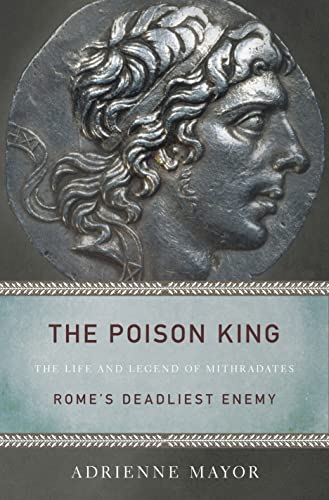
A compelling biography of the legendary king, rebel, and poisoner who defied the Roman EmpireMachiavelli praised his military genius. European royalty sought out his secret elixir against poison. His life inspired Mozart’s first opera, while for centuries poets and playwrights recited bloody, romantic tales of his victories, defeats, intrigues, concubines, and mysterious death. But until now no modern historian has recounted the full story of Mithradates, the ruthless king and visionary rebel who challenged the power of Rome in the first century BC. In this richly illustrated book―the first biography of Mithradates in fifty years―Adrienne Mayor combines a storyteller’s gifts with the most recent archaeological and scientific discoveries to tell the tale of Mithradates as it has never been told before.The Poison King describes a life brimming with spectacle and excitement. Claiming Alexander the Great and Darius of Persia as ancestors, Mithradates inherited a wealthy Black Sea kingdom at age fourteen after his mother poisoned his father. He fled into exile and returned in triumph to become a ruler of superb intelligence and fierce ambition. Hailed as a savior by his followers and feared as a second Hannibal by his enemies, he envisioned a grand Eastern empire to rival Rome. After massacring eighty thousand Roman citizens in 88 BC, he seized Greece and modern-day Turkey. Fighting some of the most spectacular battles in ancient history, he dragged Rome into a long round of wars and threatened to invade Italy itself. His uncanny ability to elude capture and surge back after devastating losses unnerved the Romans, while his mastery of poisons allowed him to foil assassination attempts and eliminate rivals.The Poison King is a gripping account of one of Rome’s most relentless but least understood foes.
User’s Reviews
Editorial Reviews: Review “Finalist for the 2009 National Book Award, Nonfiction””Winner of the 2010 Gold Medal in Biography, Independent Publisher Book Awards””One of The Washington Post critics’ Holiday Guide’s “Best Books of 2009″””Honorable Mention for the 2010 PROSE Award in Biography & Autobiography, Association of American Publishers””I can say without reservation that it’s a wonderful reading experience, as bracing as a tonic, the perfect holiday gift for adventure-loving men and women. A finalist for [the 2009] National Book Award, it’s drenched in imaginative violence and disaster, but it also wears the blameless vestments of culture and antiquity. You can have all the fun of reading about a greedy villain being put to death by being made to ‘drink’ molten gold, but still hide safe behind the excuse that you’re just brushing up on your classics.”—Carolyn See, Washington Post”Mayor gives us a more nuanced view of the so-called Poison King, placing him in his proper context as a Greco-Persian ruler following in the footsteps of his purported ancestor Alexander the Great. The most compelling aspect of this story is Mayor’s engaging style. A true storyteller, she makes Mithradates’s world come alive. This distinctive and compelling book is sure to fascinate all readers interested in the ancient world or in understanding the historical politics of the Caucasus region.” ― Library Journal”Thanks be to Adrienne Mayor for a definitive biography, blazing with color, presenting a magnificent cast headed by a hero who caused Rome to tremble for a quarter-century. . . . [H]is splendidly produced book is a cavalcade of intrigue, action, and slaughter. Danger, hope, fear, and love and lust are never absent.” ― ForeWord Reviews”Mayor has specialized in writing well-researched, readable scholarship in the history of ancient science and technology, including the pre-eminent work on ancient chemical and biological warfare. It is fitting, therefore, that her first major biography tackles the life of Mithridates VI of Pontus, known for his knowledge of poisons. It is difficult to weave personal anecdotes (the lifeblood of good biography) with the technical tidbits of science, but Mayor carries it off brilliantly, as evidenced by sections describing Mithridates’ youth and early scientific education in Sinope, and his extraordinary chemical knowledge at the peark of his reign. . . . The work is a marvel: part biography, part campaign history, and part scientific exploration, written in a style that makes the book a true page-turner.” ― Choice”Mayor has done an extraordinary job of filling many gaps in the history of this contentious and foggy period. Rightly so, The Poison King was a finalist for the prestigious National Book Award and is an effort worthy of any student of history.”—Lee Scott, Florida Times-Union”Mayor has solid research credentials, and her command of the ancient and modern sources is extensive and impressive. The digressions offered in footnotes are enjoyable and valuable, as are the appendices offering a modern checklist for evaluating Mithradates’ psychological condition. Good maps at key points in the narrative are very helpful, and the text is well written and organized chronologically. The author’s interest in ancient poisons, chemicals, explosives technology, geography and regional flora and fauna allow her to expound on these subjects while telling her story. . . . Mayor’s approach to the material blurs the line between history and historical fiction; one can easily imagine the narrative being turned into a television or movie script.”—Richard Gabriel, Military History”This is a highly coloured portrait and a very readable account of a complex individual with whom Mayor plainly has considerable empathy. The book therefore should find a wide audience and serve as an attractive introduction to its subject. . . . [Mayor] herself says, ‘Mithridates’ incredible saga is a rollicking good story’ and she has narrated it with verve, panache and scholarly skill.”—Arthur Keaveney, Bryn Mawr Classical Review”Newcomers to the field will fall in love with Mayor’s Mithradates. For more sober-if less compelling-accounts, they will turn to the recent studies listed in the very good, up-to-date bibliography included in The Poison King.”—Laurence Totelin, Isis”The prose is brilliant. . . . [W]e must regard this work as representing an important step in encouraging interest in the history of this Pontic king.”—Luis Ballesteros Pastor, Ancient West & East”Mayor is without doubt a masterful narrator with an ability to create vivid descriptions of past events and to bring historical characters alive.”—Jasmin Lukkari, Arctos”The author has read widely and shares her information with such gusto that one is easily swept up in her obvious enthusiasm.”—Philip Matyszak, UNRV Review “Mithradates should be a household name alongside his fellow rebels Hannibal, Cleopatra, Spartacus, and Attila. This detailed, juicy, entertaining, yet painstaking work of superb scholarship should finally give Mithradates the recognition he deserves.”―Margaret George, author of Helen of Troy: A Novel”Meticulous in its research, exciting in its narration, ambitious in its conception, The Poison King re-creates an era when much of the Mediterranean world rebelled against Rome. At the center of it all is the fascinating and frightening king who rallied the resistance: Mithradates. Mayor has written a terrific book.”―Barry Strauss, author of The Spartacus War”A fascination with the byways of ancient science, a wonderful eye for the telling detail, and a relish for floating theories that is almost buccaneering: these have always been the trademarks of Adrienne Mayor. Now, with this stirring biography of the toxicologist’s favorite tyrant, she parades her gift for narrative as well. Thanks to Mayor, Mithradates has emerged from the shadows at last as one of Rome’s most potent and remarkable enemies.”―Tom Holland, author of Rubicon: The Last Years of the Roman Republic”‘He died old’―so A. E. Housman refers to the subject of Adrienne Mayor’s latest enthralling book, Mithradates VI, king of Pontus. Pursuing her interest in deadly chemical and biological substances, she focuses here on the life and times of the hammer of the mighty Romans in the last century of the Republic, the hellenized oriental ruler finally nailed by Pompey the Great. Ruthless, aggressive, charming, manipulative, callous―was Mithradates a textbook sociopath? Read this exhilarating and penetrating biography to find out.”―Paul Cartledge, author of Alexander the Great”Adrienne Mayor’s The Poison King is an intriguing and highly readable new biography of one of the most controversial figures of antiquity, Mithradates―ruthless Hellenistic king, genocidaire, terrorist, alchemist, implacable enemy of Rome. It is an important contribution to our understanding of the desperate measures some rulers were prepared to take to resist Rome’s iron-fisted pursuit of empire.”―R. Bruce Hitchner, Tufts University From the Back Cover “Mithradates should be a household name alongside his fellow rebels Hannibal, Cleopatra, Spartacus, and Attila. This detailed, juicy, entertaining, yet painstaking work of superb scholarship should finally give Mithradates the recognition he deserves.”–Margaret George, author of Helen of Troy: A Novel”Meticulous in its research, exciting in its narration, ambitious in its conception, The Poison King re-creates an era when much of the Mediterranean world rebelled against Rome. At the center of it all is the fascinating and frightening king who rallied the resistance: Mithradates. Mayor has written a terrific book.”–Barry Strauss, author of The Spartacus War”A fascination with the byways of ancient science, a wonderful eye for the telling detail, and a relish for floating theories that is almost buccaneering: these have always been the trademarks of Adrienne Mayor. Now, with this stirring biography of the toxicologist’s favorite tyrant, she parades her gift for narrative as well. Thanks to Mayor, Mithradates has emerged from the shadows at last as one of Rome’s most potent and remarkable enemies.”–Tom Holland, author of Rubicon: The Last Years of the Roman Republic”‘He died old’–so A. E. Housman refers to the subject of Adrienne Mayor’s latest enthralling book, Mithradates VI, king of Pontus. Pursuing her interest in deadly chemical and biological substances, she focuses here on the life and times of the hammer of the mighty Romans in the last century of the Republic, the hellenized oriental ruler finally nailed by Pompey the Great. Ruthless, aggressive, charming, manipulative, callous–was Mithradates a textbook sociopath? Read this exhilarating and penetrating biography to find out.”–Paul Cartledge, author of Alexander the Great”Adrienne Mayor’s The Poison King is an intriguing and highly readable new biography of one of the most controversial figures of antiquity, Mithradates–ruthless Hellenistic king, genocidaire, terrorist, alchemist, implacable enemy of Rome. It is an important contribution to our understanding of the desperate measures some rulers were prepared to take to resist Rome’s iron-fisted pursuit of empire.”–R. Bruce Hitchner, Tufts University About the Author Adrienne Mayor is the author of Greek Fire, Poison Arrows, and Scorpion Bombs: Biological and Chemical Warfare in the Ancient World (Overlook) and The First Fossil Hunters: Paleontology in Greek and Roman Times (Princeton). She is a research scholar in classics and history of science at Stanford University. Read more
Reviews from Amazon users which were colected at the time this book was published on the website:
⭐I stumbled upon this book while doing research for a novel I am writing. My story involves a scene in which a city has its main cistern poisoned by Romans during a siege. As I was studying poisons of the ancient world (my story is set in First Century BCE Pontus), I saw a book on the subject,
⭐, by Stanford research professor Adrienne Mayor. I noted that she had also written a biography on Mithradates VI, so I decided to order both from Amazon. Glad I did.This book begins like many biographies do, with details and background information, and it was what I would term a “conventional read” up until Page 76. That is the departure point for the never ending flight that would be Mithradates’ life. He and his teenage companions use the ruse of going out on a hunting party to escape from his family kingdom (Mithradates had good reason to believe that his mother was intending to poison him). From this point on, the book reads like a Tom Clancy novel set in antiquity, complete with narrow escapes, detailed explanations regarding arms and tactics (especially ancient poisons, one of Mayor’s fields of expertise), and portentious acts and consequences. The pacing is quick, and once the hook was set I could not put the book down. I cruised through 300 pages the day after Thanksgiving, excitedly plowing though it as fast as I could.I have read some of the negative reviews, and I did not find her pro-multiculturalistic, anti-West/GWB slant to be irritating (and I would wager that I am far, far more politically conservative than the author, BTW). Certainly one does not have to be a zealot for multiculturalism to appreciate the polyglot giftings of Mithradates, who could allegedly write and speak in all 22 languages of his realm. What bias might be present is not shrill, so I would not warn anyone away from reading the book based on such concerns.Informative and entertaining, I consider the pittance I spent on the paperback money well spent.
⭐This book is a masterful work about the famous king Mithridates VI. I could not put it down. The only thing I dislike about it is that it wasn’t longer. An extraordinary man, an extraordinary historical personage, an extraordinary king, Mithridates has gone down in history as the Roman Republic’s last and most dangerous foe prior to its transition to an empire. Yet, and as Mayor expertly explores, there is so much more that fascinates the modern reader about the life of this great king that is often left out in historical school rooms or discourses or even other historical texts, which often gloss over Mithridates as just another eastern ruler conquered by Rome.It took Rome some 4 decades and change to “subdue” Mithridates, and it must be said that in the end it wasn’t even the Romans who defeated him but the machinations of his own feckless son and heir, Pharnaces. (It was after the rapid defeat of this Pharnaces that Caesar famously quipped “veni, vidi, vici”)I highly, highly recommend this book. This ancient king, born and crowned under celestial auspices, who saw himself and was seen as a new Alexander the Great, is 1 of the most interesting characters in history and justly deserves more modern recognition.
⭐This is a well-researched book about a fascinating character. In many way, Mithrodates’ story is the stuff of legends, but at the same time he was a “complex character” with many rather unattractive traits.As is often the case, many of the ancient sources about Mithrodates have been lost, so the author is forced to rely on the rather fragmentary remaining sources as well as relevant archeological finds. Where neither of these suffice, the author often veers into historical fiction about what Mithrodates’ might have done, based on known facts. This is not my favorite approach, but at least this author makes clear when she is deviating from historical fact into historical fiction.Other than the author’s penchant for historical fiction noted above, my main criticism is that the author is not particularly objective about Mithrodates, and portrays him in a very favorable light. While Mithrodates was certainly a fascinating character, he had many unattractive (to me) traits–a bloodthirsty murderer of tens of thousands of civilians and many family members, an obsessive preoccupation with poisons, a cruel, paranoid mind-set, and a disastrous military record against his Roman enemies. In fact, other than for his sheer dogged resistance to Rome, it is hard to appreciate many of his “heroic” qualities praised by the author.Nonetheless, a well-researched book on a fascinating topic, definitely worth a read for anyone interested in the era.
⭐Mass murderer, freedom fighter, opportunist, comeback kid, serial escapee, poison mixer.The Romans and their taxmen, the publicani’s, weren’t well known for a gentile approach in their conquered territories. This set the stage for Mithradates rise that eventually required the involvement of Rome’s most brilliant generals Sulla and Pompey to contain the drawn-out conflict.I simply love it when an ancient history expert digs out a not so obvious specific area / person in great detail. And that is what happened in this book while it lifts the veil of fiction and propaganda around Mithradates’ character. While covering Mithradates’ boyhood until his dramatic last stand in his 70s, the book narrative takes you through the intrigue of Hellenistic kingdoms of Asian Minor, the court mechanics and perhaps most of all the splendour.Obviously the book is based on sparse and incomplete records and there are large parts of Mithradates life that have remained undocumented. As such there is a level of subjective interpretation by the author. I have no doubt this angers academics. But to me it works well, the author is not presenting her narrative as fact. And it is very refreshing to magnify this late Roman Republican period from the Asian Minor point of view rather than the umpteenth book modern scholar based on interpretations of Livy and Cicero.So I really enjoyed this fascinating account of the period and conflict. The narrative is simply engaging and it reads very well.I would however point to the limited amount of illustrations. The is a relatively large amount of illustrations, even scattered through the book. The coloured centrefold photos and geographic maps are a helpful visual aid, but it remains pretty limited in my view. Books like these would massively benefit from timeline graphs, dress examples, schematics of cities, buildings and art – just to bring the imagination to life even more. Pictures and graphs often say more than a 1000 words. Yet, this appears to remain a taboo in academic circles even in this digital age where digital books defy costly and complex printing restrictions.
⭐Mithridates VI (135 to 63 BC) became in 120 or 119 BC King of Pontus – a kingdom on the South-East coast of the Black Sea. He would become one of the most persistent opponents of the Roman Republic. Most of the information we have about him comes from Roman sources on which Adrienne Mayor of course draws heavily; and there is comparatively little from the King’s side, from which her book is written. It means that she has filled in the gaps with some speculations of her own for which there is no evidence. There is a certain amount of repetition, and many references to myths, oracles and omens which surrounded Mithridates and of which he made use in the self-image he promoted. There are also many extensive excursions into history some centuries before Mithradates and also detailed accounts of earlier revolts against Rome in the region, of which Mithridates must have known and which are likely to have had an influence on his own thinking.He came to hate the Roman direct rule over what the province of Asia (today Western Turkey), with its settlers, its financial extortions and its enslavement of many of the people there, and its indirect rule over puppet states between that province and Pontus. This hatred was shared by vast numbers of subjugated Anatolians, who supported him in his struggle.Mithridates claimed descent from Cyrus the Great of Persia on his father’s side and from one of the Hellenic Alexander the Great’s generals and successors on his mother’s side. (Over and over again he modelled himself on what he had learnt about Alexander.)Already in his childhood, Mithridates seems to have been interested in poisons and in their antidotes. At the age of 15 he succeeded his father, Mithridates V, who died of poisoning in 120 BC. The suspicion was that Queen, Laodice, now the Regent for her under-age son, was responsible for her husband’s murder. Her favourite son was Mithridates’ younger brother, and Mithridates feared for his life. He left the capital, Sinope, with a small group of young friends, on a “hunting expedition” – they visited strongholds that remained loyal to the late King and now to his son. He stayed away for five or seven years before returning to Sinope to begin his reign and to deal with his enemies. Though bloodless, the nature of his take-over is not known, and Mayor again speculates. His mother died in prison and the younger brother did not survive her: Mayor surmises they were poisoned.Later in the book there is a long chapter on Mithridates’ researches and uses of poisons and antidotes – the latter often consisting of tiny doses of the poisons taken over time, which then bestowed immunity against larger doses. Mithridates himself became immune to poisons. He also experimented on criminals for further research, and poisoned many of his enemies or suspected enemies (like one of his own sons), either surreptitiously or officially as capital punishment.He now set about extending his territories. Within twenty years he had trebled their size, apparently without alarming the Romans with whom his mother had made an alliance. He eventually controlled lands around three sides of the Black Sea, and became fabulously wealthy. The nomadic tribes North of the Black Sea provided mercenaries for his armies; and the powerful Black Sea pirates became a supplementary navy for him. He allied with Colchis (today’s Georgia) and with the powerful Kingdom of Armenia, ruled by his son-in-law Tigranes II, with whose help he acquired Cappadocia on Pontus’ southern borders, which had been a puppet of Rome. Tensions then arose over two other Roman puppet states between the Roman province of Asia and Pontus: Bithynia and Phrygia. The Romans encouraged the Bithynian to attack Pontus, and this finally led to the first of the three Mithridatic Wars in 89 BC, for which Mithridates had long prepared.The Pontic army, using chariots with scythes attached to their wheels, wrought havoc on the Bithynian army in a battle that does not appear to have a name (either in the book or on the internet). His armies now swept over most of Anatolia. Generously, he set all the prisoners of war free; but he felt no such mercy for the Romans. The grasping general of the Roman troops was captured and gruesomely killed by having molten gold poured down his throat; and this was followed on one day in 88 BC by the planned massacre, by his troops and by those who had chafed under Roman rule, of some 80,000 Roman men, women and children all over Anatolia and the Aegean islands which Mithridates had captured: even those who had sought sanctuary in temples were not spared.20,000 more Romans were massacred when, in the following year, Mithridates conquered Delos. His armies invaded and occupied Greece; but the Romans, under Sulla, drove them out again, then marched into Anatolia and recovered not only the province of Asia but also Cappadocia and Bithynia as client states. Sulla was also engaged in a civil war with Marius in Italy. The Senate had outlawed him, and he was anxious to return to Italy. That meant he could not pursue the war against Pontus itself. So the first Mithridatic War ended in a peace at Dardanus (85 BC): Mithridates had to surrender Greece, Cappadocia and Bithynia. Sulla then returned to Rome and, after having massacred at least 53,000 of his enemies there, became dictator in 81 BC.Murena, the commander Sulla had left in charge of the Roman troops in Anatolia, broke the Treaty of Dardanus and attacked Pontus in 83 BC, launching the Second Mithridatic War (83 to 81 BC). But Mithridates routed Murena’s army, and recovered much of the territory he had lost.In 74 BC the Third Mithridatic War began. The Romans sent Lucullus to fight Mithridates. This war went badly for Mithridates. He ordered one of his eunuchs to kill most of his female relatives and concubines to stop them falling into Roman hands, while he himself, with 2,000 horsemen, fled into Armenia (72 BC). Tigranes gave him a further 10,000 cavalrymen.Lucullus demanded that Tigranes hand over the fugitive. Tigranes refused, and Lucullus invaded that mighty Empire with an army of 15,000 to 20,000 men. Though hugely outnumbered by the Armenian army, Lucullus defeated it outside Tigranocerta, the capital, and then destroyed it so thoroughly that its exact location is now unknown. But he failed to capture either Tigranes or Mithridates. They recruited more fighters, including Amazons, one of whom, Hypsicratea, became Mithridates’ lover, faithful companion and eventually his wife. They adopted new tactics: hit-and-run attacks, avoiding the set battles at which the Romans were so good, and Lucullus’ army became demoralized. In 67 BC the bulk of the army refused to move from the town of Nisibis which they had captured.This gave Mithridates and Tigranes the chance to invade Anatolia. Mithridates recovered Pontus. Lucullus followed him there, but again his troops refused to obey his orders. The Senate relieved him of his command and replaced him with the charismatic Pompey, who arrived with fresh troops. Pompey won a battle in 66 BC, but Mithridates again managed to escape with about 2,000 to 3,000 soldiers. This time Tigranes refused to give him shelter, and the little group fled to Colchis (modern Georgia), then somehow crossed the Caucasus, and reached the Bosphoran kingdom (the Crimea), which Mithradates had bestowed on his son, Machares. Machares had, however, made peace with the Romans. Terrified by the approach of his angry father, he killed himself, and Mithridates controlled the Bosphoran kingdom (64 BC). He made Pharnaces, Machares’ younger brother, his heir.He prepared another attack on Rome in Italy (!), but his preparations for war and the taxes he levied for this purpose were unpopular in the Crimea. Pharnaces worried about what his father was planning and rebelled. The local population demanded Mithridates’ abdication and acclaimed Pharnaces as king. Besieged in a tower with two of his teenage daughters, Mithridates poisoned the three of them. The girls died immediately, but Mithridates was too protected by the antidotes he had taken, and he had to ask his bodyguard to stab him to death. (63 BC). Nothing if known about what happened to Hypsicratea.The author finishes her account by another extraordinary piece of speculation: was it possible that Mithridates did not die in 63 BC, but that he and Hypsicratea escaped into Scythia and lived for many more years?
⭐This is a marvellous book!Not only is it excellently researched history but uses deep and sensitive imagination in the very best sense of the word,to convey the character of Mithridates and those around him.Of course the word ‘imagination’ scares people but if history is to be understood and not to be just a few scraps pieced together from records and artefacts,then ‘Imagination’ in the way used here is an essential tool.(I mean Niall Fergusson would understand that statement)So the book presents a full character of flesh ,blood and feeling ;certaily not the kind of person you would want to meet coming down the road ,but a hero and man of charisma ,daring ,hate and love.Not only that ,the book is superbly written and very exciting.What a shame Shakespeare didn’t make a play about him!many others did.One would like to imagine what sort of person Mithridates would be if he were born into our times.A sort of Thodore Roosvelt maybe?Or maybe his revolutionary ideas would rebel against the worlds of academic orthodoxies and scientific materialism ( the inheritance of the Roman mind) and become the discoverer of something like a spiritual form of medecine?So you see ,the book also succeeds by being a great stimulus, which is the very best one can ask for.!
⭐Wow, from all my history books including Caligula, Hannibal, Julius, Napoleon, this is one of my most favourite.I would love to find out how Mithradates used his zodiac memory system to learn so many languages, perhaps someone could write a future book on this?Mithradates is amazing and this book captures it.
⭐For the serious student of antiquity this is a wonderful and informative book. Highly recommended.
Keywords
Free Download The Poison King: The Life and Legend of Mithradates, Rome’s Deadliest Enemy in PDF format
The Poison King: The Life and Legend of Mithradates, Rome’s Deadliest Enemy PDF Free Download
Download The Poison King: The Life and Legend of Mithradates, Rome’s Deadliest Enemy 2011 PDF Free
The Poison King: The Life and Legend of Mithradates, Rome’s Deadliest Enemy 2011 PDF Free Download
Download The Poison King: The Life and Legend of Mithradates, Rome’s Deadliest Enemy PDF
Free Download Ebook The Poison King: The Life and Legend of Mithradates, Rome’s Deadliest Enemy