Ebook Info
- Published: 2011
- Number of pages: 317 pages
- Format: PDF
- File Size: 1.45 MB
- Authors: Barbara W. Tuchman
Description
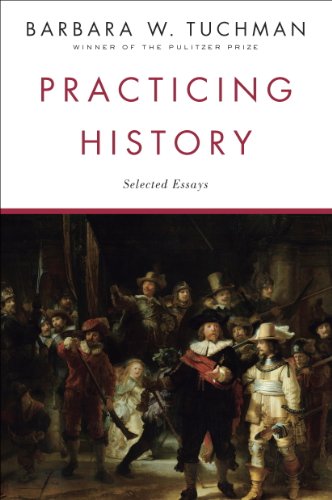
Celebrated for bringing a personal touch to history in her Pulitzer Prize–winning epic The Guns of August and other classic books, Barbara W. Tuchman reflects on world events and the historian’s craft in these perceptive, essential essays. From thoughtful pieces on the historian’s role to striking insights into America’s past and present to trenchant observations on the international scene, Barbara W. Tuchman looks at history in a unique way and draws lessons from what she sees. Spanning more than four decades of writing in The New York Times Magazine, The Atlantic, Foreign Affairs, Harper’s, The Nation, and The Saturday Evening Post, Tuchman weighs in on a range of eclectic topics, from Israel and Mao Tse-tung to a Freudian reading of Woodrow Wilson. This is a splendid body of work, the story of a lifetime spent “practicing history.” Praise for Practicing History “Persuades and enthralls . . . I can think of no better primer for the nonexpert who wishes to learn history.”—Chicago Sun-Times “Provocative, consistent, and beautifully readable, an event not to be missed by history buffs.”—Baltimore Sun “A delight to read.”—The New York Times Book Review
User’s Reviews
Reviews from Amazon users which were colected at the time this book was published on the website:
⭐This book is a wonderful resource for teaching the art of understanding history through reading, developing an instinct for corroborative detail and be the discipline of the precise ordering of events. She argues that the final and most difficult step, is creative composition regarding the events under investigation because it involves the selection only of those portions of the data collected that can recreate in the minds of the reader an appreciation of what truly transpired. Practical and illustrated by material she composed and published, it provides useful guidance for anyone interested in our fellow humans, the worlds in which they lived and ways to engage others in our enthusiasm for what we have found.
⭐Of all of the historians of the past 50 years, very few have had the success that Barbara Tuchman had. Two of her books won the Pulitzer Prize in History. Almost all were best sellers. This wonderful book is a collection of her predictably thought-provoking and readable reflections on the what history should mean to us, what history can tell us about the future and what it does not tell us.There is some unevenness in these short essays. A few are flat-out remarkable, particularly those that deal with why history is important and what it can tell us about the future. Some are a bit less absorbing but perhaps this reflects the taste of the reader. Not all readers are interested in all of the vast range of topics covered in this book of essentially unrelated essays. They are all history but some of the topics are just plain more interesting than others.Through it all, however, it is almost always useful to have a guide with the insights and skill of Mrs. Tuchman to take us through some of the great events of the twentieth century.
⭐Irrespective if the reader is a historian, a politician, or just a neophyte, this collection of essays is a splendid, most recommendable “lecture” and a greatly enjoyable reading. Barbara Tuchman manages to introduce the reader to the essential tenets of history writing: the importance of beauty and style, the significance of detail, the necessity of the “big picture”, and why/how the historian (of course!) has to keep alive the attention and interest of the reader. And – above all – why written history has to read more like a novel, rather than a long, dry listing of dates, characters and facts. Barbara Tuchman’s erudition is huge, her choice of detail(s) is exquisite, and her knowledge of subject absolutely impressive! All that presented with modesty and humility, a sharp sense of humor, but also with great candor in explaining why she likes (or dislikes) a certain historic personality or event.And last but not least: the book is the most valuable “appetizer” to stimulate the neophyte’s interest for history. My suggestion: start with her other books!
⭐Like most essay collections, there are those in “Practicing History” that don’t interest an individual reader and some that they value. I found that the ones I learned from and, or enjoyed in this book definitely outnumbered the former. Ms. Tuchman’s essays on the value of history to one who studies it and ones on the responsibilities of the historian are worth reading and rereading. The lessons she finds in her study of disastrous governmental and diplomatic blunders, often deliberate and self-serving, are valuable lessons, but I think her understandable anger about these blunders in Vietnam and WW II China are repeated too often in multiple essays. I must say that Ms. Tuchman, with her deep study of these fiascos and the understanding of the terrible consequences of them has every reason to be furious. I just got tired of reading about them. I recommend reading “Practicing History” , “The Proud Tower”, and “Guns of August”. Likely the rest after I read them myself.
⭐I often buy used books this was in good condition as advertised
⭐One of the leading historians of her generation inspires and informs on the art and narrative technique of history writing in these essays.
⭐Somewhat dated, perhaps. But, Mrs. Tuchman’s insights in “Practicing History” are timeless in key points on the myth of objectivity and keeping the historical context of events in view. In our day, history seems dependent on the historian’s political slant with few exceptions and Mrs. Tuchman speaks to that trend years before it became so obvious. Her words also speak to the growth of the post-world war one cynicism that seems as prevalent (perhaps more so) a century later. So-called “professionals” of all fields are sometimes easily offended or threatened by what Mrs. Tuchman calls “independent” communicators in their field. Attempting to dismiss or marginalize the independent/amateur is not a response to the issues they raise. Only an independent could have written this book and challenged the “professional” establishment. And few independents have the credentials to do so as Mrs. Tuchman has.This book is ideal for communicators in the field of history and historical fiction. Whether one agrees with her or not, dismissing Mrs. Tuchman is no option for the serious historian – professional or independent.
⭐I love Barbara Tuchman’s popular histories. She made history come to life. I think I now have all of her books. My favorite is The Proud Tower. Here, Barbara tells us how she does it.
⭐One of the most professional an agilely effective historians in the discipline provides accessible information about how and why historical events can be written.
⭐If there is a better or more original writer of history than Tuchman, I have never come across her or him. Barbara Tuchman brought a new look to the way she perceived history and the elegant way she wrote it.
⭐Could have written today. Reading it should be mandatory for politicians
⭐Importante é clássico texto de historiografia.
⭐
Keywords
Free Download Practicing History: Selected Essays in PDF format
Practicing History: Selected Essays PDF Free Download
Download Practicing History: Selected Essays 2011 PDF Free
Practicing History: Selected Essays 2011 PDF Free Download
Download Practicing History: Selected Essays PDF
Free Download Ebook Practicing History: Selected Essays