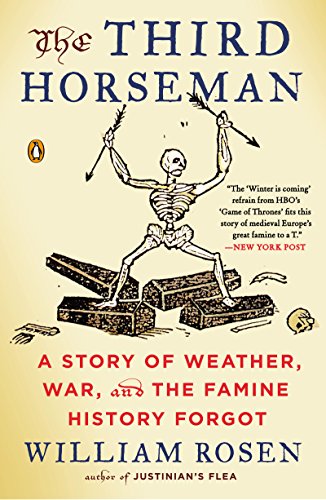
Ebook Info
- Published: 2014
- Number of pages: 302 pages
- Format: PDF
- File Size: 5.25 MB
- Authors: William Rosen
Description
The incredible true story of how a cycle of rain, cold, disease, and warfare created the worst famine in European history—years before the Black Death, from the author of Justinian’s Flea and the forthcoming Miracle CureIn May 1315, it started to rain. For the seven disastrous years that followed, Europeans would be visited by a series of curses unseen since the third book of Exodus: floods, ice, failures of crops and cattle, and epidemics not just of disease, but of pike, sword, and spear. All told, six million lives—one-eighth of Europe’s total population—would be lost.With a category-defying knowledge of science and history, William Rosen tells the stunning story of the oft-overlooked Great Famine with wit and drama and demonstrates what it all means for today’s discussions of climate change.
User’s Reviews
Reviews from Amazon users which were colected at the time this book was published on the website:
⭐Rosen has written a very readable historical overview of northwestern Europe during the late 1200s and early 1300s, however it is not about climate change. (I suspect the subtitle was chosen because of current interest in the issue.) The book is really a political history of the period. He presents a top level view of three political relationships; England vs. Scotland, England vs. France, and the Holy Roman Empire and the Papacy. He does a very good job of simplifying a key time of history for this region of Europe, made complex by the overlapping family claims for land and power, at a time when the earth was moving into the “Little Ice Age” that was to last until the latter 1800s.The book is not is what the title claims: it really does not address climate change and the great famine of the early 1300s – it really is more of a political history of the period with occasional forays into discussions of the impact of poor or no harvests caused by too much rain and floods. I say this because the first five chapters (121 pages) of the book is about how Norse raids, the Normans, the development of feudalism, with a large focus on Edward I’s attempt’s to subjugate Scotland – which all makes for interesting reading. I frequently found myself wondering when he was going to get to his narrative on the impact of climate change. It’s not until Chapter Six that he gets into any serious discussion of the rainy years of 1315 and 1316, the related famines that covered all of northern Europe, and how the climate was changing during the period. But even then it’s not long before he turns to discussing politics and power among the regions I mention above.In fact, leaving aside that this is more a political history of power politics of the period, the book really supports the theory of “The Malthusian Trap.” The author states in his conclusion that it wasn’t two years of bad weather that killed so many, any more than the battles between the rival powers. “The conditions that destroyed millions of lives during the seven years of the Great Famine appeared during the four centuries of the Medieval Warm Period. From 900 to 1300, as ten million mouths grew to thirty million – and as the least productive acres in Europe were cultivated to feed them – the balance between producing food and consuming it grew more fragile every years.” In other words, there were insufficient resources to support the existing population, especially when combined with the wars of the period and the demands this made on existing food and financial resources – a perfect storm, so to speak.Overall I found this an interesting book to read. However, if you’re already familiar with English, Scottish, and French dynastic struggles of the period you won’t find much new.
⭐I very much enjoyed Rosen’s
⭐, and therefore had expected a similarly detailed accounting of the Medieval Warming Period (MWP) of the 13th century. While this does play a role in the history Rosen writes, it really takes a back seat as much of his attention is focused on dynastic struggles of Edward I (Longshanks) and his son, Edward II. Too much attention, I think.Rosen does a brilliant job of explaining the causes behind the MWP and its conclusion as the 13th century was ending and the 14th century was beginning (no easy feat, that.) The social and economic impact of the MWP similarly explained. Sadly, this makes up only about 1/3 of the book, much of the remainder focused on the political and dynastic struggles of the Plantagenets and their rivalry with the Scots to the north (William Wallace and Robert the Bruce) and the French to the south. While of ancillary interest, I found much of it dry and a distraction from is ostensibly the focus of the book. So much attention is given to the political struggles Edward II that just over a single chapter is devoted to Flanders and the Netherlands, and barely a single chapter discusses the central Europe, Hansa and the Holy Roman Empire (parts of Europe which were also impacted by the “little ice age” of the 14th century.)For readers looking for depth, detail and an ancillary discussion of the MWP on Britain, there is much to recommend here. I had anticipated more focus on Europe as a whole with greater analysis on climate changes impact on the later middle ages.
⭐I really had high hopes for this book; I wanted more information about how weather incidents affected historical events. But no, it seems to me that this title was a clever excuse to put forth yet another book about the war between Edward I, Edward II and the Scots. I can’t see where the weather had anything to do with it except that years of famine wreaked havoc on the population, abetted by the horrors of warfare that destroyed what little food they could coax from the ground. And that’s it, in a nutshell. We didn’t really get to the topic of the climate until chapter 6. Chapter 1 through 5 gave us a “quick and dirty” medieval history lesson. I admit I knew little about the famine, but the subject could easily have been dealt with in an article rather than a whole book.
⭐Less about climate change and more about local hostilities — Rosen clearly thinks Robert Bruce was a big deal — and I suppose he was compared with Edward II but then again so am I. Did that guy ever do anything right? The book made me glad I was born in the twentieth century rather than the thirteenth — the suffering then seems unspeakable and I find it astonishing that given the hunger and pestilence men would still think that marching to a distant place to fight people they didn’t know to be a good idea. The Black Death seems to have erased the preceding famine from most history books even though the latter may have been a more significant harbinger of things to come — it did after all announce the coming of a mini ice age. The book also made me appreciate the local supermarket — I can actually go there and buy a wide variety of foodstuffs from faraway places for a relatively small portion of my income. It would have seemed like Heaven to the poor souls in the book what with a life expectancy of about twenty five.The book is interesting, funny at times lampooning the absurdities of royal life and the antics of its players but in the end enough to make one stare back in horror at the plight of our ancestors for whom not surprisingly there was a reverence for the hereafter far more than there is for us today.God bless them all wherever they are.
⭐This traces the many threads which together made up the huge famine of the early fourteenth century, showing what a knife-edge most of European civilisation was perched on following some decades of prosperity and therefore population explosion. It needed `only’ a large volcanic eruption somewhere distant to so much dislocate many aspects of life that there followed many years of famine, war, politics (mostly violent, of course) social dislocation and revolution. I never guessed that a bad summer would cause a salt shortage, and therefore a shortage of cheese, and therefore a shortage of winter sustenance, as well as a shortage of salt tax for the King. , or that Bruce’s rebellions would be made possible by the widespread famines. And of course the King (Edward 2nd) got a lot of the blame really for being king in an unlucky time. And therefore a Bad Thing. .
⭐This should really be titled The Second Horseman: The Wars Between the English and Scots. If you are looking to learn more about the famine, it’s causes and effects, I would look elsewhere.
⭐Brilliant review of the medieval history of UK and Europe discussed using historical events against weather patterns which changed so much, so quickly. Well argued
⭐An enthralling read.
⭐A great read which highlighted much food for thought for today’s world. Well written and couldn’t put it down.
Keywords
Free Download The Third Horseman: Climate Change and the Great Famine of the 14th Century in PDF format
The Third Horseman: Climate Change and the Great Famine of the 14th Century PDF Free Download
Download The Third Horseman: Climate Change and the Great Famine of the 14th Century 2014 PDF Free
The Third Horseman: Climate Change and the Great Famine of the 14th Century 2014 PDF Free Download
Download The Third Horseman: Climate Change and the Great Famine of the 14th Century PDF
Free Download Ebook The Third Horseman: Climate Change and the Great Famine of the 14th Century