Ebook Info
- Published: 2010
- Number of pages: 384 pages
- Format: PDF
- File Size: 5.67 MB
- Authors: William Rosen
Description
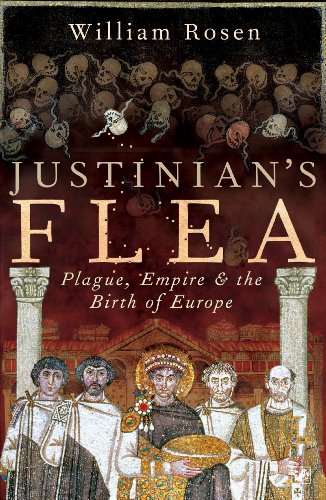
In the middle of the sixth century, the world’s smallest organism collided with the world’s mightiest empire. With the death of twenty-five million people, the Roman Empire, under her last great emperor, Justinian, was decimated. Before Yersinia pestis, the bacterium that carries bubonic plague, was finished, both the Roman and Persian empires were easy pickings for the armies of Muhammad on their conquering march out of Arabia. In its wake, the plague – history’s first pandemic – marked the transition from the age of Mediterranean empires to the age of European nation-states – from antiquity to the medieval world.A narrative history that melds contemporary sources with modern disciplines, Justinian’s Flea is a unique account of one of history’s great turning points – the summer of 542 – revealed through the experiences of the remarkable individuals whose lives are a window onto a remarkable age: Justinian, his general Belisarius, the greatest soldier between Caesar and Saladin; his architect, Anthemius who built Constantinople’s Hagia Sophia (and whose brother, Alexander, was the great physician of the plague years); Tribonian, the jurist who created the Justinianic Code; and, finally, his empress Theodora, the one-time prostitute who became co-ruler of the empire, the most politically powerful woman in European history until Elizabeth I.
User’s Reviews
Reviews from Amazon users which were colected at the time this book was published on the website:
⭐I don’t know Mr. Rosen, the author of this book. If he in person is anything like the persona of the narrator of his book, it’s a pity that I don’t. Spending time with this book is like having a talk with someone immensely insightful and equally learned (and articulate and witty) – kind of what we all hoped our college professors would turn out to be. My main disappointment in this book was that it ended. I wanted to be able to continue reading it for a lot longer.The Amazon note and the other reviews lay out the scope of the book fairly well. Let me step back a little from there. I think that Rosen’s point is that history is not only written by winners, but that it often written to play out a discussion on terms that were established by people who were either too immersed in the events of that history or too devoted to a particular interpretation of those events to be able to see them clearly.And so, patient, clever, and thoughtful person that he is, Rosen has decided to dig a little deeper into the pivot in Western history called the Sixth Century.At the beginning of that century, the Western European territories of the Roman Empire, and Rome itself, had been overrun by “barbarians”, although the gap in civilization between the Romans and the people who destroyed their Western empire was not as large as what those terms suggest. Peter Heather’s “The Fall of the Roman Empire” discusses that process quite well. The former Roman territories in what we know now as Great Britain, Germany, France, Spain, and Italy, had become a land of settlements of various tribes or bands of peoples, who were warlike, ambitious, and mobile. Northern Africa, the granary of the West, was in barbarian hands.The Empire continued in the East, ruled from Constantinople and faced with continuing threats from hostile outsiders and internal weakness.At the end of that century, a lot of the Western and African territory had been won back to Roman rule and some important changes had been made in the administration of the Empire. The Empire’s major foe to the East, the Persian empire, had been fought to a standstill and appeared to be less of a threat than it had been for a long time. Things seemed to be turning around. But they weren’t – at least not in the way a contemporary observer might have thought.Rosen’s main point is that human society from Persia to the Atlantic was reshaped in profound ways by the devastating effects of Bubonic Plague. It depopulated both the Persian and the Roman empires enormously and weakened both with a series of consequences, including a loss of the ability to resist the explosion of the conquering Arab forces spreading Islam, an inability of the Roman empire to hold its reconquered territories, with a resulting shift of its attention eastward, causing a power vacuum in the West that the church and the emerging nation states had to fill, and a change in economic power allocation brought about by the increasing value of labor in a population with fewer people. Out of all of this came the roots of what would turn into the modern world.Rosen is, as I have stated above, a sharp-eyed and thoughtful guide through these events. He also doesn’t give himself enough space to look deeply enough into them.For instance, he is right that the plague’s devastations weakened both the Roman and the Persian empires’ ability to withstand the onslaught of Islam, although that is (rightly) a small part of his focus, since the Islamic explosion began in a big way in the next century. I wish he had set the stage for the understanding of Islam’s success a little more clearly.On the one hand, there is no doubt that the Arab armies were numerous and enthusiastic and (as Rosen notes in a way that will sound familiar to people in our time) trained in proxy wars by the nations they would soon turn against in the most advanced combat techniques of their time. On the other hand, both the Persians and the Romans had been fighting against this type of enemy for centuries and they knew the ins and outs of combat with and against mounted archers about as well as it could be known.On the other hand, it’s also clear that the Arabs brought more with them than horses and arrows and sharp swords. They also brought a promise of a better life for those who accepted their rule. Islam offered a degree of tolerance of Christian and Jewish belief that was unusual at the time and, even more attractively, it offered a kind of social equality among believers (at least to some extent) that was long-gone from Christianity, after it and Rome became entwined and that was probably never the case with the Persian empire’s religions and much more social mobility than either empire could have offered at the time. The sheer cost of supporting the administrative structure of the two empires must have been enormous, and as the size of the population onto which this cost was imposed shrank from the plague, the individual burden must have become greater and less easily evaded. The invaders, by contrast, were affluent and anxious to turn their newly won riches into adornments and tools. The combination of greater freedom, increased wealth, and the chance to advance socially, must have been at least as great a weapon for Islam as the Arab armies. I wish that Rosen had addressed that point.Also, there’s a fine irony – of the kind that he usually catches – that missed his gaze. One of his points is that the introduction of the compound plow and the sudden availability of a lot of land in Europe made horses necessary and larger-scale agriculture possible. It also let to the rise of the European heavy cavalry and a warrior class made up of these soldiers (we call them knights). The part of the circle that he doesn’t close is that it is these fighters, who were nearly invincible at the time, who brought about the destruction of the Roman Empire in the Fourth Crusade, when Constantinople was attacked and sacked in 1202. This was the effective end of the Empire as a great power, though it hung on as a remainder of its former self for another 250 years.It’s also odd to me that a book by someone with experience as an editor is not more carefully proofed, but I guess that in a world in which financial people run everything the financial savings of looser tolerances in accuracy are considered worth it. So we have a clearly wrong date for Augustine’s great work, as pointed out in a previous review, and the year of the fall of Constantinople is changed from 1453 to 1458, probably a mistranscription of a handwritten number. No big deal, but it’s a sorry thing to have to advise caution and double checks on dates in a book so erudite and so pleasant to read.There are another 14 centuries left between the end of it and the present and it would please me to hear that Rosen has decided to work his way forward through as many as he can.
⭐Of all the books I’ve read about the Bubonic Plague, “Justinian’s Flea” proved to be the most deft at weaving the history of Eastern Roman Empire with the ecological life cycle of the plague bacillus, as it mutated from a relatively harmless microbe to a demon that consumed at least twenty-five million human lives, beginning in the year 540 CE.I had assumed the sixth century pandemic originated somewhere in the Great Steppe that separated the Eastern Roman Empire from China, but this author makes the case that it actually originated in the “fertile African valleys between Lake Tana in the north and Lake Rudolf in the South…it would have had its choice of northward routes aboard its flea/rat hosts, either via the Red Sea, or up the Nile…” to the great port city of Alexandria.While waiting for the demon (the author’s name for the plague bacillus) to appear, we are treated to a history of the Eastern Roman Empire as it began to split away from the West and from Rome. One of this author’s main sources is Procopius of Caesaria, the principal historian of the 6th century. He accompanied Justinian’s great general, Belisarius on many of his campaigns and wrote of them in “Wars of Justinian.” Procopius also published a salacious ‘Secret History’ which was rediscovered in the Vatican Library many centuries after it was written. This is the source for the EmpressTheodora’s early life ‘on stage’ including the infamous anecdote about her act with the geese. I never realized ancient history could be morphed into an x-rated movie!William Rosen also quotes extensively from “The Buildings of Justinian” by Procopius to describe the construction of the Hagia Sophia, the massive domed church that reigned as Christendom’s largest cathedral for a millennium. It was finished in a little under six years, which is an astonishing feat when you realize that Europe’s great gothic cathedrals such as Chartres took generations of labor to complete. The erection of Hagia Sophia’s immense dome forms one of the most noteworthy sidebars in “Justinian’s Flea.”Back to the plague itself, and the author’s interesting assertion as to why Justinian’s plague showed up when it did: a drop in the average temperature, almost certainly caused by a volcanic eruption. According to Procopius, in the summer of 536 a mysterious cloud appeared over the Mediterranean basin: “The sun gave forth its light without brightness and it seemed exceedingly like the sun in eclipse, for the beams it shed were not clear.” Modern research points to the Ilopango volcano is San Salvador as the probable culprit. What do cooler than usual temperatures have to do with the plague? “The narrow range [of optimal temperature] bracketed by flea activity and bacterial blocking had kept the disease confined to its East African focus for hundreds if not thousands of years.” The plague-carrying flea is only active within a very narrow range of temperature: from about 59 – 68 degrees Fahrenheit. When Egypt cooled down, the plague-bearing fleas were able to migrate north to the great port city of Alexandria, and from there to the rest of the Mediterranean basin.In this book’s epilogue, the author speculates on what might have been if Justinian’s plague hadn’t fatally weakened the Eastern Roman Empire, just as the European proto-states were forming and the Muslims were about to sweep out of Arabia and conquer all before them. It forms a fitting finale to this remarkable mixture of history and epidemiology. Highly recommended.
⭐A compelling volume on Justinian era, dealing with the emperor’s achievements in reuniting the empire in the context of the interactions between the Roman, Mediterranean, and Eastern World at the time, the building of Hagia Sophia, Justinianic Code and the plague influence in the collapse of the classical civilization.Full of facts, ideas and very readable, jumps from one theme to another sometimes in surprising directions. The in-depth description of the bacterium evolvement feels like another book.Justinian as a person doesn’t get enough attention and the influence of plague might not have been as important as his theory implies but I found the book enchanting and I have to re-read it at some point in the future.
⭐”Justinian’s Flea” is subtitled, “Plague, Empire & the Birth of Europe”. It is about no such thing. It is simply a selective account of events during the reign of the Emperor Justinian, and a pretty uneven one at that.The opening chapter is an introduction to the Byzantine empire, concentrating on the reign of Constantine the Great. The second chapter skates over the following two centuries very unsatisfactorily, seemingly in an attempt to get to Justinian as quickly as possible; but if that’s the intention, why bother with such a superficial account of Constantine at all?Much of the rest of the book stays with Justinian, but while some events from his reign are covered in great detail (there’s a fairly good account of Belisarius, for instance), others are passed over in a mere sentence or not mentioned at all, and one searches in vain for any objective selection criteria. There are much better accounts of this period: John Julius Norwich’s superb “Byzantium” triology, for example, manages to leave one with a much better appreciation of Justinian’s life and times despite using far fewer words.For a book which is supposed to show the impact of the plague on European life, it takes an astonishingly long time to get on to its subject matter. There are 325 pages of text, yet plague isn’t mentioned until page 167, more than half way through the book. Plague then receives only two short chapters (much of the material here being in too much scientific detail to be able to hold the interest of the average history reader), before dropping out of the account other than for occasional afterthoughts. The book simply doesn’t cover the material it claims to. There are laws against this kind of thing, you know.There are subjective parallels with events of modern history, and pointless digressions throughout. The Persians are introduced only to be removed from the story on account of (allegedly) the threat of the plague, and towards the end of the book there is a diversion into the silk trade – for what purpose, it’s hard to say.And as for “the birth of Europe” – well, it receives precisely two and a half pages at the very end (yes, that’s it – I’m not joking). These offer only a shallow and rather childish “what if” scenario, postulating that no plague would have meant no Holy Roman Empire, no Crusades, no Napoleon and no Hitler. What nonsense.”Justinian’s Flea” is a moderately interesting read of sixth century history, but it is no more than that. This is the first book by William Rosen, whom we learn has made his living more as a publisher than as a writer. One cannot help wondering whether a fellow-publisher backed this venture just to allow him to get one book to his own name. His own confession that this book was written in response to the question, “What would you do if you were unafraid to fail?” speaks for itself.Grammar and punctuation confirm to American standards, which is irritating for readers of British English. There are errata throughout, which should have been picked up by even an inexperienced proofreader.
⭐This is a fascinating book written in a ‘popular’ rather than a strictly ‘academic’ fashion but it makes for a great read. The writer’s absorption in early Byzantine history flows through every page and he has the good author’s knack of keepinjg up the pace while not mnissing opportunities to entertain and inform. I have many academic texts on this period on my shelves and Rosen’s book is worthy of a place deside them. Thoroughly recommended for new entrants to the world of Byzance.
⭐The blurb inside the front cover says that Rosen used to be head of a publishing house, and this is his first book. Implication: he’s not a professional historian. Looking at his notes at the back, his historical sources seem to be based largely around just a few works;
⭐Gibbon
⭐looms large, plus some of the other usual suspects like
⭐A. H. M. Jones
⭐and
⭐J. B. Bury
⭐. On the medical aspects of the
⭐plague
⭐, Google seems to have been his friend here.Despite what on the face of it might seem the work of an amateur, this is actually quite a good, wide-ranging work, well written in spite of some occasionally odd usage of metaphor and digressions. It’s not just about the plague but also considers the events of the couple of centuries leading up to
⭐Justinian
⭐, and within the reign of Justinian itself has such diversions as chapters about the construction of
⭐Hagia Sophia
⭐and the codification of law in the
⭐Institutes
⭐.There are flaws however, often sins of omission rather than commission, for example as I recall off the top of my head:- In discussing the Visigoths and their relationship to Rome, Rosen makes no mention whatsoever of the battle of the Frigidus in 394, which can be considered one of those turning points of history. The Visigoth army helped
⭐Theodosius
⭐defeat the usurper Eugenius, ensuring the continuation of Christian Rome, and Catholic at that, and the loss of 10,000 Visigoths, half their army, in the service of Rome, for little reward and still no homeland, certainly sowed the seeds of bitterness leading to the events of the early 5th century with Alaric and the sieges of Rome. To omit mention of this seems shockingly poor.- When discussing the collapse of the first dome of Justinian’s Hagia Sophia, Rosen does not mention that it was first weakened by an earthquake and then collapsed after a second quake. He seems to imply as a result that it simply collapsed of its own accord.- In his biological discussion, he thinks that “metazoans” comprises all multicellular life – this is not the case, but rather corresponds roughly to what we call “animals”.Looming in the background are two theses, thata) Rome and China went along parallel paths until the plague came to Rome, andb) the plague is responsible for the creation of mediaeval Europe (by assisting in the permanent breakup of the West, and conquest of the East, Africa & Spain by the Arabs).These theses seem somewhat debateable. Is Rosen implying that without the plague there might still today be some sort of gigantic political superpower covering Europe, North Africa and the Near East to match modern China? Seems unlikely to me. The ultimate causes of the lasting fragmentation of Rome were as much political, religious, military and ‘racial’ as medical.Despite the flaws, this is a book worth reading.
⭐fair price, prompt delivery and a good read
Keywords
Free Download Justinian’s Flea: Plague, Empire and the Birth of Europe in PDF format
Justinian’s Flea: Plague, Empire and the Birth of Europe PDF Free Download
Download Justinian’s Flea: Plague, Empire and the Birth of Europe 2010 PDF Free
Justinian’s Flea: Plague, Empire and the Birth of Europe 2010 PDF Free Download
Download Justinian’s Flea: Plague, Empire and the Birth of Europe PDF
Free Download Ebook Justinian’s Flea: Plague, Empire and the Birth of Europe