

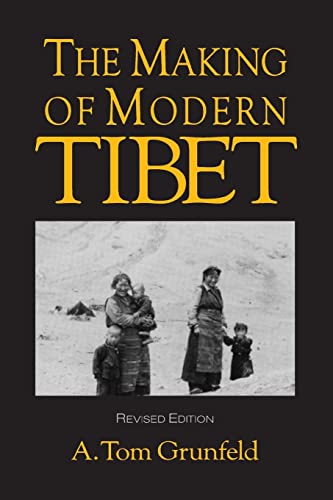
Ebook Info
- Published: 1996
- Number of pages: 370 pages
- Format: PDF
- File Size: 36.96 MB
- Authors: A.Tom Grunfeld
Description
An account of Tibet and the Tibetan people that emphasises the political history of the 20th century. This book attempts to reach beyond the polemics by considering the various historical arguments, using archival material from several nations and drawing conclusions focused on available documents.
User’s Reviews
Reviews from Amazon users which were colected at the time this book was published on the website:
⭐A comprehensive and fair account of the history and modern transformation of Tibet from a serious scholar. Brain-washed extreme communist would always consider Tibet to be naturally part of China. Tibetan separatists depict themselves as victims of Chinese invasion. Western media against rising Chinese communist power tends to picture China as a big monster bullying ethnic minorities. Which view is closer to the reality? This is a book in which you can find some facts, not political attitudes, about Tibet. For instance, the author cites “venereal disease (estimated to affect 90 percent of the population) and smallpox (afflicting about one-third of the population…) were chronic …” before 1959. This may be offensive to someone. But the fact is fact, unless one can prove it’s wrong with evidence. Overall, this is not a book to praise the pure lifestyle in the traditional Tibet culture, as some readers wish to see. It just delivers the facts, being nice or dirty.
⭐Grunfeld gives lots of statistics, and supplies a very full narrative, but he seems afraid of offending the Chinese Communist party. For example (p217), he quotes the 1982 Chinese constitution’s guarantees of freedom of religion, without any comment at all on the degree to which the constitution is enforceable via the Chinese legal system. He even compares (p263) the CCP’s view of aspirations of autonomy in its regions to the “discomfort” of Canada with Quebecois aspirations, an extraordinary comparison given that regular elections including secessionist parties (and repeated independence referendums!) occur in Quebec. Reading this book you learn a lot of facts about Tibet, but very little about the nature of the Chinese regime that rules it, nor about the views of Tibetans themselves.
⭐Very scholarly by one of the few Western historians that were brave enough to tell the truth about the Lamas and their history. That doesn’t get him syndicated articles on our illiberal , repressive , left-wing papers, posing as “progressive” however , who all just love the Lamas and bury these real histories.
⭐Good book
⭐While this book is well written (the writing style and information make for a good read), and the author seems to have performed a good deal of research, this is far from an impartial history of Tibet as the author claims. After the author makes this claim in the opening pages he commences with a look at the nature of Tibetan society prior to 1959. While uncomfortable for those sympathetic to the Tibetan nation, this opening expose is quite interesting. The author points out, with some decent source citations, that far from being the “Shangri-la” that many imagine, pre-1959 Tibet was a nation where the majority of people lived a very destitute, hard existence, where political and legal rights for many were almost unknown, where a type of feudal system existed that was on the one hand supportive of the Buddhist religion but on the other permitted very harsh punishment meted out by the ruling elite. This is believeable as far as it goes. However, when one reads the balance of the book one wonders whether one is really getting the whole story even in this opening chapter.The chapter dealing with the early history of Tibet seems innocuous and fairly balanced, although even here one begins to see that the author is focused on proving one of his central tenets – that Tibet was never really an independent nation and for most of its history maintained some filial relationship with China. This becomes noticeable when one reaches the great majority of the book, which deals with the Twentieth Century. Here the author’s bias comes forth. With each succeeding chapter, telling Tibet’s story chronologically (the first edition stopped in 1985 when it was published, but this revised edition runs to 1995), the author’s pro-China sympathies become ever clearer. This becomes very annoying after awhile. I am an avid footnote reader so I checked his footnotes throughout. There are many citations to secondary sources which in themselves are suspect (Chinese popular publications and official newspapers for instance). In some cases, particularly dealing with the 1959 revolt and subsequent events, some of the author’s most anti-Tibetan statements do not contain citations to sources at all. He even reverts in his writing (accidentally?) to using terms for the Dalai Lama and the exile government that are used in official Chinese government communiques (i.e. “The Dali Clique” and “the oligarchs”). He becomes free with his opinions questioning Tibetan sources and trying to discredit them but he quotes from official Chinese sources without comment or criticism. I gather that he felt that he had written an “impartial” history by merely citing to sources from both sides, but this is not the case if he takes the Tibetans (and their allies in the US, India and elsewhere) to task but says nothing of the intentions of the Chinese official writings from which he freely quotes and cites. Amazingly, while he details in several chapters the alleged wrongs perpetrated on many Tibetans by their ruling elite, monks, aristocracy, western governments, etc. he glosses over the effects of the Cultural Revolution on Tibet. He only ackowledges that many monasteries were destroyed, but makes no effort to try to calculate the number of Tibetans killed, jailed and tortured during this time. On the other hand he makes a tremendous effort to discredit the data from the Dalai Lama and the Tibetan exiles concerning the number of refugees who have fled Tibet since 1959.Oddly, in the very last chapter of “conclusions” the author makes his most critical statements concerning China’s rule in Tibet and the issue of Tibet’s autonomy. This comes across as too little and too late to make up for a very stilted narrative overall.If you want a general overview of Tibet, particularly its post-1950 history, from a Chinese point of view this book is pretty good. But for the pleasant writing style and a biased but thorough job of research and citation I would have given this book a 2 or 1. Take this work as an academically researched polemic but there is much more information to obtain to get “the whole picture”.
⭐This is an excellent book well written and easy to read giving a balanced view of the history of Tibet. It certainly expels the Hollywood myth of a mystical utopia and saint like Dalai Lama. It also shows some of the damage that an interventionist government like America can cause in the world.I hope that someday the author can bring the book up to the present day as China and world politics are changing at such a fast pace.Hopefully I will be able to visit Tibet in the near future to see the current situation for myself.
⭐Prof. Grunfeld, der an der State University of New York lehrt, hat hier ein ausgezeichnet dokumentiertes Buch zur Geschichte Tibets vorgelegt, mit Schwerpunkt auf den Ereignissen des 20. Jahrhunderts. Das Werk ist meilenweit entfernt von der borniert-parteilichen und propagandistischen Darstellung der Tibetfrage und der historischen Fakten, an welche die Tibet-Szene (mit Autoren wie Klemens Ludwig oder Franz Alt) die Öffentlichkeit bei uns längst gewöhnt hat. Prof. Grunfeld beweist überzeugend, dass Tibet bis zum Jahre 1913 zu China gehörte und dass die dann (beim Zusammenbruch des Kaiserreichs)erlangte, sehr relative “de facto”-Unabhängigkeit in den folgenden 37 Jahren von keiner einzigen Regierung der Welt anerkannt wurde, weder von China (das bis 1949 ja nicht von Kommunisten regiert wurde), noch von den sukzessiven Regierungen der USA, und sogar nicht von den Briten, die damals von Britisch-Indien aus ihren Einfluss auf Tibet ausgedehnt hatten und die eigentlichen Anstifter der “Unabhängigkeitsbestrebungen” des 23. Dalai Lama waren (insbesondere der heimliche Herrscher über Tibet und den 13. Dalai Lama, Sir Charles Bell).Besonders interessant fand ich die Ausführungen Grunfelds zur “Internationalen Juristenkommission”, deren Mitte des vergangenen Jahrhunderts verfassten “Berichte” bei der Argumentation der Tibet-Szene stets eine zentrale Rolle spielen. Von dieser Juristenkommission stammt die seither millionenfach wiederholte Behauptung eines “kulturellen Völkermords” der chinesischen Kommunisten an den Tibetern. Grunfeld zeigt überzeugend, auf wie schwachen Füßen diese Behauptung steht, wie einseitig, oberflächlich und voreingenommen “untersucht” und Zeugenaussagen gesammelt wurden; vor allem deckt er den politischen Hintergrund und die Entstehungsgeschichte der IJK auf, bei der es sich um eine vom US-Geheimdienst CIA aus der Taufe gehobene und finanzierte Tarnorganisation des ideologischen Kalten Krieges handelte. Auf dem Hintergrund seiner Ausführungen über die ausländischen Intrigen und Machenschaften, die den bewaffneten Khampa-Aufstand Mitte der 50er Jahre und die Flucht des Dalai Lama 1959 begleiteten, wird die chinesische Haltung verständlicher und letztlich nachvollziehbar.Kein Wunder, dass Historiker und Tibet-Spezialisten wie Grunfeld oder sein eminenter Kollege, Professor Melvyn C. Goldstein, Chairman of the Department of Anthropology der Case Western Reserve University und ebenfalls Autor von ausgezeichneten Werken zur Geschichte Tibets, nicht die Gunst der Dalai Lama-Verehrer und “Free Tibet”-Schreier genießen, sondern wegen ihrer gewahrten Objektivität und Kritikfähigkeit schon mal als Sprachrohre der Chinesen diffamiert werden. Die Tibet-Bewegten wollen eben nur einfache Wahrheiten, grob schwarz-weiß gemalte Bilder und sorgfältig gesiebte Tatsachen lesen, damit die Wirklichkeit in das Prokrustes-Bett ihrer beschränkten Schädel passt.
⭐
Keywords
Free Download The Making of Modern Tibet (CSIA Studies in International) 2nd Edition in PDF format
The Making of Modern Tibet (CSIA Studies in International) 2nd Edition PDF Free Download
Download The Making of Modern Tibet (CSIA Studies in International) 2nd Edition 1996 PDF Free
The Making of Modern Tibet (CSIA Studies in International) 2nd Edition 1996 PDF Free Download
Download The Making of Modern Tibet (CSIA Studies in International) 2nd Edition PDF
Free Download Ebook The Making of Modern Tibet (CSIA Studies in International) 2nd Edition