

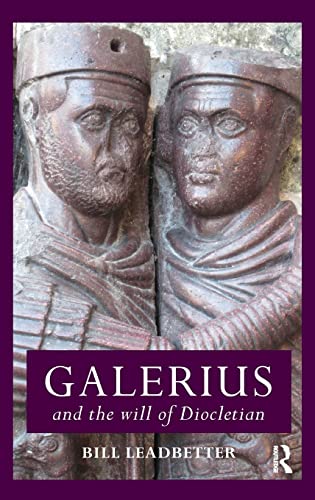
Ebook Info
- Published: 2009
- Number of pages: 280 pages
- Format: PDF
- File Size: 2.37 MB
- Authors: William Lewis Leadbetter
Description
Drawing from a variety of sources – literary, visual, archaeological; papyri, inscriptions and coins – the author studies the nature of Diocletian’s imperial strategy, his wars, his religious views and his abdication. The author also examines Galerius’ endeavour to take control of Diocletian’s empire, his failures and successes, against the backdrop of Constantine’s remorseless drive to power.The first comprehensive study of the Emperor Galerius, this book offers an innovative analysis of his reign as both Caesar and Augustus, using his changing relationship with Diocletian as the principal key to unlock the complex imperial politics of the period.
User’s Reviews
Editorial Reviews: Review “Galerius and the Will of Diocletian is a valuable read for anyone interested in the later Roman Empire.” – Albert Nofi, The NYMAS Review
Reviews from Amazon users which were colected at the time this book was published on the website:
⭐This clear narrative fleshes out the stories of Constantine and Diocletian, humanizing an important figure — probably to the fullest extent possible. Leadbetter draws on coins, inscriptions and literary sources, viewing them not only through the lens of current research but with a perspective on past research and how it may have distorted the picture. He presents an energetic, largely well-meaning, loyal, courageous and religious leader whose very virtues combined with a lack of political foresight (and in the end luck) to engender his tragedy. He was playing by rules that changed fast, and died just before he could make what might have been a history-altering move.
⭐If you are interested in the period of history known as the First Tetrarchy, and its aftermath, this is a must-read book. The author has done an excellent job of synthesizing all the sources and information to create a cogent and clear point of view as to what really happened, and why. For those interested in the coinage of the time, the author’s use of the numismatic evidence will be very compelling. My only criticism is that the editing is not up to standard from time to time, leading to some confusion for those who are not already familiar with this period.Overall, a very well done and interesting book, highly recommended for anyone interested in the subject.
⭐Galerius and the will of Diocletian is a superb book. It is largely about the little-known and much vilified (by the early Christians, for whom he was the main persecutor alongside Diocletian) Galerius, the loyal and capable Caesar to Diocletian and his successor as senior Augustus. It is also about Diocletian himself who looms as a colossus dominating his colleagues and his, and the Empire’s, political ideology, and how the Christians threatened it. Finally, it is about the unravelling of Diocletian’s political construct, compromised and then destroyed by the usurping sons of two of Diocletian’s colleagues who were not supposed to reign: Maxentius `(on of Maximius) and Constantine (son of Constance).The book is a political history of the period between AD 284, when Diocletian seized power to December 311 and his death. Galerius, his chosen successor, had died a few months before after failing to defeat Maxentius and avenge Severus, his own nominee as Augustus in the West, and after having passed an Edict of Toleration that stopped the Persecution of Christians. One of the main interests of this book is to present a clear and very plausible explanation of the causes of Galerius’ failure to perpetuate Diocletian’s ruling system. According to the author, it was not, as often mentioned, because Diocletian’s system was not dynastic. Rather, it was because the key ingredient – Diocletian’s domination of the college and his unquestionable supremacy – was missing. Despite Galerius’ qualities, and Bill Leadbetter shows that he had many, he was unable to exercise a similar level of authority and attract the same kind of respect from his colleagues as his former Emperor had.As the author shows rather well, Galerius’ problems started straight after Diocletian’s rather exceptional abdication, as he was confronted with Constance Chlorus, who had also become Augustus and who was older (and therefore senior) than him. Galerius, despite his efforts, had to accept Constantine’s usurpation and concede to him the title of Caesar and the rule in Gaul, Spain and Britain after the death of Constance Chlorus. He was also unable to put down the rebellion of Maxentius. The later seems to have been a rather shrewd political operator. He called his father Maxentius out of his semi-forced retirement (he had rather reluctantly complied with Diocletian’s orders and abdicated at the same time as the Senior Augustus) to benefit from his military experience.The overall assessment of Galerius’ reign as Diocletian’s Caesar (AD 293 to AD 305) and then as senior Emperor (AD 305 to AD 311) is far from being entirely negative. However, his major achievements seemed to have occurred during the former period, during which he was Diocletian’s faithful and talented lieutenant, particularly his crushing victory over the Persians, which Diocletian converted into a diplomatic triumph, and on the Danube frontier. In other words, the core thesis of the author is that he was at his best when being Diocletian’s henchman, but he was unable to step into his shoes.Related to this assessment is a detailed and fascinating explanation regarding the causes and the responsibilities of such a failure. There are also careful analyses and explanations provided about specific key events such as Diocletian’s amazing abdication – the only Roman Emperor to ever renounce the supreme power and retire – and the Great Persecution. Contrary to the very biased and misleading views of Lactancius, which many historians still tend to promote, both events were, according to the author, very much Diocletian’s decisions,A further benefit of this book is that it also draws interesting portraits of the actions and characters of most of the other less well-known key players, none of which were insignificant. One of these is Constance Chlore, Constantine’s remarkable and quite formidable father whose own achievements are occulted by those of his son. Another impressive character was Diocletian’s colleague as Augustus (and friend). As the author makes clear, Diocletian and these two (and possibly Galerius, although he seems to have much younger than the others) probably knew each other ever since Diocletian’s accession which they are supported. As Bill Leadbetter shows very well, it is this knowledge, predictability and trust between the old comrades in arms which was entirely missing with both Maxentius and Constantine. Neither of the two was intended or supposed to reign and neither seems to have been trusted by either Diocletian or by Galerius, his number two.Once again: a superb, original and convincing read, which is well worth five stars.
⭐A summary of the review on StrategyPage.Com:’Following the “Crisis of the Third Century,” Diocletian (r., 284-305), instituted widespread reforms in the Roman Empire, not least forming the “Tetrarchy,” appointing a co-emperor and two understudies. Galerius was Diocletian’s understudy, and succeeded him in 305, ruling until his death from disease in 311. In this volume, Prof. Leadbetter (Cowan U., Australia) gives us a life and times of Galerius based on a critical evaluation of documents, coins, inscriptions, histories (noting Christian ones are suspect, as Galerius was a persecutor), and more. He uses Galerius’ career, and interactions with many other actors in the period, to examine the nature of Diocletian’s reforms. Leadbetter does not resolve the issue of whether Diocletian was a radical innovator with a comprehensive plan of reform in mind, or merely made adjustments to institutions based on practicality and precedent (e.g., there were cases of co-emperors in the past, military and provincial organization had often been restructured, etc.), but he does help throw considerable light on the period. Part of the Routledge series “Roman Imperial Biographies,” this volume is a valuable read for anyone interested in the later Roman Empire.’For the full review, see StrategyPage.Com
⭐Although this is nominally a biography of Galerius, and indeed the book focusses upon him, it also gives coverage to other emperors of the period 284-311, most notably Diocletian and the relationship between him and Galerius, but also Maximian, Constantius, Constantine, Severus, Maxentius, Maximinus Daza and Licinius. It is a most welcome book indeed as more general histories cover the complex relations between such a large number of emperors over such a short period rather briefly.Bill Leadbetter forcefully argues against any notion of a “tetrarchy”, this being a construction entirely of later historians. Rather, he asserts, Diocletian’s intentions were entirely within the framework of existing practices, an attempt to form a dynasty through marriages, rather than some novel kind of college of emperors. Certainly there was no formal assignment of territories, and the Caesari acted more like servants of the Augusti to carry out certain operations on their behalf, particularly in securing the borders.The relationship between Diocletian and Galerius is reconsidered in some detail, reasserting the dominance of Diocletian over the claims made by some of the sources. Diocletian’s abdication was entirely down to himself and part of his plan to ensure the dynastic succession while he was still able to control it, and not due to the influence of Galerius. The persecutions of Christians were the product of Diocletian’s own piety and devotion to the old gods, and not caused by the persuasion of Galerius. In the end however Diocletian’s hopes in Galerius did not live up to expectation; Galerius in his inheritance was not equal to the ability of Diocletian, unable to maintain the ‘concordia’ with and ultimately outmanoeuvred by the ambitions of the others.This is a great work of thorough scholarship and fresh insight, which should be essential reading for those interested in this period.
⭐Galerius and the will of Diocletian is a superb book. It is largely about the little-known and much vilified (by the early Christians, for whom he was the main persecutor alongside Diocletian) Galerius, the loyal and capable Caesar to Diocletian and his successor as senior Augustus. It is also about Diocletian himself who looms as a colossus dominating his colleagues and his, and the Empire’s, political ideology, and how the Christians threatened it. Finally, it is about the unravelling of Diocletian’s political construct, compromised and then destroyed by the usurping sons of two of Diocletian’s colleagues who were not supposed to reign: Maxentius `(on of Maximius) and Constantine (son of Constance).The book is a political history of the period between AD 284, when Diocletian seized power to December 311 and his death. Galerius, his chosen successor, had died a few months before after failing to defeat Maxentius and avenge Severus, his own nominee as Augustus in the West, and after having passed an Edict of Toleration that stopped the Persecution of Christians. One of the main interests of this book is to present a clear and very plausible explanation of the causes of Galerius’ failure to perpetuate Diocletian’s ruling system. According to the author, it was not, as often mentioned, because Diocletian’s system was not dynastic. Rather, it was because the key ingredient – Diocletian’s domination of the college and his unquestionable supremacy – was missing. Despite Galerius’ qualities, and Bill Leadbetter shows that he had many, he was unable to exercise a similar level of authority and attract the same kind of respect from his colleagues as his former Emperor had.As the author shows rather well, Galerius’ problems started straight after Diocletian’s rather exceptional abdication, as he was confronted with Constance Chlorus, who had also become Augustus and who was older (and therefore senior) than him. Galerius, despite his efforts, had to accept Constantine’s usurpation and concede to him the title of Caesar and the rule in Gaul, Spain and Britain after the death of Constance Chlorus. He was also unable to put down the rebellion of Maxentius. The later seems to have been a rather shrewd political operator. He called his father Maxentius out of his semi-forced retirement (he had rather reluctantly complied with Diocletian’s orders and abdicated at the same time as the Senior Augustus) to benefit from his military experience.The overall assessment of Galerius’ reign as Diocletian’s Caesar (AD 293 to AD 305) and then as senior Emperor (AD 305 to AD 311) is far from being entirely negative. However, his major achievements seemed to have occurred during the former period, during which he was Diocletian’s faithful and talented lieutenant, particularly his crushing victory over the Persians, which Diocletian converted into a diplomatic triumph, and on the Danube frontier. In other words, the core thesis of the author is that he was at his best when being Diocletian’s henchman, but he was unable to step into his shoes.Related to this assessment is a detailed and fascinating explanation regarding the causes and the responsibilities of such a failure. There are also careful analyses and explanations provided about specific key events such as Diocletian’s amazing abdication – the only Roman Emperor to ever renounce the supreme power and retire – and the Great Persecution. Contrary to the very biased and misleading views of Lactancius, which many historians still tend to promote, both events were, according to the author, very much Diocletian’s decisions,A further benefit of this book is that it also draws interesting portraits of the actions and characters of most of the other less well-known key players, none of which were insignificant. One of these is Constance Chlore, Constantine’s remarkable and quite formidable father whose own achievements are occulted by those of his son. Another impressive character was Diocletian’s colleague as Augustus (and friend). As the author makes clear, Diocletian and these two (and possibly Galerius, although he seems to have much younger than the others) probably knew each other ever since Diocletian’s accession which they are supported. As Bill Leadbetter shows very well, it is this knowledge, predictability and trust between the old comrades in arms which was entirely missing with both Maxentius and Constantine. Neither of the two was intended or supposed to reign and neither seems to have been trusted by either Diocletian or by Galerius, his number two.Once again: a superb, original and convincing read, which is well worth five stars.
⭐Un libro necessario, che ricostruisce con grande perizia le vicende, le sfide e i problemi della Tetrarchia e dei suoi principali fautori, Diocleziano e Galerio, suo delfino ed eredeQuesta recensione e’ di un libro in inglese, percio’ la condurro’ in inglese anziche’ Italiano pur essendo su Amazon.it.The book is quite enjoyable for everyone interested in analyzing more closely Diocletian’s famous Tetrarchy and how it functioned. I was amazed to discover that Tetrarchy is actually a later word to refer to something that at the time was just considered an adoption policy, much similar to other periods of the Empire (for example when Antoninus Pius adopted Lucius Verus and Marcus Aurelius at the same time). The Empire was able to recover and to re-flourish for a brief period thanks to Diocletian’s reforms and this book glances through them pretty effectively. Only sad point, it really is mostly a book for whoever wants to write a paper on Diocletian (which is why I bought it) and therefore the narration of the events and the comment might seem a little dry at times. It arrived punctually and I would recommend it to anyone interested in the period it deals with.
Keywords
Free Download Galerius and the Will of Diocletian (Roman Imperial Biographies) 1st Edition in PDF format
Galerius and the Will of Diocletian (Roman Imperial Biographies) 1st Edition PDF Free Download
Download Galerius and the Will of Diocletian (Roman Imperial Biographies) 1st Edition 2009 PDF Free
Galerius and the Will of Diocletian (Roman Imperial Biographies) 1st Edition 2009 PDF Free Download
Download Galerius and the Will of Diocletian (Roman Imperial Biographies) 1st Edition PDF
Free Download Ebook Galerius and the Will of Diocletian (Roman Imperial Biographies) 1st Edition