

Ebook Info
- Published: 2003
- Number of pages: 672 pages
- Format: PDF
- File Size: 10.43 MB
- Authors: Harrison E. Salisbury
Description
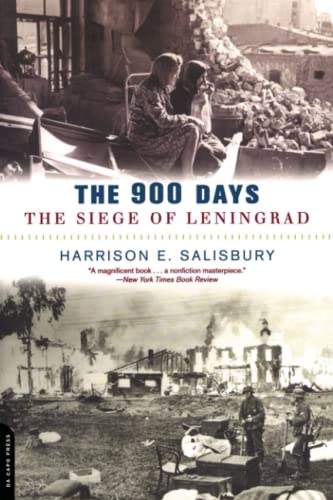
The Nazi siege of Leningrad from 1941 to 1943, during which time the city was cut off from the rest of the world, was one of the most gruesome episodes of World War II. In scale, the tragedy of Leningrad dwarfs even the Warsaw ghetto or Hiroshima. Nearly three million people endured it; just under half of them died, starving or freezing to death, most in the six months from October 1941 to April 1942 when the temperature often stayed at 30 degrees below zero. For twenty-five years the distinguished journalist and historian Harrison Salisbury has assembled material for this story. He has interviewed survivors, sifted through the Russian archives, and drawn on his vast experience as a correspondent in the Soviet Union. What he has discovered and imparted in The 900 Days is an epic narrative of villainy and survival, in which the city had as much to fear from Stalin as from Hitler. He concludes his story with the culminating disaster of the Leningrad Affair, a plot hatched by Stalin three years after the war had ended. Almost every official who had been instrumental in the city’s survival was implicated, convicted, and executed. Harrison Salisbury has told this overwhelming story boldly, unforgettably, and definitively.
User’s Reviews
Editorial Reviews: Review “A reminder that wars are messy and require the greatest resolve.” — Bookviews.com January 2004 About the Author Harrison E. Salisbury is the author of American in Russia, Moscow Journal, and other books.
Reviews from Amazon users which were colected at the time this book was published on the website:
⭐”While from the proud tower in the town, death looks gigantically down”-Edgar Allen Poe (1809-1849) from his poem titled “The City in the Sea.” Such a phrase could describe Leningrad in May, 1941. Little did the Leningraders know that by the end of the year, these people would be in a life-and-death struggle against the Germans, famine, disease, and bitter cold. Although the the bitter cold helped save the Leningrad survivors. Harrison Salisbury’s book THE 900 Days is well researched book describing the courage and perseverance of the Leningrad citizens and Red Army troops who successfully defended Leningrad for 900 days against overwhelming odds.Salisbury began his book an idyllic view of Leningrad in May, 1941. Students finished final examinations. Young lovers strolled the parks arm-in-arm. Parents and children enjoyed the long hours of daylight not knowing what they would face by the end of the year. Joy and happiness were followed by death, famine, fatal illness, and, as mentioned above, bitter cold.When Hitler & co. started Operation Barbarossa on June 22, 1941, Stalin & co. were caught unprepared even though the signs were obvious. German air force pilots invaded Soviet air space. Some German air force pilots accidentally landed at Soviet airports. Reports of a mass German mobilization close to the USSR were ignored by Stalin. For some reason, Stalin feared Hitler and the Germans. Stalin thought Hitler would honor the Non Aggression Pact of 1939. Those who mentioned possible invasion, and, as Salisbury noted, were charged as saboteurs and provokers and threatened with firing squads. When the Germans began their invasion, Salisbury wrote that Stalin thought that some German commanders were too exuberant and that the invasion was a skirmish even though the Germans were bombing areas deep in Soviet territory.When Stalin FINALLY realized the serious desperate situation and retreated to his dacha. When Stalin finally regained his nerve, he learned to listen and shut his mouth while listening experienced military commanders. Leningrad was obviously one of the targets of the German invasion along with Moscow and Stalingrad-now Volgograd. The first few days of the German attacks on Leningrad were not very dramatic. However, as Red Army troops retreated and the Germans took control of islands and towns close to Leningrad, the Leningrad situation deteriorated quickly. The worse disaster was the German bombing of the food warehouses in the Badayev region of Leningrad. The Leningraders immediately know the the disaster that struck. Salisbury was clear that the potential for widespread famine was well known in spite of false assurances of some Communist Party bureaucrats and leaders.Salisbury gave good detailed data as to the reduction of rations which, for many Leningraders was below subsistence levels. Factory workers and Red Army troops got far better rations than other civilians especially the very young and the elderly. As Salisbury wrote, famine led to desperation whereby corn seed, wall paper and other mixtures were concocted for food. Pets, birds, and other animals disappeared for food. Famine led to crime. Forged ration cards were used, and those who printed ration cards forged extras for themselves. Finally the NKVD and NKGB put an end to these forgeries by shooting those guilty. Another type of crime the Soviet secret police faced was the fact that otherwise law abiding citizens murdered to get ration cards. As efficient and thorough as the Soviet secret police were, the latter crimes were much more difficult to solve.Aside from Soviet unpreparedness at the start of WW II, another problem was the initial command ineptness of the Red Army in 1941. Some commanders were shot. Those politically connected including Kulik and Beria were incompetent but were able to shift blame for their stupidity. While the Red Army troops fought bravely, inept command caused huge casualties. Lack of big guns and ammunition contributed to the woes of Leningrad. The only consolation was that the brave Red Army troops inflicted huge casualties on the German invaders.What may surprise readers is that the Leningraders “joined the fray.” Young Communists, factory workers, musicians, artists, and college students went to the front where many died due to lack of training and not enough arms or ammunition. The great Russian Shostakovich lost many of his musicians due to either privation or in combat when they were not practicing. When the Leningraders knew that the Germans could get into the city, they stored arms, Molotov cocktails, grenades, and planted mine fields to welcome any German intruders. Parts of Leningrad were armed camps.The section titled Children’s Sleds was indicative of the high death rates. Children’s sleds were used as hearses to carry the dead to mass graves. Those who were too weak to walked were often transported by stronger people to get to homes and shelters. A photo of two men in a park appeared as someone sitting and one lying in snow. Both men were dead. An angry woman scolded a pharmacist for now not helping a poor soul, and the pharmacist said she was a pharmacist and not a medic. The poor soul was already dead. Salisbury noted that a man dying from famine refused to be helped by a police officer. The doomed man said he just wanted to be left alone and to die in peace.Again, as noted above, General Winter helped the cause. Lake Ladoga, the largest lake in Europe, froze in 20 to 30 below zero degrees. Soviet physicists calculated the thickness of the ice for transport of troops, food, weapons, ammunition, and fuel into Leningrad. While some of this effort failed, the effort was effective to prevent complete death. Also the bitter cold weather took its toll on German troops who were not supplied with winter gear.As the siege ended, the Leningraders regained their confidence. These people fully realized what they achieved in defiantly preventing German invasion of the city. The Leningraders argued that Leningrad was afraid of death. However, death now feared Leningrad. The Leningraders were not defending Communist ideology. They were defending the Russian Motherland and more important their city. The people were defending THEIR CITY. They were defending the home of Tolstoy, Dostoevsky, and other great Russian literary figures. They were defending the residences of famous Russian scientists and and mathematicians.Tragically,. when WW II was over, Stalin’s paranoia led to purges of the surviving Leningrad heroes. Monuments, memorials, and museums praising the heroism of Leningrad were ruined or relocated. Only in 1957 did Khrushchev & co. posthumously rehabilitated Leningrad’s heroes and heroines. While museums and memorials were restored on a smaller scale, the fact is that recently larger memorials and tourist museums have been erected to honor Leningrad’s heroes.As previously noted, the people of Leningrad thought of Leningrad as THEIR CITY.. Hitler was so confident that he planned to have a major celebration party in Leningrad. He then planned to raze what was left of the city and turn Leningrad into an artificial lake which the undersigned mentioned in another review. The fact is that Hitler never had his celebration. Hitler is dead, but the memory of the courage of Leningrad is alive as part of history.James E. EgolfMay 4, 2016
⭐This an eye opener.
⭐Straight up, the Siege of Leningrad lasted either 872 or 880 days, depending on whether you begin the count from the German capture of Mga or Shlissel’burg, not 900 days. I guess “The 880 Days” didn’t sound so good as a book title, but in any case, deliberately mis-labeling a historical event is not a good way to write a history of that event. Harrison E. Salisbury’s The 900 Days was a sensation when it first appeared in the West in 1969 since it was really the first major book in English that covered the epic siege of Leningrad in any detail. Furthermore, compared to the white-washed Soviet histories of the Great Patriotic War which attempted to conceal that over one million civilians died in Leningrad during the siege, Salisbury’s book was brutally frank and honest. I remember reading this book in the early 1970s and considered it quite good. However, The 900 Days has not aged well and now nearly forty years after it first appeared, the value of this book has been reduced by over-reliance on too narrow a source base and the author’s acceptance of Soviet-era falsehoods. When I re-read this book recently, I saw a journalistic account that is riddled in places with factual inaccuracies or mistakes, some of which it is clear that the author never bothered to check. Also, The 900 Days, like David Glantz’s more recent books on Leningrad only focuses on the Soviet perspective, while failing to address the German or Finnish sides in any detail. Furthermore, the book really only covers the first year of the siege in any depth; the remaining two years are glossed over quickly in the final chapter. Nevertheless, The 900 Days is very well written in parts and it remains a `classic’ in conveying the suffering endured by the people of Leningrad. Yet given its limitations, the book should now be viewed as an introduction to the siege, rather than a definitive history. The 900 Days is divided into five parts. Part I, “The Night Without End,” should have been called “the introduction without end,” because the author spends an interminable 130 pages – nearly a quarter of the book – describing events before the German invasion. It is particularly annoying in the manner in which the author describes how a host of minor characters heard about rumors of war approaching and his depiction of Leningrad as a sun-filled `paradise’ with women wearing diamonds and children eating ice-cream. No Stalinist-repression or Gulags here, please. Everything was happy, happy before the war. Part II, “The Summer War,” comprises about 140 pages and is easily the best section in the book, detailing the German advance toward Leningrad and the desperate Soviet measures to erect hasty defenses. The role of Leningrad Party boss Andrei Zhdanov is particularly well covered (he had already been exorcised from post-war Soviet histories, so Salisbury’s account may remain the definitive one on this character) and Salisbury is at pains to point out that Zhukov’s brief role at Leningrad was less vital that the standard “the General-who-never-lost-a-battle” histories depict. Salisbury does mention German plans and actions from time to time, but mostly at high-level. Soviet units and some commanders are mentioned – the role of engineer Bychevsky is interesting – but there are very few front-line accounts. There are a significant number of factual errors – such as the frequent claim that the German paratroopers were frequently used in airborne drops in this sector (there were frequent rumors of this in July-August 1941 because of the German airborne attack on Crete in May 1941, but the author failed to `weed out’ wartime rumors), that entire German units were destroyed, etc. He claims that the German commander for Leningrad was going to be “SS General Knut” when there was no such officer in the Wehrmacht or SS. At least Salisbury admits – unlike Soviet sources – that it isn’t clear why the Germans failed to continue the offensive in September 1941 when Leningrad’s defenses were crumbling. Part III, “Leningrad in Blockade,” covers the German encirclement of the city and also is well written, although marred by a number of factual errors. Part IV, “The Longest Winter,” is really the heart of the book and this is the section that most readers will remember, with all its somber details about a civilian population starving to death en masse. The final section, “Breaking the Iron Ring,” is only 50 pages long and covers the period summer 1942 to January 1944 in a twinkling (and skips over several Soviet disastrous offensives on the Volkhov). By this point, the author appeared to be running out of steam (or sources) and events are described briskly. In conclusion, the author estimates that one million or more civilians died in Leningrad during the siege, marking it as one of the most horrific experiences ever inflicted on a city(comparing it to Hiroshima and the 1870 siege of Paris). First and foremost, The 900 Days is a journalistic account and the author has a predilection for `human interest’ type anecdotes over narrative history, although some is provided. The author’s focus on a group of Soviet `poets’ (it seems like every other person is described as a poet) and `intellectuals’ continues ad naseum throughout the book, but the author neglects that most of these favored `peacocks’ were approved by the party (while other writers went to the Gulag). All in all, the 900 Days remains a classic of sorts and it remains the best depiction of the human tragedy in Leningrad, but as more historical material comes to light, its failings are becoming more evident with time.
⭐I first read “The 900 Days” more than 20 years ago and finally own my own copy. It is one of the most powerful nonfiction books you will ever read. 25 years after his own visit to Leningrad at the end of the siege in 1944, American journalist Harrison Salisbury set out to tell the definitive story of one of World War II’s most consequential battles.The millions of Germans and Central Europeans who invaded the USSR in June 1941 were divided into three major groups. Army Group Nord was tasked with capturing Leningrad and at first it appeared they would succeed. Indeed, I am forced to the conclusion that holding Leningrad after it was besieged was wasteful of lives. But what choice did the Soviets have? Salisbury notes that the Germans had been ordered to keep attacking Leningrad even if it surrendered.The level of suffering and starvation in Leningrad in the winter and spring of 1942 is comparable to what was happening in Auschwitz at roughly the same time. The people of Leningrad starved because they were Russians, the prisoners in Auschwitz were gassed because they were mostly Jews; and the Nazis believed neither group had any place in Europe. Such suffering is the ultimate argument against the existence of God just as the fact the Nazis were finally defeated is the ultimate argument for His existence.If you have any interest in World War II or the history of Russia generally, please read “The 900 Days.” It and the siege of Leningrad are a monument to the human spirit for all time.
⭐I must admit, at the time of writing I am current 60% the way through this very long book. But I wanted to write this now as a disclaimer, this book is an extremely slow burner, and the siege itself starts only half way through the book. I have read many books that cover the whole eastern from campaign in the time it has taken me to get from the start of the book to the start of the siege, and most of the information that takes up this space is interesting, but not what I bought the book for. I’m going to leave 4 stars in the assumption that the siege itself will be covered in as much detail as the build-up was.
⭐This excellent book covers the agonies of the City of Leningrad from Spring 1941 until the late 1950’sIt is well paced and very readable.The author opens by setting the scene on the build up to a war, and the approach of operation Barbarossa, and takes you through the horrors of the Nazi invasion & subjugation of the populac, the disatrous and bloody evacuation of Tallinn, and on into the initial encirclement of the city.He documents the mind-boggling days of the first winter of 41/42 when the inhabiatnts are reduced to starvation in a frozen, unlit, shell of a city.then he moves onto the preparations to break the Iron ring around the city and the eventual lifting of the siege or blockade.The final chapters cover the Leningrad “affair” after the war when Stalin sought to erase the significance of the siege and many hundreds of notable persons involved in the battles, administration or documentation disappeared.The book is wholly drawn from Soviet sources which the author fully documents, plus his own visits to Leningrad after the war.I would have liked to read more from the Red Army soldiers point of view, and for some balance the German perspective on the vicious fighting involved.The maps were poorly reproduced and insufficient for a detailed understanding of the campaigns without resorting to othermap material.[…] Thanks for reading this.
⭐A 1969 book, but very deeply researched covering the lead up to the siege of Leningrad in which maybe 800,000 died of hunger, disease and German shelling.Growing up with these memories from his parental generation Putin has little sympathy for those who get in his way.
⭐Like Russia at War, The 900 Days is written by a US journalist, shortly after the end of WWII. It is untainted by Cold War rhetoric and propaganda. The siege of Leningrad was a very grim episode in Russia/the Soviet Union’s very grim experiences of WWII. The book focuses on the human element of the siege, what the people endured. It is well written and compelling. Anyone who hasn’t heard of the siege of Leningrad, should read this book and think about why today’s Russians are so alarmed about the rise of neo-Nazism in Europe.
⭐This book was recommended in The City of Thieves: a novel which I also recommend. This book is based on actual historical records and personal accounts of the siege but is written engagingly so even a layman such as myself can follow it. If you are after a light overview of the siege I recommend The City to Thieves, if you interested in what actually happened or have any interest in WW2 history, this book is not to be missed.
Keywords
Free Download The 900 Days: The Siege Of Leningrad in PDF format
The 900 Days: The Siege Of Leningrad PDF Free Download
Download The 900 Days: The Siege Of Leningrad 2003 PDF Free
The 900 Days: The Siege Of Leningrad 2003 PDF Free Download
Download The 900 Days: The Siege Of Leningrad PDF
Free Download Ebook The 900 Days: The Siege Of Leningrad