Ebook Info
- Published: 2015
- Number of pages: 304 pages
- Format: PDF
- File Size: 4.13 MB
- Authors: James A. Benn
Description
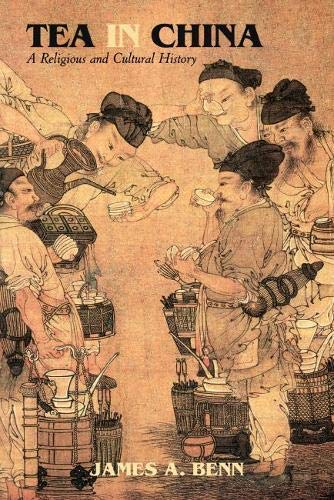
Tea in China explores the contours of religious and cultural transformation in traditional China from the point of view of an everyday commodity and popular beverage. The work traces the development of tea drinking from its mythical origins to the nineteenth century and examines the changes in aesthetics, ritual, science, health, and knowledge that tea brought with it.The shift in drinking habits that occurred in late medieval China cannot be understood without an appreciation of the fact that Buddhist monks were responsible for not only changing people’s attitudes toward the intoxicating substance, but also the proliferation of tea drinking. Monks had enjoyed a long association with tea in South China, but it was not until Lu Yu’s compilation of the Chajing (The Classic of Tea) and the spread of tea drinking by itinerant Chan monastics that tea culture became popular throughout the empire and beyond. Tea was important for maintaining long periods of meditation; it also provided inspiration for poets and profoundly affected the ways in which ideas were exchanged. Prior to the eighth century, the aristocratic drinking party had excluded monks from participating in elite culture. Over cups of tea, however, monks and literati could meet on equal footing and share in the same aesthetic values. Monks and scholars thus found common ground in the popular stimulant―one with few side effects that was easily obtainable and provided inspiration and energy for composing poetry and meditating. In addition, rituals associated with tea drinking were developed in Chan monasteries, aiding in the transformation of China’s sacred landscape at the popular and elite level. Pilgrimages to monasteries that grew their own tea were essential in the spread of tea culture, and some monasteries owned vast tea plantations. By the end of the ninth century, tea was a vital component in the Chinese economy and in everyday life.Tea in China transcends the boundaries of religious studies and cultural history as it draws on a broad range of materials―poetry, histories, liturgical texts, monastic regulations―many translated or analyzed for the first time. The book will be of interest to scholars of East Asia and all those concerned with the religious dimensions of commodity culture in the premodern world.
User’s Reviews
Editorial Reviews: Review The book contains a wealth of material on the social and intellectual interchange between the Buddhist clergy and wide sections of the educated laity. It deserves the attention of all whose interest lies in the role of religion in the life of the Chinese elite. ― Religious Studies ReviewJames A. Benn’s new book is a history of tea as a religious and cultural commodity in China before it became a global commodity in the nineteenth century. . . . the book makes not only a great read, but also a very useful pedagogical resource! ― New Books in East Asian Studiesln terms of scholarship, Benn ‘s Tea in China (hereafter TiC) is Sinologically and Buddhologically generally adequate. By and large, Benn’s translations are up to snuff, and his references to and annotations for early texts, for the most part, are reliable. . . . There is much we can learn from TiC. ― Journal of Chinese StudiesTea in China makes an important contribution to the study of religion in China by using a single commodity to demonstrate how religion–specifically Buddhism–is not cut off from the aesthetic, economic, and culinary worlds, but exists in connection to them. It will certainly become a foundational work for future studies of tea’s religious and cultural significance in China. ― Studies in Chinese Religions About the Author James A. Benn is professor of Buddhism and East Asian religions at McMaster University.
Reviews from Amazon users which were colected at the time this book was published on the website:
⭐I can only agree 100% with Matthew London’s review (the only other one so far). This is a major work. It covers tea in China from the beginning through the Ming Dynasty; it is best on Tang and Song. It draws on a vast range of Chinese sources, almost none of them previously mined in any detail by western writers. It does indeed, as London says, avoid the tired myths; it breaks new ground and provides us new translations throughout. Benn shows that tea was closely associated with Buddhism from the beginning through Song. He provides details on differing ways of brewing the stuff over the centuries. He has some fun with the incredible lengths of tea connoisseurship, which resemble wine snobbery today. For anyone interested in tea, or in the history of Chinese consumption, this is an indispensable book.
⭐excellent book – well researched, and full of fascinating details
⭐great book
⭐James Benn has written a scholarly masterpiece which has earned a prominent place of honour among my exhaustive collection of tea books. Dispensing with the usual (and quite sad) tendency to repeat the tired myths about tea as if they were absolute truths, he has dug down deep into the sources and refreshingly returned with clarity and eruditness to not only dispel the false, but more so, to paint a new picture of the evolution of tea and tea culture in China. This is a very valuable book. HIGHLY RECOMMENDED- Matthew London – Photographer and Author of THE SPIRIT OF TEA: An Offering to Tea Lovers
⭐An important essay for those who are interested in chinese poetry and tea culture as well. Full of quotations. A useful bibliography.Maybe I was hoping to finally have found a book giving information on the Chinese origins of the Japanese tea ceremony, but this book has left me dissatisfied. The author has visibly done extensive research on the subject of tea consumption in China, but his essay is much too academic; it is too factual for its own good and the interplay between different buddhist, taoist and literati sensibilities for drinking tea gets lost in the unending gallery of anecdotes to support the author’s not so clear thesis.J’avais espoir d’avoir enfin trouvé un livre pouvant m’informer sur les origines chinoises de la cérémonie de thé japonaise, mais ce livre m’a laissé insatisfait. Visiblement, l’auteur a fait beaucoup de recherche sur le sujet de la consommation de thé en Chine, mais son livre est beaucoup trop universitaire; les éléments factuels s’empilent au détriment de l’analyse sur l’interaction entre les sensibilités des bouddhistes, des taoïstes et des lettrés, qui se perd dans une galerie sans fin d’anecdotes servant à soutenir la thèse un peu confuse de l’auteur.
Keywords
Free Download Tea in China: A Religious and Cultural History in PDF format
Tea in China: A Religious and Cultural History PDF Free Download
Download Tea in China: A Religious and Cultural History 2015 PDF Free
Tea in China: A Religious and Cultural History 2015 PDF Free Download
Download Tea in China: A Religious and Cultural History PDF
Free Download Ebook Tea in China: A Religious and Cultural History