

Ebook Info
- Published: 1995
- Number of pages: 275 pages
- Format: PDF
- File Size: 66.12 MB
- Authors: Trevor N. Dupuy
Description
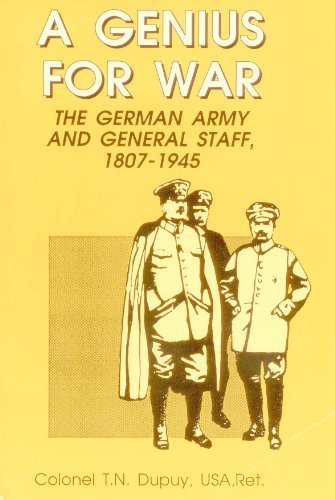
Book by Trevor N. Dupuy
User’s Reviews
Editorial Reviews: Review An invaluable approach to comprehending German military power. — The Washington Post, August 11, 1985 Since the Prussian armies of Frederick the Great achieved their amazing victories in the mid-18th century, the Prussian and German armies have established the standard of military excellence against which the performance of all other armies has been measured. This widely acclaimed book explores the reasons behind th e excellence of German fighting forces, and attributes much of this skill to the Prussian and German General Staffs. The author ‘s hypotheses are substantiated in brilliant analyses of German performance in victory and defeat. — From the Publisher
Reviews from Amazon users which were colected at the time this book was published on the website:
⭐A Review of the Book ” A Genius For War….” By T. N. DupuyThere seems to be a general consensus among many military historians that the German army in the last two centuries was the most efficient army in Europe; many even believed it was the finest in the whole world! The author of this book deals with this issue in great details basing his opinions on extensive research.What became evident in the development of the German army ( known previously as the Prussian army) was an emphasis on what they called the “General Staff”. This group of officers is situated between the high command (the king, emperor, commander in chief…) and the lower fighting regiments. These officers were carefully screened and selected from the most intelligent candidates, and then trained meticulously for war. They became the elite of the army – sharp, sophisticated and ruthless in battle. The emphasis in training was on planning, strategy, mobilisation, and speed; this speed was clearly evident in their “blitzkrieg” shock attacks which terrified and confused the enemy. The so called father of this training was a shrewd officer, Scharnhorst, whose teachings became a reference book for the German devastating “war machine”. Of his renowned students was the Staff General Moltke. It is said that in his attack against the French in 1970, he decimated the French army ( led by Napoleon lll) and turned the battle into a total humiliation of the French. He was swift, precise, and merciless.By the 20th century, the mighty German army reached such a high degree of refinement that it threatened, and was feared by, most European states. From its war system emerged such effective generals that some historians considered almost comparable to the world legends, like Napoleon, Hannibal, Alexander the Great, Julius Cezar and Genghis Khan. Outstanding amongst these generals were Hindenburg, Ludendorff, Himmler, Rommel, to name a few. The German War system was so admired that other countries were anxious to emulate it.But given that the German War Machine reached this stage of perfection, how could we explain its failure in two World Wars? Where and how did things go wrong – not once but twice? Historians differ, but what is generally accepted as the cause behind these failings are: a) underestimating the Allies’ navy and sea powers (German war experience was mostly “land-minded”); b) not accounting for the potential power of the Americans; and c) the German experience was geared to wars of short durations, unlike the extended world wars.Overlooking all these issues, the reader cannot help but wonder about one over-riding question: Of what benefit is this extensive, and expensive, research carried out by the author? It is hardly conceivable that modern militarism today would learn anything valuable from this research. We know well that wars in the 19th and 20th centuries were mostly land wars. Today, we hear and read about atomic bombs, nuclear weapons, long-range ballistic missiles, drones and other sophisticated weapons. Some wars are even fought without traditional weapons. The latest are “economic wars”, where the enemy is made to kneel and beg while it is totally subdued without even shooting one bullet. (See for example John Perkins’ book ” Confessions Of An Economic Hit Man”). Here, sanctions, restrictions and financial alliances replace hard weapons but remain equally deadly.If this book is not beneficial to modern militarily life, and if the author’s main focus is the excellence of the “general staff”, perhaps then we are overlooking a most crucial issue. The question a thoughtful reader should be asking is : What have these war geniuses really bequeathed to us – other than the awesome devastation, misery and the death of over fifty million people? True, it was done effectively and… “beautifully”, But, what a wasteful and awful use of the rare gift of genius!!Fuad R. QubeinMay, 2016
⭐I thought this was a well written book by a person who was well acquainted with his subject. The book starts right after the Napoleonic Wars and illustrates the thinking of some far thinking Prussian generals. They realized thatGerman manpower did not create lsuperior soldiers. Other countries had men just as able. They also wanted to make the German Army superior by creating better leadership and better coordination from the top. To achieve this a General Staff was created. The old ways of raising, training and leading an army were discarded. The creators of the General Staff wanted to create an entity that would insure superior leadership not just in their time but and enduring power that would institutionalize military brilliance. They succeeded. The GeneralStaff always included men of real talent and in many cases there were men of extraordinary brilliance. It is true that Germany lost wars but it was never because they were out generaled. I agree with the author that the German General Staff was the best the world has ever known but I am not sure that he proved the German soldier was so superior to all other soldiers. They may have been but the body of statistics that the author used to prove his point, I consider somewhat suspect. On the other hand, he knows more about it than I but still that niggling doubt about the validity of his statistics lingers in my mind. The General Staff functioned pretty much as it was designed to do from its inception until Hitler came to power. Hitler was very lucky in the first years of his power but when he invaded Russia and took leadership away from the General Staff, all was lost. Hitler had no military knowledge of military matters excepting his service as a corporal in WW I. Had he left his major military campaigns in the hands of his generals the war may have had a different outcome. This is an interesting and thought provoking book.
⭐A very good perspective on the General Staff and the reasons for Germany’s military capabilities. A good overview of German (political and military) history as well. A very enjoyable read.
⭐This was a topic about which I knew very little. I found it hugely enlightening although it did veer between a narrative history and a statistical analysis. This at times did get in the way. But a well researched and interesting book written by someone who knows what they are talking about!
⭐I love Dupuy but this got a bit dry and flumpish for my liking. Lots of the useful tactical stuff is brushed over in favour of political tedium and as such he fails (as I see it) to show what it was that the Germans did to make them so good at fighting.
⭐Not as dry as might be expected. A thorough analysis of the professional Prussian/German attitude to making war.
⭐This book was excellent, easy to read and very informative.Would recommend this book to students of the history of Germany and bothWorld Wars
⭐The book is not called “organisation of the army and German general staff”, it openly states what the writers intentions for the book were. These were to convince people of the effectiveness of the German general staff and the usefulness of such a system in modern warfare. The book does a good job at showing the effectiveness of the staff and the way it, the army and the wider world interacted. It doesn’t however give such a clear view on how the generals staff worked. The book does explain why it was so effective but some of the most important information in the book, like the way the staff recruited new members, is only upon briefly while much less important information is repeated many times and explained in much more detail. By the end of it it is difficult to piece together the way this staff worked because of the the way in which the changes made in the organisation of the staff are described. The book is also pretty old and so is the information in it so much of the information on the world wars is outdated.
Keywords
Free Download A Genius for War: The German Army and General Staff, 1807-1945 in PDF format
A Genius for War: The German Army and General Staff, 1807-1945 PDF Free Download
Download A Genius for War: The German Army and General Staff, 1807-1945 1995 PDF Free
A Genius for War: The German Army and General Staff, 1807-1945 1995 PDF Free Download
Download A Genius for War: The German Army and General Staff, 1807-1945 PDF
Free Download Ebook A Genius for War: The German Army and General Staff, 1807-1945