

Ebook Info
- Published: 2007
- Number of pages: 310 pages
- Format: PDF
- File Size: 1.54 MB
- Authors: Eugene L. Rogan
Description
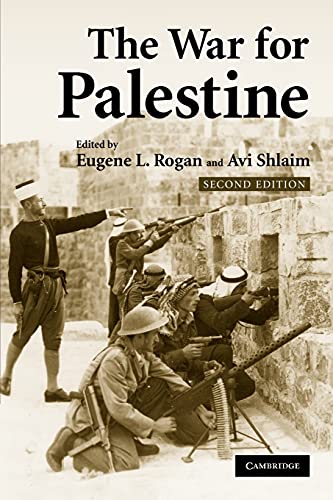
The 1948 war led to the creation of the state of Israel, the fragmentation of Palestine, and to a conflict which has raged across the intervening sixty years. The historical debate likewise continues and these debates are encapsulated in the second edition of The War for Palestine, updated to include chapters on Saudi Arabia and Lebanon. In a preface to this edition, the editors survey the state of scholarship in this contested field. The impact of these debates goes well beyond academia. There is an important link between the state of Arab-Israeli relations and popular attitudes towards the past. A more complex and fair-minded understanding of that past is essential for preserving at least the prospect of reconciliation between Arabs and Israel in the future. The rewriting of the history of 1948 thus remains a practical as well as an academic imperative.
User’s Reviews
Editorial Reviews: Review ‘The result is a book which is rich in new material and new insights and which enhances considerably our understanding of the historical roots of the Arab-Israeli conflict.’ The Middle East’ … a scholarly, readable volume that will provoke more debate …’. Reviews in History’This stimulating guide to the complex political and military topography of the 1948 war sets new, rigorous standards for subsequent scholars, and should be required reading for anyone who needs to understand what the whole Arab-Israeli business is about.’ Contemporary Review’… a cogent and comprehensive work on the central event in the Middle East in the year 1948 … The War for Palestine demonstrates a dedication to empirical research and a determination to draw independent conclusions’. English Historical Review’This volume presents important and original scholarship on the 1948 war … It succeeds in bringing together historians from different backgrounds and demonstrates their ability to communicate and jointly challenge historical myths.’ American Journal of Islamic Social Sciences’This critical look at internal factors on the Arab side is most welcome in order to understand the events of 1948.’ Journal of Peace Research Book Description The updated second edition of The War for Palestine presents the genesis of the Arab-Israeli conflict. About the Author Eugene L. Rogan is University Lecturer in the Modern History of the Middle East and a Fellow of St Antony’s College, University of Oxford. He is the author of Frontiers of the State in the Late Ottoman Empire (1999) and editor of Outside In: On the Margins of the Modern Middle East (2002). He is editor of The Contemporary Middle East series published by Cambridge.Avi Shlaim is Professor of International Relations and a Fellow of St Antony’s College, University of Oxford. He was a British Academy Research Professor in 2003–6 and he was elected Fellow of the British Academy in 2006. His previous publications include War and Peace in the Middle East: A Concise History (1995), The Iron Wall: Israel and the Arab World (2000) and Lion of Jordan: The Life of King Hussein in War and Peace (2008). Read more
Reviews from Amazon users which were colected at the time this book was published on the website:
⭐I used this book for research about the palestinian people. It is an excellent book, very well written, ample portrait of everything that hapenned in 1948 , before and afterwards. Studies of the new archives, well written commentaries.
⭐A clear look into the final Ottoman collapse and the rise of modern Turkey, including a clear description of the Armenian tragedy still being officially denied by the Turks. There must be a final reshuffle of the arbitrary Middle Eastern entities and the thousand year old Sunni/Shia conflict before true stability is to be attained in this important region.
⭐Rohan and these writers have produced an easily read and thought provoking book. A balanced look at 1948 from the Arab and Israeli points of view.
⭐good general survey
⭐Historical information about an area steeped in disinformation and misinformation….good basis for beginning to understand what is taking place in the region now.
⭐I recommend “War and Remembrance” by Israeli historian Yehoshua Porath in the summer 2002 issue of Azure on the subject of this book. The revisionist historians in it have attempted to tell “new” history of Israel and consider the entire previous historical record to be propaganda for the Zionist cause. In this book, Benny Morris, Avi Shlaim, Rashid Khalidi and Edward Said consider Jewish conduct in the 1947 and 1948, how the Jewish people defeated seven Arab armies, if the Jewish people were outnumbered and if they intended to expel the Arabs.They dismiss all pre-revisionist Israeli history as a “quest for legitimacy,” not honest accounting. That’s pretty wild, because as Porath says Israeli universities and professors have supported views like these “for some time now” and have been honest about Israeli history. Yigael Alon and Israel Galili wrote the Book of the Palmah that gave Walid Khalidi material to argue in 1959 that the Dalet Plan was “the master plan of the Zionists” for wholesale expulsion of Palestinians and the 1973 History of the Hagana included the Dalet Plan’s whole text.Porath says the charge that Israel carried out a deliberate and systematic expulsion of the Palestinian Arabs is not “remotely substantiated by the extensive research that has been carried out in the last few decades.”They take material very selectively from the fringes of Israeli archives. Based on that, Porath says anyone could “make outrageously false claims”– that Israel’s victory resulted from “an imperialist conspiracy or an overwhelming advantage in manpower and arms.” He says that is what these editors do, and I believe him, since he knows the Israeli record as well as any historian alive.The book says the Arabs failed because they had no unified command, allying all the Arab forces. They were driven apart by intense disputes between their nations and the Arab regimes were afraid to send large forces to the front. That’s not news. As Porath points out, it has been in traditional histories by people like Nathaniel Lorch and Meir Pa’il for a long time.A chronology on the book’s first few pages lists November 30, 1947 as “outbreak of civil war in Palestine.” Porath says it would be more proper to call the `civil war’ “an assault upon the Jewish civilian population undertaken by the Palestinian Arabs” after they rejected the UN Partition Plan passed and accepted by the Jewish people the day before.This book wants readers to think that 100 Arabs killed at Deir Yassin was the only massacre. It wasn’t. Porath mentions other massacres too–the December 30, 1947 murder of about 50 Jewish Haifa refinery workers by their Arab co-workers and the April 13, 1948 massacre of more than 80 Jewish doctors, nurses and Hebrew University workers on Mount Scopus in Jerusalem.Rashid Khalidi’s essay on Palestinian Arab failure in 1948 covers Jerusalem Mufti Haj Amin al-Husseini, not very politely. Here’s another oversight. Husseini was, in Porath’s words, “an ardent and influential supporter of the Nazis and the Holocaust.” A day after Hitler rose to power, Husseini gave Jerusalem’s German Consul “his blessings in the name of `three hundred million Muslims’,” and urged the Nazis to take the whole world. He spent “much of the war” with the SS and Heinrich Himmler and in 1943 and 1944 talked Himmler out of trading Jewish lives for millions of dollars and military hardware. The Jews were murdered and at Husseini’s request, the Nazis promised genocide for the Jews of Palestine, too.Porath’s review points out another of Khalidi’s oversights. The Jewish defenders of the Etzion Bloc who surrendered to the Arab Legion of the Kingdom of Transjordan were treated under formal rules of war. But nearly all the 131 people who surrendered to Palestinian Arabs were murdered. Only two survived.At the same time, Jordanian forces in Jerusalem removed from the city all the Jewish residents, numbering about 100,000. Porath wonders if anyone could “seriously examine the war of 1948” without noticing that a significant Arab minority stayed in the part of Palestine that became Israel, while those parts of the country that fell under the Jordanian or Egyptian rule “became Judenrein.”In another essay, Avi Shlaim considers the number of fighters on each side. Porath calls it “a remarkable study in scholarly distortion.” By taxing itself to the limit, Palestine’s Jewish community managed to gather 35,000 soldiers by mid-1948, a number that reached 95,000 by early 1949. That compared to 25,000 Arab fighters. Shlaim claims Jewish fighters outnumbered Arabs at every stage of the war. Porath says this is not true. “Shlaim himself admits that the Arab states sent only a small portion of their armies” to Palestine and could have sent far more had they wished.Besides that, Porath tells us that Shlaim “ignores the huge difference in manpower reserves available to each side.” By early 1949, Israel had at most 750,000 Jewish residents, compared to 50 million in the 7 Arab states in the war. Israel’s Jewish people had taxed themselves to the maximum. The war had ground their small economy and “vital industries” to a halt. But “the Arab states, by comparison could have fought the war indefinitely without seriously affecting their citizens’ way of life.”Finally Columbia University professor Edward Said offers a personal account of his family’s departure from the Talbieh neighborhood of Jerusalem. Porath says this is most useful in its unintended effect. Traditional Israeli histories always claimed that urban Palestinians left their homes voluntarily as they wearied of the war. Khalil al-Sakakini provides one of the best such accounts of his family’s departure from Katamon in Jerusalem, but there are many others in the Israeli and British sources of the time. Porath says that Said’s account “matches the testimonies of Sakakini and many others like him, and serves therefore to confirm further the traditional account.”I didn’t like this book at all. But if I had any doubts, Yohoshua Porath sealed it for me.
⭐This book is written and edited by a handful of new historians and various academics who study the Israeli-Palestinian/Israeli-Arab conflict.It discusses 1948 from an overall perspective instead of focusing on one actor or part of the war like most books on the subject. This is why I say it is a good introduction. Almost every author who writes in here has a book or long article detailing specifics in their articles here. Contrary to other reviewers, I think the book adequately addresses the war, its failures on all sides, and its impact on the Middle East. The book is not a comprehensive history, but more a showcasing of various motives and issues involved in it, hence it does not have every little detail. Much to the dismay of the other reviewer, the impact of Deir Yassin is what they emphasize, NOT that the Zionists did it. The impact of Deir Yassin massacre on the Palestinian/Arab community was much stronger than the impact of the Gush Etzion or Haifa massacres. A simple reading of the book and/or others would easily validate this. The book is worth reading for an introduction on 1948, beyond that, there are many other books that are better.
⭐An excellent historical examination of why the Palestinians never had a chance
⭐I ordered this book for my husband. He has been quite taken with it and does mention it to others as something that must be read concerning the Palestine situation,
⭐Very good documentation of a forgotten history
Keywords
Free Download The War for Palestine: Rewriting the History of 1948, 2nd Edition (Cambridge Middle East Studies 15) (Cambridge Middle East Studies, Series Number 15) 2nd Edition in PDF format
The War for Palestine: Rewriting the History of 1948, 2nd Edition (Cambridge Middle East Studies 15) (Cambridge Middle East Studies, Series Number 15) 2nd Edition PDF Free Download
Download The War for Palestine: Rewriting the History of 1948, 2nd Edition (Cambridge Middle East Studies 15) (Cambridge Middle East Studies, Series Number 15) 2nd Edition 2007 PDF Free
The War for Palestine: Rewriting the History of 1948, 2nd Edition (Cambridge Middle East Studies 15) (Cambridge Middle East Studies, Series Number 15) 2nd Edition 2007 PDF Free Download
Download The War for Palestine: Rewriting the History of 1948, 2nd Edition (Cambridge Middle East Studies 15) (Cambridge Middle East Studies, Series Number 15) 2nd Edition PDF
Free Download Ebook The War for Palestine: Rewriting the History of 1948, 2nd Edition (Cambridge Middle East Studies 15) (Cambridge Middle East Studies, Series Number 15) 2nd Edition