Ebook Info
- Published: 2016
- Number of pages: 512 pages
- Format: PDF
- File Size: 12.13 MB
- Authors: Eugene Rogan
Description
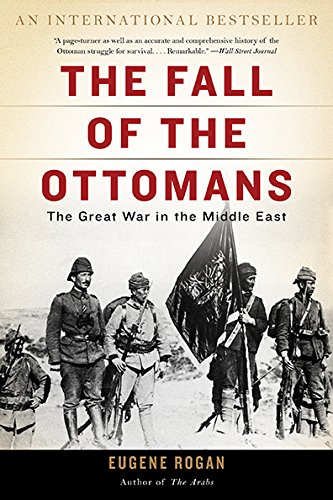
The thrilling and definitive history of World War I in the Middle East By 1914 the powers of Europe were sliding inexorably toward war, and they pulled the Middle East along with them into one of the most destructive conflicts in human history. In The Fall of the Ottomans, award-winning historian Eugene Rogan brings the First World War and its immediate aftermath in the Middle East to vivid life, uncovering the often ignored story of the region’s crucial role in the conflict. Unlike the static killing fields of the Western Front, the war in the Middle East was fast-moving and unpredictable, with the Turks inflicting decisive defeats on the Entente in Gallipoli, Mesopotamia, and Gaza before the tide of battle turned in the Allies’ favor. The postwar settlement led to the partition of Ottoman lands, laying the groundwork for the ongoing conflicts that continue to plague the modern Arab world. A sweeping narrative of battles and political intrigue from Gallipoli to Arabia, The Fall of the Ottomans is essential reading for anyone seeking to understand the Great War and the making of the modern Middle East.
User’s Reviews
Editorial Reviews: Review “A remarkably readable, judicious and well-researched account of the Ottoman war in Anatolia and the Arab provinces.”―Mark Mazower, Financial Times”Rogan has written an impressively sound and fair-minded account of the fall of the Ottoman Empire.”―Max Hastings, Sunday Times (London)”[An] assured account…. The book stands alongside the best histories.”―Economist”The book is not only exact and readable but also has the elements of a thriller and thus is all the more remarkable in view of its thoroughness in covering a linguistically and historically difficult subject.”―Wall Street Journal”This engrossing history unfolds in the Middle Eastern theatre of the First World War, capturing the complex array of battles, brutalities, and alliances that brought down the six-hundred-year-old Ottoman Empire…. Rogan argues that the empire’s ultimate demise was the result not of losing the war but of a clumsily negotiated peace. His balanced narrative unearths many seeds of current conflicts.”―New Yorker”Admirable and thoroughly researched…. A comprehensive history of World War I in the Middle East.”―New York Review of Books”[An] intricately worked but very readable account of the Ottoman theocracy’s demise…. This is an extraordinary tale and Rogan recounts it well.”―New York Times”To have written a page-turner as well as an accurate and comprehensive history of the Ottoman struggle for survival is a remarkable achievement.”―Wall Street Journal”As the Middle East is collapsing all around us, if you wanted to know where it all began and when, read this great book by a great Oxford historian.”―Fareed Zakaria, Fareed Zakaria GPS, Book of the Week”[Rogan’s] account is geopolitical and military writing at its best – taut, anecdotal and extraordinarily researched. A tangled story, to be sure, one that both commands and rewards the reader’s attention.”―Washington Times”A comprehensive, lucid and revealing history…. This book will surely become the definitive history of the war.”―The Times (UK)”The Fall of the Ottomans is a remarkably lucid and accessible work of history, involving a large cast of contradictory and complex characters…. Telling quotations from diplomats, field commanders, and ordinary soldiers of all the combatants lend the narrative a powerful sense of immediacy.”―The Daily Beast”Eugene Rogan has given us an absorbing history of the war’s principal military and political battles in the Middle East through the eyes of those who fought them.”―Mustafa Aksakal, chair of Modern Turkish Studies and associate professor of history at Georgetown University”[A] masterly history of the Ottoman empire in its final years…. Eugene Rogan has written a meticulously researched, panoramic and engrossing history. The book is essential reading for understanding the evolution of the modern Middle East and the root causes of nearly all the conflicts that now plague the area. The Fall of the Ottomans is an altogether splendid work of historical writing.”―Ali A. Allawi, The Spectator (UK)”A fantastic, readable, and much needed study of the most chronically neglected of all of the Great War’s participants: the Ottoman Empire. Informative and enlightening.”―Alexander Watson, author of Ring of Steel: Germany and Austria-Hungary in World War I”This is a gripping, masterful account of World War One in the Middle East from the vantage point of the Ottoman Empire…. Combining magisterial scholarship with a keen sense of drama and lively narrative style, it tells a grim story but a fascinating one…. If you want to understand the underlying causes of conflict and violence in the Middle East in the last century, you will not find a better book.”―Avi Shlaim, authorof The Iron Wall: Israel and the Arab World”This book opens up a window on vital chapters in the shaping of the Middle East as well as the history of the Great War, bringing together vivid personal details with a broad historical panorama of human suffering and heroism, the incompetence and folly of the general staffs, and the scheming of the great powers.”―Rashid Khalidi, authorof Resurrecting Empire: Western Footprints and America’s Perilous Path inthe Middle East”Thoroughly researched and elegantly written by one of the leading experts on the region, The Fall of the Ottomans reminds us that the 1914-18 conflict was truly a world war with huge and continuing consequences. No one is better equipped than Eugene Rogan to handle the course and impact of the war in the Middle East and he does a superb job, telling a complex and multifaceted story with great clarity, understanding, and compassion. This timely and important work restores the Middle East to its rightful place in the history of the Great War.”―Margaret MacMillan, author of The War That Ended Peace: The Road to1914″Thrilling, superb, and colorful, Eugene Rogan’s The Fall of the Ottomans is brilliant storytelling. Filled with flamboyant characters, impeccable scholarship that illuminates the neglected Near Eastern theater of WWI–showing how the Ottomans managed repeatedly to defeat the Allies–and revelatory analysis that explains the modern Mideast, The Fall of the Ottomans is truly essential but also truly exciting reading.”―Simon Sebag Montefiore, authorof Jerusalem: The Biography About the Author Eugene Rogan is professor of modern Middle Eastern history at the University of Oxford and the director of the Middle East Centre at St. Antony’s College, Oxford. The author of numerous books, including the international bestseller The Fall of the Ottomans, Rogan is the recipient of the Albert Hourani Prize. He lives in Oxford, England.
Reviews from Amazon users which were colected at the time this book was published on the website:
⭐The fall of the Ottomans – The great war in the Middle East presents an engaging history of the final years of the Ottoman Empire which was dismantled at the end of the first world war. The book gives a comprehensive overview of the political environment both prior to and during the war. It provides details on the major battles fought as well as an overview on the tragedy of the Armenian genocide that occurred. It is highly readable and the author has the readers attention throughout the entire book. The dismantling of the Ottoman Empire and the forming of the modern Middle East is of fundamental historic importance and much of what decided that is contained in this book.The Fall of the Ottomans begins while the empire is in terminal decline The weak Ottoman state had been in decline for a long time but the author begins with the domestically politically challenging period of 1908-13 while the Sultan had reclaimed authority due to a weak parliamentary government. The author introduces the political movement of the Young Turks who were focused on bringing back the parliamentary process to Turkey and create a stronger national voice for the people. The author details how the weakness of the state and the hostile borders the Ottomans faced led to a Young Turk bargain with the Germans’s after the start of the first world war to become allies. In particular Turkey felt threatened by Russia which had long outstanding border and citizen disputes due to orthodox and muslim rivalries near Serbia. The author gives the reader insight into the German’s perspective on the value of the Ottomans and in particular how a jihad could help catalyze local rebellions throughout the colonial empires of France and in particular Great Britain. The author discusses how the Turkish helped disrupt the Italian conquest of Libya initially with the help of religious ties (though this ended badly) and how such a model was seen as a force that could help throughout the war.The author then starts giving the details of the major battles in the Near East between the Allies and the Turks. The Turks initially lost a sequence of battles and territory in Egypt and modern Iraq. The perspective that the Turks were a military liability for the Germans and an easy target for the Allies led to the move to take Istanbul via the Dardanelles. The strategy and history is given of Gallipoli is then given which marks the turning point for the Turks. The battles were horrific for both sides with mass loss of life on both sides but the retreat by the British at Gallipoli was a major setback. The author discusses how the fractured Ottoman empire was creating rifts in the local populations where people’s allegiances were torn. In particular many Orthodox Armenians favored Allied victory as they felt repressed and underrepresented in the empire. The move to resettle orthodox christians took place in small communities near Greece but with the Armenians the policy took a most sinister turn and the Turks undertook the first modern genocide and through death marches and outright killing, decimated the Armenian population in the empire. The details are horrifying and the author spends time going through how the events unfolded as well as the nonetheless inexcusable outcome as well as the modern day issues that still surround the events. The author then moves back to the middle east where Turkey first lost major territory and gives a history of Kut, where the English took the city but then had to surrender due to exhaustion of resources. The horrors of the war and the starvation and conditions endured are given along with some photos. The author spends quite a bit of time as well on the Arab revolt and Lawrence of Arabia. The mixed allegiances of the Arab sub populations and the lack of affiliation with the Ottoman based Caliphate goes to show that the initial belief in the power of a call to jihad was misplaced. The author also spends time discussing the Sykes-Picot Agreement and in particular how the Arab revolt and alliance with the Allies was based of a subsequent territorial understanding of what the post war landscape would be, which was liberated and under the rule of Amir Faysal and his sons. The Ottomans of course lost the war and the author goes into how that took place. The ending was quick and the dismantling of the Ottoman Empire was entire. All of the Middle East was carved up and into what we see today. The author gives the reader the political reasons for the need to create a zionist Palestine and how it was and continues to be bitterly disputed. The Turks got a buffer between themselves and Russia with the creation of new nation states and kept Constantinople and Anatolia. The author is careful to discuss how the modern map of the region was effectively created in those weeks and their repercussions lie with us today.The Fall of the Ottomans was really enjoyable to read and it completely refreshed my understanding of the last days of the Ottoman Empire as well as the events in the first world war that led to its dissolution. For all interested in the forming of the modern middle east, the first world war or the Ottoman empire, this book is a must read. Even without those interests this book will hold your attention!
⭐In anticipation of traveling to Turkey, I decided to buy this book. In the end, I’m glad I finished reading the book but it wasn’t easy. The book is very detailed regarding battles and it wasn’t a page turner by no means. The best part(s) we’re connecting the dots between the WWI and the spoils of war giving clarity to how the borders of many Middle Eastern or Arab countries were drawn.
⭐The Middle Eastern theater of WWI has kind of fallen through the cracks in written history available in English. Most of what we know comes from Hollywood: “Lawrence of Arabia”, “Gallipoli”, “ The Lighthorsemen”. It is considered a sideshow to the trenches in Europe. Yet British casualties in this sideshow equal or exceed the total of all American war casualties from the revolution to the present day.The author begins with the conditions facing the Ottomans just prior to the outbreak of war in 1914. Their empire was in decline and in need of modernization. They also faced “predator nations” looking for some territory to nip off and add to their own empires. To try to play off the predators the new leaders of the Ottoman Empire allied themselves with Germany and Austria. It seemed like a good idea at the time. (There probably was no alternative, anyway)In the authors telling, the Ottomans found themselves in a multifront war without the resources to cope with more than one at a time. At the same time the British grossly under estimated the tenacity and endurance of the Ottoman solders. The narrative records one side or the other taking bold military initiatives which in case after case degenerated in to trench warfare. It is easy to sympathize with the Ottoman leadership – they were trying to hold together an empire which was threatening to crumble even before war broke out. The Armenian genocide is treated by the author. The Armenians, or at least their leaders, sympathized with with the Russians who were at with the Ottomans and hoped a Russian victory would result in an independent Armenian homeland. The Ottoman leadership obviously saw this as a deadly threat and decided the most effective response was to kill the Armenians- all of them! This is ticklish for both the author and the reader – you can understand the motives but genocide is srill genocide regardless of the motive.As far as political and military leadership there are few stars. Mostly it seems all sides just meddled along. There are two exceptions: the German generals who were given command of parts of the Ottoman army were competent professional who knew what needed to be done and then did it; and there was Allenby who managed to avoid the tendency of assaults to degenerate in to trench warfare by use of deception and reliance on the maneuver abilities of cavalry. (Cavalry by have become obsolete in Europe but was essential in the Middle East.)The author has thoroughly referenced and footnoted his materials. Much of his source material was original documents in Turkish which until now he says western historians had little access to. See much of the events from the Ottoman side makes the events hang together in an understandable narrative better than any previous account I have encountered.
⭐Good book about the once mighty Ottoman Turkish Empire’s last, fatal crisis: the First World War and its aftermath.‘Fall of the Ottomans’ contains often dramatic stories of marches and battles but goes well beyond military history, telling us about the countries, characters and wider issues involved, drawing on accounts by people of many nations, from generals and ambassadors to corporals and priests.I use the terms Ottoman and Turkish partly interchangeably below but ‘Ottoman Empire’ (named after the ruling dynasty) was the country’s official name. The core of the Empire was Turkish but it covered much of the Middle East.In the English speaking world, we tend to hear of aspects of the Ottoman role in the 1914-1918 War in isolation: Gallipoli, Lawrence of Arabia & the Arab revolt, the Armenian massacres, General Allenby’s army conquering the Holy Land, the awful fate of British Empire troops besieged at Kut-el-Amara, and the often forgotten Turkish-Russian front, but we are rarely told which of these was most important or how they affected each other. This is the first work I have read to pull all these together. It also mentions aspects of the war I didn’t know existed. To give a couple of examples out of many:-In 1916 a Russian army advanced through Persia to within 100 miles of Baghdad, threatening to capture it before the British; -Hundreds of thousands died of famine in Syria during the war, caused by drought, locusts, disruption by war and Allied naval blockade.Unlike some historians, the author gives fair prominence to the French and French Empire forces at Gallipoli as well as British Empire forces there.In the earlier part of the war, the Dardanelles, including Gallipoli [Gelibolu in modern Turkish], the straits guarding the approach by sea to the Ottoman capital Constantinople/ Istanbul, were the main front for the Turks, who sent more than half their army there.When the Allies withdrew from Gallipoli in January 1916 several Turkish divisions should have been freed to take the initiative on other fronts. However, much of this advantage was neutralised by a daring surprise Russian attack. In apparently impossible winter conditions in the Lesser Caucasus Mountains (although the Russians were better clothed for the cold) the Russians under General Yudenitch outflanked and destroyed the majority of the Turkish Third Army, advanced deep into Eastern Turkey, and caused shock across the Ottoman Empire.The breakdown of the Russian army’s discipline and spirit after the 1917 Revolutions relieved the pressure on the Ottoman Empire’s eastern front. This could have allowed the Turks to reinforce their hard-pressed other fronts and perhaps hold out longer. However, once again the Ottomans lost their chance, committing large forces to a vain attempt to recover territory lost in the 19th Century in the Caucasus.One limitation of this book is that it does not explain how the Ottoman government and constitution worked. We are told there was a Sultan and a Parliament, but little else about them or what they did. All important decisions seemed to be made by a group of three key ministers, who had come to power by violence rather than election, and who all died violently within a few years of the war’s end. We are also not told why the Empire was unable to mobilise as many troops as the European powers, despite what must have been a large population if the Empire’s Arab lands are included.A puzzle for the Allies was the unpredictability of Ottoman resistance. In 1915-16 the Allies’ unsuccessful Gallipoli campaign and disastrous advance up the River Tigris to Kut el-Amara were in hindsight dangerously over-ambitious. However, that was not obvious beforehand because in earlier encounters Ottoman forces showed little fight.The Ottoman army could be ferocious, courageous and tenacious, as at Gallipoli defending their capital, led by effective generals like Mustafa Kemal [later called Atatürk]. Yet morale could be brittle. After 200 years of almost continuous defeats by Western countries, most recently in 1911-1913 by Greece, Serbia and Italy, Ottoman confidence was shaky. [Another historian wrote that the First World War showed the Ottoman Empire was old and rotten and spent, but that the Turkish people were not.]Across the Empire the Ottoman army conscripted Muslim Turks, Arabs and Kurds; Christian Greeks and Armenians; and Jews. Such a diverse army’s loyalty to the Ottoman cause naturally varied.Even before the officially sanctioned murder and starvation of the Empire’s Armenian Christians in 1915-16, Armenians in the Ottoman army were murdered by Turks and Kurds serving with them, who mistrusted them. This was both the cause and consequence of the willingness of Armenians to desert to the Allies, often bringing useful information about the numbers and position of Ottoman troops.Legalistic arguments about whether the Turkish atrocities against Armenian and Assyrian Christians during the First World War were ‘genocide’ can be a pointless distraction from the fact that they were horrifyingly cruel. However, ‘genocide’ is accurate. The intention was that even if not all shot or bayoneted, most Armenians would die from the harsh conditions on their supposed re-settlement marches. (The author does not deal with the argument in A. Bostom ‘The Legacy of Jihad’ that forced re-settlement marches under conditions in which many were bound to die deliberately revived a medieval Muslim tactic against conquered unbelievers.)In the aftermath of the war, the then Turkish government admitted that massacres of Armenians had occurred and put several officials on trial for ordering them. This was reported in the Turkish press. The government hoped that singling out individuals for blame would avoid the victorious Allies holding the Turkish nation as a whole responsible.Once the Turks recovered their confidence and military power in the early 1920s under Atatürk, that was no longer necessary. Successive later Turkish governments refused to admit that the massacres occurred, presumably to try to protect Turkey’s reputation.This may have had the opposite effect. In denying that there were massacres of Armenians at all, the Turks are unable to explain the context. Armenian terrorists had killed Muslim civilians as well as vice versa. Armenians in the Ottoman capital Constantinople / Istanbul, foolishly, openly celebrated the Allied landings at Gallipoli, and openly hoped Constantinople would fall to the British and French. That does not justify the Turks’ terrible revenge, but it does show that the fault was not all on one side.Some of the British and Empire troops surrounded and starved into surrender at Kut el-Amara in Mesopotamia later wrote about their hardships in the siege, but could not bear to write about what happened after they surrendered. As prisoners of the Turks they endured ‘death marches’ similar to those recently inflicted on Armenian civilians, whose bones could sometimes be seen by the roads along which British, Indian and Australian Prisoners of War were made to march.During the War, most interested parties plotted how they might gain if the Ottoman Empire fell. Armenians and some Arabs wanted independence. The Allies secretly agreed to share out Ottoman territory between themselves after the war. Yet Britain also promised a largely independent state or federation of states for the Arabs; and to the Jews a national homeland, although not necessarily an independent state, in Palestine, although most of the then population of Palestine were Arabs.Those who like to blame the West and especially Britain for everything therefore single out Britain’s hard to reconcile promises to different parties at different stages in the war as making Britain the real villain, to blame for the current woes of the Middle East.Well, yes and no. I am uncomfortable reading about the partly broken promises of Arab independence made by Britain to the Hashemite family (Sharif Hussein of Mecca and his sons such as Feisal) to encourage them to lead an Arab revolt.On the other hand I cannot help feeling that Britain is sometimes held to a different standard than everyone else, and no allowance made for circumstances. The British were hardly the only ones to make hard to reconcile promises to different parties in pursuit of their own interests, under the pressure of fighting the biggest war in history up to that time. Sometimes survival must trump principles.The Turks on the outbreak of war offered their support (at a price) to both sides until Germany made them the better offer. The Germans sought to strengthen their alliance with Turkey by spreading false rumours there that Kaiser Wilhelm II had converted to Islam. The future leaders of the Arab revolt pledged loyalty to the Ottoman Empire even as they secretly schemed with Britain to overthrow it. They later agreed to recognise French rule in Syria after the war while privately intending to forcibly drive the French out as soon as the opportunity arose.The often awful history of Lebanon, Syria and Iraq under independent Arab rule since the 1940s hardly suggests that independent Arab rule was always a good thing anyway.While the Hashemites were badly disappointed at the peace settlement, they still got the kingdoms of Iraq and Jordan out of it and reign in Jordan to this day. Mecca and most of the Arabian Peninsula, for the first time for hundreds of years, ended up under Arab rule, even if mainly by the rival Saudi dynasty rather than the Hashemites.
⭐This book was recommended to me by a friend who said it really helped him understand the historical background to a lot of today’s politics. He also said the writing was such that one just wanted to keep turning the pages to read on.Having read this book, I agree with him on both points. I love reading and watching history related material. This is an exceptional book and I learnt so much on a topic I thought I already knew quite a lot about. This book has really changed a lot of my previous (incorrect) understandings of what caused World War 1 and the significance of the Eastern Front of the Great War.I also learnt more about the Armenian genocide than I had ever known.The book contains moving anecdotes of sparks of humane behaviour between soldiers fighting each other in trench warfare that is surprising to read and not the kind of stuff normally covered in standard histories.The tempo of the book and stle of writing is like if a really exciting thriller. I kept wanting to just keep reading on and on.Importantly, the book covers both perspectives of Allied Poerws and Central Powers. Unbiased account.This book is clearly an example of history telling at its very best. I highly recoomend this book.
⭐This is a wonderfully readable referenced account of the demise of the Ottoman Empire under the Young Turks as a result of the First World War. Britain and France were afraid that German and Ottoman efforts to encourage a jihad against them would envelope their colonies in Africa and India and swallow up precious troops desperately needed for the western front. They wrongly expected that the Ottomans would be more easily beaten on the fronts that developed in the Caucasus, Dardanelles and the Middle East and Mesopotamia. Their humiliations experienced at places like Gallipoli and Kut, and serious challenges faced in Gaza and elsewhere, proved them wrong. Attention is paid to the plight of the Ottoman Christians, notably the Armenians, seen as fifth columnists. The author points out the exaggerated blame placed on Churchill rather than Kitchener for Gallipoli, and the fact that Turkish state documents written during the trials at the end of the war clearly pointed to an Armenian genocide. Also included of course is the role played by TE Lawrence and the subsequent betrayal of Arab independence by avaricious Britain and France.
⭐One hundred years on from the Great War it is right that we should be commemorating the great tragic events that characterised it. Most of the attention is understandably on the Western Front with its five years of gruesome, deadly struggle. But whilst the battles in Europe are the ones we most remember we should not forget that this was a World War and that there was plenty of action away from France and Belgium. Nor should we forget that the consequences of the War were profound as three great empires fell along with their monarchs and that the seeds of later horrors were sewn as the politicians failed catastrophically to create the conditions for lasting peace.The three fallen Empires were the Russian (consequence: 70 years of totalitarianism), the Austro-Hungarian and the Ottoman. It is how the latter fell that this fine book is about. The empire was shaky well before the outbreak of war with pressure from Arab Nationalism, Russian expansionism and from a changing leadership in Istanbul itself. The “Young Turks” were modern challengers to the hegemony of “Divine Right” Ottoman rule and whilst their lust for power was the main driver they nevertheless also wanted to modernise a State rather lost in its past. When the war broke out there was a brief flirtation with Britain and the Allied Powers but the logic, as they saw it, of joining Germany and Austro-Hungary was stronger. That was certainly what the Germans wanted and the military alliance that they established was strong with some German officers running Ottoman units. The Ottoman military record was actually quite good with Gallipoli, that mad and deadly Churchillian adventure, being a triumph for them – albeit a horrendously costly one in respect of loss of life. Gallipoli was not the only Ottoman win against the Allies and the latter needed to reinforce their Armies in the region as well as building their own alliance with the Hashemite (Arab Nationalist) forces. This latter story (Lawrence of Arabia and all) is wonderfully and illuminatingly well told.In the end a combination of their own internal contradictions, venality (especially the Armenian massacre) and the overwhelming force of a strong opposition was to defeat the Ottomans and in the post war peace negotiations the Empire was forcibly broken up. In the post war period Mustafa Kemal Atatürk created a modern State of Turkey and the imperial dream disappeared. It would not have happened without the Great War, at least not so quicklyThis is a magnificent and very readable book. Much of the research is original and Rogan puts the story together very skilfully. You cannot really understand the Great War without understanding the part the Ottomans played in it – and the consequences were profound.
⭐This book clearly explains the progress of the 1st World War in the Middle East, which most Great War books give minimal attention. The Entente powers were in continual fear of triggering Jihad by attacking the Caliph (the Turkish Sultan) and Moslem arabs and causing religious rebellion in French and English Colonies in North Africa and India.It never happened but it did shape Entente war planning to be more cautious and reduced the pressure on the Ottomans.Neither did it prevent Britain and France from planning a carve up of the Ottoman Empire long before the prospect of actually defeating the enemy, and encouraging Arab rebellion whilst still planning to take over most of the Arab regions and allow a homeland in Palestine for Zionist Jews. We live with the tragic consequences of the post war settlement today, so this period of history remains relevant.
Keywords
Free Download The Fall of the Ottomans: The Great War in the Middle East in PDF format
The Fall of the Ottomans: The Great War in the Middle East PDF Free Download
Download The Fall of the Ottomans: The Great War in the Middle East 2016 PDF Free
The Fall of the Ottomans: The Great War in the Middle East 2016 PDF Free Download
Download The Fall of the Ottomans: The Great War in the Middle East PDF
Free Download Ebook The Fall of the Ottomans: The Great War in the Middle East