Ebook Info
- Published: 2000
- Number of pages: 368 pages
- Format: PDF
- File Size: 2.22 MB
- Authors: Paul Stephenson
Description
This is a narrative political history of the northern Balkans in the period 900-1204. It treats the Balkans as the frontier of the Byzantine empire, and considers imperial relations with the peoples living in the Balkans, including the Serbs, Croats, Bulgarians and Hungarians. It also considers responses to invasions from beyond the frontier: by steppe nomads, from beyond the Danube, and by western powers through Hungary and across the Adriatic sea. The first four crusades, 1095-1204, are considered in some detail, and extensive use is made of archaeology.
User’s Reviews
Editorial Reviews: Review “…Stephenson has incorporated into his work recent sigillographical publications as well as reports on archaeological finds…usefully discussed and analyzed with the help of tables, graphs, and maps of find spots. The book is well written and discussion is concise, and is recommended for all collections.” Choice”…can be lauded both as a successful synthesis of a number of practical, and some theoretical, problems related to Balkan dimensions of the High Middle Ages, and as a thorough new reading of the available written sources, supplemented with overviews of archaeological discoveries made in Southeast Europe during the last decades.” Comitatus Book Description A history of the relations between Byzantium and the Balkan peoples, 900–1204.
Reviews from Amazon users which were colected at the time this book was published on the website:
⭐As other reviewers have already noted on both the UK and the US site, this book, first published in 2000 and derived from the author’s doctoral dissertation at Cambridge in 1996 is purely and simply a masterpiece that warrants the top rating. There are multiple reasons for this and they relate to the author’s style, scholarship and methods just as much as they do to the substance of the book.First of all, the author’s scholarship is impressive and his ability to renew and, as another reviewer has noted, revolutionize his topic – Byzantium’s Balkan frontier – is quite amazing. This is especially the case since this book comes well after Dimitri Obolensky’s also excellent book (The Byzantine Commonwealth – 1971). The scope of Paul Stephenson’s book is narrower, because he focuses on the frontier from 900 to 1204 instead of presenting a panorama of Eastern Europe and the Byzantine influences that it was subject to for a thousand years (500 AD to 1453 AD). It is also different because Stephenson’s book is a political study whereas Obolensky’s tends to focus of cultural aspects that made the Balkans a part of the “Byzantine Commonwealth”. To a large extent, the two books therefore complete each other.Second, another merit of this book is to make use of numerous materials which had not been available to earlier authors and which complete and largely fill in many of the gaps left the written sources. These include coins and lead seals, but also the study of byzantine fortifications across the Balkans, building on studies of British authors for Asia Minor, but also on the work of Ducellier with regards to the system of fortifications put in place by the Byzantines to defend what is nowadays the Dalmatian, Albanian and Greek coasts. It is largely on the basis of these materials that the author reaches most of his conclusions.Third, the author’s style and his decision to construct a complete narrative of the period and to divide it into chapters makes this book somewhat more accessible to the non-specialist. This is despite the fact that it is very much a piece of very high quality scholarship. With regards to the chronology itself, and the chapters derived from it, the author distinguishes five periods. These alternate between periods during which the Byzantine Empire either consolidates its position in the Northern Balkans following a period of deterioration or expands, even if in a limited way. The last period, from 1180 to 1204 is one of rapid deterioration from which, this time, the Empire never fully recovered.Fourth, the author puts pay to nationalistic “legends” such as that of the “Byzantine Yoke”. This is done, in particular, by showing that the Empire, as part of its traditional governance and diplomacy in frontier zones, used a wide range of methods and devices to govern and exercise influence both within the borders and beyond the borders. The second element used is to show that, in many cases, Byzantium ruled through the local elites which were rather and mostly happy to benefit from the Empire’s subsidies, titles, gifts and status symbols. A third, and particularly interesting point, was to argue that the main reasons for the Empire’s final loss of control of the Balkan frontier were the growing competition with the Germanic Empire and the emergence of states (the Kingdom of Norman Sicily, Venice and the Kingdom of Hungary) which competed with each other and against the two Empires to assert control over portions of the Balkans.Fifth, another key component of this book is the author’s ability to show how the Byzantine Empire’s priorities in the Balkans tended to shift overtime, depending upon where the main threat to its domination was coming from. When the principal threat to the Empire’s security and stability was the Bulgars (during the 10th century), control of the Black Sea ports and of the Via Egnatia between Thessalonica and Dyrrachion were the priorities. Later on, when facing nomads during the 11th century and the Kingdom of Hungary during the 12th century, control of the north-south road going up to Nis (Naissus), Belgrade (Singidunum) and Sremska Mitrovica (Sirmium) became a priority.For those particularly interested in the topics covered in this book, there are a number of other books and sets of studies. I can recommend the two following books by Jonathan Shepard, who reviewed Paul Stephenson’s doctoral dissertation:- Byzantine diplomacy, a collection of 21 studies edited by Simon Franklin and Jonathan Shepard, and first published in 1992- Emergent elites and Byzantium in the Balkans and East-Central Europe (Varorium Collected Studies Series), which contains twelve studies published by Jonathan Shepard between 1989 and 2006 and which tend to complete and supplement the book of his former student.Note however that, unless you are a real “fan” of Byzantium, or you absolutely need to have a personal copy of these two books as a student or a professor, you might be better off by borrowing them from a library, because they are rather expensive.
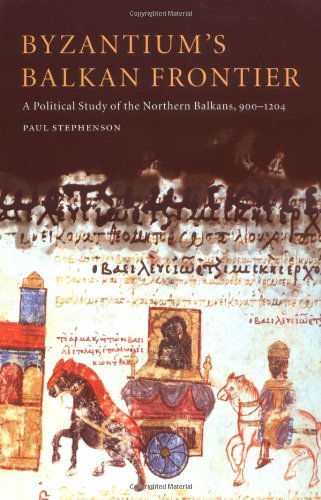
⭐This is one of the most important contemporary books for the history of the Byzantine Balkans. It creates a thoroughly new picture of the social, economic and political life of the time and, for good measure, it comes beautifully set within a colorful cover taken from a medieval Byzantine manuscript. For readers interested in this specific aspect of the Byzantine world, it is definitely “the one to own.’Conducted during the 1990s, those frenzied years of nationalism in the Balkans, Stephenson’s research is among other things, an antidote to that nationalism. Indeed, he rejects the notion of Balkan natives as having been engaged in a chronic struggle to overthrow the “Byzantine yoke.’ In actual fact, he notes,”the peoples of the northern Balkan lands seem to have worn their political allegiances lightly. This is not to say that they did not feel intense personal loyalty to local or regional rulers: it is clear they did. However, there is no indication that this was translated into a higher loyalty, and certainly not to a sense of belonging to any abstract entity like a “nation.’ “Sources do not support the notion [that] an ethnic awareness, still less a national consciousness, motivated rebellions” (p. 320).In its synoptic coverage, careful attention to detail, and use of the full range of textual and tangible source materials, this book bears the signs of an influence that to most readers would remain invisible- that is, the scholarly influence of Jonathan Shepard, expert in Byzantine-Russian history, and occasionally adventurous Oxford don James Howard-Johnston, whose relatively infrequent publishing, students know well, owes entirely to that time-honored unsatisfied desire for perfection of old-school scholars. For years, fans of this eminent historian have had to rely on the “trickle-down’ method of attaining his insights vicariously, through the work of those influenced by him. This fact makes Byzantium’s Balkan Frontier: A Political Study of the Northern Balkans, 900-1204 even more significant.(This is a partial review excerpt. The full review is available at Balkanalysis.com).
⭐As other reviewers have already noted on both the UK and the US site, this book, first published in 2000 and derived from the author’s doctoral dissertation at Cambridge in 1996 is purely and simply a masterpiece that warrants the top rating. There are multiple reasons for this and they relate to the author’s style, scholarship and methods just as much as they do to the substance of the book.First of all, the author’s scholarship is impressive and his ability to renew and, as another reviewer has noted, revolutionize his topic – Byzantium’s Balkan frontier – is quite amazing. This is especially the case since this book comes well after Dimitri Obolensky’s also excellent book (The Byzantine Commonwealth – 1971). The scope of Paul Stephenson’s book is narrower, because he focuses on the frontier from 900 to 1204 instead of presenting a panorama of Eastern Europe and the Byzantine influences that it was subject to for a thousand years (500 AD to 1453 AD). It is also different because Stephenson’s book is a political study whereas Obolensky’s tends to focus of cultural aspects that made the Balkans a part of the “Byzantine Commonwealth”. To a large extent, the two books therefore complete each other.Second, another merit of this book is to make use of numerous materials which had not been available to earlier authors and which complete and largely fill in many of the gaps left the written sources. These include coins and lead seals, but also the study of byzantine fortifications across the Balkans, building on studies of British authors for Asia Minor, but also on the work of Ducellier with regards to the system of fortifications put in place by the Byzantines to defend what is nowadays the Dalmatian, Albanian and Greek coasts. It is largely on the basis of these materials that the author reaches most of his conclusions.Third, the author’s style and his decision to construct a complete narrative of the period and to divide it into chapters makes this book somewhat more accessible to the non-specialist. This is despite the fact that it is very much a piece of very high quality scholarship. With regards to the chronology itself, and the chapters derived from it, the author distinguishes five periods. These alternate between periods during which the Byzantine Empire either consolidates its position in the Northern Balkans following a period of deterioration or expands, even if in a limited way. The last period, from 1180 to 1204 is one of rapid deterioration from which, this time, the Empire never fully recovered.Fourth, the author puts pay to nationalistic “legends” such as that of the “Byzantine Yoke”. This is done, in particular, by showing that the Empire, as part of its traditional governance and diplomacy in frontier zones, used a wide range of methods and devices to govern and exercise influence both within the borders and beyond the borders. The second element used is to show that, in many cases, Byzantium ruled through the local elites which were rather and mostly happy to benefit from the Empire’s subsidies, titles, gifts and status symbols. A third, and particularly interesting point, was to argue that the main reasons for the Empire’s final loss of control of the Balkan frontier were the growing competition with the Germanic Empire and the emergence of states (the Kingdom of Norman Sicily, Venice and the Kingdom of Hungary) which competed with each other and against the two Empires to assert control over portions of the Balkans.Fifth, another key component of this book is the author’s ability to show how the Byzantine Empire’s priorities in the Balkans tended to shift overtime, depending upon where the main threat to its domination was coming from. When the principal threat to the Empire’s security and stability was the Bulgars (during the 10th century), control of the Black Sea ports and of the Via Egnatia between Thessalonica and Dyrrachion were the priorities. Later on, when facing nomads during the 11th century and the Kingdom of Hungary during the 12th century, control of the north-south road going up to Nis (Naissus), Belgrade (Singidunum) and Sremska Mitrovica (Sirmium) became a priority.For those particularly interested in the topics covered in this book, there are a number of other books and sets of studies. I can recommend the two following books by Jonathan Shepard, who reviewed Paul Stephenson’s doctoral dissertation:- Byzantine diplomacy, a collection of 21 studies edited by Simon Franklin and Jonathan Shepard, and first published in 1992- Emergent elites and Byzantium in the Balkans and East-Central Europe (Varorium Collected Studies Series), which contains twelve studies published by Jonathan Shepard between 1989 and 2006 and which tend to complete and supplement the book of his former student.Note however that, unless you are a real “fan” of Byzantium, or you absolutely need to have a personal copy of these two books as a student or a professor, you might be better off by borrowing them from a library, because they are rather expensive.
⭐This is by far the best book I’ve read so far about Byzantium !!!It describes in detail -but without becoming tiresome !!!- Byzantium’s Balkan frontier, that is the interaction between the Byzantine Empire and the non Byzantine Balkan people. The reader is densely informed about the other non Byzantine protagonists of the Medieval Balkans (along with the supra-Balkanian Hungarians and the Italian Normans who are frequently involved in the Balkans) in the period ca. 900-1200 and their interactions with the Byzantines. The concept of “frontier” is analyzed and further divided in “ideological” and “effective”.I am not exaggerating when I say that ever since I started reading this book I couldn’t leave it from my hands.The book is well written, well referenced, it incorporates detailed philological and archaeological information and -I repeat- at no point it gets tiresome !!!
Keywords
Free Download Byzantium’s Balkan Frontier: A Political Study of the Northern Balkans, 900–1204 in PDF format
Byzantium’s Balkan Frontier: A Political Study of the Northern Balkans, 900–1204 PDF Free Download
Download Byzantium’s Balkan Frontier: A Political Study of the Northern Balkans, 900–1204 2000 PDF Free
Byzantium’s Balkan Frontier: A Political Study of the Northern Balkans, 900–1204 2000 PDF Free Download
Download Byzantium’s Balkan Frontier: A Political Study of the Northern Balkans, 900–1204 PDF
Free Download Ebook Byzantium’s Balkan Frontier: A Political Study of the Northern Balkans, 900–1204