Ebook Info
- Published: 2017
- Number of pages: 373 pages
- Format: PDF
- File Size: 10.55 MB
- Authors: Christopher R. Browning
Description
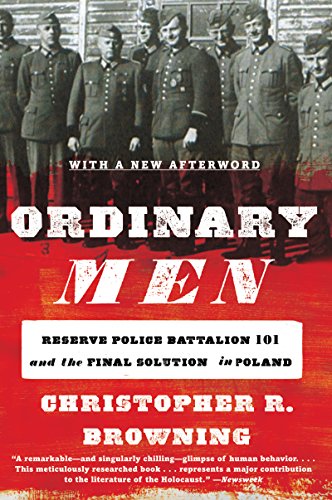
“A remarkable—and singularly chilling—glimpse of human behavior. . .This meticulously researched book…represents a major contribution to the literature of the Holocaust.”—Newsweek Christopher R. Browning’s shocking account of how a unit of average middle-aged Germans became the cold-blooded murderers of tens of thousands of Jews—now with a new afterword and additional photographs.Ordinary Men is the true story of Reserve Police Battalion 101 of the German Order Police, which was responsible for mass shootings as well as round-ups of Jewish people for deportation to Nazi death camps in Poland in 1942. Browning argues that most of the men of RPB 101 were not fanatical Nazis but, rather, ordinary middle-aged, working-class men who committed these atrocities out of a mixture of motives, including the group dynamics of conformity, deference to authority, role adaptation, and the altering of moral norms to justify their actions. Very quickly three groups emerged within the battalion: a core of eager killers, a plurality who carried out their duties reliably but without initiative, and a small minority who evaded participation in the acts of killing without diminishing the murderous efficiency of the battalion whatsoever.While this book discusses a specific Reserve Unit during WWII, the general argument Browning makes is that most people succumb to the pressures of a group setting and commit actions they would never do of their own volition. Ordinary Men is a powerful, chilling, and important work with themes and arguments that continue to resonate today.
User’s Reviews
Reviews from Amazon users which were colected at the time this book was published on the website:
⭐This well-researched, in-depth account of one reserve police battalion deployed in Poland in the early 1940s is a chilling, must-read account for anyone who’s ever wondered how the Holocaust happened and whether it could happen again, and especially for those who just know that they would never do any such thing.The book is very well organized. Following a brief preface which lays out the author’s intent and the pros and cons of the methodology, the book opens with a brief, tantalizing, nauseating account of the opening minutes of the massacre at Josefow. This chapter ends with Major Trapp’s astounding offer to allow anyone not feeling up to the task of eliminating Jews to step out. Contrary to popular belief, the perpetrators of the Holocaust were not merely following unavoidable orders. There was an element of choice involved. Why then did so many policemen make the choice to join it, while so few chose not to?The next few chapters help to set the stage for the events and actions of the Order Police. Browning discusses the demographic make-up of the Order Police, especially the fact that many were older reservists and primarily civilians, while only a small number of the younger men were career policemen.Browning describes the initial use of the Order Police in the “Final Solution” in Russia and their role in the deportations of Jews. While these sections are not directly about Battalion 101, they do give a picture of the kinds of activities of the Order Police prior to the mass executions later in Poland. What is particularly noteworthy about this section is Brown’s chilling ability to expand on rather bland reports by examining what isn’t mentioned, or mentioned only in passing. For instance, the reports focus on limited rations for the troops and how that affected morale, but little is mentioned of the nearly complete absence of food for the thousands of Jews. In another part the death of nearly 2,000 Jews on a transport train is mentioned only by oblique reference. Already, elements of distancing and dehumanizing can be seen, which pave the way toward mass extinction.Browning next turns his attention to Battalion 101 specifically, tracing their descent into murder and mayhem from the July 1942 massacre at Josefow to the November 1943 “Harvest Festival” massacre – the largest killing operation against Jews in the war. He details the different types of missions the battalion was used for, especially “deportation” operations which involved clearing ghettos, herding Jews onto trains, and escorting trains to extermination camps. Although these operations were not “massacres” per se, and although the policemen didn’t have direct experience of the gassing at the camps, they did involve plenty of violence, including the shooting of old and sick Jews and those who resisted. Plus, the police must have known what happened at the camps, since they never escorted Jews from the camps to any other destination. Also described are the “Jew hunts” in between clearing the ghettos, when smaller bands of police would, often on intelligence from local Poles, root out and exterminate small groups of Jews and partisans hiding in the woods.In each of these operations, Browning explores how different men volunteered for, reluctantly accepted, or distanced themselves from serving. Some men, for instance, stayed away from their commanding officer when selections were being made for operations. Others, albeit few, actively resisted or refused to serve. Most, however, either volunteered to serve or served willingly when selected. Once selected, some approached their task with brutal enthusiasm, some shot only when superior officers were around, and others sought different assignments or drifted away once the shooting began. The fact that there were always enough volunteers and willing shooters meant that there were few repercussions for those who didn’t participate or those who stopped participating, except for being labeled “weak” by their fellow men.Following a brief chapter on the outcomes for many of the men of the battalion after the war and a chapter exploring the alliances and divisions between and among the Germans, the Poles and the Jews, the final chapter gets down to the meat and potatoes: why did most of these “Ordinary Men” participate in the mass shootings of the Jews? Browning explores issues of selection, racism, conformity, camaraderie, authority and de-humanization. He rejects the idea that Battalion 101 was in any way specially selected for the task of implementing the “Final Solution”. Just the opposite in fact – based on their demographics, it might be expected that they would be the least likely to kill innocent Jews. Browning also rejects each of the other factors as a total explanation, but some combination thereof seems key. Embedded, societal disdain and contempt for the Jews primed the men to view them as less human, certainly less so than the “superior” Germans. Faced with orders to exterminate the Jews, obeying authority, conforming with the group, and supporting one’s fellow troops seemed the better choice than appearing “weak” or being too sympathetic to the Jews.One factor that Browning doesn’t really consider, however, is the effect of the experience of killing itself. He describes how the men were initially shocked at Josefow and went into action without the time (or desire) to consider the implications of their actions. Many were sickened and traumatized and had to stop shooting. But once they had shot, however, it seems their fate might have been sealed. They would have had to display extreme moral awareness and moral courage at that point to recognize the wrongness of their actions and to reverse course. Psychologically speaking, once a person has committed a violent act, it’s far easier to rationalize that act than to repent of it. But it’s hard to justify the murder of innocent people, so the only way is to retroactively buy into the prevailing prejudices about such people in order to override the idea of their innocence. Regardless of one’s prior feelings about the Jews, once one has killed Jews, the only rationalization possible is to accept that Jews are indeed “filthy vermin” in need of extermination. Otherwise, one has committed a morally heinous crime that would be, literally, unconscionable.This updated edition of the book concludes with an extensive Afterword in which Browning responds to Daniel Jonah Goldberg’s criticisms. Goldberg reviewed the same documents as Browning, yet came to a different conclusion, which he presented in “Hitler’s Willing Executioners”: that the Germans’ historical anti-Semitism primed the pump in a way that made them quite willing, if not eager, to kill the Jews. No pressure or coercion was necessary; orders merely served as a convenient pretext to do what they wanted to do anyway. I haven’t read Goldberg’s work, but I found the discussion quite interesting. From what I read, I’d say Browning has the better argument, but not having read any rebuttal from Goldberg, I won’t award either the final point.I recommend this book for every thinking adult (and even high school students). Certainly this book is fascinating for history buffs and those interested in World War II and the Holocaust. But it goes beyond the Holocaust. If the perpetrators of the Holocaust were just a large collection of fringe madmen, then we can rest easy now that the Holocaust is over. But Browning seems to be saying that we all have a bit of potential fringe madman in us, and the right combination of authority, conformity and stoked-up prejudices could bring out the worst in even the best of us. I think history and current events suggest Browning might be right. 4.5 stars.
⭐This book was written well but it did give me nightmares. These true stories are not for the faint of heart. It is very disturbing to know not that long ago people were capable of these violent acts.
⭐Good read but the book is made so very cheaply. Many books I’ve received lately are made with crappy workmanship. I prefer a book to a screen and miss the retail bookstores of the past.
⭐This should be read in middle schools every where so they can see what is coming should they truly make certain choices
⭐This is an extremely well written and researched book. The section at the end includes a refutation of Goldhagen’s criticism as well as reflections on the book 25 years after it was first published. Definitely recommend it.
⭐Ordinary Men: Reserve Police Battalion 101 and the Final Solution in Poland is a nonfiction account of the genocidal journey of a police battalion conscripted into Hitler’s Final Solution, mostly from first-hand accounts of the men themselves (from their interrogations when they were put on trial in the 1960s). The term “ordinary men” refers to the types of men they were before they became part of the war effort. Many (if not the majority) were cigarette salesmen, bakers, metropolitan police officers, and bankers. They were middle-aged men deemed too old to be conscripted into the regular army. In short, they were not the kinds of people you might expect would go on to become mass-murderers.The first mass murder takes place in a Polish town called Jozefow. The commander of the unit was teary-eyed and choked up when he gave the order to his men. Accounts hold that he even gave them a way out, stating that if any man didn’t think they were up for the challenge (of murdering thousands of Jews on that day), they were free to step down. About twelve men (among hundreds) decided to step down and opt out of the killing. As a side note, these are the men we should really be studying, because if every man had their courage, we may have avoided the Holocaust altogether. Nevertheless, 1,500 Jews were shot in the back of the head and neck that day. Many were killed on the spot, and many were gravely injured, but left in the mass grave to suffer a slow, more painful death, being suffocated by their friends and family as they fell on top of them.The book follows the battalion through other such mass killings, Judenjagd (“Jew Hunt”) in the Polish countryside, and their participation in gathering up and deporting Jews to Treblinka (a literal death sentence). Ultimately, these bakers, salesmen, and police officers were directly responsible for the deaths of 38,000 men, women and children through mass-shootings, and another 45,200 through collecting people from the ghettos and forcing them onto trains for Treblinka (a Nazi extermination camp).Browning offers up a variety of reasons that these ordinary men participated in genocide, some more pertinent than others. Among those reasons are deference to authority, psychological need for conformity, fear of a brutal regime, fear of looking “weak” in front of other members of the battalion, detachment from the people they were killing, and indoctrination via the Nazi propaganda machine. None of these individual reasons would have been enough to drive ordinary men to mass murder, but altogether, the reasons became enough for many of them.“But those who killed cannot be absolved by the notion that anyone in the same situation would have done as they did. For even among them, some refused to kill and others stopped killing. Human responsibility is ultimately an individual matter.” -Christopher Browning via Ordinary Men Chapter 18While reading Browning’s conclusions, I couldn’t help but think about the conclusions of other men who have grappled with the evil deeds of men. In their own ways, both Jung and Solzhenitsyn tell us that we all have the inherent capability for malevolence. Jung adds that being hyper-aware of that fact is essentially our only shot at preventing us from acting upon it.“The line dividing good and evil cuts through the heart of every human being.” Aleksandr Solzhenitsyn via The Gulag Archipelago“…inasmuch as I become conscious of my shadow I also remember that I am a human being like any other.” -Carl JungFinal say: 4/5 stars. This is a very powerful book that is difficult to read at times due to the (necessarily) graphic depictions of violence. If you are at all interested in human nature or World War II, read this book.
⭐Once I started reading this book it was difficult to out down. Author looks at an Order Police Battalion during World War Two. Well researched.
⭐Not great bed time reading, more like ESSENTIAL bed time reading – although you will possibly have difficulty sleeping. This book elicited emotions that I have not felt since watching ‘The World At War’ as a young teenager over forty years ago.A warning as to how groups of conscripted ‘ordinary men’ can be manipulated, coerced and encouraged to carry out acts of dehumanising evil. ending in slaughter and cold hearted murder on an industrial scale. While some soldiers refused to carry out their orders, others relished the murder, The frightening point of this book is that the majority of conscripts simply shrugged their shoulders and got on with the ‘job’ at hand.Mass murder and genocide have happened more than once throughout human history, they will very probably happen again. None are so blind as those blinded by ideology and labouring under the illusion of ‘a grand destiny’. Then there are those who harden their hearts and either ‘just follow orders’ or simply ‘look the other way.’. Truly terrifying food for thought.
⭐I have nothing but praise for this book mainly because it avoids convenient and simplistic approach of blaming “anti-semitism” as the one and overwhelming reason why “ordinary Germans” committed most hideous crimes. The author shows a number of factors that must be considered with his role being partially that of a historian but also partially of a social-psychoanalyst. Inclusions of other studies 25 years after the initial publication has been incredibly useful and telling.The sad thing is the book also shows how little justice has been served for the most cruel murders of thousands of men, women and children. When the legal system did act, the punishment was laughably inadequate and almost certainly didn’t affect the most serious offenders. Policeman murdering Jews during the war serving also as a policeman after the war is telling us possibly more than the author intended… It shows that Nuremberg trials have only given us “feel good illusion of justice” while most of the “ordinary murderers” were not only not punished but lived their lives even in positions demanding respect.
⭐Frightening in it’s both it’s honesty and how repeatable it is – history’s monster’s were people like us! An amazingly human story of how easily we could all be deceived into committing acts of imaginable brutality. Considering current narratives within mainstream media arguably a required read, if only to sit on a coffee table to spark conversation.
⭐I don’t know where to start. The book is very well written, really captures the moments and portrays the perpetrators of some of the worst crimes in a way I didn’t expect: as ordinary people who were just doing their job. Some evaded. Others enjoyed it. Most endured it.A truly brilliant account of the horrors of the Nazi regime and how easily they could happen again.
⭐I found this work Tedious and Heavy going.The research carried out is admirable,but all it amounts to is a brief resume of the Battalions war diaries and witness statements taken years after the event in which the said witnesses always attempt to deny or downplay their involvement in the mass killings.The last few chapters of the Book descend in to the usual quasi psychology argument about why these men carried out the crimes that they did.And after the war the men who committed the Crimes in the East simply slipped back in to their previous anonymity that they had before the war,most of them lived well in to old age and died peacefully.
Keywords
Free Download Ordinary Men: Reserve Police Battalion 101 and the Final Solution in Poland in PDF format
Ordinary Men: Reserve Police Battalion 101 and the Final Solution in Poland PDF Free Download
Download Ordinary Men: Reserve Police Battalion 101 and the Final Solution in Poland 2017 PDF Free
Ordinary Men: Reserve Police Battalion 101 and the Final Solution in Poland 2017 PDF Free Download
Download Ordinary Men: Reserve Police Battalion 101 and the Final Solution in Poland PDF
Free Download Ebook Ordinary Men: Reserve Police Battalion 101 and the Final Solution in Poland