

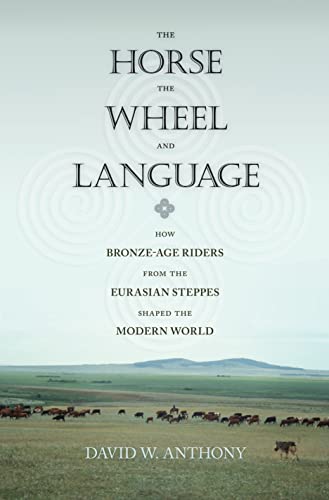
Ebook Info
- Published: 2010
- Number of pages: 568 pages
- Format: PDF
- File Size: 18.91 MB
- Authors: David W. Anthony
Description
Roughly half the world’s population speaks languages derived from a shared linguistic source known as Proto-Indo-European. But who were the early speakers of this ancient mother tongue, and how did they manage to spread it around the globe? Until now their identity has remained a tantalizing mystery to linguists, archaeologists, and even Nazis seeking the roots of the Aryan race. The Horse, the Wheel, and Language lifts the veil that has long shrouded these original Indo-European speakers, and reveals how their domestication of horses and use of the wheel spread language and transformed civilization. Linking prehistoric archaeological remains with the development of language, David Anthony identifies the prehistoric peoples of central Eurasia’s steppe grasslands as the original speakers of Proto-Indo-European, and shows how their innovative use of the ox wagon, horseback riding, and the warrior’s chariot turned the Eurasian steppes into a thriving transcontinental corridor of communication, commerce, and cultural exchange. He explains how they spread their traditions and gave rise to important advances in copper mining, warfare, and patron-client political institutions, thereby ushering in an era of vibrant social change. Anthony also describes his fascinating discovery of how the wear from bits on ancient horse teeth reveals the origins of horseback riding. The Horse, the Wheel, and Language solves a puzzle that has vexed scholars for two centuries–the source of the Indo-European languages and English–and recovers a magnificent and influential civilization from the past.
User’s Reviews
Editorial Reviews: Review “Winner of the 2010 Book Award, Society for American Archaeology””David W. Anthony argues that we speak English not just because our parents taught it to us but because wild horses used to roam the steppes of central Eurasia, because steppedwellers invented the spoked wheel and because poetry once had real power. . . . Anthony is not the first scholar to make the case that Proto-Indo-European came from this region [Ukraine/Russia], but given the immense array of evidence he presents, he may be the last one who has to…. The Horse, the Wheel, and Language brings together the work of historical linguists and archaeologists, researchers who have traditionally been suspicious of each other’s methods. [The book] lays out in intricate detail the complicated genealogy of history’s most successful language.”—Christine Kenneally, The New York Times Book Review”[A]uthoritative . . .”—John Noble Wilford, New York Times”A thorough look at the cutting edge of anthropology, Anthony’s book is a fascinating look into the origins of modern man.” ― Publishers Weekly”In the age of Borat it may come as a surprise to learn that the grasslands between Ukraine and Kazakhstan were once regarded as an early crucible of civilisation. This idea is revisited in a major new study by David Anthony.” ― Times Higher Education”Starting with a history of research on Proto-Indo-Europeans and exploring how this field for obvious reasons assumed an ethno-political dimension early on, leading PIE scholar Anthony moves on to established facts . . . then shifts his focus to the interrelation of the three essential elements of horse, chariot, and language and how the first and second provided the means for the spread of Indo-European languages from India to Ireland. The bulk of the book contains the factual evidence, mainly archaeological, to support this argument. But a strength of the book is its rich historical linguistic approach. The combination of the two provides a remarkable work that should appeal to everyone with an interest not just in Indo-Europeans, but in the history of humanity in general.”—K. Abdi, Dartmouth College, for, CHOICE”David Anthony’s book is a masterpiece. A professor of anthropology, Anthony brings together archaeology, linguistics, and rare knowledge of Russian scholarship and the history of climate change to recast our understanding of the formation of early human society.”—Martin Walker, Wilson Quarterly”The Horse, the Wheel, and Language brings together the work of historical linguists and archaeologists, researchers who have traditionally been suspicious of each other’s methods. Though parts of the book will be penetrable only by scholars, it lays out in intricate detail the complicated genealogy of history’s most successful language.”—Christine Kenneally, International Herald Tribune”The Horse, the Wheel and Language maps the early geography of the Russian steppes to re-create the lost world of Indo-European culture that is as fascinating as any mystery novel.”—Arthur Krim, Geographical Reviews”In its integration of language and archaeology, this book represents an outstanding synthesis of what today can be known with some certainty about the origin and early history of the Indo-European languages. In my view, it supersedes all previous attempts on the subject.”—Kristian Kristiansen, Antiquity”A key book.”—David Keys, Independent Review “If you want to learn about the early origins of English and related languages, and of many of our familiar customs such as feasting on holidays and exchanging gifts, this book provides a lively and richly informed introduction. Along the way you will learn when and why horses were domesticated, when people first rode horseback, and when and why swift chariots changed the nature of warfare.”―Peter S. Wells, author of The Battle that Stopped Rome”A very significant contribution to the field. This book attempts to resolve the longstanding problem of Indo-European origins by providing an examination of the most relevant linguistic issues and a thorough review of the archaeological evidence. I know of no study of the Indo-European homeland that competes with it.”―J. P. Mallory, Queen’s University, Belfast From the Back Cover “If you want to learn about the early origins of English and related languages, and of many of our familiar customs such as feasting on holidays and exchanging gifts, this book provides a lively and richly informed introduction. Along the way you will learn when and why horses were domesticated, when people first rode horseback, and when and why swift chariots changed the nature of warfare.”–Peter S. Wells, author of The Battle that Stopped Rome”A very significant contribution to the field. This book attempts to resolve the longstanding problem of Indo-European origins by providing an examination of the most relevant linguistic issues and a thorough review of the archaeological evidence. I know of no study of the Indo-European homeland that competes with it.”–J. P. Mallory, Queen’s University, Belfast About the Author David W. Anthony is professor of anthropology at Hartwick College. He is the editor of The Lost World of Old Europe (Princeton). He has conducted extensive archaeological fieldwork in Ukraine, Russia, and Kazakhstan. Read more
Reviews from Amazon users which were colected at the time this book was published on the website:
⭐The book has lots of interesting facts:==Peoples who have adopted agriculture will a sense of ethics that can require extreme sacrifices. According to the author, when it’s a rough winter, the people must favor starvation of a some of their people, rather than eating the breeding stock or the seeds for planting. If they eat the breeding stock or planting seeds, they will not be able to continue their agricultural way of life in the Spring.==The first horses were probably domesticated for their meat. Horses can survive better in snow than cows and sheep, because horses can use their hooves to clear away ice and snow. Sheep will just push snow away with their noses to get at underlying grass, but if there’s icy snow, their noses get bloody and they starve.==There are particular sound transitions that languages make based on where the tongue sits in the mouth. For instance, in Latin, kent for 100 would transition to cent in French because the consonant “s” and the vowel “e” are both made with the tongue in the front of the mouth. In contrast, the hard “k” sound and the vowel “o” are made with the back of the mouth, so those two will transition together. Based on which sound transitions are smoothest and expected, linguists can back-calculate progenitor languages.==It is possible when horses were domesticated for riding by examining the bit wear on the teeth of the skeletons.==Although some historians have claimed that nomadic societies such as the Schythians or the Yamnaya could only survive by acting as parasites on established agricultural societies, in fact this author says that the nomads could engage in enough agriculture and metallurgy to survive on their own. pp. 321-322.==The gene for lactose tolerance evolved around 4600 to 2800 BCE in the steppes west of the Ural mountains. The cow provides more milk than sheep or other animals, and is thus revered as sacred in many Indo-European cultures (p. 326).
⭐The author is an archaeologist and not an historical linguist and as such the second half of the book is filled with a great deal of archaeological detail from the Ukraine and Russia – the presumed heartland of the Indo-European people. Positively the author does not assume the reader knows a great deal about either archaeology or linguistics, making the book eminently readable for interested laymen. Another advantage – or disadvantage – is that the author defends the existence of an Indo-European language as if it were on trial given the number of linguists who deny its existence given the fragmentary evidence. Nevertheless the existence of a common ancestor to almost all European and a number of Asian languages has been recognized at least since the time of Sir William Jones. Jones was a scholar sent to India in order to learn Sanskrit for legal purposes and ended up recognizing astonishing similarities between Greek, Latin and Sanskrit. In 1786 he stated,”The Sanskrit language, whatever be its antiquity, is of a wonderful structure; more perfect than the Greek, more copious than the Latin, and more exquisitely refined than either, yet bearing to both of them a stronger affinity, both in the roots of verbs and the forms of grammar, than could possibly have been produced by accident; so strong indeed, that no philologer could examine them all three, without believing them to have sprung from some common source, which, perhaps, no longer exists.”The author concurs with Jones and more current scholars such as J.P. Mallory who defend the existence of an Indo-European language despite the gaps in the reconstructed vocabulary lists. All in all linguists have come up with some 1,500 roots of Indo-European and thousands of words (cognates) common to modern Hindi, Persian, Russian, Greek, Italian, German, Lithuanian, Irish, Welsh and Icelandic. Key words such as wool (from sheep), wheels, wagons, horses and chariots are key in identifying the original European speakers and from whence they came. Other key words common to Indo-European languages today that hark back to Proto Indo-European are words such as “loks,” the word for trout, and the words for trees such as a “beech.” By a process of elimination the author follows the path of J.P. Mallory and others and argues that the Indo-European language originated in the Pontic-Caspian Steppes, a vast swathe of terrain that spans the northern shores of the Black Sea and arches over to the north of the Caspian Sea. It encompasses much of the Ukraine, the Volga region of southern Russia and part of eastern Kazakhstan. It is a region with rich, dark soil and is swallowed up by the sky in a way not unlike Big Sky country in the Dakotas. It is a region comprised of temperate grasslands, savannahs and shrubland. It is filled with rivers and forests, and lies north of the Caucasus Mountains, east of the Ural Mountains and west of mainland Europe.When did this language or collection of dialects exist? Somewhere between 4500 BC and 2500 BC. Why? Because those are the dates when the daughter languages of Indo-European began to go their own way. Anatolian, the language of the Hittite Empire that collided with the Pharaohs of Egypt, broke off around 4,000 BC. Tocharian, a language spoken in western China by people with eyes the color of the sky, broke off circa 4,000 BC and lost connection with the other Indo-European languages. Between 3500 and 3000 BC the speakers of Celtic-Italic began to expand west and early Germanic speakers left the region around 3300 BC to heard towards the Baltic Sea and Scandinavia. Around 2500 BC the ancestors of Greek speakers began to descend into Greece and Turkey while the the Balts broke off from the Slavs. Between 2500 and 2200 BC the Indo-Europeans crossed the Caucasus mountains and descended into Persia and northern India. Some of the holy scriptures of Hinduism, the Rig Veda, give key insights into early Indo-European life and culture Iran, Afghanistan and India during the Bronze Age.Wheeled vehicles were probably invented further south in Mesopotamia but when they were introduced to the Indo-European homeland around 3300 BC it caused an explosion. The development first of the wagon would have made farming and transportation easier and would have slowly revolutionized contact between peoples. Instead of walking by foot, humans could now cross the vast Eurasian steppes that separate much of Europe from Asia. It was then that the expansion of most of the Indo-European peoples took place as the Celts, Germans, Baltic, Slavic and Armenian peoples assimilated and or conquered the other peoples of Europe. At the very least their languages “conquered” Europe, for only a very few – Basque, Finnish, Estonian, Hungarian and Sami – are not of Indo-European origin. The author emphasizes absorption through favorable treatment of other peoples rather than conquest. The spread of the Indo-European languages and peoples was a multi-leveled and uneven process that continues to this day. The first most significant stage for the author surprisingly was not the original spread and cultural domination of prehistoric Europe but the Roman Empire and the spread of the Latin tongue. Second the colonial expansion of the Spanish, British, Russian and French empires and third the “recent triumph” of American English that follows in the wake of the British Empire, making English the lingua franca par excellence. Despite the vast number of people who inhabit Asia today (over 4 billion) Indo-European languages are spoken by over half the world’s population, ensuring the study of Proto Indo-European and its heartland for a long time to come.Overall this book is quite readable but the degree of interest in the archaeological details of the Ukraine will determine how much time one spends with the second half of the book. For a similar and more concise overview I would recommend Jean Manco’s “Ancestral Journeys,” Cavalli Sforza’s “The Great Human Diasporas” and the works of J.P. Mallory and Colin Renfrew.
⭐This book, published in 2007, describes recent discoveries of archaeology and linguistics, as well as the new tools that researchers have at their disposal — their capabilities and limitations. And it put the new-found pieces together to form a coherent picture. For me, it was a revelation.The story focuses on the steppes north of the Black Sea and the Caucasus, instead of the Near East or India. Many of the archaeological sites discussed are in Ukraine. Place names and rivers are now familiar from news of the Ukrainian War. That’s where horses were first domesticated and where chariots were invented. It is also the likely starting place of Indo-European languages. Previously little known, overlapping and interlinking cultures independent of Egypt, Assyria, Babylonia, Sumer, Akkad, and India became the basis of English and other languages now spoken in Europe.Multiple vast migrations led to the spread of culture and language. These migrations were not based on military conquest, and they took place over the course of thousands of years. Often the migrations went from east to west, but sometimes people returned west to east.I recently read The Origin of Consciousness in the Breakdown of the Bicameral Mind by Julian Jaynes. Jaynes claimed that there was no self-perception, no idea of the self before about 1200 BC, the time-frame he gives for the breakup of the “bicameral mind.” This discoveries described in this book totally debunk that theory. “The initial expansion of the Indo-European languages was the result of widespread cultural shifts in group self-perception. Language replacement always is accompanied by revised self-perceptions, a restructuring of the cultural classifications within which the self is defined and reproduced.” p. 340 The origins of Indo-European were in the millennium 4000-3000 BC.
⭐This book was described in the West as a masterpiece when it first appeared, and won a distinguished prize. But in 2015, comprehensive ancient DNA reports began to appear that compared the DNA of the steppe horse-tamers (now usually called the Yamnaya) who are described in Anthony’s book with the genetic profile of living Western European males. The results were startling – and rather upsetting to most archaeologists of the Bronze Age, whom Anthony had followed in preferring to believe that major cultural change at this time, along with the Proto-Indo-European language, was spread ‘by pots not people’. The DNA studies showed a massive replacement of the Y-chromosome of Neolithic European males by the distinctive R1a and R1b Y-DNA of the Bronze Age steppe riders. R1b is the Y-DNA haplogroup now carried by almost all West European males. At the end of the Neolithic, there now appears to have been a 90% replacement of the male Y-DNA in the UK; a recent study of Iberia in the same period has confirmed a staggering 100% replacement of the existing Y-DNA by steppe Y-DNA. These startling conclusions are summed up in chapter 5 of David Reich’s Who do you think you are? Ancient DNA and the new science of the human past. Such figures have wholly discredited the thesis proposed by Anthony, summarised at the end of his book as follows: “It is not likely that the initial spread of Proto-Indo-European dialects into regions outside the Pontic-Caspian steppes was caused primarily by an organized invasion or a series of military conquests.”The bulk of the meticulous archaeological research described by Anthony was done by Soviet and East European archaeologists, listed in his bibliography but not mentioned in his acknowledgments. Yet before Anthony’s book the story of the steppe riders had already been presented to Western readers in great detail, by Marija Gimbutas. However, Gimbutas offered a very different interpretation of the data, and although she was viewed condescendingly by most Western archaeologists, who saw her work as eccentric and misjudged, ironically it is her interpretation of the weaponised steppe riders’ astonishingly violent impact on central European society and culture in the Neolithic (a culture she called Old Europe) that has been vindicated by the DNA results. It WAS an invasion, albeit one which appears to have unfolded in waves. The arrival of the steppe riders in Central, then Western Europe brought to power an extremely violent patriarchal society whose veneration of a Sky God, hierarchical social structure, and love of warriors and weapons contrasted significantly with the values of the Neolithic societies it displaced.If you have already read Gimbutas, you may have noticed a striking omission from Anthony’s curiously sanitised picture of the steppe warriors’ culture: although his book includes several illustrations which depict the disturbing ‘double burials’ often found in the steppe riders’ kurgans, he seems unable to acknowledge that these typically represent human sacrifice. This practice, together with multiple animal sacrifices, was routinely performed at the elaborate funerals of their chieftains and senior warriors. Such double burials were the origin of the practice later known in India as sati, where the wife or wives of the dead leader would be required to die and enter the otherworld with him, in some cases being accompanied by children and slaves. It seems to me quite inexcusable that Anthony omits any reference to this illuminating and to my mind, damning detail. For along with their fondness for sacrificing horses, cattle and other animals at key burial sites (which were usually kurgans), this practice speaks volumes about the values of the violent society that overran Europe during the Bronze Age. So anyone who thinks Anthony’s book is the last word on this subject should immediately read Gimbutas, for eg The Kurgan culture and the Indo-Europeanisation of Europe, or The Civilisation of the Goddess.
⭐This is a great book if you want to learn more about the archaeology of the Proto-Indo-Europeans on the Russian Steppes. Disappointingly, the title is misleading as it covers almost nothing about the spread of Indo-European outside of the steppes.The book starts well enough with an exploration of Proto-Indo-European as a language – what we know, and what we can learn from it. But then it soon falls into a repetitive pattern of archaeological reports for the large number of identified cultures in the steppes over a couple of thousand years. After a while this really begins to drag.Perhaps more disturbingly, Anthony seems so desperate to prove his own ideas he thinks nothing of backhanding the giants of archaeology who came before him, not least Marija Gimbutas, who was singularly responsible for identifying where the Proto-Indo-Europeans originated. Anthony also repeatedly takes swipes at other archaeologists, sometimes in a way that seems a little too personal.However, the value of this book comes from the steppe archaeology itself, and no doubt will prove of keen interest for further research. This also means this book is likely to disappoint and even bore the casual reader simply looking for a general overview of who the Proto-Indo-Europeans were and what how they “shaped the modern world”.There’s also the important caveat that genetic studies published after this book show that the spread of Proto-Indo-European languages was far more violent and deadly than Anthony tries to argue. He also seems unaware of Cunliffe’s argument that the Proto-Celtic branch travelled to Western Europe through the Mediterranean.So, overall, a potentially useful text for interested archaeologists – hence 4 stars – but not for general readers.
⭐Giving four stars is not a reflection of the quality of the book which is first class but on the number of people likely to enjoy it. It is for university students at least.The question it deals with is not new; it is at least 2 hundred years old, namely the origin of the Indo-European languages. As the book says, about half the people of the world speak an Indo-European language. Nor are the conclusions of the book different from the commonly-held view that they originated in the steppes north of the Black and Caspian Seas. The author combines linguistic and archaeological studies. He does so with great thoroughness, drawing on Russian and Ukrainian studies now available to those able to read Russian and there are many of these. The problem for the non-expert is that there a too many of these. What is suitable for a university student is less suitable for the general reader, and I found myself skipping.As is common nowadays, the author dismisses the theory from Rassenkampf (racial wars) of Social Darwinism. Rather, Indo-European became regarded as a prestige language, the language of high status families. Greek, Latin, and Arabic spread in a similar manner, as indeed did English, French and Spanish. Prestige no doubt followed success in battle, but did not involve wiping out populations. The use of the horse for riding and the composite bow, also helped.This exhaustive work sums up recent scholarship on the subject. It does not explain the origin of the local dialect of the steppes which was to prove so influential.
⭐Though this is a book that advances a highly complex set of academic arguments – that the spread of proto-indo-european languages was not accomplished by violence, that linguistic methods can supplement the physical evidence to pinpoint its origins and fundamental splits – it is also highly readable for interested laymen. I myself cannot judge his ideas against the evidence, but I learned an immense amount about the transition from the late neolithic to the bronze ages, where a single population divided and moved into both Europe and S Asia, disseminating a root language, technologies, a new economic and agricultural system, and finally an innovative socio-political system. The essence of Anthony’s argument, in my reading, is that all these interacted to produce a relatively peaceful expansion.First, in 5500 BC, the proto-indo-europeans (PIE) were small bands of foragers based in the Pontic-Caspian riverrain and seaside regions. While neolithic agricultural techniques were spreading, PIE adopted herding techniques of grass-eating species, enabling them to convert previously useless steppe grasses into animal protein. This vastly increased their range of potential living spaces. Horses, in particular, represented a good food source: they could paw through snow to grass, rather than depend on their noses like sheep, which preferred to starve than scrape their tender snozes as winter wore on. This hugely increased their wealth and nutritional options, expanding their population, prestige, and power. In this way, they became a significant cultural force. (Interestingly, it appears that 2 offshoots – the Hittite language groups and the Tocharians – split off prior to this, around 4500-4000 BC.)Second, a series of stunning technological inventions increased their mobility and speed over unprecedented ranges. Not only did the wheel make its appearance, but so did the wagon and eventually the chariot. This reinforced PIE economic power and, particularly with the chariot and the newly acquired ability to ride horses instead of just eating them, made them a formidable military power as well. They were able to protect themselves as well as raid others and then beat a hasty escape. The need to protect herds also enhanced the status of male warriors. Finally, as their herds grew to enormous proportions, PIE sought new grazing areas, spurring further spreading west, northwest, and southeast.Third, according to Kennedy, PIE developed a political system based on 2 customs that enabled them to incorporate local peoples relatively peacefully, with the adoption of PIE dialects and intermarriage eventually mixing the populations. On the one hand, with their wealth and economic system, PIE developed client-master relations with locals, in effect incorporating them into a lower rank of their hierarchy. This was accomplished to their mutual advantage, trading prosperity for peace and stability. On the other hand, there was a system of guest-host relations, also to promote peace and sharing, in particular in feasts given by PIE to prove the superiority of their economic-agricultural system. In this way, over thousands of years, PIE dialects spread to autochtons as they were absorbed into a quasi-political order. Though Anthony did not quite prove to my satisfaction that this was accomplished without depending on a great deal on warfare, I admit it is possible it happened non-violently.By 3200 BC or so, the PIE had created a gigantic diaspora of related but independent regions. With the perfection of bronze smelting, the relative uniformity of the many groups facilitated trade, initiating an unprecedented era of prosperity that lasted through 2000 years, to the iron age. It was during this time that PIE split into Celtic, Italic, Germanic, Indo-Iranian, Baltic, and Slavic groupings (to name a few!), eventually leading to the modern languages that a full 70% of the world speaks today. This is absolutely wonderful stuff for the brain, a rare intellectual adventure. You can also gain a deep understanding of the Bronze Age, though little of the culture can be known with any specificity. It is also a primer on historical linguistics, lucidly written, that examines the structure of PIE languages; for example, its grammar is elaborately structured to reflect time and action, which is not the case with other basic root languages (Hopi, for example, incorporates one’s assessment of the accuracy of a source of information into its grammar, shaping thought in an entirely different way).That being said, this is a very academic book. THere are long passages where seemingly obscure points are proven. They can be tedious to the uninitiated and easily skipped. For myself, I dislike long descriptions of graves and pottery shards, of which there are very many; the same goes for the linguistic reconstruction of PIE, which necessitates long discussions of word roots and their evolution into modern usages. Of course, to be scientific, these arguments must be made. To his credit, Anthony always brings the reader back to remind us of where he is going and what it means, which make the book a consistent pleasure.I recommend this book with the greatest enthusiasm. It is also beautifully written and has plenty of personal observations, such as his efforts with his wife to prove that horses were ridden by gauging wear on horse’s teeth, that are funny and instructive.
⭐A very interesting work on the origins of the Indo-Europeans in the Pontic Caspian Steppes between 5000BCE and 2000 BCE. A bit long and heavy going? I found it hard to remember all the names of the different cultures and archaeological sites, especially as many acronyms were used! I was a little disappointed more Indo -European word etymologies were not used,and Proto-Indo-European was not reconstructed as a language? All-in-all it was a seminal work on the archaeology and history and prehistory of the origins of the Indo-European Peoples and Nations!
Keywords
Free Download The Horse, the Wheel, and Language: How Bronze-Age Riders from the Eurasian Steppes Shaped the Modern World in PDF format
The Horse, the Wheel, and Language: How Bronze-Age Riders from the Eurasian Steppes Shaped the Modern World PDF Free Download
Download The Horse, the Wheel, and Language: How Bronze-Age Riders from the Eurasian Steppes Shaped the Modern World 2010 PDF Free
The Horse, the Wheel, and Language: How Bronze-Age Riders from the Eurasian Steppes Shaped the Modern World 2010 PDF Free Download
Download The Horse, the Wheel, and Language: How Bronze-Age Riders from the Eurasian Steppes Shaped the Modern World PDF
Free Download Ebook The Horse, the Wheel, and Language: How Bronze-Age Riders from the Eurasian Steppes Shaped the Modern World