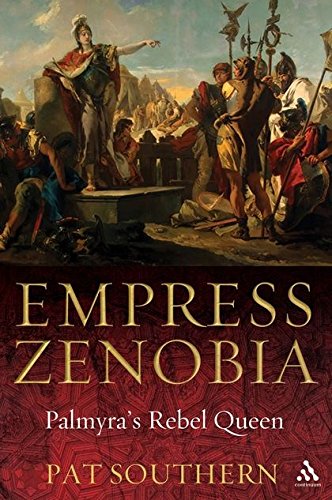
Ebook Info
- Published: 2009
- Number of pages: 224 pages
- Format: PDF
- File Size: 5.71 MB
- Authors: Pat Southern
Description
The ancient sources for the life and times of Zenobia are sparse, and the surviving literary works are biased towards the Roman point of view, much as are the sources for two other famous women who challenged Rome, Cleopatra and Boudica. In Empress Zenobia, Pat Southern seeks to tell the other side of the legendary 3rd century queen’s place in history. As queen of Palmyra (present-day Syria), Zenobia was acknowledged in her lifetime as beautiful and clever, gathering round her at the Palmyrene court writers and poets, artists and philosophers. It was said that Zenobia claimed descent from Cleopatra, which cannot be true but is indicative of how she saw herself and how she intended to be seen by others at home and abroad. This lively narrative explores the legendary queen and charts the progression of her unequivocal declaration, not only of independence from Rome, but of supremacy. Initially, Zenobia acknowledged the suzerainty of the Roman Emperors, but finally began to call herself Augusta and her son Vaballathus Augustus. There could be no clearer challenge to the authority of Rome in the east, drawing the Emperor Aurelian to the final battles and the submission of Palmyra in AD 272. Zenobia’s story has inspired many melodramatic fictions but few factual volumes of any authority have been published. Pat Southern’s book is a lively account that is both up to date and authoritative, as well as thoroughly engaging.
User’s Reviews
Editorial Reviews: Review “Verdict: Southern’s biography is an accessible and vital addition to Roman historical knowledge. Exhaustive research and extensive footnotes make this an excellent aid to undergraduate or graduate research. Recommended for academic libraries. Background: Southern (The Roman Empire from Severus to Constantine; The Roman Army) examines the life and times of Zenobia, who ruled Palmyra as regent to her son, Vaballathus, in the late third century C.E. The author skillfully presents the turbulent world of the late Roman Empire and Zenobia’s rise to power. Using historical records and archaeological evidence, Southern portrays Zenobia as less of a rebel or power-hungry ruler than a leader who had the interest of her people and the security of her realm at heart; she also carefully considers other theories and opinions that have arisen over the centuries.” — Melinda Gottesman, Library Journal (Xpress Reviews), February 15, 2009″A detailed evaluation of current Zenobian studies, taking robust stands on disputed points, such as the lack of evidence for 3rd-century city walls protecting Palmyra … and Zenobia’s ultimate fate.” – The Times Higher Education Supplement”this book…contains all we are ever likely to know about her[Zenobia]”4 July 2009 (The American Spectator)“Verdict: Southern’s biography is an accessible and vital addition to Roman historical knowledge. Exhaustive research and extensive footnotes make this an excellent aid to undergraduate or graduate research. Recommended for academic libraries. Background: Southern (The Roman Empire from Severus to Constantine; The Roman Army) examines the life and times of Zenobia, who ruled Palmyra as regent to her son, Vaballathus, in the late third century C.E. The author skillfully presents the turbulent world of the late Roman Empire and Zenobia’s rise to power. Using historical records and archaeological evidence, Southern portrays Zenobia as less of a rebel or power-hungry ruler than a leader who had the interest of her people and the security of her realm at heart; she also carefully considers other theories and opinions that have arisen over the centuries.” – Melinda Gottesman, Library Journal (Xpress Reviews), February 15, 2009 About the Author Pat Southern is an expert on Classical History and is the author of many authoritative books in this area including The Roman Empire from Severus to Constantine; The Late Roman Army and biographies of Augustus and Domitian (all published by Routledge).
Reviews from Amazon users which were colected at the time this book was published on the website:
⭐The Empress Zenobia is the most famous woman of antiquity after Cleopatra. She was the queen of Palmyra who attempted to become Empress of Rome as the Empire seemed poised to fall apart. This is probably Pat Southern’s greatest book. I have read several of her other ones (
⭐,
⭐) and I tend to find them to be like reading an encyclopedia. This one is rather more involved than her other ones. Perhaps because there is less written about Zenobia than any of her other subjects she feels it necessary to tell more about the times themselves. This fills her book out and gives it a soul. I think that the biggest problem with her earlier books is that she focuses on the events of the lives rather than the feel of them. Either that or she has just grown as a writer. At any rate this book is well written and presents the period quite well. Zenobia herself is rather a mystery, but there is no further information to be gleamed from the sources. Still, Southern presents a plausible interpretation of her motives that fits with the data. I’d recommend that this book be read in conjunction with a book on Aurelian like
⭐or
⭐. That would give a better understanding of the wider issues.
⭐given the limited info on Zenobia, this author set the stage and teased out as much info as she could. So glad to get the book.
⭐I’ve visited Palmyra, & have read much Syrian history including Richard Stoneman’s far more readable Palmyra and Its Empire: Zenobia’s Revolt against Rome, 1994. I bought the Pat Southern book in the hope of knowing more about Palmyra. I got more of nothing than I bargained for!To be fair, Southern is upfront at the outset on the absence of source material, conflicting scholarly theories & opinions, and, as a result, her work can largely be summarized as “virtually nothing is beyond doubt.” She covers, in painful detail, the Roman Empire in Syria & Parthia (Persia), noting every single emperor, general & endless possible translations of extant inscriptions. I wanted to read about Zenobia, but she makes no appearance until halfway through the book, and again, most of the text is dedicated to “not beyond doubt” background. Zenobia’s husband Septimus Odenathus comes across as a fairly well-developed achiever, but the arguments over his various titles seemed superfluous. Probably the title of Southern’s book is misleading–Empress Zenobia: Palmyra’s Rebel Queen. The book really focuses on the decline of the Roman Empire over three centuries. Omitting period scholars, anyone interested in Palmyra & Queen Zenobia will find Stoneman much more rewarding.
⭐Very good book
⭐Impressive!
⭐The third quarter of the third century saw Rome pull out of the tailspin it had been in since the death of Alexander Severus; but before Aurelian was able to reunite the three vast sub-kingdoms that had split off from Roman rule, things got really bad. Part of the situation entailed the capture of Emperor Valerian by Persian emperor Shapur. The only thing that prevented Shapur from taking the eastern provinces of the Roman Empire was the city-state of Palmyra rallying to defeat him. At this point Palmyra begins to become the hegemonic power in the Roman east. At the helm of this city-state was one of the canniest and most fascinating women of the ancient world, Zenobia. She carefully navigated a place for the Palmyrene state between an expanding Persian Empire and a wounded Roman Empire. I am a relative newcomer to the work of Pat Southern, having read her history of the Roman army and her history from Severus to Constantine previously. Southern is great, a deep knowledge of Classical antiquity coupled with a lively style makes her books informative but not dry.
⭐Queen Zenobia is one of the most famous women-rulers of Antiquity, alongside Boadicea (for the British, at least), Queen of the Iceni, and Cleopatra, Queen of Egypt (partly thanks to Hollywood), although there are not that many of them to begin with. Her claim to fame is that, following the assassination of her husband and his eldest son, she took over his kingdom and role as guardian of the Eastern frontier against Persia, ruled for a few years and expanded her kingdom to most of the Roman East, provoking a Roman backlash and the destruction of her regime by Emperor Aurelian, the “Restorer of the World”.At the outset, I should emphasise that this is a very good book which is well-written and clear. It presents, in addition with what little we know about the historical Queen and the legends that built up about her over the ages, her motives and the events in which she took part.One of the most interesting parts of this book is the immediate context for these events, her so-called “revolt” and her attempt to proclaim herself “Empress of Rome.” To present this context, which is one of this book’s strongpoints, Patricia Southern has drawn on numerous sources, including archaeology since Palmyra is one of the few relatively well excavated sites in the Middle East sites, which all appear in her rather comprehensive bibliography. In particular, this book owes quite a lot to Richard Stoneman’s older but more biased and more speculative work on “Palmyra and its Empire” (1992), and even more that the author seems prepared to acknowledge.A particularly interesting feature is the presentation and analysis of Palmyra and its mixed population, partly Aramaic, partly Arabic, but also with Parthian (one of her husband’s generals had a distinctly Parthian name) and probably also Persian inputs. A related feature, also well-described, was the strategic role played by this oasis and the trading Empire that it built overtime from the second century onwards.A key consideration, and perhaps the most valuable contribution of the book, is to consider that Palmyra, for all her vaunted riches, may have started to decline. At the very least, it’s prosperity, which was based on long-distance trades and caravans transporting the goods from Southern Arabia, India and the Far East to the Roman world was certainly severely affected by the resurgent and very bellicose Sassanid Monarchs from the 220s onwards. An added consideration is the growing threat, disruption and insecurity created by the rival Arab Tanukh confederation who would later become the Lakhmids and the allies/clients of the Sassanid Empire. It is these economic factors, which are plausible and even likely even if impossible to prove, that are central to the author’s book and theory. It is the commercial decline that resulted from these disruptions that explains both the willingness of Palmyra and Odenathus (Zenobia’s husband and self-styled King of Palmyra) to get more involved on the Eastern frontier when Rome was finding it increasingly difficult to ensure this security and Zenobia’s decision to rebel against Rome, invade rich Egypt and take control of its valuable trade routes with India at a time where the routes through Mesopotamia and the Persian Gulf were disrupted by war.Another important, and more general, consideration is the care taken by Patricia Southern to indicate the numerous shortcomings and limitations in the patchy and very unreliable surviving sources. To a large extent, this is not such much a book about what we known about Queen Zenobia of Palmyra as it is a book about what we do not know about her and her real intentions. One of the results of this is that we simply do not have any realistic description of what Queen Zenobia may even have really looked like. Another consequence is that much of the intentions and ambitions that are attributed to her may have been done with hindsight. The implication is that, once again, they could be very much tainted by victorious Roman propaganda, particularly if this could put Emperor Aurelian, “the Restorer of the World”, in a more favourable light.There are also some additional mysteries that are simply impossible to solve given the sources’ shortcomings.One is the murder of Odenathus and his son with Patricia Southern placing this event in Asia Minor at a time where the Palmyrean general and his troops were busy repelling incursions from the Goths. This is a real “cold case” that the author carefully investigates without coming up with any conclusive evidence as to whether the Emperor Gallienus, the Sassanid one or Queen Zenobia could have been the real instigators. Neither of the three really seems to have had a very solid motive for doing so and the author is accordingly tempted to believe that Odenathus may therefore have been killed as the result of a rivalry and factional dissension within the leadership of Palmyra without being able to present a very convincing case.Another is whether Zenobia intended to break from Rome from the beginning and take over as much of the East as she could grab or whether she was somehow pushed to do so. In the first case, she would have simply been biding her time and waiting for the most favourable occasion, such as the death of Emperor Claudius from the plague in 270. In the second case, this is where the explanation about Palmyra’s economic decline comes into play. Another intriguing factor is that Zenobia’s “rebellion” – if this is what it really was – did not meet with any opposition from the Roman governors and legionary legates stationed in the Middle East at the time, with the exception of Egypt.A third mystery is what Zenobia intended to do or could hope for when she allegedly attempted to escape from the “siege” of Palmyra and was caught as she supposedly was trying to find refuge with the Sassanid Persians who were nevertheless her bitter enemies.Finally, even her demise is somewhat controversial. Most historians, including the author, accept that she was exhibited in Aurelian’s triumph, that she was speared by Aurelian just like Tetricus – the Gallic usurper – was and that she ended her days in comfortable retirement in a Roman villa. There is however one source that claims that she was executed after Aurelian’s triumph. A further mystery is that we simply do not know what happened to her son and to the hypothetical other children that she may have had.On all these topics and a few others, Patricia Southern comes up with interesting and even fascinating discussions and tentative but plausible conclusions. One point here is that if you like detective stories and “who dun it” investigations, you are likely to some of these pieces.The book does however have other limitations. The maps, photos and illustrations are rather bland, to be charitable. Also, and contrary to Richard Stoneman’s book, where each of the elements above are better, there is no map of the city of Palmyra itself and no indication of how big and how populated her kingdom was before taking control of Roman Asia. Another limitation is the description of the military operations, and of the battles that Aurelian had to fight, in particular, which I found rather poor. Because of these limitations, I will rate this book a strong four stars, but not five.
⭐Queen Zenobia is one of the most famous women-rulers of Antiquity, alongside Boadicea (for the British, at least), Queen of the Iceni, and Cleopatra, Queen of Egypt (partly thanks to Hollywood), although there are not that many of them to begin with. Her claim to fame is that, following the assassination of her husband and his eldest son, she took over his kingdom and role as guardian of the Eastern frontier against Persia, ruled for a few years and expanded her kingdom to most of the Roman East, provoking a Roman backlash and the destruction of her regime by Emperor Aurelian, the “Restorer of the World”.At the outset, I should emphasise that this is a very good book which is well-written and clear. It presents, in addition with what little we know about the historical Queen and the legends that built up about her over the ages, her motives and the events in which she took part.One of the most interesting parts of this book is the immediate context for these events, her so-called “revolt” and her attempt to proclaim herself “Empress of Rome.” To present this context, which is one of this book’s strongpoints, Patricia Southern has drawn on numerous sources, including archaeology since Palmyra is one of the few relatively well excavated sites in the Middle East sites, which all appear in her rather comprehensive bibliography. In particular, this book owes quite a lot to Richard Stoneman’s older but more biased and more speculative work on “Palmyra and its Empire” (1992), and even more that the author seems prepared to acknowledge.A particularly interesting feature is the presentation and analysis of Palmyra and its mixed population, partly Aramaic, partly Arabic, but also with Parthian (one of her husband’s generals had a distinctly Parthian name) and probably also Persian inputs. A related feature, also well-described, was the strategic role played by this oasis and the trading Empire that it built overtime from the second century onwards.A key consideration, and perhaps the most valuable contribution of the book, is to consider that Palmyra, for all her vaunted riches, may have started to decline. At the very least, it’s prosperity, which was based on long-distance trades and caravans transporting the goods from Southern Arabia, India and the Far East to the Roman world was certainly severely affected by the resurgent and very bellicose Sassanid Monarchs from the 220s onwards. An added consideration is the growing threat, disruption and insecurity created by the rival Arab Tanukh confederation who would later become the Lakhmids and the allies/clients of the Sassanid Empire. It is these economic factors, which are plausible and even likely even if impossible to prove, that are central to the author’s book and theory. It is the commercial decline that resulted from these disruptions that explains both the willingness of Palmyra and Odenathus (Zenobia’s husband and self-styled King of Palmyra) to get more involved on the Eastern frontier when Rome was finding it increasingly difficult to ensure this security and Zenobia’s decision to rebel against Rome, invade rich Egypt and take control of its valuable trade routes with India at a time where the routes through Mesopotamia and the Persian Gulf were disrupted by war.Another important, and more general, consideration is the care taken by Patricia Southern to indicate the numerous shortcomings and limitations in the patchy and very unreliable surviving sources. To a large extent, this is not such much a book about what we known about Queen Zenobia of Palmyra as it is a book about what we do not know about her and her real intentions. One of the results of this is that we simply do not have any realistic description of what Queen Zenobia may even have really looked like. Another consequence is that much of the intentions and ambitions that are attributed to her may have been done with hindsight. The implication is that, once again, they could be very much tainted by victorious Roman propaganda, particularly if this could put Emperor Aurelian, “the Restorer of the World”, in a more favourable light.There are also some additional mysteries that are simply impossible to solve given the sources’ shortcomings.One is the murder of Odenathus and his son with Patricia Southern placing this event in Asia Minor at a time where the Palmyrean general and his troops were busy repelling incursions from the Goths. This is a real “cold case” that the author carefully investigates without coming up with any conclusive evidence as to whether the Emperor Gallienus, the Sassanid one or Queen Zenobia could have been the real instigators. Neither of the three really seems to have had a very solid motive for doing so and the author is accordingly tempted to believe that Odenathus may therefore have been killed as the result of a rivalry and factional dissension within the leadership of Palmyra without being able to present a very convincing case.Another is whether Zenobia intended to break from Rome from the beginning and take over as much of the East as she could grab or whether she was somehow pushed to do so. In the first case, she would have simply been biding her time and waiting for the most favourable occasion, such as the death of Emperor Claudius from the plague in 270. In the second case, this is where the explanation about Palmyra’s economic decline comes into play. Another intriguing factor is that Zenobia’s “rebellion” – if this is what it really was – did not meet with any opposition from the Roman governors and legionary legates stationed in the Middle East at the time, with the exception of Egypt.A third mystery is what Zenobia intended to do or could hope for when she allegedly attempted to escape from the “siege” of Palmyra and was caught as she supposedly was trying to find refuge with the Sassanid Persians who were nevertheless her bitter enemies.Finally, even her demise is somewhat controversial. Most historians, including the author, accept that she was exhibited in Aurelian’s triumph, that she was speared by Aurelian just like Tetricus – the Gallic usurper – was and that she ended her days in comfortable retirement in a Roman villa. There is however one source that claims that she was executed after Aurelian’s triumph. A further mystery is that we simply do not know what happened to her son and to the hypothetical other children that she may have had.On all these topics and a few others, Patricia Southern comes up with interesting and even fascinating discussions and tentative but plausible conclusions. One point here is that if you like detective stories and “who dun it” investigations, you are likely to some of these pieces.The book does however have other limitations. The maps, photos and illustrations are rather bland, to be charitable. Also, and contrary to Richard Stoneman’s book, where each of the elements above are better, there is no map of the city of Palmyra itself and no indication of how big and how populated her kingdom was before taking control of Roman Asia. Another limitation is the description of the military operations, and of the battles that Aurelian had to fight, in particular, which I found rather poor. Because of these limitations, I will rate this book a strong four stars, but not five.
Keywords
Free Download Empress Zenobia: Palmyra’s Rebel Queen in PDF format
Empress Zenobia: Palmyra’s Rebel Queen PDF Free Download
Download Empress Zenobia: Palmyra’s Rebel Queen 2009 PDF Free
Empress Zenobia: Palmyra’s Rebel Queen 2009 PDF Free Download
Download Empress Zenobia: Palmyra’s Rebel Queen PDF
Free Download Ebook Empress Zenobia: Palmyra’s Rebel Queen