

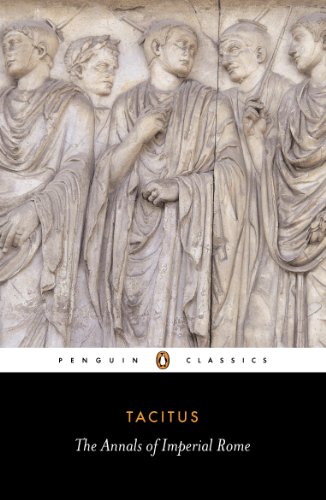
Ebook Info
- Published: 2023
- Number of pages: 412 pages
- Format: PDF
- File Size: 4.69 MB
- Authors: Tacitus
Description
Tacitus’ Annals of Imperial Rome recount the major historical events from the years shortly before the death of Augustus up to the death of Nero in AD 68. With clarity and vivid intensity he describes the reign of terror under the corrupt Tiberius, the great fire of Rome during the time of Nero, and the wars, poisonings, scandals, conspiracies and murders that were part of imperial life. Despite his claim that the Annals were written objectively, Tacitus’ account is sharply critical of the emperors’ excesses and fearful for the future of Imperial Rome, while also filled with a longing for its past glories.
User’s Reviews
Reviews from Amazon users which were colected at the time this book was published on the website:
⭐Good service. Great book.
⭐Tacitus (AD c.55-117), a Roman senator of the 2nd Century AD and famed historian, has written a brilliant year-by-year account of the Roman Empire from 14 AD to 66 AD. The book begins with the last year of Augustus and the assumption of power by the new emperor Tiberius and concludes with the final years of Nero. While certainly not the fault of either Tacitus or the contemporary editor, it is unfortunate that the book is missing vital chapters that have been lost over the centuries. This is particularly galling because the gaps come in vital transitional years. Thus, the loss of the chapters covering 30 and 31 AD leaves us without a description of the fall of Sejanus, commander of the Praetorian Guard under Tiberius. It gets worse, with the nine years of 38-47 AD also missing. This excludes the entire reign of Caligula and the first six years of Claudius’ reign. Finally, the last chapter is missing the years 67-69 AD which cover the fall of Nero and the beginning of civil war. These missing years make the book painful to read because just as a particular section is reaching a climax, the main even is deleted. Thus what remains of the history is mostly the middle years of Tiberius, Claudius and Nero. There is no doubt that Tacitus is a biased historian, despite his claims to impartiality. According to him, Tiberius, Claudius and Nero were all pretty poor emperors, marred by gross personal and moral flaws. This is far too simplistic, particularly given that nowhere does Tacitus espouse pro-Republican or anti-oligarchical opinions. Claudius in particular comes off worse than most readers would expect, after a generally favorable modern image due to Robert Graves’ I Claudius. Tiberius is a highly controversial figure due to his aloof personality, but the portrait of him as a paranoid sex-obsessed maniac is more hostile than objective. Tacitus fails to mention that the last century of the Roman Republic was marred by violence that affected most if not all of Roman society. One man rule had given rulers the ability to eliminate most opposition but it had also centralized violence. The beginning of the Pax Romana – the greatest gift of the principate to World history – is not apparent to Tacitus. The book does have interesting chapters on Germanicus’ retribution campaign in Germany, a cohort that is decimated for cowardice in Africa and the revolt of Queen Boudicca in Britain. When the British are defeated in 60 AD and 80,000 are slaughtered, Tacitus proudly notes that, “the Romans did not spare even the women. Baggage animals too, transfixed with weapons, added to the heaps of dead. It was a glorious victory…” Some of Nero’s part-time hobbies make interesting reading, too. Nero liked to disguise himself and go out with a gang of thugs into the city of Rome at night and harass or assault people at random. After several incidents where he himself was roughed up by his intended victims, Nero began taking gladiators along as bodyguards. There is also a brief mention of Jesus Christ and Pontius Pilate, the only Roman mention of this trial. However the book tends to drag down in places, like the treason trials of Tiberius and the purges of Nero. As far as this translation by Michael Grant, the translator has taken far too many liberties. Readers familiar with the Roman Empire will be annoyed by Grant’s clumsy use of “brigade” instead of “legion”, “battalion” instead of “cohort” and “company commander” instead of “centurion”. Grant drifts further from the true meaning by referring to a legion plus its auxiliaries as a “division” and there are a number of other substitute terms. These substitutions add nothing to reading clarity and it gets confusing when he refers to brigades and divisions simultaneously. On the plus side, the maps at the end of the book and the appendices were quite useful.
⭐arrived with large diagonal crease in front cover
⭐Great translation by Michael Grant. Thoroughly enjoying it. Superior to other translations out there, in my opinion. The Penguin Classics could do their readers a favor, however, and publish their books in a bit larger font.
⭐Tacitus is without doubt one of my favorite historians on any subject matter. this translation is very very good. I Highly recommend it from all angles. if you want to start toread a work of the great ancient historians i would start with this one. there is a lot hee but he delves deep into veryday life and you feel it from a man who is still living it. A patriot who is not affraid to show it but also not woried to point out what went wrong and what should be fixed. Human to the core.
⭐This book is a masterpiece. It begins with a battle in what is now Germany. The description of the rugged Roman Legions is shocking and informative. There were often insurrections for more pay. These were usually put down harshly, a method Tacitus agrees will help keep order. In describing the city of Rome and its upper class citizens, I was amazed at the backbiting, lies, executions, and barbarous behavior shown by almost everyone. It is a bitter book and shows how power corrupts absolutely. I admit to having to read it in small doses for the terrain covered is very bleak.
⭐Ordered for School and it helped
⭐Good resource. Thorough. I like that you can use the index to search for specific people.
⭐5 stars for Tacitus and the seller. 2 for the translation. Refer to a Roman legion as a “brigade” or a “division”, or to a centurion as “company commander” or “junior staff officer” at a lecture, you’ll be a laughing stock. Even as a 16 year old with no formal education in classical antiquity, I know this. An excellent read, but an unpalatable translation.
⭐Over the years, I have become more interested in what these men from long ago had to say and how it compares with modern thought. I wonder sometimes if we have progressed at all. For me, riveting reading.
⭐Excellent book
⭐In-depth. Exactly what I was looking for…
⭐Great classic read.
Keywords
Free Download The Annals of Imperial Rome (Classics) in PDF format
The Annals of Imperial Rome (Classics) PDF Free Download
Download The Annals of Imperial Rome (Classics) 2023 PDF Free
The Annals of Imperial Rome (Classics) 2023 PDF Free Download
Download The Annals of Imperial Rome (Classics) PDF
Free Download Ebook The Annals of Imperial Rome (Classics)