

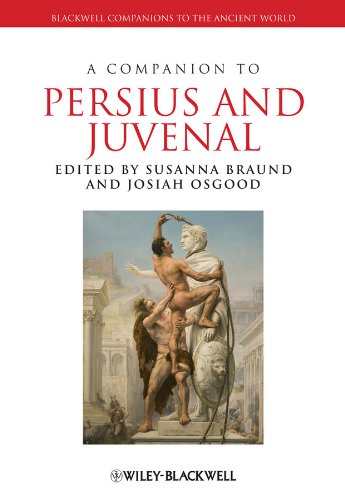
Ebook Info
- Published: 2012
- Number of pages: 632 pages
- Format: PDF
- File Size: 3.17 MB
- Authors: Susanna Braund
Description
A Companion to Persius and Juvenal breaks new ground in its in-depth focus on both authors as “satiric successors”; detailed individual contributions suggest original perspectives on their work, and provide an in-depth exploration of Persius’ and Juvenal’s afterlives. Provides detailed and up-to-date guidance on the texts and contexts of Persius and JuvenalOffers substantial discussion of the reception of both authors, reflecting some of the most innovative work being done in contemporary ClassicsContains a thorough exploration of Persius’ and Juvenal’s afterlives
User’s Reviews
Editorial Reviews: Review “Braund and Osgood’s A Companion to Persius and Juvenalis an excellent book. Specialists, non-specialists, and students alike will find in this volume a comprehensive and spacious approach to these challenging poets.” (Phoenix, 1 May 2014)“The whole book can be recommended, but I will single out a few chapters as especially interesting. . . In general, this is a useful book and a good first port-of-call for those new to the subjects.” (Religious Studies Review, 1 December 2013)“This dense volume makes a stimulating contribution to the study of imperial Latin satire.” (Bryn Mawr Classical Review, 1 October 2013)“Graced with a 40-page bibliography, this 600-page work should become indispensable to classical scholars and anyone interested in satire. Summing Up: Essential. Upper-level undergraduates and above.” (Choice, 1 July 2013) From the Inside Flap Satire, written in the verse of heroic epic but focused on the evils of contemporary society, was ancient Rome’s original contribution to world literature. Two great practitioners of this art, Persius and Juvenal, wrote under the early emperors. Inspired by their Republican predecessors, both radically reinvented the genre. The companion breaks new ground by examining both authors as “satiric successors,” using a model that has been successfully applied to other imperial writers, particularly epic poets. Detailed individual contributions examine topics such as the satirists’ techniques of allusion, their relationship to other genres, and their political stance. A preliminary section orients readers to the lives and times of these authors, the transmission of their texts, ancient scholarship on them, and their sometimes challenging language. The volume includes an examination of the successors to Persius and Juvenal, including the dramatic revival of the tradition in the Renaissance. An outstanding feature of this book is an in-depth exploration of Persius and Juvenal’s afterlives as found in the work of modern poets and translators, in scholarship and school texts, and in the present-day mass media. From the Back Cover Satire, written in the verse of heroic epic but focused on the evils of contemporary society, was ancient Rome’s original contribution to world literature. Two great practitioners of this art, Persius and Juvenal, wrote under the early emperors. Inspired by their Republican predecessors, both radically reinvented the genre. The companion breaks new ground by examining both authors as “satiric successors,” using a model that has been successfully applied to other imperial writers, particularly epic poets. Detailed individual contributions examine topics such as the satirists’ techniques of allusion, their relationship to other genres, and their political stance. A preliminary section orients readers to the lives and times of these authors, the transmission of their texts, ancient scholarship on them, and their sometimes challenging language. The volume includes an examination of the successors to Persius and Juvenal, including the dramatic revival of the tradition in the Renaissance. An outstanding feature of this book is an in-depth exploration of Persius and Juvenal’s afterlives as found in the work of modern poets and translators, in scholarship and school texts, and in the present-day mass media. About the Author Susanna Braund is Professor of Latin Poetry and its Reception at the University of British Columbia. She is the author of Latin Literature (2002), a major edition of Seneca’s De Clementia (2009), and translator of A Lucan Reader. Selections from Civil War (2009). Josiah Osgood is Professor of Classics at Georgetown University. He is author of Caesar’s Legacy: Civil War and the Emergence of the Roman Empire (2006), Claudius Caesar: Image and Power in the Early Roman Empire (2011), and A Suetonius Reader (2011). Read more
Reviews from Amazon users which were colected at the time this book was published on the website:
⭐I suspect Susannah Braund is responsible for a good deal of the quality of this volume, as her own work has been quite fastidious and careful, while the introduction by Josiah Osgood makes a confused argument about poetic succession to try to tie the pieces together.So for every fine piece by EJ Kenney (on diction), Shadi Bartsch (on stoic philosophy and satire), and Paul Roche (on self-representation), there’s a muddled one like Barbara K. Gold’s, which waffles about before spending a few pages just listing and summarizing Juvenal’s portrayals of women without much further comment. Gold does remark that Juvenal objectifies and demeans women. But if you haven’t figured that out just from *reading* Juvenal, nothing is going to convince you–or more likely, you see women the same way Juvenal does.Way too much space is devoted to reception, as per current trends. Since “reception” has to tie the subject matter to non-classical subject matter, it tends to make for vague pieces full of homilies. Dan Hooley’s piece is a case in point, using slippery passive constructions like “was widely seen” and ending with the not-quite-profound “Yet Persius’ satire is in many ways written to the twentieth and twenty-first centuries.” Sure, whatever. Braund’s two co-authored chapters in this section are high points, focusing on Dryden and the scholia.The final chapter, Martin Winkler’s “Persius and Juvenal in the Media Age,” is an embarrassment, forcing parallels with everything from Disney’s Snow White to gangsta rap to Michael Moore (people think him and Juvenal are “one-sided or go too far”!), throwing everything at the wall in hopes something will stick. Then he gives a three-page translation of Harry Schnur’s completion of Juvenal’s Satire 16, before concluding Not Persius, not even Horace, but Juvenal is the “prince of satirists.” And Juvenal’s satiric perspective has become completely ours.” If you say so.Anyway, the good pieces are quite good, certainly of high enough quality to make the remaining pieces appear painfully inadequate. Caveat emptor.
⭐
Keywords
Free Download A Companion to Persius and Juvenal 1st Edition in PDF format
A Companion to Persius and Juvenal 1st Edition PDF Free Download
Download A Companion to Persius and Juvenal 1st Edition 2012 PDF Free
A Companion to Persius and Juvenal 1st Edition 2012 PDF Free Download
Download A Companion to Persius and Juvenal 1st Edition PDF
Free Download Ebook A Companion to Persius and Juvenal 1st Edition