

Ebook Info
- Published: 2012
- Number of pages: 416 pages
- Format: PDF
- File Size: 5.33 MB
- Authors: Peter Zarrow
Description
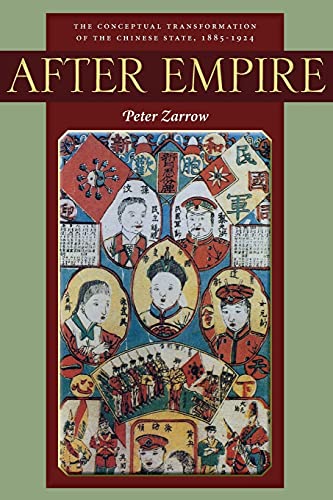
From 1885–1924, China underwent a period of acute political struggle and cultural change, brought on by a radical change in thought: after over 2,000 years of monarchical rule, the Chinese people stopped believing in the emperor. These forty years saw the collapse of Confucian political orthodoxy and the struggle among competing definitions of modern citizenship and the state. What made it possible to suddenly imagine a world without the emperor?After Empire traces the formation of the modern Chinese idea of the state through the radical reform programs of the late Qing (1885–1911), the Revolution of 1911, and the first years of the Republic through the final expulsion of the last emperor of the Qing from the Forbidden City in 1924. It contributes to longstanding debates on modern Chinese nationalism by highlighting the evolving ideas of major political thinkers and the views reflected in the general political culture. Zarrow uses a wide range of sources to show how “statism” became a hegemonic discourse that continues to shape China today. Essential to this process were the notions of citizenship and sovereignty, which were consciously adopted and modified from Western discourses on legal theory and international state practices on the basis of Chinese needs and understandings. This text provides fresh interpretations and keen insights into China’s pivotal transition from dynasty to republic.
User’s Reviews
Editorial Reviews: Review “[F]inely argued and cogently presented . . . Peter Zarrow’s book is a welcome addition to the study of the modern transformation in Chinese history, and without doubt will remain one of the most authoritative researches on the development of Chinese political ideas for many years to come.”―Zhijun Ren, Histoire Sociale/Social History”The result of this detailed historiographic study is a volume written both for the curious student and for expert historians of modern China. While the former will be intrigued by the chronologically compact minutiae of the transition from the Qing empire to the Republic of China, the latter will appreciate the unceasing analysis of historical interpretation, most fruitfully discussed in Zarrow’s endnotes . . . In summary, After Empire is an important contribution to the historical discourse of China’s imperial-republican transition and should also be widely welcomed by non-specialists with an interest in China.”―Lars Peter Laamann, Journal of Northeast Asia History”Zarrow challenges us to think about political developments in China from an indigenous framework or worldview.”―Kendrick Kuo, E-International Relations”In a familiar intellectual-biographical vein, [Zarrow] analyzes the evolving thought of such seminal and influential advocates as Kang Yuwei and Liang Qichao, and, to a lesser extent, Tan Sitong, Zhang Binglin, Yan Fu, and the less well-known Yang Du. Careful re-examination and comparative analysis of their ideas, and the foreign sources on which they drew, yields the best and most carefully nuanced survey currently available of the logical necessities and possibilities governing the debates about national identity and constitutional forms, the roles of culture and ethnicity, and processes and prospects of nation-building. The discourse analysis based on these well-known iconic figures is further reinforced by Zarrow’s fresh readings and wide-ranging citations of the contemporary public media . . . [I]nterdisciplinary historians and the modern China field will be grateful to Zarrow for this major contribution.”―Don C. Price, Journal of Interdisciplinary History”After Empire: The Conceptual Transformation of the Chinese State, 1885-1924 is a welcome and highly recommended core addition to personal, community, and academic library Chinese History collections.”―Midwest Book Review”This is a deeply researched and intellectually ambitious work. Zarrow speaks with the authoritative and convincing voice of one who knows his subject deeply and has thought long and hard about the issues.”―Henrietta Harrison, Harvard University About the Author Peter Zarrow is Research Fellow at the Institute of Modern History, Academia Sinica, in Taiwan. His research focuses on modern Chinese cultural history, with a special interest in intellectual change, scholarship, and historiography. Excerpt. © Reprinted by permission. All rights reserved. AFTER EMPIRETHE CONCEPTUAL TRANSFORMATION OF THE CHINESE STATE, 1885–1924By Peter ZarrowStanford University PressCopyright © 2012 the Board of trustees of the Leland Stanford Junior UniversityAll right reserved. ISBN: 978-0-8047-7869-5 ContentsPreface……………………………………………………………………viiAcknowledgments…………………………………………………………….xiiiIntroduction……………………………………………………………….11 Kang Youwei’s philosophy of power and the 1898 reform movement…………………242 Liang Qichao and the Citizen-State………………………………………….563 “Sovereignty” and the translated State………………………………………894 Voices of receding reaction………………………………………………..1195 Identity, History, and Revolution…………………………………………..1476 Restoration and Revolution…………………………………………………1817 Founding the Republic of China……………………………………………..2128 The Last Emperors…………………………………………………………242Conclusion…………………………………………………………………272List of Characters………………………………………………………….299Notes……………………………………………………………………..307Bibliography……………………………………………………………….353index……………………………………………………………………..377Chapter OneKang Youwei’s Philosophy of Power and the 1898 Reform Movement On September 28, 1898, six men were summarily executed in Beijing. They became known as the “six noble men” (liu junzi) or martyrs, symbols of selfless dedication to reform. They were arrested and held for trial, but their trials were cut short as the court panicked that a supposed plot against the Qing, or at least against the court faction surrounding empress Dowager Cixi, was in the works. At least one of the martyrs, tan Sitong, chose not to flee but deliberately gave up his life to inspire his countrymen. Thus ended the “hundred days of reform” of 1898. Cixi put the Guangxu emperor (r. 1875–1908), her hapless nephew, under house arrest on an island in a lake in the imperial City. Other reform leaders fled into exile. The most important of these were Kang Youwei (1858–1927), the intellectual godfather of the reform movement, and his disciple Liang Qichao (1873–1929). They immediately wrote accounts of the reform movement that became potent political weapons in the battles for the minds of the Chinese that followed. More important for us here are the questions of how the reform movement came to embody ideas that had been fermenting for a decade or more; why it scared Cixi; and where it might have been leading. The “hundred days of reform” in 1898 was the culmination of a movement dedicated to fundamental institutional change since the early 1890s and fueled by the shock to public consciousness of China’s defeat at the hands of Japan in a struggle for influence in Korea. The “hundred days” shook China’s political institutions to the core, but less because of the proposed reforms themselves than the new philosophy that lay behind them. Winning the ear of the Guangxu emperor and his top advisers in the spring of 1898, the reformers, led by Kang Youwei, drafted edicts to establish government bureaus to support agriculture, industry, and commerce; a postal system; a modernized military; a new university; and a more transparent fiscal system. Although proposals to modernize the educational and examination systems raised concerns among men who had spent their lifetimes studying the Confucian classics, concrete reforms remained modest. In late August, the emperor moved to reorganize the central government and abolish certain posts. In terms of the edicts themselves, even here there was nothing to challenge Manchu political supremacy or the position of the court. Yet in a nervous atmosphere—factional plotting, secret policymaking, racial tension between Han Chinese and Manchus, and military defeat and humiliation—antennas were super-sensitive to danger. Guangxu moved to enlarge the right to memorialize the throne. On the one hand, this was hardly a revolutionary step; there was a long tradition of Confucian pieties about keeping open the “road of speech.” But on the other hand, it was a blow to the highest of the emperor’s ministers, to whom alone Qing dynastic law had traditionally given the right to memorialize. If anything, such a change would broaden the emperor’s authority, limiting the ability of his ministers to control his access to knowledge—a very old problem in Chinese statecraft theory. But it also reflected the calls of younger, reformist gentry to be heard, as we will see below. At any rate, in the reforms of 1898 themselves there was nothing about a constitution or establishing local assemblies, much less a national parliament. The reforms represented ideas that many moderates had long supported. However, it is true that Guangxu seemed to be moving in an ever more radical direction by the end of the summer, announcing his intention to carry out future political changes. As well, Kang’s personal support of a constitution and parliament and his attacks on “the institutions of the ancestors” were well known. When Guangxu moved to appoint leading reformers to high ministerial positions, the conservatives moved decisively against him. Cixi’s “coup d’état” assured that her men would remain in the top positions at court, in the provinces, and in the military. The reforms, such as they were, were entirely abrogated. Cixi had stepped back from day-to-day control of administration in favor of Guangxu in 1889, but she had remained the ultimate arbiter of policy and appointment. Now she resumed full power. Even moderate voices for reform were cowed. There is no telling whether Cixi and her advisers really believed an anti-Manchu plot was underway, but they were right to be nervous about the future. The reform movement had been built on an explosive growth of open and openly politicized literati clubs and journals and academies—various study societies—after 1895. These groups, sometimes with only the barest of links to officialdom, challenged the court’s right to limit social forces and determine policy behind closed doors. But Cixi was also shortsighted to oppose reform. After 1898, it was the Manchu court that had to struggle to prove its legitimacy. After 1898, new forms of political engagement and new standards of state-society relations were considered legitimate by China’s townspeople and young literati. The reformers lost their heads, or at least their domiciles, but won the argument. For since 1898, leaders have had to justify their rule in terms of representing the nation. Throughout the twentieth century even the most dictatorial regime has claimed to rule in the name of the people. By 1898, when reformers asked what made the West strong, they focused on a perhaps paradoxical combination of “popular power” (minquan) and wealthy governments. Popular power did not necessarily imply enfranchising ignorant masses, but it was a loose way of talking about democratic ideas and constitutional government as seen in the West and Japan. As Xiong Yuezhi notes, it was crafted to legitimate calls for reconstituting the Qing state. The reform movement engaged in a creative appropriation, based at this point on limited knowledge of the West shaped by largely Confucian moral goals, of the nation-state, of mass citizenship, of constitutionalism and representation, and of commercial development. It is true that for both practical and theoretical reasons, the reformers sought no changes in China’s lineage-based rulership. Practically, they hoped for the support of the court to reshape the bureaucracy and were in no position to challenge its authority. Theoretically, they favored using all the autocratic powers of the emperor along the lines of their interpretations of peter the Great and the Meiji emperor. But “popular power” shifted the terms of discourse by linking the “people” (min) as active political agents to the basis of the state. The very ambiguity of “popular power” proved to be a persuasive factor in reconceptualizing the legitimate state, as sovereignty (zhuquan) shifted from the monarchy to the populace, however defined, in the eyes of radical literati. In other words, the discursive center of the polity moved from the dynastic house to the nation. The 1898 reform movement marked a pivotal moment in the creation of a distinctively Chinese national identity defined in political terms that implied a future of full-fledged political rights and participation of citizens. The question of the emperor’s relation both to the state and particularly to the nation suddenly emerged as urgent and troubling to any reform agenda. The move to radical reform had deep roots. Structural, long-term stresses on the political system provoked a few literati to begin questioning the balance of power between court and locality, or between central government and literati. A sense of crisis had been building up since the end of the eighteenth century, long before military losses to the foreign powers began to chip away at Chinese sovereignty in the 1840s. Some of its problems seemed disastrous but not deep-seated: the elderly Qianlong emperor had allowed court favorites to engage in massive corruption. Some of these crises were broader—the White lotus rebellion, which began in the late 1790s and blazed for eight years in central-northwest China. In no small part fostered by pervasive corruption that weakened the Qing’s armies, the rebellion was nonetheless successfully put down once a new emperor came to the throne and was able to clean house. But only a few scholars of the day realized that the crisis was structural. Above all, a demo graphic explosion beginning in the eighteenth century had left too many farmers struggling to survive on too little land. Also, the size of government had not kept up with the growing population. This made it more difficult to maintain efficient administration and encouraged the growth of local “sub-bureaucracies” outside of the official civil service system. Nor could the regular civil service keep up with the over-production of educated men. many members of the lower gentry engaged in business or managed public projects such as schools or irrigation works. Philip Kuhn has perceptively noted that collectively they were becoming an incipient national elite, and they maintained ties to official circles. The Qing’s proscriptions against factionalism were rapidly falling apart. Such problems were slow to ripen, however, and in spite of the numerous threats of the nineteenth century, the Qing survived. The political structure finally became destabilized during the 1890s for four reasons. First, the rise of Cixi had already created two foci of power, the empress Dowager and the young emperor, neither of which was fully legitimate by itself, as Marianne Bastid has shown. Second, the Sino-Japanese War of 1894–1895 had not merely resulted in a shocking defeat, but an unprecedented indemnity and loss of territory—not merely the loss of offshore islands and claims to suzerainty over bordering states, but lands that had been incorporated into the Qing provincial bureaucracy. The treaty of Shimonoseki granted Japan an indemnity of 200 million taels of silver (ten times the indemnity the Qing had been forced to pay the Western powers in both opium Wars a generation earlier), Taiwan, and the Liaodong Peninsula. Russia, concerned over the threat of a Japanese presence in Manchuria, and backed by Germany and France (the “triple intervention”), forced Japan to relinquish the Liaodong Peninsula, for which the Qing then agreed to pay an additional 30 million taels. This sum being considerably more than the Qing’s annual revenues, Japan offered a convenient financing plan, though at a high rate of interest. By the early 1900s, a quarter to a third of government revenues went to repay foreign debts. The annual payments were enough to cripple such half-hearted Self-strengthening reforms as the Qing wished to pursue. The prospective loss of Liaodong, though averted, led directly to a new phase of foreign demands—the “scramble for concessions”—for direct and indirect control over strategic coastal areas and for rights to build mines and railroads. In other words, not the mere fact of defeat but ongoing crises weakened the Qing government in the late 1890s and opened the road to radical reforms. Third, by 1898 the factions revolving around the emperor and the empress Dowager had expanded beyond mere court politics, and represented a new ideological divide among the gentry. This factional struggle was a precipitating cause of the 1898 reforms, as the emperor’s faction reached out to politically marginal scholars like Kang. And fourth, the very reforms advocated in 1898 marked a contradiction at the very root of the attempt to reconceptualize the state. The emperor was, on the one hand, to be all-powerful and all-wise, pushing reforms to completion against obscurantist opposition; on the other hand, he was to be literally self-effacing, creating new power structures that would replace the court with literati-government and ultimately acknowledge that sovereignty lay in the people. The logical consequence of this intellectual tension was that if the emperor proved incapable of implementing reforms, then he was expendable. The failure of the 1898 reform movement led to the rise of a revolutionary movement. Although Kang Youwei never wavered in his belief in constitutional monarchy, others became less certain that a constitutional system needed a monarch at all. SAGE KANG Kang was a native of the province of Guangdong, a precocious student, and a man who assigned himself the mission of saving China. Guangdong, though long prosperous thanks to its key position in the Qing’s international trade and its tropical farmlands, was peripheral to Qing culture and scholarship until the nineteenth century. Perhaps this was a good basis for producing political radicals. Kang was perhaps the most influential politico-philosophical writer of the 1890s in China, and he was one of the key figures in the project of creating modern Chinese thought. Kang was born to a locally prominent family that had produced several successful examination candidates. He was heir to a somewhat eclectic style of Neo-Confucian thinking associated with Guangdong scholars. Given Kang’s precociousness, his beloved grandfather, and after his grandfather’s death the family collectively, expected him to study for the examinations. the Chinese civil service examination system, it is important to remember, was not a single test but a long series of local, provincial, and capital examinations that took most men half a lifetime to conquer, if they ever conquered it. Kang achieved initial examination success early, which gave him the official status of scholar, or low-ranking gentry, but the provincial juren degree eluded him until 1893. He then won the capital jinshi degree in 1895, ironically just as he was protesting the Qing court’s agreement to sign the humiliating treaty of Shimonoseki. Kang’s teacher Zhu Ciqi (1807–1881) emphasized both individual moral rectitude and engagement with the world. Kang appreciated Zhu’s emphasis on true—moral—learning, rather than crude preparation for the civil services exams. Zhu Ciqi took a deliberately eclectic approach to the major schools of scholarship. The dominant new school of the eighteenth century had been Han learning, an attempt based on philological methods to strip away the accretions of later exegesis and determine exactly what the classics had really meant. Han learning scholars tended to despise the Song neo-Confucians for their textual misreadings and also for excessive moralizing. They relied heavily on Han dynasty exegesis, which was after all closer in time to when the classics were written. Han learning was thus opposed to Song learning. But philology was dangerous. The research of Han learning scholars produced two unexpected results. First, it revealed that many passages in the classics were forged—that is, were clearly interpolations that had been written as late as the Han dynasty. This was not entirely a new suspicion, and it did not amount to a challenge of the fundamental veracity of the classics as such. The second unexpected result, however, was to have momentous consequences in the hand of Kang Youwei. That was the rediscovery of a long-forgotten school of Confucian thought, the new Text Learning, which had originally flourished in the hands of such Han dynasty scholars as Dong Zhongshu (179–104 BC). I will discuss the basic tendencies of new text learning below; here, it is simply important to note that many of the political reformers of the mid-1800s and even earlier were adherents of the school. It seemed to justify activism. (Continues…) Excerpted from AFTER EMPIREby Peter Zarrow Copyright © 2012 by the Board of trustees of the Leland Stanford Junior University . Excerpted by permission of Stanford University Press. All rights reserved. No part of this excerpt may be reproduced or reprinted without permission in writing from the publisher.Excerpts are provided by Dial-A-Book Inc. solely for the personal use of visitors to this web site. Read more
Reviews from Amazon users which were colected at the time this book was published on the website:
⭐Very good book on the Chinese intellectuals in late Qing and early Republic. Zarrow gives precise description and critique on various advocates of nationalism like Liang Qichao, Wang Jingwei and Zhang Zhidong.
⭐Ambitious in scope, Peter Zarrow’s After Empire: The Conceptual Transformation of the Chinese State, 1885-1924 is a descriptive and analytical history of the intellectual currents that swept away China’s edifice of kingship and erected a new polity. The new polity was oftentimes confused and ambiguous, but clearly the spell of emperorship was broken.This conceptual transformation began while a conservative Confucian understanding of monarchy still had a strong grip on the imagination of the masses. The Qing dynasty held the Mandate of Heaven; the Qing ruler remained integral to the cosmic order; and the social hierarchy depended on the monarchic principle, which anchored society in place. In the spiritual realm, this monarchism assumed religious trappings in rituals and symbols, sacralizing the emperor in his person. Into this comprehensive imperial system, Zarrow injects the question: how did this conception of the political and social order transform into the republicanism of the early twentieth century?HOW INFLUENTIAL WAS WESTERN POLITICAL THOUGHT?Popular accounts of China’s history point to the humiliating defeat of the Qing in the Opium Wars (1839-1842,1856-1860) that sparked the paroxysm of violence in the Taiping Rebellion (1850-1864) and the Self-strengthening Movement. The clash of West and East, in this narrative, laid bare the intellectual bankruptcy of the late Qing, which set the elites scrambling to adapt to Western norms in order to modernize. Zarrow proffers a more nuanced account. While this West-East confrontation indeed forced late Qing elites to examine their governing system, this examination also had indigenous motivations. Military defeat was complemented by deeper, structural issues: there was not enough land distributed for farmers to survive and the population explosion overwhelmed administrative resources. But more importantly for Zarrow’s work, late Qing intellectuals looked to their own heritage, working within a non-Western framework, to reformulate China’s polity. Western political theory acted as a subversive element, but the building blocks remained Confucian, at least initially.Zarrow demonstrates this indigenously-driven transformation of China’s governing order by surveying key intellectuals within their historical milieu and the resistance they faced. By the end of his survey, readers are acquainted with the constitutionalists (or “radical reformers,” “constitutional monarchists”), late Qing conservatives, and revolutionaries. Yet Zarrow’s significant contribution is teasing out the intra-divisions among these three broad categories and hence providing a messier, but more accurate, vision of China’s political climate at the turn of the century.FROM “ROAD OF SPEECH” TO “POPULAR POWER”In the 1870s to 1880s, low-ranking officials and non-official gentry walked the “road of speech,” which appealed to the emperor for a stronger anti-Western posture. In 1885, the Empress Dowager Cixi closed this road after concluding the Sino-Franco War, only to be reopened by the Guangxu emperor and closed yet again in 1898 when Cixi wrested power. Zarrow argues that by the closure in 1898 and the expelling of several key reform-minded intellectuals, there was a shift to “popular power” (minquan). In fact, Zarrow writes “this entire book is about the transition from the road of speech to popular power,” (p. 19) which took another decade to culminate in the 1911 Revolution.ConstitutionalistsBefore the 1898 expulsion, constitutionalists were already making intellectual headway. Among the constitutionalists, Zarrow focuses primarily on Kang Youwei and Liang Qichao, and to a lesser degree Yan Fu, Zhang Binglin, and others. Kang Youwei applied New Text Confucianism in creative ways, removing the sacred mantle from the emperor and placing it on Confucius and the ancient sage-king. In so doing, the emperor’s legitimacy stemmed from following this revisionist version of a democratic Confucius. Kang supported the monarchy, but a constitutional one; and even more, a monarchy that sought reforms that would eventually reduce the emperor to a powerful uniting symbol, but a symbol nonetheless.Liang Qichao, Kang’s protege, was more radical and went through several phases. The first break with Kang was his rejection of New Text epistemology, on which Kang’s whole enterprise rested. Without the sage-king Confucius, Kang lost his principle of legitimacy. Liang rejected Confucianism as a stricture on intellectual freedom, the very thing that progress required. Yet later he shifted from a more pluralist understanding of society to advocating a centralized, disciplinary state. This birthed a “statist” doctrine whereby the nation served to uphold the state. In the end, Liang settled on a doctrine of the “organic state” where the social contract tied the state and the people together in an egalitarian mold.After 1898, both Kang and Liang Qichao spent time in Japan, along with other exiled thinkers, where they studied the Meiji restoration. Since study of Western political thought in Japan was already well underway when they arrived, Japanese language acted as a medium for Western political concepts to enter Chinese vocabulary. These late Qing intellectuals did not swallow whole the ideas of democracy and equality. No, many thought these “Western” ideas in fact originated in the East with philosophers such as Mozi (egalitarianism, free love), but were later discredited by Mencius. Hence it was natural that Kang, Liang, and other constitutionalists would face resistance, even from those who agreed that reform was needed.Resistance to Constitutional ReformOne such reformer that Zarrow treats in detail is Zhang Zhidong. Known for a moderate traditionalism, Zhang was reform-minded, but feared that democracy would overthrow the dynasty. The imperial state upheld the social order and together, the imperial state and society, were rooted in the cosmic order. Late Qing conservatives did not see the state as the highest good, but rather the “unity of governance and the Teaching” (zhengjiao heyi) created order while dynasties and states rose and fell.More stringent reactionaries could be found in Hunan. For them, hierarchy created a social order in which all entities stood interconnected. The empire and the family ran parallel to each other. To lose one was to lose the other. To lose the patriarchal emperor was equivalent to losing the father, and hence to lose the imperial order was to lose the family as well. While moderate reform was necessary, these should be focused on technology and infrastructure.RevolutionariesThis incremental transformation flowered with the revolutionaries. Though the revolutionaries differed widely on a whole host of issues, Zarrow pinpoints three unifying ideas: history is progressive and linear, China’s minzu identity is based on race and culture, and a good society recognizes equality (pingdeng), popular power (minquan) and human rights. While the first and third ideas are common to the constitutionalists (e.g., Kang, Liang), the second is in sharp contrast. (Note that many revolutionaries believed in constitutionalism, but without monarchy, as Kang advocated). Revolutionaries were anti-Manchu, while constituional reformers did not see Manchus as the main problem. In other words, for the revolutionaries, the nation was prior to the state. They wanted China to be a nation-state, based on minzu, as opposed to a civic-state based on citizens (guomin).Revolutionaries found democracy and egalitarianism rooted in ancient Han culture and the sage-kings, while despotism was slavery imposed by the invading Manchus over the Han people. Depostism was the public realm made private property by the ruler. Again, constitutionalists agreed with the revolutionaries about the public realm being the property of the people rather than that of a dynasty or empire, but disagreed with the racial coloring. Anti-Manchuism as wielded by the revolutionaries was not a scapegoat to blame for the relative decline of China, but part of a grander narrative of reimagining the essence of the state.New Culture MovementYet another strain of political thought was the New Culture Movement, personified by Chen Duxiu. In trying to pair individual morality with a republican polity, Chen asked the haunting question, “What’s wrong with the Chinese?” His answer was Confucianism, which legitimated despotism and taught the people to desire slavery. Chen’s solution was moral education, not a political agenda. Moral politics was founded on a moral people.THE DEATH OF COSMOLOGICAL EMPIREWith this great shift in political imagination, it is no wonder that both Yuan Shikai’s self-proclaimed emperorship and the coup to enthrone Puyi failed. These events marked the dying gasps of the old order, rather than evidence of its salience. This new political imagination, though divided among several conflicting groups, used the language of a public interest implying popular participation. Late Qing and early Republic elites also shunted political theology as superstition and rather civil religion of teleology/progressive nature of constitutionalism.The primacy of the states, “statism,” remains in the political ideology of China today. Sun Yatsen viewed ethnic nationalism as equivalent to the state-nation because for Sun the Chinese people were already a nation, having been a single state since the Qin and Han dynasties. Subsequent dynasties were merely regime changes. But for Mao Zedong, who had a more theoretical understanding of the state, viewed the People’s Republic of China “not as a multi-ethnic nation but a multinational state. And not as a nation-state but as a socialist state, ultimately a more advanced stage in the progress of world revolution” (p. 288). Statism synthesized Mao’s dictatorship against class enemies and democracy for the masses.In this 296-page monograph, the depth of Zarrow’s research is on full display. By examining different intellectual heavyweights in turn, he explains in detail the cogs comprising each political thinker’s theory of the state. This is particularly the case in Zarrow’s treatment of Liang Qichao, whose political ideas take several sharp turns during his life and travels. But this deep dive is not without its effects on the book as a whole. After Empire oftentimes reads more like a textbook on Chinese political philosophy rather than an intellectual history. The larger narrative often disappears in the details and Zarrow’s concern for parsing out every philosophical nuance.After Empire should also be considered an interdisciplinary work. Zarrow addresses the more material aspects of this transformation by examining imperial religio-cosmological rituals, holidays like Double Ten, symbols such as the flag, and even the national anthem. This anthropological twist enriches the scholarship and shows transformations beyond this political philosophizing had real repercussion on the ground. The evidential value of these observations, however, remains inconclusive. Did the policy and philosophical debates among late Qing and early Republic elites actually filter down to the people? If so, by what mechanism? This causal relationship is implied, but left unaddressed.After Empire follows the same vein as Wang Hui’s seminal The Rise of Modern Chinese Thought. The intellectual history of Europe has been thoroughly mined and imbibed. Perhaps it is time for the rich legacy of Chinese political thought to join the mainstream and enter common discourse. After Empire, though far from a definitive work, is another monograph to add to the growing scholarship in this field which has been largely neglected among Western academics studying comparative politics and political thought. Zarrow challenges us to think about political developments in China from an indigenous framework or worldview.This review was originally published on e-IR [,..] and subsequently at The Asian Crescent […].
Keywords
Free Download After Empire: The Conceptual Transformation of the Chinese State, 1885-1924 1st Edition in PDF format
After Empire: The Conceptual Transformation of the Chinese State, 1885-1924 1st Edition PDF Free Download
Download After Empire: The Conceptual Transformation of the Chinese State, 1885-1924 1st Edition 2012 PDF Free
After Empire: The Conceptual Transformation of the Chinese State, 1885-1924 1st Edition 2012 PDF Free Download
Download After Empire: The Conceptual Transformation of the Chinese State, 1885-1924 1st Edition PDF
Free Download Ebook After Empire: The Conceptual Transformation of the Chinese State, 1885-1924 1st Edition