

Ebook Info
- Published: 2020
- Number of pages: 656 pages
- Format: PDF
- File Size: 7.11 MB
- Authors: Tim Mackintosh-Smith
Description
A SUNDAY TIMES AND TLS BOOK OF THE YEAR “Masterly and brilliant”—Simon Sebag Montefiore “A book of vast scope and stunning insight.”—Anthony Sattin, Spectator “Commanding erudition and a swashbuckling style define this history of the Arabs”—Justin Marozzi, Sunday Times This kaleidoscopic book covers almost 3,000 years of Arab history and shines a light on the footloose Arab peoples and tribes who conquered lands and disseminated their language and culture over vast distances. Tracing this process to the origins of the Arabic language, rather than the advent of Islam, Tim Mackintosh-Smith begins his narrative more than a thousand years before Muhammad and focuses on how Arabic, both spoken and written, has functioned as a vital source of shared cultural identity over the millennia. Mackintosh-Smith reveals how linguistic developments—from pre-Islamic poetry to the growth of script, Muhammad’s use of writing, and the later problems of printing Arabic—have helped and hindered the progress of Arab history, and investigates how, even in today’s politically fractured post–Arab Spring environment, Arabic itself is still a source of unity and disunity.
User’s Reviews
Editorial Reviews: Review “Although Mackintosh-Smith’s book is perfectly scholarly, it is not a dutiful plod through a succession of slaughtered sultans and viziers or a tallying of gains and losses in forgotten battles in unpronounceable places. On the contrary, Arabs keeps throwing out brilliant insights, like sparks from a Catherine wheel.”—Robert Irwin, Literary Review“A fascinating and richly detailed chronicle of Arab language and culture offers some thought-provoking historical parallels”—Ian Black, The Observer“Commanding erudition and a swashbuckling style define this history of the Arabs”—Justin Marozzi, The Sunday Times”Sweeping book [. . .] It addresses vital questions of Arab identity and nationhood. There can hardly be a better guide than Mackintosh-Smith, who has near- mythical status among western observers of the Middle East”—Richard Spencer, The Times Ireland”[Mackintosh-Smith] is ideally positioned to make the tangled past vividly present. . . . [He] handles his complex account with great aplomb.”—Eric Ormsby, Wall Street Journal“A long time in the making, Tim Mackintosh-Smith’s erudite study, Arabs: A 3,000-Year History of Peoples, Tribes and Empires was worth the wait”—Justin Marozzi, Evening Standard (Best summer holiday reads)“[An] extraordinary new survey” —Shiraz Maher, New Statesman“A marvelous journey brimming with adventure and poetry and narrated by a keen, compassionate observer.”—Kirkus Reviews (starred review)”This new history of the Arabs is not the usual fact and date textbook tale but unfolds as a thoughtful and philosophical historical essay that analyzes the evolution of Arabic-speaking peoples, the Arabs and the Arabized, and the powerful role of their language in unity and diversity. . . . Highly recommended.”—Choice“A significant and rewarding book.”—B. Harris Jr., Choice”This brilliant and fascinating history book will change the way we analyze the happenings in the Arab world.”—Washington Book Review“Superb. What really distinguishes this book from others is the sheer number of its insights into Arab history, all of which are tantalizing. There is also a poignancy to the telling of the complex story of the Arabs because of the circumstances Mackintosh-Smith finds himself in while writing, in virtual lock-down in Sana’a during the ongoing civil war and invasion of Yemen by Saudi Arabia and the UAE.”—Steven C. Caton, Professor of Contemporary Arab Studies at Harvard University“This controversial new work by Mackintosh-Smith strips away centuries of erroneous myth-making and returns the turbulent history of the Arab peoples to the secure bedrock of their language. Anyone hoping to understand, let alone write about the Middle East, will need to read and inhale this profound, witty and scholarly achievement.”—Barnaby Rogerson, author of The Last Crusaders“Arabs is a refined and pleasing tour through the history of a remarkable people, civilization and language. It’s in touch with the poetry of the desert a millennium and a half ago and the trauma of war in the mountains today”—Jonathan A.C. Brown, Alwaleed bin Talal Chair of Islamic Civilization at Georgetown University”Masterly and brilliant. Arabs is a beautifully written narrative and acute analysis, both fresh and original, filled with fascinating characters and ideas, with as much depth before Islam as after and a true feeling not just for the Arab experience in history and faith but also for its language and culture. This book could only be written by a writer with a knowledge of the geography of the Arab soul as well as the Arab land.”—Simon Sebag Montefiore, author of Jerusalem”Quite brilliant. Arabs is well written with personal touches of someone who has experienced the last thirty years of Arab history at the very centre of things. I am full of admiration for this inspiring book, with its quite original and timely view of Arab historical identity, and cannot wait to see it on the shelves.”—Philip Kennedy, author of Recognition in the Arabic Narrative Tradition About the Author Tim Mackintosh-Smith is an eminent Arabist, translator, and traveler whose previous publications include Travels with a Tangerine and Yemen. He has lived in the Arab world for thirty-five years and is a senior fellow of the Library of Arabic Literature.
Reviews from Amazon users which were colected at the time this book was published on the website:
⭐The book is insanely good, I couldn’t stop reading it until I got to the last page. With that said as with most best books it’s not perfect. It’s not a historical book in its strict sense. You will not get a perfect timeline of the events associated with the arab tribes, although you will find a plethora of historical facts inside. While the book structure does follow the historical time flow on the large scale, still almost every chapter might jump from the currently described events to the deep past and from the to the distant future and back. The author created a narrative that could be best described as a love letter to the arab culture expressed by an erudite in the arab-lore.So if you are interested in chronology per se, this should not be the first book you buy.Another thing that attracted and annoyed me at the same time was the author’s effort to understand what were the roots of widespread tyranny and corruption in contemporary arab societies. Mr. Macintosh-Smith did it through the dualism of tribal/settled forms of life in the arab culture that he thinks went though all its history. But when he states that the for many arab countries corruption is not the failure of the system, but IS the system I feel like his enchantment played a trick to him since the same can be said about many other parts of all the world, if not most of it. What in author’s description is specifically arabic and what could be described as the current state of affairs on the international, global scale?So the book allegedly on the arab history is as much about arab politics and sociology, and because the author is not as well trained in those as in his direct subject, his ideas might appear highly disputable. But it also means that the book is not as detached and descriptive as one might expect from historical study, but displays author’s high level of involvement and participating. And that’s exactly why this book is so magical – it’s not only and not primarily about historical facts, it’s about the arab culture(s) and its/they prospects now. Through his book Mr. Mackintosh-Smith managed not only to transmit the historical timeline of arabs, but also express the inner beauty of their cultures (and primarily arabic language!) and reassert the progressive elements that are buried in them under the debris of permanent fighting among themselves. This is the book of hope, not matter how little of it left.To sum up, if you are looking for mere workbook on arab history you should start with some other texts. If you are interested in everything arabic, you will definitely like this book. I highly recommend it!
⭐I certainly empathize with some of the negative comments here — confusing narrative structure, not a “history”, and the like. I came to this book knowing absolutely nothing about Arabs, Arabia, Islam, and the Muslim world. I do know a fair bit more about the histories of the empires — Rome, Persia, Byzantine — that have impinged on them, however. Which gave me a place to stand as the author elaborates the essentially linguistic basis of Arabian culture and its emergence in opposition to those other centers of gravity. The author writes beautifully and knowledgeably: he knows where he lives and he lives what he knows. So to those critics who prefer other authors on the topic, all I can say is read him with THAT particular knowledge guiding your understanding. This book, like the author’s conception of Arabic, is the product of a profound cultural cross-fertilization.
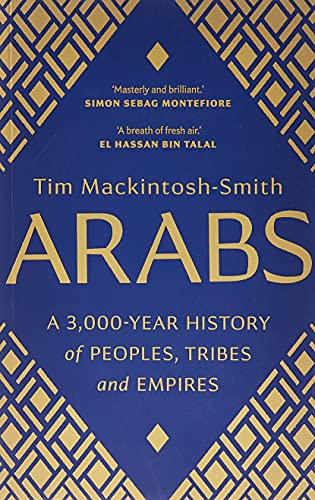
⭐Genuinely the best book I have read in 2020 and for the past several years. Tim’s writing style is stunningly poetic yet balanced with wit and humor. Style and substance meet across the pages as Tim takes you on a journey across time and geography using a very unique thread throughout it all (won’t spoil for readers). I had very little exposure to Arab culture and history prior to this but Tim explains it through a birds-eye view as well as on-ground testament and primary resources. Overall, my words can’t do this book justice. Though the stunning cover does (judge the book by its cover, it is simply gorgeous.)
⭐One of the very few books that I found so excellent and informative that I had to purchase in hard copy in addition to the Kindle copy I started reading. I worked with linguistics while in the military and found the author’s approach, knowledge and treatment of Arab history–through a linguistic prism–captivating and superb. If I had this book back when I was Active Duty, I might well have been inspired to pursue a follow-on career working with mid-eastern languages. By the way, the book stands on its own legs as a fascinating historical read (even without the wealth of language/linguistic information). So good.
⭐Incredibly researched honest look at Arab history that gives Arabic civilization its due without PC efforts to exaggerate the nobility of people who were flawed like us all. Arab nationalists, Islamic extremists and western xenophobes would probably object to some of the content. For example, Islamists won’t want to hear about the corruption and political scheming of Arab conquerors in the early centuries of Islam and the pre-Islamic roots of much of Arabic culture. As the book points out, Arab school children are taught that spreading religion was the main goal of conquests that really began as “super raids” in search of booty, in several senses of the word. The book emphasizes how the Arabic language created Arab identity through the centuries and how its calcification by grammarians in the Middle Ages accounts for much of what ails that culture even today, from religious extremism to a fear of modernity.
⭐As a person who has always focused on European history, I approached this book with only sketch knowledge of the subject. I was aware that there was a time during which the Arabs had advanced far beyond the Europeans, only to falter and to stagnate for the next millennium. The author of this book goes by the unlikely name of Tim Mackintosh Smith but apparently has lived in Yemen long enough to be have a very strong command of his subject. After theArab renaissance and enlightenment, Arab disunity set in and according to Tim the main force holding the various people who identify themselves Arabs was the Arabic language which very few of them speak or write fluently. Islam was of course also a factor, but the the author sees it as secondary to their linguistic culture.
⭐Tim Macintosh Smith explains the paradox that is Arab nationalism, identity and Islam. Arab unity was a short lived thing, for a people who are born individualists. Arab historians have always pointed out settled communities will be subject to the predatory actions of nomads. The Prophet Mohammed was the first and only one to unify the Arab Nation. He was the first one to commit the language to a written form in the Koran. But as Tin Macintosh Smith says Classical Arabic has never been the Lingua Franca of any Arab State. Pointing out even a small country, Bahrain has two incompatible Arabic dialects. The unifying benefits of classical Arabic have never been fully realised. Islam and the Prophet Mohammed reconciled the laws governing religious and civil duties. A respect for both religious and civil duties are fundamental to Islamic beliefs. Unfortunately we are human and cannot live up to the duties imposed on us by our religious beliefs. Shame on us!A couple of points after more time to reflect! The information on the Pre-Islamic Arab people is difficult to find and even more difficult to verify. The Author states the history was passed down verbally. With only passing references made about them, by other civilisations. He then claims the Koran was the first book written in the Arabic language. How would this be possible with no written script development, over a considerable period of time?
⭐I have lived and worked in Arab countries and travelled in many others, so I was very excited about an overview of Arabs over 3,000 years. The author comments that he starts in the middle of the story, but more significantly for me is the poor structure of the book.His knowledge is beyond doubt but i did not feel that this was communicated at all well. The rambling, shapeless sentences and digressions within a lack of context merely confused. In my opinion it is very badly written.By contrast I have just read two brilliant books by the historian David Olosoga which are models of clarity, balance , subtlety and elegance. I am sad and frustrated at being unable to get through this book, Arabs, and have now given up, even though I find the subject fascinating . I wish I had never bought it but maybe the Oxfam bookshop will be able to profit .
⭐Tim Mackintosh-Smith has managed the impossible: to write a comprehensive, balanced and unbiased history while wearing his heart on his sleeve. The book also benefits from being lucid, easy to read and scattered with flashes of often mordant wit. In all of its over 500 pages I did not find a single misprint or infelicity of language (something which my previous experience of Yale University Press leads me to attribute to the author’s care and abilities, rather than any expertise on the part of the publisher). I cannot recommend this book too highly. It is difficult to imagine it’s being supplanted in the foreseeable future as THE book to read on the Arabs.
⭐For Tim Mackintosh-Smith, history isn’t something that is dry nor dusty: it’s happening right outside the window of his house in Yemen. He approaches his subject not just with interest or passion, but with love: it makes his work not just learned but personal. I learned a great deal from it: highly recommended.
⭐Tim’s passion and knowledge for the history of the Arab world shines through with every page in this book not only does he explore the histories of the peoples but he also explores the history of the Arabic language which goes hand in hand with its peoples. furthermore as an Arab his modern history observations are on point and quite relatable.I highly recommend this book to all who have any interest in Arab history from the long forgotten past all the way to the present.
Keywords
Free Download Arabs: A 3,000-Year History of Peoples, Tribes and Empires in PDF format
Arabs: A 3,000-Year History of Peoples, Tribes and Empires PDF Free Download
Download Arabs: A 3,000-Year History of Peoples, Tribes and Empires 2020 PDF Free
Arabs: A 3,000-Year History of Peoples, Tribes and Empires 2020 PDF Free Download
Download Arabs: A 3,000-Year History of Peoples, Tribes and Empires PDF
Free Download Ebook Arabs: A 3,000-Year History of Peoples, Tribes and Empires