Ebook Info
- Published: 2011
- Number of pages: 417 pages
- Format: PDF
- File Size: 11.79 MB
- Authors: Thomas T. Allsen
Description
From antiquity to the nineteenth century, the royal hunt was a vital component of the political cultures of the Middle East, India, Central Asia, and China. Besides marking elite status, royal hunts functioned as inspection tours and imperial progresses, a means of asserting kingly authority over the countryside. The hunt was, in fact, the “court out-of-doors,” an open-air theater for displays of majesty, the entertainment of guests, and the bestowal of favor on subjects.In the conduct of interstate relations, great hunts were used to train armies, show the flag, and send diplomatic signals. Wars sometimes began as hunts and ended as celebratory chases. Often understood as a kind of covert military training, the royal hunt was subject to the same strict discipline as that applied in war and was also a source of innovation in military organization and tactics.Just as human subjects were to recognize royal power, so was the natural kingdom brought within the power structure by means of the royal hunt. Hunting parks were centers of botanical exchange, military depots, early conservation reserves, and important links in local ecologies. The mastery of the king over nature served an important purpose in official renderings: as a manifestation of his possession of heavenly good fortune he could tame the natural world and keep his kingdom safe from marauding threats, human or animal. The exchanges of hunting partners—cheetahs, elephants, and even birds—became diplomatic tools as well as serving to create an elite hunting culture that transcended political allegiances and ecological frontiers.This sweeping comparative work ranges from ancient Egypt to India under the Raj. With a magisterial command of contemporary sources, literature, material culture, and archaeology, Thomas T. Allsen chronicles the vast range of traditions surrounding this fabled royal occupation.
User’s Reviews
Reviews from Amazon users which were colected at the time this book was published on the website:
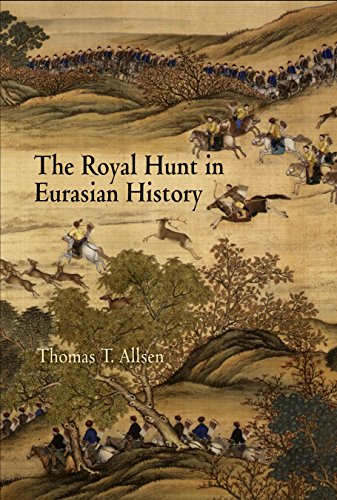
⭐When I first bought this book, I had two things in mind. One was to learn about the concept of the Royal Hunt, which I had been aware of from readings in history and archery literature. The other was to see what Allsen would make of it. I have two other books by this author and I was impressed but the depth of the analysis and the breadth of the sources he presented.Perhaps I should warn other readers, I am not shy when it comes to footnotes nor am I put off by diacritical marks and other linguistic indicators. On the other hand, it is quite possible to read this book without reference to the notes and come out of the experience with a clear picture of the subject and with considerable knowledge of the various cultures.It is easy to assume that a book with this title would be about hunting or about royal pursuits with all the baggage that either subject could be expected to have attached. Instead it is about the royal hunt as an institution, what it meant in the many societies in which it existed, and how its international character reveals the transfer of ideas, goods and animals. Of course in exploring the nature of the hunt, there are many details interesting to the hunter and also in the behaviour of royalty, but the nature of the royal hunt is of more interest to the author. He is careful to show how the hunt was viewed by participants and contemporaries. He discusses the antiquity of some of the ideas that underlay the institution. He looks at the interaction between the various cultures which practised the royal hunt. He discusses the internal relevance of the hunt; what it means to the ruler and what effects it has on the local population. Interestingly, he discusses the international trade in hunting animals: falcons, hounds and cheetahs.There are thirteen chapters including the Conclusions. They represent a careful breakdown of the features of the hunt. Some sub-headings such “Who Hunted?”, “Hunting Parks at the Core and the Periphery”, “Animal Partners” give a taste of the detail and chapter headings like “Administration”, “Conservation” and “Legitimation” give some idea of the greater themes in the book. The sources of the book include eye-witness accounts, literary exemplars and historical annals among many others.The book is a solid 402 pages with 21 black and white figures and a colour dust jacket depicting the Qing Emperor, Qianlong, hunting. Fifty pages of notes are accompanied by roughly sixty-six pages of sources with a bibliography of modern works.The royal hunt, as presented by Allsen, is a great state occasion with many obvious meanings and quite as many obscure ones. The massive ring hunts of Asia are described from eye witness accounts, both local and by foreigners. The staged nature of the royal participation is shown and the importance of royal success is explained. Despite the high level of organisation necessary, it is equally clear that these hunts were dangerous and their military ramifications are not lost on the author nor were they hidden from contemporary observers. In the far west of Eurasia, the Europeans did not necessarily have all of the features of the royal hunt in the core area, but they were aware of many of peculiarities to the distant hunts in Asia and particularly in the Middle East.At a less elevated level, there is discussion of the movement of specialists and specialist knowledge between cultures. Frederick II, the Hohenstaufen Holy Roman Emperor, wrote a book on hawking that showed how much the influence of Arab hunting traditions were known in Europe. Even hunting animals were traded all over the world. The popularity of cheetahs lasted for many centuries and extended across the whole breadth of the Eurasian land mass. It may have been one of the contributors to their current low population density. Since they did not breed in captivity, they were captured from the wild and trained. The now valuable “hunting leopards” were then traded all over the world and often came complete with handlers. The turnover in animals must have been high. Travel was dangerous, hunting was equally risky and they did not have that long a lifespan to start with. Everything from elephants to gyrfalcons was traded and needless to say, such exotic animals were signs of prestige.The royal hunt iss shown to combine advertising royal competence, providing a service in controlling wild animal numbers, putting together relaxation and military training, and also allowing the movement of large numbers of soldiers without actually declaring war.This is only a snapshot of a very complex book. It is rich in ideas and also in detail. Its bibliography puts a large number of interesting books and articles together in an accessible package. Once you have read this book, you will want to read more on the subject. By putting the royal hunt into context, this book illuminates many ideas that have been lost in our current technological society. It is sometimes hard to consider that many of our ancestors saw the wild as a threat and hunting as a defence. It is more understandable that it was a source of food and relaxation for the participants. Bringing the royal presence into remote areas may have some resonance with the behaviour of modern politicians touring small towns and regional areas.”The Royal Hunt in Eurasian History” was a strenuous read, but it left me feeling that I understood a bit more of the past and that I had exercised my brain in the same way as the hunters had tested their bodies.
⭐The topic might seem frivolous, but Tom Allsen’s incredibly detailed and insightful study shows that royal hunts were critically important in politics, international trade, military training and development, and, yes, food supply. Hunting parks, on the other hand, often took land away from cultivation, causing hardship. The book is informed by a very deep knowledge of the science involved–the biology of hunting falcons, the breeds of dog, the habits of hunting cheetahs, and everything else one could want. I missed this book when it came out (Sorry Tom-I was retiring and moving in 2006) and I wish I’d gotten around to it sooner.Two thoughts occur on reading it. First, the hunt had a lot more to do with the development of modern science than I realized. Frederick II’s treatise on falconry is so far ahead of its time that it is still used by falconers as a serious text–otherwise unheard-of for a 13th century book. Frederick had every single element of modern science down pat: need for verification and falsification, need for direct experiments (even with controls–loose to be sure), the need to systematize facts and get names right, need to count everything countable, and so on. He was exceptional, but other treatises on hawks and hounds, and hunting in general, were also infinitely more scientific than the formal “science” of the time.The other thought is that we clearly don’t know much about conservation in those days. The hunts described would have wiped out everything down to the rabbits if there had not been a lot of careful game management. Perhaps fertile India and rich, remote South China would have had a few animals left, but the deserts of Mongolia, Central Asia, and the Near East would have been completely cleared. (After all, even subsistence hunting by Native Americans thinned out the game in pre-Columbian North America–in spite of a strong conservation ethic and nothing remotely close to these royal hunts.) Allsen gives full details on what we know, but we actually don’t know much about this. The contemporary powerful conservation ethic in Mongolia and nearby regions suggests what must have once been fairly general. I wish we knew more.
⭐While there were a few details I found useful, I primarily bought this book out of interest in the massive Mongolian hunts and was a little disappointed in the rather scant coverage. I felt this could have used more attention given the significance in Mongol military training. This is really a one of a kind book so I don’t want to complain too much. To give an idea of the depth of research, the bibliography is 40 pages long, and filled with many great primary source references.If you have an interest in this subject, the book is filled with a treasure trove of great stories that illustrate all the features of the hunt from antiquity. It is a history lesson unto itself, and I highly recommend it.
Keywords
Free Download The Royal Hunt in Eurasian History (Encounters with Asia) in PDF format
The Royal Hunt in Eurasian History (Encounters with Asia) PDF Free Download
Download The Royal Hunt in Eurasian History (Encounters with Asia) 2011 PDF Free
The Royal Hunt in Eurasian History (Encounters with Asia) 2011 PDF Free Download
Download The Royal Hunt in Eurasian History (Encounters with Asia) PDF
Free Download Ebook The Royal Hunt in Eurasian History (Encounters with Asia)