

Ebook Info
- Published: 2013
- Number of pages: 232 pages
- Format: PDF
- File Size: 34.98 MB
- Authors: Victor H. Mair
Description
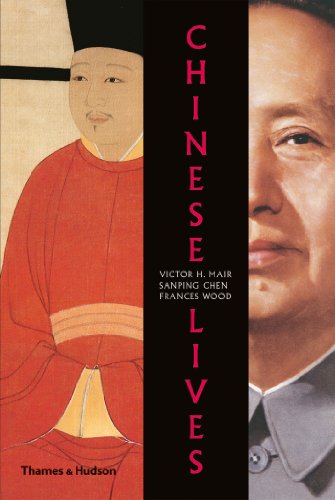
3000 years of Chinese history presented through the lives of ninety-six illustrious participants from all periods and all parts of the countryChina is the most populous country on earth, with the longest history of any modern nation. Here, the full range of Chinese cultural and scientific achievements, as well as its military conquests, wars, rebellions, and political and philosophical movements, are told through the eyes of real people who created or were involved in them. The subjects include emperors and empresses, concubines, officials and political figures, rebels, exiles, philosophers, writers and poets, artists, musicians, scientists, military leaders, and committed pacifists. From Fu Hao, an early warrior lady of the thirteenth century BC, to the late twentieth-century leader Deng Xiaoping, their careers, achievements, misdeeds, disasters, punishments, ideas and love stories make this an unforgettable read. Illustrated with portraits, paintings, written documents, bronzes, sculptures, and location maps, and written in an authoritative yet accessible style, Chinese Lives provides the perfect introduction to China’s history and her peoples.
User’s Reviews
Reviews from Amazon users which were colected at the time this book was published on the website:
⭐Taken as a whole, the purposeful, well-conceived bricolage that is Chinese Lives is greater than the sum of its parts. This wide-sweeping pageant is no parade of emperors and generals: Rather it features Daoists, Buddhists, and Confucians; Tibetans, Sogdians, Khitans, Turks, Koreans and Indians; poets, scientists, and rebels; courtesans, eunuchs, and statesmen. Overall, the book contains 96 carefully chosen biographical entries that span time (from a Shang dynasty warrior Queen to resilient Deng Xiaoping), showcasing men and women of all backgrounds, reflecting China’s geographical and ecological complexity, rich ethnic diversity, and religious pluralism. Furthermore, this elegant book is a visual triumph–filled with a breathtakingly diverse array of images: from beautifully-rendered maps to traditional ink paintings, Maoist era propaganda posters to lovely scenes of Jiangnan beauty, Ming woodblock cuts of rough-and-tumble town life to conventional imperial portraits, from funerary epitaphs to images from ancient pharmacopeia. Worthwhile and enjoyable!
⭐Of “popular” Western books on Chinese civilization, this is certainly a rather unique one. It tries to present the entire history of China via the lives of a hundred or so personalities. As such, the book can be reviewed from two angles.First, the selection of the historical characters. How representative are these people and how much of Chinese civilization is epitomized by these hundred lives? This is probably a rather subjective question and different readers may entertain different preferences. So I may as well elaborate the issue into detailed dimensions: does the book provide a complete picture of the political, cultural, and economic history of China? My take is that the book has a good selection of Chinese historical players in political and cultural spheres.Almost all important politicians and generals are included, either directly or via another figure (e.g. the founding emperor Liu Bang of the Han dynasty is covered in the bio of Xiang Yu, the rival contender of the throne). I have noted a high percentage of ethnic personalities, both statesmen and non-statesmen. The authors apparently try to revise the conventional view of a largely monolithic Han China. I believe recent scholarly work and archeological findings support the authors’ emphasis of the roles of non-Han ethnicities in ancient China. The authors’ mention of the Hun (Xiongnu) ancestry of the Ban family of the Han dynasty, one of the greatest Chinese historians, is quite impressive in this respect. The inclusion of numerous women in the book also seems to represent a palpable effort to challenge the conventional image of a male-dominated China. Political correctness aside, this certainly provides more depth in understanding China’s real history, in which mothers and grandmothers actually enjoyed a very high socio-familial status unmatched in other parts of the world. The cultural dimensions get a very good representation too, with many philosophers, authors, poets/poetesses, scientists, and artists included in the book.One regret is that, besides the somewhat light coverage of economic life (primarily via the careers of reformist statesmen Wang Anshi and Zhang Juzheng), one finds few commoners in the book. It is probably the inherent shortcoming of this genre of books that present mostly movers and shakers of human history. In this respect, the story of a deserted wife is perhaps a conscious compensation for this lack of ordinary lives in the book.My second angle for reviewing the book is how it presents the lives of the historical personalities. Granted, most of them were famous characters whose stories are available from other sources. My reading is that, besides the conventional storylines, the authors often introduced and supplemented surprisingly non-mainstream views and unique points, the Hun ancestry of the Ban family being one of the examples. I may add several more examples.The very first bio, that of the royal lady Fu Hao, suggests that the status of women of the Shang was different than all other dynasties. This does not conform to the conventional view of China.The bio of the ethnic leader Tuoba Gui explicitly mentions that the Sui and Tang dynasties were successors to the “Barbarian” Tuoba, certainly a refreshing observation vis-à-vis the conventional wisdom that the Tang was a high watermark of Chinese civilization.The mass-murderer Zhang Xianzhong’s atrocities have become a rather muddy issue ever since the communists elevated him to a revolutionary peasant leader. The widely reported killings by Zhang were then blamed on either Manchu troops or simply forgeries by the “reactionary” landlord class. The authors’ citing of a nearly contemporary Western source, the1654 book Bellum Tartaricum, by Martino Martini, is therefore convincing and unique.I have more reservations regarding the inclusion of several modern characters, particularly Mao and Deng. Although it is understood for the sake of completeness, most readers would have had ample opportunities to learn about these two communist leaders from other sources. Thus two short biographies would hardly be adequate to synthesize the enormous amount of readily available information, much less the wide spectrum of political views.Technically I find the book’s all-pinyin spelling without an English-Chinese glossary a little inconvenient, especially for readers who are versed in the old Wade-Giles system. Despite these minor shortcomings, I would still give the book five stars largely due to its unique features and points.
⭐China is a place where many people live, but for many of us it remains “a far away country of which we know little.” And yet it is a huge and complex country, and a huge proportion of the world’s population live there. In this book we encounter the Chinese through a series of short biographies of people who have contributed to its development. These biographies cover a wide range of time and place, and their very distribution shows the length of Chinese civilisation. There are strengths and weaknesses to this approach. The biographies are short and introductory. They are descriptive, and give us a good introduction to the subjects, but they raise as many questions as they answer. They give us a framework of events, but not always an understanding of the background and thinking that went into the events happening. The more I read them the more I felt these were overtures, rather than symphonies.The strength of the book is that it allows us to meet and see a wide sweep of Chinese history, and to meet many interesting characters. The authors set a basic context for each life described.There are certain themes that emerge throughout this book. In many ways the Chinese are like us- they fight over land and wealth, and sometimes welcome foreigners and sometimes don’t. There is an endless battle between the regions of China, and an endless struggle to make sure there is enough food to go round. There is an endless struggle to keep China as one country and avoid it splitting into smaller kingdoms. The power of the the centre has waxed and waned several times during history, and could easily do so again. Some people show great honesty and integrity, and some make a great success out of veniality.Then there are many ways in which China’s history and culture seems different from ours in Europe. There is their mixed religious background- Daoism, Confucianism, Buddhist. They do not seem to have had the wars of religion we have had in the West. Yet the wars they have had have been just as brutal and lives seem to be lost very quickly. There’s a terrible price for ending up on the losing side. Many of the lives in this collection show temporary success and promotion and then when fortune changes disgrace and execution. There’s never a feeling here that Chinese lives are easy, or that many of their leaders live to die in their beds peacefully. Old Emperors are regularly removed by their impatient younger children.One other difference is that the Chinese do not seem to have a great tradition of explorers and empire builders. There’s one man in this book who is an explorer beyond China’s boundaries, and one man who is a great wanderer within China. But the kind of exploration we know in European History in characters such as Christopher Colombus, Prince Henry the Navigator, Magellan, Francis Drake, James Cook and General Wolfe don’t seem to be mirrored amongst the Chinese. The Chinese seem to have had a huge amount of work on just to hold China together and protect its borders from the rest of Asia.This book gives us many glimpses into how China came to be the way it is. It shows us a different place, and many different times, and a different way of thinking from our own. It gives a very good start for exploration, and it is written in such a way that once you have read this book you will be tempted to look further into Chinese history.Comment Comment | Permalink
⭐Good and quick service
⭐China is fascinating, for its longevity, it’s diversity, the extremes in its history. Having just read two books on China’s experiences during WWII, when this came up I felt it’d be intriguing to add some historical breadth to my scant knowledge of this land, it’s people’s, and cultures. Perhaps taking a cue from such enterprises as the excellent
⭐A History of the World in 100 Objects
⭐*, this book portrays Chinese history and culture via 96 brief biogs of notable Chinese figures. Billing itself as ‘fresh and involving… an unforgettable read’, does it live up to this promise?Well, unlike one reviewer I read over at Amazon.com, who thought it a superficial patchwork, I’m enjoying this book a lot, and find that it stimulates further interest. The format allows one to browse the many and varied characters at leisure, or plough through chronologically. I just dipped in randomly, letting my own interests or the fancy of the moment lead me, from such well-known figures as Confucius or Mao, to those I knew less about, like the abandoned Wife of Mang or the early Daoist Zhuang Zi, or back to figures I recently read about, like Sun Yat Sen and Chiang Kai-shek; I have found it all both fascinating and informative.I found the mixture of types or areas of culture (e.g. art, politics, philosophy, etc.), and the writing style of the individual entries well-balanced, easy to read, interesting, and accessible. Overall this is a rich smorgasbord of highly interesting characters, very noticeably dominated by men, but including a few women. One omission I was surprised by was Lao Tzu. He is referred to several times (as Laozi), but it’s other Daoists I’d not heard of before who get the full (if short) treatment here. As well as the ‘pen-portraits’ the book is enriched by just over 80 illustrations, more than 50 of which are in colour.* Best in its original radio form, but available subsequently as both an
⭐audiobook
⭐and in paperback and hardback.
⭐If you want to know something about a country, study the people who came from there. This book is a set of 96 mini biographies of Chinese people throughout the long written history of China, from Fu Hao in the 13th century BC to Deng Xiaoping, Mao’s successor in the latter 20th C. This is really not a book to read at a sitting, but one which should be dipped into, with reference to the map at the front as an aid! The sub-title of the book is ‘People who made a civilization’. There were advanced societies and science in China when we were running around wearing woad. By necessity the stories are of those people who have made a difference on a very large stage. There is no clue here as to the lives of the little people.With China taking its place at the international top table it has become ever more necessary to have some understanding of what the country is all about, where it came from and what the implied values of the society are. This book provides a very basic understanding of what Confucianism and Daoism are. If you are visiting China, doing business there or just have an interest in people and history this is a valuable resource.The book is very well presented with plentiful high quality illustrations. It is a pleasure to pick up and read, reminding you of the benefits of reading something in print rather than electronically. This is, however a starting point, a GCSE rather than a Master degree. If you find something of particular interest, you can always delve deeper.
⭐China is a place where many people live, but for many of us it remains “a far away country of which we know little.” And yet it is a huge and complex country, and a huge proportion of the world’s population live there. In this book we encounter the Chinese through a series of short biographies of people who have contributed to its development. These biographies cover a wide range of time and place, and their very distribution shows the length of Chinese civilisation. There are strengths and weaknesses to this approach. The biographies are short and introductory. They are descriptive, and give us a good introduction to the subjects, but they raise as many questions as they answer. They give us a framework of events, but not always an understanding of the background and thinking that went into the events happening. The more I read them the more I felt these were overtures, rather than symphonies.The strength of the book is that it allows us to meet and see a wide sweep of Chinese history, and to meet many interesting characters. The authors set a basic context for each life described.There are certain themes that emerge throughout this book. In many ways the Chinese are like us- they fight over land and wealth, and sometimes welcome foreigners and sometimes don’t. There is an endless battle between the regions of China, and an endless struggle to make sure there is enough food to go round. There is an endless struggle to keep China as one country and avoid it splitting into smaller kingdoms. The power of the the centre has waxed and waned several times during history, and could easily do so again. Some people show great honesty and integrity, and some make a great success out of veniality.Then there are many ways in which China’s history and culture seems different from ours in Europe. There is their mixed religious background- Daoism, Confucianism, Buddhist. They do not seem to have had the wars of religion we have had in the West. Yet the wars they have had have been just as brutal and lives seem to be lost very quickly. There’s a terrible price for ending up on the losing side. Many of the lives in this collection show temporary success and promotion and then when fortune changes disgrace and execution. There’s never a feeling here that Chinese lives are easy, or that many of their leaders live to die in their beds peacefully. Old Emperors are regularly removed by their impatient younger children.One other difference is that the Chinese do not seem to have a great tradition of explorers and empire builders. There’s one man in this book who is an explorer beyond China’s boundaries, and one man who is a great wanderer within China. But the kind of exploration we know in European History in characters such as Christopher Colombus, Prince Henry the Navigator, Magellan, Francis Drake, James Cook and General Wolfe don’t seem to be mirrored amongst the Chinese. The Chinese seem to have had a huge amount of work on just to hold China together and protect its borders from the rest of Asia.This book gives us many glimpses into how China came to be the way it is. It shows us a different place, and many different times, and a different way of thinking from our own. It gives a very good start for exploration, and it is written in such a way that once you have read this book you will be tempted to look further into Chinese history.
⭐”Chinese Lives” consists of 95 brief biographies of Chinese men and (less frequently) women who have left a mark on the country’s history. The book is arranged chronologically from Fu Hao, ‘Woman warrior of the Shang’, in the 13th century BC to Deng Xiaoping who died in 1997. I particularly enjoyed reading about the deserted wife of Mang, the subject of a long lamentary poem written in the 7th century BC (one of many poems quoted in the book), Zhang Zeduan from the early 12th century, who painted a detailed depiction of the bustling capital of Kaifeng, Lin Zexu ‘one of the most upright and capable officials in Chinese history’, who tried to ban the opium trade, and Heshen, the corrupt official whose life immediately precedes his, and finally the Empress-Dowager Cixi, one of China’s last imperial rulers. Many of the lives seem to end violently, emperors and their relatives seemed particularly prone to being killed by mothers, brothers, and sons, and there are plenty of power struggles within the vast country.Sometimes the life consists of a dense barrage of unfamiliar names and places without much opportunity for more memorable detail (something particularly true of the various military leaders), however elsewhere the format works very well and although there must be many hundreds of lives which could have been included I came away with a good, if necessarily very basic, overview of 3300 years of Chinese history.A one would expect from Thames & Hudson, “Chinese Lives” is a beautiful book with thick matt creamy paper and plentiful high-quality illustrations. Having read it all the way through, I imagine this is a work I will return to again for reference.
Keywords
Free Download Chinese Lives: The People Who Made a Civilization in PDF format
Chinese Lives: The People Who Made a Civilization PDF Free Download
Download Chinese Lives: The People Who Made a Civilization 2013 PDF Free
Chinese Lives: The People Who Made a Civilization 2013 PDF Free Download
Download Chinese Lives: The People Who Made a Civilization PDF
Free Download Ebook Chinese Lives: The People Who Made a Civilization